Blog Archives
CRIMSON BLOODLINES The Rise of King Musa Africa’s First Vampire


Crimson Bloodlines tells the story of Emma Woodford, a passionate genealogist whose quest to uncover her family roots leads her to a shocking discovery, she is descended from King Musa I of Mali, the famed ruler of the 14th century. Her curiosity takes her from the quiet hum of city life to the scorching heart of Africa, where history, myth, and horror collide. The story starts like a historical mystery and slowly turns into a supernatural thriller, blending the grandeur of West African history with the dark myth of vampirism. The book pulls readers from scholarly research tables to ancient ruins and secret cities hidden beneath the desert sands, creating an atmosphere thick with tension and wonder.
I didn’t expect a vampire story to weave so neatly into African history, but author Aubin Jack makes it work. His writing has a cinematic feel. You can almost hear the hiss of the desert wind or see the gleam of a gold-encrusted citadel rising from the dunes. At times, the prose is lush and descriptive, even indulgent, which slows the pace but also deepens the mood. I found myself swept up in the worldbuilding, the Tuareg warriors, the sacred baobab trees, the mystery of Old Mali, though I occasionally wished for a tighter focus. Still, the book’s heart beats with genuine curiosity about ancestry, identity, and power. I felt Emma’s excitement, her fear, her awe at discovering she might be part of something ancient and monstrous.
Underneath the fantasy and bloodshed is a sharp commentary on legacy and climate change, a surprising but fitting connection, given the author’s background in public safety and activism. Some passages veer into lecture territory, but they come from a sincere place. What stood out to me most was how human this story feels despite its supernatural premise. The vampire lore isn’t just for thrills; it’s used to explore how power, greed, and immortality twist even noble intentions. By the time King Musa’s transformation unfolds, the horror feels earned. It’s not just about monsters feeding on blood, it’s about humanity feeding on the planet and on each other.
Crimson Bloodlines is part adventure, part history, part warning. I’d recommend it to readers who like their historical fiction with a bite of the supernatural, especially those drawn to African mythology, lost civilizations, or climate-driven allegory.
Pages: 150 | ASIN : B0DTRL2D52

The Deficit of Critical Thinking
The Ascent of Greed and the Audacity of Mind Stealing follows a young graduate who enters the corporate world with high hopes, only to encounter greed, manipulation, and the unsettling rise of artificial intelligence. What was the inspiration for the setup of your story?
The inspiration came from my observation that many young graduates leave college with little critical knowledge about the rapidly developing transformative technology of artificial intelligence. Certainly, this technology is giving a helping hand to different sectors of society, resulting in improvements in people’s well-being. However, drawbacks are also emerging from its application. My observation is that young graduates are rightly enthusiastic about the positive aspects of this technology, but they pay little attention to its impending negative effects. That is why Adam, the main character of the book, was shocked when he learned from a layman in a café about the dangers of brain-reading technology. Does this mean that our teaching institutions are failing to instill critical thinking in their students? Or have the latter become so venal that they only focus on securing employment and earning good money? Some of these graduates, like the book’s protagonist, appear to have left college with little awareness of the consequences of the indiscriminate use of AI.
Yet our planet is full of news about unwanted initiatives driven by AI. The most critical issues raised by the media concern the destabilizing nature of fake news, as well as the threat posed by the excessive replacement of human jobs by machines. Obviously, there are many other sophisticated applications of this technology—such as in strategies for war games—about which we have little information.
In the past, we were used to seeing the younger generation fighting against perceived or real threats to society. Nowadays, however, despite the warning signals from subject matter experts and intellectuals about the unchecked development of AI, there is little outrage directed at those who push for its unregulated expansion. Why is the younger generation not outraged by this fact?
The book narrates a successful remedy to the deficit of critical thinking regarding AI development: the formation of an Action Group aimed at creating awareness about the dangers of unregulated AI within society. The Group was organized by a few enlightened young men and women who decided to act together in sensitizing the wider population about this impending danger. In a way, consciously or unconsciously, the Group was striving to instill in people’s minds a critical perspective on the unchecked development of AI, thereby compensating for the deficiency they had suffered at school. Eventually, they managed to raise awareness across entire populations, who fought for the regulation of AI and ultimately convinced policymakers to accept it.
Some events in the book were chillingly like real-life events. Did you take any inspiration from real life when developing this book?
Some of the chillingly realistic events are indeed based on real-life experiences, most notably those related to fake news. I took inspiration from a true story about a politician from a small locality whose reputation was tarnished by fake news, ultimately affecting his eligibility for public office. Likewise, the harmony of an extended family I knew was destroyed by false news created by certain individuals.
It is unfortunate that in such instances, the effects of fake news continue to linger even after the news has been exposed as baseless mendacity. Victimized people no longer seem as spontaneous as they once were. That is why Chapter 12 of this book, a product of my creative writing, is dedicated to the devastating impact of fake news.
What were some themes that were important for you to explore in this book?
Three important themes have inspired this book. The first is the wickedness of fake news, which I mentioned above. The second theme is the news about research in some Asian universities regarding their advancements in reading the human brain. Apparently, this research has progressed to the point where scientists expect to be able to scan people’s thoughts and convert them into text. The possibility of such an occurrence blew my mind and compelled me to deliberately create a state of confusion between reality and fantasy, so that due attention would be given to this sensitive issue of tampering with the most important human organ.
The third theme is the loss of jobs, as many tasks are being replaced by AI. This process is happening right in front of us. Simple examples include the replacement of cashiers by self-checkout machines; the introduction of chatbots in place of customer service representatives; and the replacement of bank tellers and loan officers by ATMs and online banking. Of course, even more significant job replacements—less visible to the public—are taking place in the industrial and transportation sectors. The book focuses on this issue, and explores the darker aspects of unemployment by imagining the disaster it could unleash in a once-happy community.
Will this novel be the start of a series, or are you working on a different story?
At present, I am busy developing a story about the misfortune of an African migrant family that almost made it to Europe, but in the end did not, because the boat on which they were traveling was swallowed by the hungry Mediterranean Sea. The book is, once again, a product of my imagination, but it closely follows the true experiences of thousands of individuals and families. Although the reasons for emigration to Europe are numerous, the book will focus on political themes related to the lack of freedom and democracy in the migrants’ countries of origin.
Author Links: Amazon | GoodReads
Driven by an insatiable greed for profits, the corporation prioritizes sales above all else, disregarding cultural values, beliefs, and ethical boundaries. Employees are trained to focus solely on increasing revenue, with little regard for the moral implications of their actions. To achieve their goals, the corporation deploys advanced AI systems that not only replace human ingenuity but relegate staff to subordinate roles beneath the machines.
In its quest for dominance, the corporation ventures into a controversial new realm: brain-reading technology. By accessing the minds of two young individuals, it seeks to uncover consumer preferences at an unprecedented level, triggering widespread outrage over the invasion of privacy and the potential for exploitative mind control. This reckless experimentation not only exposes the dark side of AI but also raises profound ethical and legal questions.
As the societal backlash intensifies, activists and thought leaders rally to expose the dangers of unregulated AI development. They document the devastating impacts of these technologies and demand immediate action from policymakers to prevent further harm. Public outcry ultimately forces governments to enact strict regulations, averting the catastrophic consequences of an unchecked AI future.
Through a thought-provoking narrative, AI and the Ascent of Greed explores the collision between humanity’s ethical values and the rapid advance of technology. With a powerful blend of corporate intrigue and societal critique, Pietros Kidane crafts a cautionary tale that challenges readers to consider the implications of technological progress on our collective future.
The Reckoning of Chaos and Magic
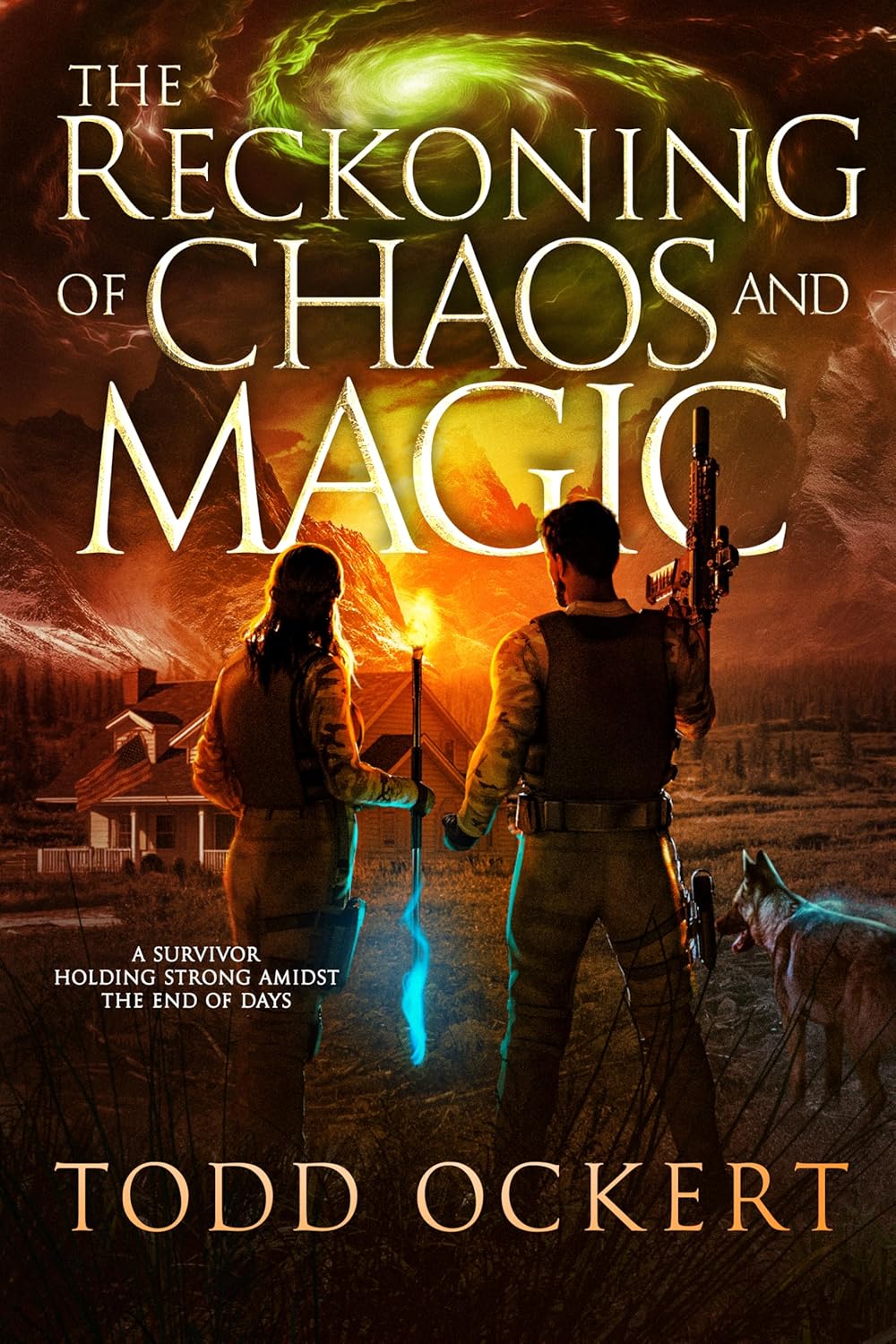
Todd Ockert’s The Reckoning of Chaos and Magic picks up in a world torn apart by disaster and violence, where ordinary people cling to survival through grit, loyalty, and a surprising spark of the supernatural. The story follows Mel and her crew from Freedom Ranch as they navigate a brutal new world after civilization’s collapse. Between biker gangs, gunfire, and a hint of midlife magic, Ockert weaves an intense and emotional tale of resilience and found family. It’s a mix of post-apocalyptic survival, combat realism, and mystical discovery, all grounded in friendship and love.
What really struck me about this book was how human it felt. The writing is raw, fast, and filled with emotion. You can feel Mel’s fear and fire. She’s strong, sarcastic, and flawed in all the right ways. The story never slows for long, yet it never loses sight of its characters. The world is cruel, and Ockert doesn’t sugarcoat that, but there’s warmth under the grit. I liked how the dialogue feels like real people talking under pressure. The moments of humor hit right when you need them, like a deep breath between storms. Sometimes the pacing felt jumpy, almost cinematic, but that also gave it energy, like watching an action movie unfold with heart. The magic side of the story adds a weird but welcome twist, it’s subtle, not sparkly, and feels more like power hidden in ordinary people than fantasy for its own sake.
I have to say, this book hit me harder than I expected. The writing isn’t about fancy turns of phrase; it’s about connection and survival. I found myself rooting for every battered, bloodied character. The scenes of violence are harsh, but they’re written with honesty, not shock value. The women in this story, Mel, Gail, Shelly, aren’t damsels or sidekicks. They’re the backbone of the book, and their friendship feels real, full of teasing and fierce loyalty. I also loved the touches of romance, especially between Mel and TJ, which felt tender and grounded in years of shared struggle rather than something sugary or forced. At times, the dialogue leans a bit heavy on exposition, but the sincerity of the writing more than makes up for it. You can tell Ockert loves these characters and the world he’s built for them.
It’s not just about chaos and magic, it’s about what people choose to protect when the world falls apart. I’d recommend this one to readers who love strong characters, action mixed with heart, and stories that don’t flinch from the dark. If you’re into post-apocalyptic tales like The Walking Dead but wish the heroes had a touch of witchy wonder, this book’s your jam. It’s rough, real, and full of hope where you least expect it.
Pages: 346 | ASIN : B0FG87T7T1
Terra Secundus: A Novel of Colonization of Titan


Terra Secundus is a richly imagined sci-fi novel that follows Paul Rexton, a soldier-turned-news-explorer sent to report on humanity’s colonization of Titan, Saturn’s largest moon. Through his journey, the book explores ambition, identity, and the dangers of unchecked progress. From Earth’s “Longevity Wars” to the discovery of Blue Ice, a mysterious energy source that could reshape civilization, the story blends political drama, personal reflection, and wonder at the unknown.
The author paints a future that feels both vast and believable, filled with new technologies, evolving religions, and the long shadow of human history. The glossary of terms felt like stepping into a fully realized civilization. Yet, at its core, the story stays personal. Paul isn’t a stereotypical space hero; he’s a curious, conflicted observer trying to make sense of a world that keeps expanding faster than its morality.
The writing often feels old-fashioned in a good way, dense, descriptive, and philosophical. When Paul’s editor, Lana Emerson, sends him on his Titan assignment, their exchange brims with tension and respect. It’s less “blast-off adventure” and more about duty, curiosity, and the cost of truth. I especially loved the sections describing Titan itself: the orange skies, the methane seas, and the eerie silence of an alien world. The conversation between Paul and Evelyn Best, a local officer, about Blue Ice and the fragile ecosystem beneath Titan’s crust perfectly captures the book’s sense of awe and unease.
What makes Terra Secundus stand out is its focus on people, not just technology. The Artborn androids, like Erika, Paul’s robotic companion, are more than machines. They’re reflections of humanity’s desire to create, control, and connect. The pacing is slow at times, but it suits the introspective tone. Each scene feels like it’s building toward something deeper, a question about what progress really means.
Terra Secundus isn’t flashy space opera; it’s thoughtful, emotional, and quietly haunting. It’s perfect for readers who enjoy rich, idea-driven science fiction like The Expanse or Solaris. If you like stories that make you think long after the last page, this one will stay with you like a distant echo from the edge of space.
Pages: 157 | ASIN: B0FPBN7GQ8

What Might Be Possible

Dark Place centers around three students who stumble on an unsettling truth that society is being manipulated, and those labelled as “dispossessed” are being erased from existence. Where did the idea for this novelette come from?
I wanted to develop a near-future story in which a worldwide authority invokes extreme emergency powers to control a burgeoning population, resulting in the loss of freedom and rights.
The idea of a hidden penal colony came to mind, and a social scoring system would be the mechanism to segregate and banish the dispossessed.
My writing of the story started as a typical dystopian trope, but as it grew, I didn’t want it to be stark black and white: ‘good’ idealistic rebels versus ‘evil’ authority. So it becomes more nuanced when the three protagonists are stranded in the Dark Place and learn that it has a greater purpose with profound consequences. The protagonists must navigate not only external dangers but also their own internal struggles, confronting differences between themselves and moral dilemmas.
Dark Place has been described as subverting dystopian tropes and I hope readers find that rewarding.
What are some things that you find interesting about the human condition that you think make for great fiction?
There is a degree of anxiety in the world today about the future. Perhaps every generation in the past has had similar misgivings.
My intention is to write about what might be possible a few steps down the road. I don’t want to write far-future settings with fantastical technologies far removed from what we have now. Grounding the story in a familiar world, echoing some of today’s challenges, has more resonance.
The science inserted in the fiction, I felt, was well-balanced. How did you manage to keep it grounded while still providing the fantastic edge science fiction stories usually provide?
A lifelong interest in the societal implications of technology began in the 1980s when I taught the new technologies of microelectronics and microcomputers in colleges and universities. This early professional life directly influenced my creative pursuits, leading to my first story Larrs’ Ghost (published in a computing magazine) which explored a “computer-generated world” long before virtual reality was a common term. More recently Close To You is a cautionary tale about the imminent dominance of big corporations developing ever more powerful artificial intelligence and virtual reality.
Dark Place is set in a time just down the road from now, so the technology is a plausible extension of today: drones are becoming more advanced; flexible microelectronic circuits (I call them membranes) already exist in rudimentary form; AI is advancing at speed.
Can we look forward to more work from you soon? What are you currently working on?
I feel there’s a lot more to develop with the premise of Dark Place. Although the ending finished with a profound reveal, I deliberately left some aspects of the story open-ended that mirrors the uncertain future facing the characters and the broader society. The lack of a neat, conclusive resolution hopefully encourages readers to reflect on the story’s themes beyond the final page.
So now I’m working on parts two and three. Part two is how the people in the camps progress in the knowledge that the outside world is in total collapse and how they rise to the challenges they face. Part three is how they defend themselves from an external existential threat. How much will they fall back on technology to protect their new world? The three protagonists will have increasingly conflicting ideas on how they see their future world.
Author Links: Facebook | Website
In a near-future world ravaged by resource depletion, society is controlled by the Authority, which enforces a strict social credit system. Failure to maintain a high enough score means banishment to the mysterious “Dark Place.”
When three inquisitive students, Ros, Femke, and Domhnal, discover that parts of a hidden Earth have been concealed from the privileged population of the “Light Place,” they are determined to expose the Authority’s brutal culling system. To do so, they must intentionally lower their scores and enter the Dark Place, only to discover it holds secrets far more profound than they ever imagined.
Dark Place is a gripping novelette that transcends typical dystopian narratives. Praised for its compelling dialogue and nuanced characters, a testament to author Christopher Kell’s experience as an award-winning playwright, the story is a masterful exploration of moral ambiguity, technology’s ethical implications, and the enduring resilience of the human spirit. It is a thought-provoking journey that invites readers to reflect on the nature of freedom, the quest for truth, and what it truly means to survive. This powerful and multi-layered examination of contemporary issues through a dystopian lens is a key element of the novelette’s intellectual value and demonstrates the author’s ability to imbue a short work with significant philosophical weight.
Arcanoforge: Midnight Metropolis

Arcanoforge: Midnight Metropolis is a feverish plunge into the neon-choked streets of Noctara City, a dystopian sprawl where humans and husks, ghosts and hemo magicians blur into a single, strange pulse. The story follows Tattie, a blood seer who’s fled her dying homeworld, and Brax, the man who tracks her across galaxies as their shared past claws its way back into the present. Around them spin a chorus of restless lives, skaterats, dealers, dreamers, all caught in the thrumming heart of a city that feels alive and dying at once. It’s part cyberpunk, part occult noir, and part heartbreak.
The writing is gritty, poetic, and weirdly tender. Author Caroline Barnard-Smith doesn’t just describe Noctara, she burns it into your head with words. Every street and shadow has its own personality, every conversation crackles like static. I loved how the world felt handmade, patched together with old wires and bad memories. The characters stumble through it broken and fierce, never really heroes, just people trying to stay one step ahead of decay. The prose leans heavily on texture, smells, lights, and sounds, and it builds a rhythm that makes the whole book feel like a song played through busted speakers. Sometimes it’s overwhelming, but in the best way.
There’s this deep ache about survival, about what we lose when the world stops caring. I kept thinking about the husks, these half-human enforcers who’ve traded pain for obedience, and how much that says about our own craving for numbness. And Tattie, she’s messy, angry, brilliant. I believed every choice she made, even when it hurt to watch. The story toys with power, guilt, and the ghosts that cling to love long after it’s gone.
Arcanoforge: Midnight Metropolis reads like Blade Runner crashed into The City & The City with a shot of Neuromancer’s grit and the bruised heart of a Becky Chambers story. I’d recommend it to anyone who loves science fiction that’s soaked in mood and grit. Fans of Gibson and VanderMeer will feel right at home. If you like your futures dark and your magic dirty, if you want to taste the metal in the air, this book’s for you.
Pages: 278 | ASIN : B0FFH6BS5L
A Chance to Use My Knowledge

The Right Time is a time-slip romance where a woman escaping an abusive marriage wakes up in the 1980s, finding a second chance at freedom, love, and self-discovery amid the ache of what she’s lost. What inspired you to blend time-slip elements with a story of domestic survival and healing?
I was continuing my Time Slip series that started in The Wish: A Time Slip Novel, the first of a series of stand-alone women’s fiction stories that will take place in various times. The therapist from The Wish, Dr. Maeve Fossey, is the only recurring character, as she hears the wishes and mysteriously causes them to come true.
A couple of years ago, Taylor Jenkins-Reid’s Malibu Rising won a Reader’s Choice award for best Historical Fiction. It was set in the 80s, and this blew my mind! I grew up in the 80s. I love reading historical fiction, but I hadn’t written any. If the 80s are historical fiction, I can finally write a “historical” story set in a time I remember and provide details that feel authentic without a ton of research. I loved 80s music, movies, and TV, so this was my chance to use some of that knowledge.
How did you approach writing the 1980s setting in a way that felt nostalgic but not overly romanticized?
In 1985, I was thirteen years old, so I was old enough to remember a lot about the time. I think because I was there, I didn’t over romanticize it. There are advantages and disadvantages to every time.
Andie’s journey feels deeply personal. Was any part of her story drawn from real experiences or people you’ve known?
There are several pieces of this story that are based on real events, and writing about them was a type of therapy. The late-night fights between my mom and her boyfriend from when I was ten were real. On at least two memorable occasions, I heard them fighting, mostly his loud voice. Once, he tried to hit her and missed, punching a hole through the drywall of their bedroom wall. The second time, he broke a sturdy homemade stool in the kitchen, smashing it to pieces for emphasis as he berated her. For the next several months, until we moved, I had trouble sleeping. The cat and dog were also real. My cat would climb up to my loft bedroom to sleep, and the boyfriend’s dog would guard the base of the ladder.
My mom’s excuse about hitting a doorknob when trying to explain a black eye is something I also remember. The black eye was a turning point because she was unable to hide the abuse at work after that. Usually, he hit her where it didn’t show. Her co-workers all drove trucks and helped us move that Friday.
Also, real was being stood up by my co-workers for a Starbucks gathering in 2018 or 2019 that many said they would attend. In the story, nobody shows up. In real life, after waiting 75 minutes alone, I left and was walking home when someone else texted to ask if we were still there. I didn’t tell her I’d given up. I went back and met her for twenty minutes before heading home again. On the way, I ran into 5 others from work who’d gone out for drinks instead. I was hurt because they’d been no-shows for me and had gone out in the neighborhood anyway. They hadn’t bothered to tell me they’d changed their mind or invited me to go to Browns instead. I’ve never tried to have an after-school get-together again. If invited to a book launch, my co-workers don’t even RSVP, so I stopped including them. Like Andie, I struggle with personal connection daily.
And, who hasn’t been stuck in a Customer Service loop somewhere, trying to use authenticator apps and personal verification questions? Most of the time, all I want is to get through to a person who can help, not AI Customer service or endless menu loops that don’t answer your question or let you choose a team member to speak to. The frustration is real.
The other piece that was more fun to use was my experience working at video stores. I worked in one from April 1989 to July 1990 in high school. I worked at another through my third to fifth years of university from 1992 onward, keeping one shift a week through my substitute teaching years, only giving it up when I was hired for a full-time teaching position in September 1996.
What can readers expect in book three in your A Time Slip series?
I am toying with a few different ideas, but the one calling to me the most is related to The Right Time. One of the tertiary characters may suffer a heartbreak and find herself somewhere new. She is in her early thirties in 1985, and I think she will wish herself into the future, but I’m not sure where yet, but I hear Canada is lovely.
With two more Racing books planned, a dystopian heist clamouring for attention, and romantic suspense in progress, my next time slip story is still swirling through my thoughts without feeling concrete. Not yet.



 LITERARY TITAN