Blog Archives
Trolling in Social Media

BLOATER follows a neurosurgeon devastated by his wife’s sudden death who experiences a psychological collapse and makes it his mission to enact justice on the world by killing off sinners. What was the inspiration for the setup of your story?
I felt it would be interesting to weave a tale of retribution for those who use social media platforms to spew hate and prejudice upon innocents. My intention was to create a deranged vigilante to exact vengeance. I spent many years in the operating theater as a surgical device representative for several Fortune 500 medical manufacturers, so a medical setting felt comfortable.
Dr. Jeremiah Nowak is a fascinating character, watching him transform and justify his killings. What scene was the most interesting to write for that character?
I endeavored to subtly display Nowak’s increasing obsession with killing, and the satisfaction he derived from it. My favorite scene to write was the finale, where we witness his lust for mutilation and murder, but then ride along as it all comes apart.
I felt that BLOATER delivers the drama so well that it flirts with the grimdark genre. Was it your intention to give the story a darker tone?
Yes. It was important for me to help the reader understand that although trolling in social media is hurtful and can be harmful, it pales in comparison to a maniacal quest for blood.
What is the next book that you’re working on, and when can your fans expect it out?
I am writing a sequel that delves into another Camby and Lanquist investigation. I hope to complete the book by March of 2026. My original plan was to develop a series of three novels for the duo, but I am open to more depending upon the response from your readership.
Author Links: GoodReads | Website | Amazon
The man who once repaired the human brain begins to dissect the human soul… one sinner at a time.
His victims don’t just disappear.
They float—bloated, ballooned, grotesquely smiling—left drifting like obscene warnings across the city skyline.
Each murder is a flawless surgical performance.
Each body a message carved in flesh.
Each kill more daring than the last.
And Nowak tells himself it isn’t vengeance.
It’s justice.
You Write What You Know

Reservations follow a gifted FBI profiler with psychological insight whose mentor dies while working on a serial killer case, leaving her to pick up where he left off. What was the inspiration for the setup of your story?
First, I have to start with a backstory. In 2017, I was having a difficult time in my life; ending a 28-year marriage, leaving a job I was unhappy in, selling my house, and in need of a life overhaul. One day, I woke up and demanded a do-over from the Universe. Several nights later, the dreams started, and the books began. This book, Reservations (originally under a different title), was written in less than a month, followed by six more in a period of six months. I dreamt every night and wrote every day. The dreams were a visceral guide, with me filling in the blanks. A lot of stops and starts, but eight years later, here we are.
Samantha Wright is as real a character I could write because she is all of us. She is me. The story is about losing those who are close to us, who have made us who we are, and when they are lost to us, how we move on and try to make them proud with our attempt, we try to make things better. Sam has a career at the FBI, dealing with death while trying to find justice for the victims of the heinous things people do to each other. In this world, we all deal with what Sam does, just in a more unnoticed way. Just as Sam is trying to learn to live with everything she witnesses and is surrounded by daily, so are we with the very personal stories we all have to tell about how we live within the 24-hour news cycle and the reality we all see. I needed Sam to be many things, and she could be those things if her job had leverage to it.
I enjoyed Samantha’s character; she is engaging, intelligent, and complicated, not at all predictable. What was your inspiration for Samantha Wright’s character, and how did you craft her outlook on life?
They say you write what you know, and there is a lot of subconscious memory that is a treasure trove of bits and pieces that surface once they are awakened. Samantha Wright is a culmination of women I’ve known over the years that made a difference in me and my thinking, and by morphing those qualities and remembrances – well – Samantha was born. Once I had Samantha Wright and the dreams, I pieced the puzzle together. I’ve worked for attorneys as a paralegal, and that brought connections to stories of people and situations that made sense of the dreams and enabled me to weave a story together anchored by this amazing woman, Samantha Wright. Sam’s outlook is one of despair backed by hope. Strength of conviction, but willing to be weak, with not always knowing what to do. A yearning for love, but knowing her responsibilities will always color any relationship she would have. Again, Sam is us. I write with first and third person – I want the reader to know at all times all the characters in the scene and what they feel, think, and say, even when Sam isn’t part of the scene.
What were some themes that were important for you to explore in this book?
I have always had a connection, an affinity to Native culture, having lived in the Western state of Colorado. I’ve been drawn to the sense of Tribe and the rich history since I was young. I’ve also lived in situations that brought abuse, addiction, strength through fear, cultural divides, and love, of course, in my life and the life of those I know. I try to slowly bring themes into the plots, without being preachy or making it stand out – themes don’t have to stand out; they just have to be absorbed by the reader as part of the story. I want the reader to think back and see layers in what they’ve read.
Is this the first book in the series? If so, when is the next book coming out, and what can your fans expect in the next story?
The series has seven books – the first, Reservations: A Samantha Wright Crime Series, the second, The Last Profile, which just launched on Amazon, continues the core characters that are so integral to the plots and the important stories they bring forward. The Last Profile has Samantha following a case on and off the reservation, three plots going on at the same time, leading her through a maze of lies and betrayal by the very people her life centers around. If you love Will Little Bear, he helps Sam work the case that is supposed to finally free her from the FBI, so they can have the life they yearn for. Five more books follow; manuscripts finalized, waiting in the wings to be launched every six months. Plots that you may never have read before, characters that attach themselves to you, and relatable stories that resonate with the reader. The books are about people who have a family life and a work life – they figure out how to make it work, and in Sam’s case, her family, her tribe, is her foundation that gives her the ability to do her most difficult job, finding justice and a voice for those who can’t speak for themselves.
Author Links: GoodReads | Website | Amazon
When Special Agent Samantha Wright’s mentor dies while profiling a disturbing serial killer case known as “The Reservations Case,” she’s left to pick up the pieces—and finish what he started. Young Native American boys are being abducted, sexually assaulted, and murdered across multiple states, and the trail leads deep into the heart of the American West.
Sam is no ordinary profiler. Gifted with an uncanny psychological insight and a darkly self-deprecating sense of humor, she sees patterns others miss. But as the case grows more complex—and culturally sensitive—she’ll need more than sharp instincts to bring the killer to justice.
With help from her commanding yet complicated boss, Special Agent Charlie Falken, and a skilled Cheyenne tracker, Will Little Bear, Sam must navigate the perilous intersection of federal law, reservation sovereignty, and cultural trauma. As tensions rise and bodies pile up, alliances deepen—and so do emotions.
RESERVATIONS is a gripping crime thriller that blends psyc
The Cost of Competence

Stealing Stealth follows a CIA officer tasked with protecting a new stealth technology who must enlist the help of a brilliant thief to stop it from falling into the wrong hands. What was the inspiration for the setup of your story?
I wrote the initial draft of this story when I was deployed in Afghanistan. I was constantly in this battle with what is said and what is left unsaid, in an intriguing chess match with men who were both my ally and not at the same time. To capture this specific paranoia, I thought of the mid-1970s. We often look at the Cold War through the lens of the 80s. That was the end. But just before that, everything was messy. The Church Committee was exposing CIA secrets, Vietnam had just ended, and trust in institutions was crumbling. I wanted to drop a “Boy Scout” character like John Olson into that moral grey zone and force him to work with someone like Gabrielle Hyde, who represents pure, chaotic individualism. The stealth technology itself was the perfect catalyst because it represented a revolution in warfare that terrified everyone. The idea that a plane could be invisible to radar felt like magic in 1977.
There was a lot of time spent crafting the character traits in this novel. What was the most important factor for you to get right in your characters?
Competence. Nothing kills a thriller faster than characters who make stupid decisions just for the sake of the plot. I wanted Olson and Hyde to be masters of their respective crafts. When they fail, it’s because they were outmaneuvered by a smarter opponent, not because they were making bad choices. I also wanted to explore the cost of competence. For Olson, his dedication to the CIA cost him his personal life. For Hyde, her tragic youth led to brilliance as a thief, but it also left her isolated. The most important factor was ensuring that even when they were enemies, they respected each other’s skills. That mutual respect is the engine of the book.
How did you balance the action scenes with the story elements and still keep a fast pace in the story?
My background in special operations taught me that real action is rarely a continuous two-hour firefight. It’s hours of tension followed by seconds of chaos. I tried to replicate that rhythm, but with a better balance. Also, it is important that the reader cares. 1970s politics and game-changing aircraft technology are complicated enough, but I needed the reader to feel that pressure. Then, as the tension built through briefing room politics, the surveillance, and the planning, the reader finally felt the stakes. The pacing comes from the pressure cooker effect; the clock is ticking, and the walls are closing in. Then I added the guns.
What is the next book that you are working on, and when can your fans expect it to be out?
The next book is Arctic Fire, releasing in April 2026. It is a tonal shift from the spy world of Stealing Stealth. It’s a Neo-Western Noir set in the Alaskan wilderness, following a female Marine veteran who uncovers a conspiracy in a small, frozen town. Think Wind River meets Sicario. After that comes Eye of the Caldera. It’s a high-octane disaster thriller inspired by incredible true events and a declassified CIA operation. It drops in the Fall of 2026.
Author Links: GoodReads | X (Twitter) | Facebook | Website | Amazon
At the height of the Cold War, America’s revolutionary stealth technology could tip the balance of power. Now the race to control it threatens to derail a critical nuclear treaty between the world’s two superpowers.
Soviet operatives are close to acquiring this game-changing military secret. CIA Officer Olson has just seven days to protect America’s biggest technological advantage from falling into the wrong hands. His only hope lies with the brilliant thief he couldn’t catch: Gabrielle Hyde.
Inside the secretive Skunk Works facility, nothing is what it seems. Hyde and Olson discover Moscow isn’t the only enemy. A traitor from within is thwarting their every move. With both the FBI and KGB closing in and bodies piling up, Olson faces an impossible choice: follow orders from an agency that no longer trusts him or follow Hyde into an elaborate con against his own government.
From a decorated Air Force Colonel with 26 years in special operations and field command comes an authentic Cold War thriller where the greatest threats wear familiar faces.
Trust no one. Question everything. And never underestimate Gabrielle Hyde.
For fans of David McCloskey’s Damascus Station, John le Carré, and Daniel Silva, Stealing Stealth is a high-stakes heist where the only way to protect freedom is to steal its deepest secret.
Unexpected Psychologies

Drinking from the Stream follows two young men on the run for different reasons who cross paths and set out together exploring East Africa and their own morals in a world where dictatorship and mass murders are the norm. What was the inspiration for the setup of your story?
I left the US to travel one week after graduating college. When I came back five years later, my mother kept asking me, “What did you really do in Africa?” How to explain what I was thinking, whom I had met, where I had gone, what I had seen and felt and heard, smelled and tasted, what I had learned, what scared me, what made me laugh, and what inspired me? I decided to write a novel, a kind of anthem for the generation that came out of the wreckage of the ’sixties and whom I met on the road. I thought the story I wanted to tell would have more weight if the character who kills his antisemitic persecutor was not actually Jewish, thus forcing him into unexpected psychologies. Having two narrators allowed me to broaden the scope and to develop the characters in many more settings and situations than would otherwise be possible, and through their eyes also to show more of Africa and of the world.
You took your time developing the characters and the story, which had a great emotional impact. How did you manage the pacing of the story while keeping readers engaged?
There are novelist tricks that I had to learn. A novel consists of scenes. Something must happen, or else there’s no reason for the scene to be there. Scenes should ”start late and end early,” not waste time, and leave the reader wanting to know what comes next. I alluded to massacres at the start of the book, which I hoped would give readers a feel for what came next. There is a rhythm to travel which speeds up and slows down, and the action of the book also speeds up and slows down.
What were some themes that were important for you to explore in this book?
A partial list: friendship, long-distance travel on bad roads with little money, politics and history, courage, the world of the early 1970s, East Africa and Ethiopia, judgment, colonialism, revolution, mass murder, dictatorship, insurrection, racism, loyalty, small acts of bravery.
What is the next book that you are working on, and when can your fans expect it to be out?
Next book: A TRIP BY CANOE (short stories) to be published by Koehler Books July 2026.
Author Links: GoodReads | Website | Amazon
Jake Ries, a twenty-two-year-old Nebraska farm boy turned oil roughneck, turns fugitive when he unintentionally kills a homicidal White supremacist on an oil platform in the Gulf of Mexico. On the run, he meets Karl Appel, a restless Oxford dropout and former anti-war activist struggling with his own personal demons. Together they throw caution to the wind and plunge into the Ethiopian and East African hinterland, where they discover that dictatorship and mass murder are facts of life.
Where The Pecan Trees Grow


Where The Pecan Trees Grow, by Thomas Gates, follows Miguel, a Mexican father who leaves his drought-stricken home in Michoacán to cross the border and search for work in the United States. His journey is dangerous and exhausting, filled with tense nights in the desert, smugglers who mix threat with necessity, and close calls with patrols. Eventually, he finds work on a pecan farm in California, where the quiet rhythm of trees and soil gives him a fragile sense of hope. The story moves between struggle and calm, fear and stubborn faith. It is about survival, family, and the long, slow work of building a life from almost nothing. It is also about promise, the kind that sits heavily on the heart.
I found myself swept up in the raw honesty of the story. The writing feels simple in the best way. It opens a clear window into Miguel’s thoughts and fears. I kept pausing when the story talked about soil or trees. Something in those passages felt grounding. I could feel the heat from the fields, smell the dust, and hear the quiet talk between workers. The tense scenes, like the border chase and the near discovery in the truck, hit hard. They left me holding my breath and maybe gripping the page a little too tight. The gentle moments hit just as hard. The letters Miguel writes but cannot send, his quiet walks through the rows at night, and the way he treats the orchard like something alive and listening. These parts warmed me more than I expected.
There were moments when the book made me ache a little. The prejudice he meets in town feels eerily familiar. Still, the story never falls into hopelessness. It keeps lifting itself up, often because of the farm, the trees, and the quiet steadiness of Big Jim. I liked how the book painted Jim as tough but fair. No speeches. No miracles. Just a man who sees effort and decides it is worth backing. The pacing surprised me at times. Some chapters rush with danger while others slow into a gentle hum. I liked that. Life isn’t even. It jumps and stumbles, and the story captures that feeling well.
By the end, I felt proud of Miguel in this strange way, like I had watched him build himself again layer by layer. I would recommend Where The Pecan Trees Grow to readers who enjoy character-driven stories, especially ones rooted in real emotional stakes. Anyone who likes tales about migration, perseverance, and the quiet strength of ordinary people will find something meaningful here. It is a great choice for book clubs, too. There is a lot to talk about, and even more to feel.
Pages: 163 | ASIN : B0G5M3CDRX

The Chip
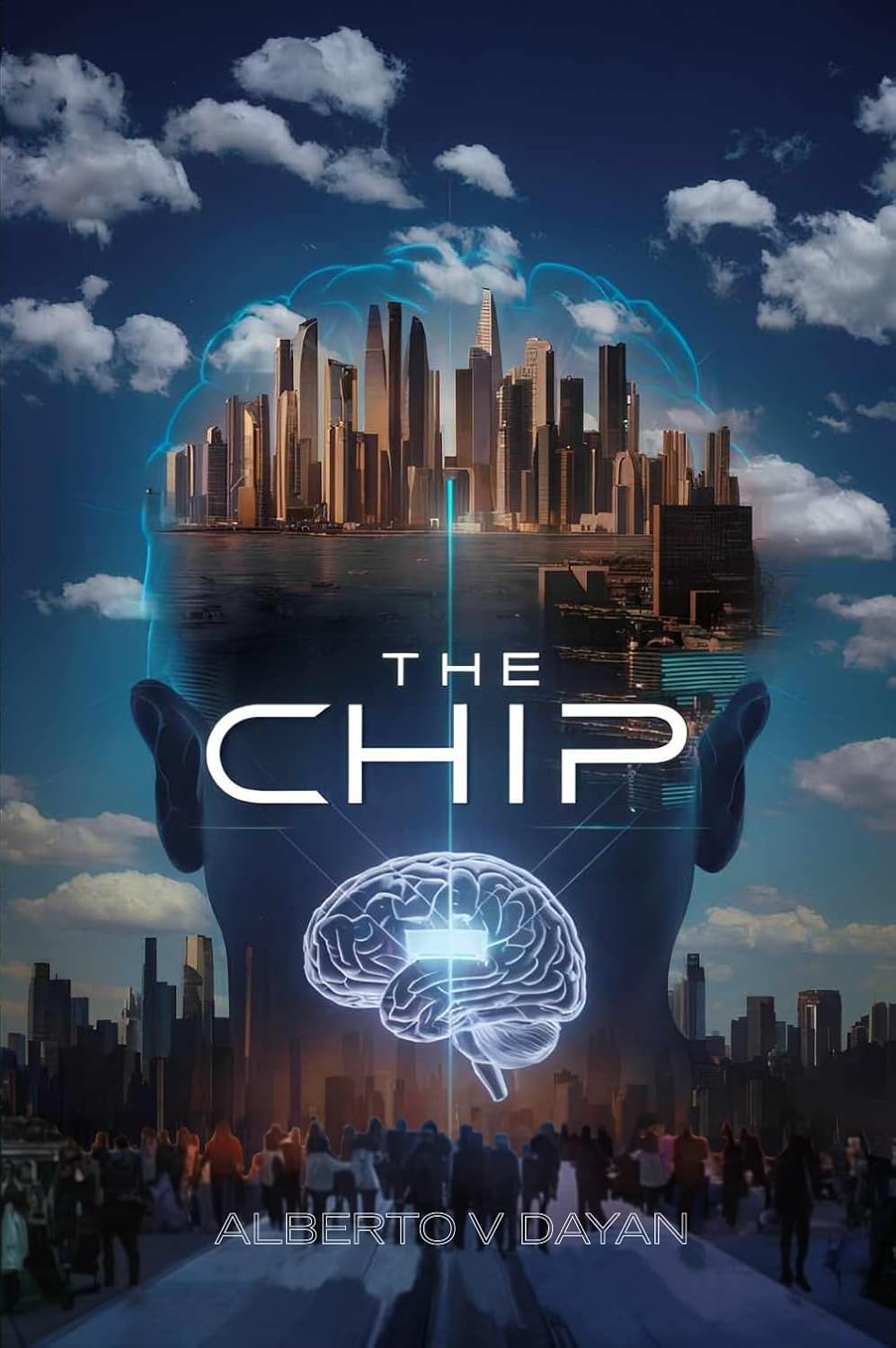

The Chip follows Phillip Novak, a brilliant and driven CEO who secretly implants an advanced A.I. microchip into his brain. The surgery turns him into a kind of superhuman thinker, and the world quickly bends around his newfound power. Governments scramble, cultures fracture, and everyday people start asking whether they should become “enhanced” too. It begins as a story about invention and ambition, then widens into a global clash over identity, freedom, and who we become when we let technology crawl into our minds.
The writing often moves at a quick clip, and I liked that. It gave the story a sense of momentum, almost like the world itself was speeding up the moment Phillip woke from surgery. Some scenes felt larger than life. His fleets of look-alikes, his secret mountain compound, his perfect confidence. I kept thinking how bold it was to paint a character with so much certainty. I would have liked more space to breathe with Phillip and understand him as a man rather than a symbol. Even so, I enjoyed how the book made big ideas feel close and personal. I kept turning pages because I wanted to see how far this technology would push him.
The book plays with power in a way that made me uncomfortable in the best sense. Watching governments rush to control the Chip felt scarily real. The split between “Enhanced Persons” and everyone else gave me a knot in my stomach. I caught myself thinking about how easily people trade freedom for convenience and how quickly leaders twist “safety” into something else entirely. Some of the social changes came fast, but the emotional weight landed. I found myself wondering what I would do. Would I let someone drill a device into my skull if it promised to make me brilliant? The book never answers that for you. It just sits with you and pokes at your thoughts.
The Chip is a cautionary tale, a thriller, and a tech fantasy all at once. I think this book is a strong fit for readers who enjoy fast pacing, high-concept ideas, and stories that make them question where our world is heading. If you like fiction that blends science with moral tension and if you enjoy thinking about the consequences of our inventions long after you close the book, then The Chip will be right up your alley.
Pages: 171 | ASIN : B0DJMJHRC4
Slickrock

Slickrock blends a fast kidnapping thriller with a rugged, sun-bleached wilderness adventure. The story kicks off when Relic, a loner and moonshiner who haunts Utah canyon country, discovers a body in a fake granary. At the same time, college student Malia is yanked from a nightclub and dragged into a scheme run by a revenge-hungry crew. Sheriff Leavitt and Deputy Dawson try to track down a missing ranch hand, but their investigation collides with the kidnappers’ plans. The book jumps between these threads until everything crashes together in Slickrock Canyon, where desert storms, gunfights, and raw survival force each character to show who they really are.
The pacing moves fast, like the book can’t wait to shove you around the next corner. I really liked the way the author paints the canyon. It feels hot and harsh and alive in a way that made me thirsty just sitting on my couch. Relic ended up being my favorite part of the book. His quiet grit sneaks up on you, and the way he tries to help Malia even though the whole mess has nothing to do with him makes him feel grounded and real. I also liked how the author lets scenes breathe just long enough before snapping into chaos. It kept me on my toes, and I didn’t mind that one bit.
The villains are nasty, but a few of their scenes felt over-the-top. Malia’s storyline pulled me in, especially the terror and confusion she feels early on, but I sometimes wanted more space inside her head instead of being rushed along. Still, when the story drops her into the wilderness with Relic, everything tightens up again. Their scramble through canyon forks and flash floods has a wild, sweaty energy. The writing hits hardest when it sticks to people running for their lives under a huge sky.
The book is punchy and dramatic. If you like thrillers that sprint rather than stroll, or if you enjoy survival stories set in wide open desert country, this one will probably scratch the itch. It’s especially good for readers who love a mix of crime, action, and a little rough humor. And if you’re the type who likes rooting for the stubborn, dusty outsider who’d rather avoid everyone but still ends up saving the day, Relic alone makes the journey worth it.
Pages: 300 | ASIN : B0G1CD2S61



 LITERARY TITAN