Blog Archives
Case Files from the Nightfall Detective Agency: Fury of the Vampire
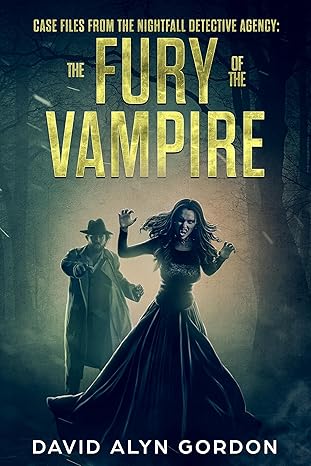

David Alyn Gordon’s Fury of the Vampire is a sweeping supernatural thriller that jumps across centuries, from ancient Jerusalem to 1920s Arizona, weaving together myth, history, and horror. The story follows vampires, werewolves, jinn, and humans caught in webs of betrayal, love, and ambition. At its heart is the eternal struggle between Lilith, Abram, and a cast of characters tied to mystical objects like the Ring of Solomon. Intertwined with this are political conspiracies, mob dealings, and the simmering tension of racial injustice in early 20th-century America. It’s a bold mix of folklore, pulp action, and noir detective work.
I enjoyed how daringly the author blends myth with history. Seeing Lilith spar with Abram in one chapter and then finding myself in the smoke-filled dance halls of Prohibition-era Tucson in the next kept me hooked. The pacing is brisk, and the action scenes pop with energy. I found myself leaning in whenever vampires clashed with werewolves or when political schemers whispered in dark corners. The dialogue can be blunt, sometimes even melodramatic, but it fits the pulpy, high-stakes feel of the book. It reminded me of flipping through an old serialized adventure, where the thrill matters more than polish.
Some passages carry raw emotional weight, like Malia grieving for her cousin, while other scenes are exaggerated. That didn’t ruin the ride for me, though. If anything, it made the book feel unpredictable. I enjoyed how unapologetically it leaned into its own wildness. It’s not a quiet or subtle novel; it’s brash, bloody, and loud. And I have to admit, I had fun with that. Sometimes I rolled my eyes, other times I grinned, and a few moments genuinely made me pause and think, especially the parts dealing with cultural memory and injustice.
I’d say Fury of the Vampire is best for readers who love fast-moving supernatural adventures, who don’t mind a little chaos in their fiction, and who want something that feels both familiar and refreshingly strange. If you’re into folklore reimagined as a gritty pulp detective saga, this is your book. It’s messy, it’s fierce, and it absolutely has bite.
Pages: 164 | ASIN : B0FLTB1L71

The Coldmoon Cafe

The Coldmoon Café is a strange and beautiful book. It’s part gothic fairytale, part fever dream, and part late-night forum thread from the ‘90s. The story follows a rotating cast of mourners, monsters, and misfits who stumble into a mysterious café that only seems to exist for the broken. There’s no central plot in the usual sense. Instead, it’s a collage of scenes, slow-burning conversations, poetic memories, and surreal moments of magic and grief, set against a backdrop of found family, old rites, and quiet hunger. The café, always watching, becomes more than a place. It’s a mood, a threshold, a ritual. And the people who gather there aren’t just characters. They’re ghosts of the internet age, wrapped in myth and melancholy.
The prose is lyrical, atmospheric, and at times so intimate it feels like eavesdropping. It drifts between styles like journal entries, script-like dialogue, and immersive third-person. What surprised me most was how emotional it got. Not loud, not dramatic. Just a steady ache. Like someone humming an old lullaby at the edge of a dream. The author manages to make the supernatural feel deeply human. There are vampires, shifters, witches, and magical scars, but what resonates the most are the quiet admissions of grief, of guilt, of wanting to matter to someone. Some parts made me tear up without warning.
The pacing is uneven, I think on purpose. Some chapters are full of action, others are just two people talking in a room for pages. There’s no traditional story arc, no tidy resolutions. And it leans heavily into its origin as a stitched-together roleplay with references, fragmented lore, insider nods that could leave some readers a little adrift. But for me, that was part of the magic. It feels like a digital séance. A love letter to forgotten usernames and forum ghosts who made stories when no one was watching. There’s a strange honesty in that. A kind of myth born out of message boards and memory.
I’d recommend Coldmoon Café to anyone who’s ever felt like a liminal creature. Folks who grew up online, who found solace in dark fantasy, who know what it’s like to carry sadness in your bones but still laugh with your friends at 3 a.m. It’s for people who miss LiveJournal, who remember the beauty of broken syntax and late-night confessions. This isn’t a book you read fast. It’s one you sit with. Maybe while it’s raining. Maybe while you’re a little heartbroken. Maybe while you’re ready to believe in something weird and beautiful again.
Pages: 583 | ASIN : B0FGW3YTJR

Multiverse Mayhem


Multiverse Mayhem, the third installment in Aurora M. Winter’s “Magic, Mystery and the Multiverse” series, picks up right where the chaos of book two left off. Ana Zest, the sharp-witted and surprisingly courageous teen heroine, faces down the Crimson Censor, a villain as stylish as she is brutal, in a fiery, magic-fueled standoff that propels Ana and her friends on a desperate quest across fantastical realms. From spell-splintered forests to dwarven strongholds, Ana grapples with betrayal, trauma, and the aching weight of responsibility, all while missing her tongue, her brother, and any semblance of a normal life. The multiverse is at stake, and the only things standing in the way of destruction are a talking dog, a bag of enchanted dust, and the pure grit of a girl who just wants her brother back.
I was charmed and unnerved by the writing in equal measure. The prose flips between whimsical and dark without warning, which makes the tone delightfully unpredictable. One moment, you’re giggling at a sass-tossing talking dog, and the next, you’re gritting your teeth as Ana gets her tongue magically severed. The worldbuilding is rich and clever, though sometimes a bit dense. There were moments where I felt lost in the swirl of spells, tech, and shifting allegiances. Still, I never wanted to stop reading. The action scenes are tight, the banter is sharp, and Winter’s pacing rarely falters. The emotional beats like Ana’s fear, her guilt, and her stubborn hope land beautifully. Even the villain, Crimson, is magnetic in her evil elegance.
What surprised me most was how invested I became in the book’s ideas about identity and choice. Hunter, the conflicted vampire-son of the Big Bad, is a standout. His scenes teeter on the edge of romantic tension and moral ruin, and I never knew whether to root for him or throw something. The story doesn’t sugarcoat the consequences of betrayal or the trauma of war. Ana’s struggle to reclaim her voice, literally and metaphorically, felt raw and real, even surrounded by magic hippogriffs and portal keys. There’s also a healthy distrust of authority that threads through everything, and the book doesn’t pretend that good and evil are always easy to spot. I liked that. It made the stakes feel more grounded, even when the characters were flying through dimensional portals.
Multiverse Mayhem is a chaotic, clever, and heartfelt ride through a universe that’s as magical as it is dangerous. I’d recommend this book to readers who love found families, high-stakes fantasy, and just the right amount of weird. Fans of Harry Potter, Artemis Fowl, or Percy Jackson will feel right at home, though they might be surprised at how much darker and more philosophical this series is willing to get. It’s a wild ride, but it’s got heart. And magic. And a dandy-lion that turns the tide of battle. What more could you want?
Pages: 370 | ASIN : B0DCKCGT7R
A Sandbox of Possibilities

Vexed follows the outcast twin of a royal wendigo house, living in hiding, who is thrust back into a world that feeds on power and control, where her ability to love is seen as a weakness, and her greatest fear is becoming a monster like the rest of them. What was the inspiration for the setup of your story?
I’ve always been fascinated by the darker side of folklore—particularly wendigos and skinwalkers. For a while, I wasn’t quite sure how to approach them without falling into the usual tropes. But then it hit me: why not lean into what I already enjoy doing—taking something familiar and reshaping it into something unsettling, emotional, and new? That was something readers appreciated in The Orphan Maker (Book 1 of the series), and their response gave me the confidence to push further. With Vexed, I wanted to continue subverting expectations, not just in terms of myth, but in how we portray monstrosity, love, and identity. Emilia’s journey is my way of asking: What if the real horror isn’t the monster’s form—but what we’re willing to become to survive?
It seemed like you took your time in building the characters and the story to great emotional effect. How did you manage the pacing of the story while keeping readers engaged?
Pacing is something I take very seriously—especially in a series where emotional stakes evolve across multiple books. In The Orphan Maker, the protagonist Damien was strategic, composed, and emotionally closed off. So for Vexed, I wanted a complete shift. Emilia, while equally intelligent, is emotionally raw—her turmoil is deeply internal. That contrast was deliberate. I wanted to disorient readers, to make them feel the weight of her silence and her slow unraveling. Structurally, I made sure every chapter carried either emotional or plot-driven tension, weaving personal revelations with external threats. It’s a careful balance—letting the characters breathe while still turning the screws. That tension keeps the pages turning.
In fantasy novels, it’s easy to get carried away with the magical powers characters have. How did you balance the use of supernatural powers?
Fantasy gives you a sandbox of possibilities—but too much freedom can dilute impact. So from the very beginning, I set hard rules for the supernatural. In my planning process, I define exactly what each creature or bloodline can and cannot do, and I document these limits religiously—post-its, diagrams, notebooks, you name it. Power in my world always comes at a cost. If a character uses an ability, there has to be tension or consequence, either physically, emotionally, or narratively. That way, the magic becomes part of the story’s weight—not an escape from it. I want readers to feel that powers don’t make a character stronger—they expose who they really are.
Where does the story go in the next book, and where do you see it going in the future?
I’m incredibly excited for Book 3. Without giving too much away, I’ll say this: the stakes will rise, and the lines between human and monster will blur even more. Readers who’ve followed Emilia’s journey will see her pushed further—to the edge of everything she once believed about herself. Expect more secrets, more betrayals, and yes, more of the world’s hidden lore unfolding. The series as a whole is about identity and inheritance, about what we carry from the past and whether we can ever truly choose who we become. Even in a world of vampires, wendigos, and ancient bloodlines, I believe the heart of every story is still about the choice to be kind… or cruel. That tension will only grow as the saga continues.
Author Links: GoodReads | Facebook | Website
In a world where ancient dynasties feed on control, lust, and carnality, Emilia must survive a court of predators that sees love as weakness and hunger as strength. But the real threat isn’t the creatures around her—it’s the one awakening inside her.
Vexed is a dark supernatural thriller that expands the mythos of The Orphan Maker, diving deeper into a world of secret societies, brutal inheritance, and seductive horror. With relentless pacing and prose that bites like a wendigo’s teeth, this is a story that won’t let go.
Vexed

D.A. Chan’s Vexed, the sequel to The Orphan Maker, plunges us back into a world ruled by ancient bloodlines, dark legacies, and monstrous truths cloaked in elegance. Emilia Vasa, the outcast twin of a royal wendigo house, is yanked from the fragile peace of a life she built in hiding. Forced back toward the cruel empire of her birth, she must navigate manipulation, political alliances, old wounds, and the ever-looming shadow of becoming what she fears most—a monster like the rest of them.
Reading Vexed felt like stepping into a gothic opera that never lets up. Chan writes with emotional urgency—his prose is sharp and immersive, always soaked in atmosphere. I was completely swept away by Emilia’s voice: bitter but vulnerable, regal yet scared. She’s a character I rooted for even as I wanted to shake her. The writing walks a brilliant tightrope—both lyrical and grounded, layered with real feeling. Every sentence carries tension. The emotions—grief, fear, longing—stab through in quiet, gut-wrenching moments, especially in scenes with Anja and Michael. I stayed up late flipping pages, chest tight, because I had to know what was coming.
But it’s not just the writing—it’s the ideas that stay with me. This book isn’t just about a girl caught between two worlds. It’s about legacy and survival. It’s about the cruelty of power disguised as tradition. The wendigo myth is used so smartly—not just horror, but metaphor. Chan explores the hunger for control, the rot at the heart of family, and the cost of being different. There’s a quiet brilliance in how Emilia’s “defect” becomes a kind of strength, even as everyone tries to strip her of agency. That conflict—between the lie she must perform and the truth of who she is—makes the book pulse with tension. It’s relatable, even when the characters are monsters.
I can’t recommend Vexed enough to readers who love dark fantasy with real emotional teeth. If you liked Leigh Bardugo’s Ninth House, or the political dread of The Hunger Games with a gothic twist, this will hit you hard. It’s intense and it’s cruel and tender in equal measure. This book is not for the faint of heart, but if you want something that cuts deep and lingers long after the last page, Vexed is it.
Pages: 335 | ASIN : B0FBV1PJ1N
Vampires Are Our Friends

Immortal Gifts follows a centuries-old Jewish vampire on the run from an antisemite trying to make him permanently dead, who falls in love with a mortal woman in the twenty-first century. What was the inspiration for the setup of your story?
The original concept was a one-time challenge with my writing group: “The vampire has a wife. Set the story in the last five years.” Several people submitted wildly different stories. Mine turned into Immortal Gifts.
I’m a Pantser, and it’s a normal part of my process to reread what I’ve written and extract subtext. Early on, I started to feel that the character was Jewish. That was interesting, so I went with it.
A lot of Abraham’s early biographical details (date and place of birth and desire to study at an academy that does not allow Jews) came from the life of Jewish composer Louis Lewandowski. Obviously, Abraham is not Lewandowski! But Lewandowski ended up being the first Jewish student at the Berlin Academy. Lewandowski was admitted as a favor to his friend, Felix Mendelssohn. Abraham, not having a Mendelssohn, lied.
Abraham is not the typical vampire often found in paranormal books; he offers readers a human perspective on supernatural beings and explores how immortality affects who they are. What were some of the emotional and moral guidelines you followed when developing your characters?
I was primarily interested in the concept of immortality in choosing vampires. It’s true that my vampires have the no-food and sunlight issues, but that was primarily so the reader wouldn’t immediately say “Immortality? Sign me up!” 🙂
Aside from that, I wanted my vampires to be very grounded in reality. Vampires are always people—that’s one of the things that makes them fun to me—but I wanted them to be very much the person they always were. If someone is a good person, eternal life in itself won’t change that. If someone is a bad person, immortality won’t change that, either. In other words: it’s your choices and actions, not the length of your life, that determines your moral alignment.
Early on the question of consent started coming up. Turning someone without asking permission first is, at the very least, a faux pas. When is it justified? Is it okay to turn someone without their consent to save their life if they haven’t offered an opinion? When is it okay to make someone’s medical decisions for them? Because that’s what it is in my book: a miracle cure for almost any ailment that also has significant drawbacks.
What were some themes that were important for you to explore in this book?
Mortality. Grief. Consent. Resilience in the face of oppression.
At one point I was describing the book to my sister and told her, “Don’t be afraid of the vampires. Vampires are our friends. You know what’s not our friends? The natural processes by which our loved ones get sick and die. Those are horrifying.” (Our parents are both dead, by the way.)
Will there be a follow-up novel to this story? If so, what aspects of the story will the next book cover?
I’m working on the second book, and we’re still talking about mortality (and gifts). We did leave off with a couple of characters in uncertain situations and had a reveal about a third.
A lot of Immortal Gifts was written during the pandemic and has a lot of pandemic-feeling isolation. The second book is shaping up to be more… sociable.
Author Links: GoodReads | Facebook | Website | Amazon
Prussia, 1841. Abraham only ever wanted to play violin. Hiding his Jewish status so he can study at the prestigious Berlin Academy of Music, the eager young man is delighted to find a patron who believes in him. But he’s mortified when his new friend turns him into a vampire… and Abraham earns the fury of an ancient antisemite who vows to see him permanently dead.
Fleeing the hate-mongering fiend across the decades, the sensitive violinist at last settles in twenty-first-century New Jersey with a mortal woman. But when he discovers his relentless tormentor has tracked him down yet again, Abraham despairs he’ll never find true happiness.
With everyone he’s ever loved at risk, can he escape the rage of a ruthless bigot?
In a complex tale woven through history, Katherine Villyard delivers a fresh and insightful twist on the vampire novel. Infusing the narrative with profound themes of love, betrayal, and the nature of monsters, she crafts an unforgettable saga of surviving prejudice that will keep readers turning pages deep into the night.
Immortal Gifts is the thoughtful first book in the Immortal Vampires contemporary fantasy series. If you like well-drawn characters, dual-timeline storytelling, and pulse-pounding suspense, then you’ll adore Katherine Villyard’s compelling read.
Buy Immortal Gifts to tap a vein of devotion today!
Where Is My Blood Going?
Vampires in BC follows a man who has been partially transformed into a vampire as he grapples with his new identity and the moral questions he faces in this new form. What was the inspiration for the setup of your story?
I was in the hospital waiting for a delayed operation, so I caught up on reading. I decided to re-read Bram Stoker’s Dracula. It awakened a long-hidden fascination with vampires, and then, as my blood was being taken twice a day, I wondered what they were doing with it. The idea of vampires stalking the corridors emerged as we were a sitting target for bloodsuckers to take advantage of. At night in my ward, there were times when patients screamed, which awakened my creative side.
However, I have always been fascinated by the animal and human worlds from different standpoints. My dog’s perspective on life is very different from mine, and I wonder how an intelligent animal would react to what we have done to the environment. I wanted to bring that up, not to lecture about it but to introduce it as an idea for people to consider. Jude also faces a moral dilemma as Vampires in BC depicts the struggle between instinctive behaviour and human compassion.
Did you plan the tone and direction of the novel before writing, or did it come out organically as you were writing?
The first draft emerged while I was writing the book, but the characters created the novel’s direction. A lot of re-writing took place, and ideas surfaced as I was writing. As I said, the characters come alive and know how they behave. They develop, and for example, I’ve tried to show how Gav comes across as a wise-cracking, arrogant teen, but he has another side to him, and although Jude doesn’t acknowledge this openly, he benefits from Gav’s interventions.
What were some themes that were important for you to explore in this book?
The underlying sexuality in the book resonated with me. If you can shape change as Vampires do, what’s to stop you from becoming a woman, a man, or an animal? With vampires, their overwhelming need to survive is to feed on blood, and the most desirable blood comes from us. However, they have to attract humans, seduce and overwhelm them. You may notice that with those they want to turn, they ask permission first, but at other times, when they have a different objective, they don’t.
Transformations from human to vampire and the lure of longevity are fascinating topics to explore. Don’t we all want to live longer? The lure of wealth and unlimited power is bubbling under the surface of our psyche, which leads to the question: What are we prepared to do to achieve those aims? It’s the age-old dilemma of selling your soul to the devil for riches. Christopher Marlowe’s play Doctor Faustus explores this wonderfully.
The changes we are experiencing due to climate change because of human exploitation gave me a chance to look at it from another species’ point of view. Change, however, is frightening and has repercussions that may not always be positive. So, how does Jude try to balance his love for his vampire life with vestiges of his human empathy?
Can fans look forward to more books from you soon? What are you currently working on?
The first book scattered seeds that could be followed up in a sequel but are still in the embryo stages. I’ve also got an unfinished book waiting for me to return to. However, I found writing about vampires was a lot of fun, as you can create a fantasy worldview around them. In a potential sequel, I would like to concentrate on how vampires are similar to humans with complex characters. One of the younger vampires I’ve introduced could be developed, along with the mission Jude and Gav set for themselves. I also need to develop the roles of the Children of Sasquatch and the Canadian Special Forces. But I’d also like to get reactions from readers to get their perspectives.
Author Links: GoodReads | X | Facebook | Website | Instagram | Book Review
Although Jude loves the power of being a partial vampire, which includes shapeshifting into whatever he wants, he struggles with guilt over the harm his vampiric nature may cause. His human side clings to his past, but as a vampire he has access to a world of power, immortality, and liberation from human limitations.
Should he work to destroy the world he lives in and dominate the planet, or side with humans in fighting the vampires that control him?
Vampires in BC
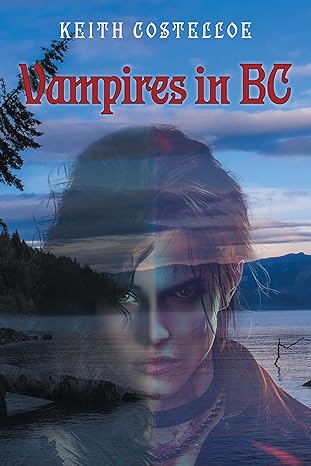
Vampires in BC, by Keith Costelloe, is a mesmerizing fantasy novel that immerses readers in a dark and atmospheric world where the lines between life and death, human and vampire, blur hauntingly. The story centers on Jude, a character partially transformed into a vampire by the enigmatic Dr. De’Ath. Jude grapples with his identity and the moral dilemmas of his new existence, all while possessing a unique ability to morph between male and female forms, which he uses to explore his fluid sexuality and seduce his victims. This shapeshifting power further complicates his internal struggle between his past human life and his present vampiric state. The novel opens with a chilling prologue set around a campfire, where Dr. De’Ath, in a sinister twist, unveils her vampiric nature to a group of unsuspecting teenagers. From there, the narrative delves into Jude’s experiences and the clandestine world of vampires living beneath a hospital. Led by Dr. De’Ath, these vampires see themselves as saviors of the Earth, destined to cull humanity and restore planetary balance.
Throughout the book, Jude wrestles with the duality of his nature—his human emotions and memories clash with the cold, predatory instincts of a vampire. As he navigates this new world, he must confront his desires and the reality of being a creature that preys on humans. The narrative is richly infused with gothic elements, exploring themes of identity, morality, and the seductive nature of power.
Vampires in BC is a thought-provoking exploration of identity and morality within a gothic horror framework. Keith Costelloe’s evocative writing, with its rich descriptions, vividly paints the eerie world Jude inhabits. One of the book’s many strengths lies in its characters. Jude is a compelling protagonist, torn between his human past and vampiric present. His ability to shift between genders adds a unique dimension to his character, allowing for a nuanced exploration of gender fluidity and sexuality. This aspect of Jude’s character is handled with sensitivity and depth, making his internal conflict all the more poignant. The pacing of the story is well-balanced, with moments of introspection and character development interspersed with intense, suspenseful scenes.
Costelloe’s writing style is both lyrical and precise, creating a haunting atmosphere that lingers long after the final page is turned. The book’s exploration of its darker themes may not be for everyone. The moral ambiguity of the characters, particularly the vampires’ justification for their actions as protectors of the Earth, challenges readers to question traditional notions of good and evil. This moral complexity is a strength but also demands readers to engage deeply with the text.
Vampires in BC is a gripping and atmospheric read that offers more than just a traditional vampire tale. It delves into the complexities of identity, the nature of power, and the consequences of our actions, all within a richly crafted gothic horror setting. Fans of the genre will appreciate the book’s depth and the fresh perspective it brings to vampire mythology.
Pages: 289 | ASIN : B0DJT1HFVS



 LITERARY TITAN