Blog Archives
Hydrangeas from Dad: His Gift from Beyond that Rescued My Soul – Healing and Thriving After the Loss of a Loved One


Hydrangeas from Dad is a memoir and spiritual reflection about Mary Ellen Connett MacDonald’s loss of her father, Bill Pukatch, and the extraordinary message she believes he sent her after his death: a text from his phone containing a photo of blue hydrangeas. The book begins in the raw terror of “the dreaded call,” moves through the family’s tender hospice vigil, the memorial service, and the author’s stunned encounter with the mysterious hydrangea text, then opens into a wider meditation on soul, afterlife, courage, shamanism, family legacy, her mother’s later death, wild horses, and the practices that helped her live with more truth and spirit.
I found the strongest parts of the book to be the scenes grounded in ordinary human detail. The barbecue dinner interrupted by the phone call, the long night drive, her father gripping her hand in the hospital, the family singing and sleeping in his room, Paul asking to hug the urn one last time: these moments have a plainspoken ache. The writing is at its best when it trusts those images. I could feel the strange intimacy of waiting beside a dying parent, the way time becomes thick and sacred, the way everyone in a family suddenly becomes both child and adult. The hydrangea text is the book’s central mystery, but what moved me more deeply was the emotional weather around it: guilt over missed calls, the stunned silence after death, the hunger for one more sign that love hasn’t vanished.
I also admired the book’s courage, even when I didn’t always feel equally persuaded by every idea. MacDonald writes with complete conviction about the immortality of the soul, continued communication after death, guardian angels, spirit guides, drumming, and shamanic practice. Readers who share or are open to those beliefs may find the book deeply consoling. I appreciated that the book doesn’t treat grief as something to be tidied away. It treats grief as a threshold, a fierce and unwieldy teacher. The later sections on soul nourishment, wild horses, Rocket the mustang, and creative self-claiming broaden the memoir beyond bereavement into a portrait of a woman deciding, after loss, not to live half-hidden anymore.
Hydrangeas from Dad is heartfelt, vulnerable, and spiritually unapologetic. It’s a book less interested in proving its mysteries than in showing how one woman was changed by them. Its language can be tender, emphatic, and sometimes overflowing, but that fullness feels connected to the book’s central pulse: love keeps speaking, even after the body is gone. I’d recommend it especially to readers grieving a parent, anyone drawn to after-death communication and soulful healing, and people who want a companionable, emotionally generous book about turning loss into a more honest life.
Pages: 156 | ASIN: B0G3NNM4W3

A is for Amy


A Is for Amy by Steven Crandell is a romantic comedy novella about Amy, a young widowed mother of three trying to find her way back into desire, confidence, and choice after grief, betrayal, and exhaustion have narrowed her life. The story follows her alphabetically through encounters with Charlie, an alluring ex-milkman with his own wounds, and Quentin, a gentler surprise who eventually becomes the more grounded romantic possibility. It’s funny, messy, and deliberately intimate, a romance that is less about being rescued than about remembering that wanting something is allowed.
I really liked the voice. It’s sharp, playful, and sometimes outrageous, but underneath the jokes there is real loneliness. Amy’s thoughts move the way a tired parent’s mind moves, bouncing from breast-feeding to unpaid bills to sex to self-help books to the weird emotional weather of being seen again. I liked that the humor doesn’t polish her life into something cute. It lets the house be chaotic. It lets grief be ugly. It lets motherhood be loving and boring and gross and sacred, sometimes all on the same page.
Crandell makes a bold choice with the alphabet structure, and I think it works because the book itself feels like Amy trying to name her life one piece at a time. Attraction. Baby Bartlette. Freedom. Nutella. Yes. The structure gives the novella a quick, bright rhythm, almost like flipping through snapshots. I did sometimes feel the comedy pushed hard, especially with Bart and some of the broader side characters, but even then, the excess seems tied to Amy’s way of surviving. She turns pain into punchlines because otherwise the pain would just sit there, heavy and unmoving.
As a romantic comedy novella, A Is for Amy will probably appeal most to readers who like love stories with bite, warmth, and a little domestic chaos. I would recommend it to anyone who enjoys character-driven romance, especially stories about second chances after loss. This book has sass, it has crumbs on the floor, kids at the door, and a heart that keeps choosing to open.
Pages: 95 | ASIN : B0GL9VKNXS
Address

In Address, author Sosena Audain starts with the apparently local mystery of Professor Patrick Shelby, a nanotechnology scholar found dead at Clymer University, his organs inexplicably necrosed, and then keeps widening the aperture until the case pulls in campus politics, military backgrounds, false identities, Russian operatives, and finally a threat tied to the President’s State of the Union. The novel moves through alternating first-person voices, especially Henry Chu, Braum Madaki, and Camilla Rivera, so the investigation feels less like a straight procedural than a relay race of temperament, wit, and concealed histories. By the end, what begins as a murder puzzle has become a full-blooded national-security thriller.
This book doesn’t think small. I felt that almost immediately in Henry’s opening chapters, where grief, comedy, and suspicion all jostle in the same paragraph, and again when Braum and Camilla enter with their almost mythic résumés and clipped self-possession. That could have turned pompous, but Audain often saves it by letting personality cut against polish: Henry is impulsive and oddly charming, Camilla is serrated and funny, Braum is so controlled he becomes entertaining by sheer force of restraint. I enjoyed the friction among the trio more than any single clue. Their banter gives the novel voltage, and the first-person rotation keeps the story from settling into one flavor for too long.
I also admired the book’s willingness to be a little extravagant. Address is not shy about melodrama, high competence, or sudden escalations, and I think it works best when it embraces that rather than apologizing for it. The shift from campus homicide to geopolitical plot is audacious. It’s sometimes baroque, but never dull. The prose and characterization sometimes announce themselves so emphatically that subtlety gets elbowed aside. Still, I would rather read a thriller that lunges than one that sleepwalks. This one lunges. It has the logic of a fever dream wrapped around the chassis of a procedural, and that combination kept me reading even when I could feel the gears grinding.
I’d hand this to readers who enjoy political thrillers, espionage thrillers, mystery, and conspiracy fiction, especially people who like their suspense brisk, high-stakes, and unabashedly cinematic. It will likely appeal more to fans of Brad Thor or Vince Flynn than to readers looking for the hush and exactitude of a classic puzzle mystery, though there is a bit of Dan Brown-style momentum in the way one revelation kicks open the next door. Address is a thriller that keeps widening the room until the walls are basically the nation.
Pages: 179 | ASIN: B0H19QG12P
Matthew’s Journey: The Return Home

Matthew’s Journey: The Return Home follows Caroline and Matthew, two young lovers from Meadowshire whose future is torn open when Matthew leaves for the battlefields of Vlaysar. The novel moves between Caroline’s vigil at home and Matthew’s brutal struggle to survive the war, building toward the emotional force of his longed-for return. This is a story about love under siege: by distance, fear, violence, and the terrible silence of not knowing.
I was most struck by the book’s sincerity. The novel is openly emotional, and that honesty gives the story much of its unique energy. Caroline’s longing isn’t treated as decorative romance; it becomes a daily labour, as real as baking bread, mending damage, or standing by the road scanning every passing soldier’s face. The war scenes, meanwhile, strip away Matthew’s boyish dream of glory and replace it with mud, blood, heat, confusion, and moral disgust. I appreciated how the book refuses to let war remain abstract. Its cost shows up in bodies, homes, rumours, empty places at tables, and people who return as “walking ghosts.”
The prose is lush, with a strong taste for color, weather, birdsong, and the textures of rural life. The narration can linger over an image or moral point. But that same fullness is also part of the book’s character. It has the cadence of an old-fashioned romantic epic, earnest and panoramic, more interested in emotional saturation than speed. When it works best, the natural world around Meadowshire becomes a counter-melody to human cruelty: bees and songbirds on one side, cannons and shattered men on the other.
The target audience is readers who enjoy historical romance, war fiction, homecoming stories, and sentimental literary romance with a strong moral center. Readers of Nicholas Sparks may recognize the devotion and emotional directness here, though Birrell’s novel leans more toward wartime pastoral and anti-war fable than contemporary romance. Matthew’s Journey is a tender, anguished story about holding a place in the heart for someone who may never come back, and discovering that hope, however bruised, can still find the road home.
Pages: 170 | ASIN : B0G4T1W8Z7
The Story Shaped Itself

Doryto and the Door of Wanderers centers around a man with the exceptional ability to find almost anything, who is pulled into a mysterious interdimensional adventure. Where did the idea behind this novel come from?
The idea actually started with a tagline: Doryto is hired by his grandmother to find himself in another dimension where he has lost everything. From there, the story shaped itself as I wrote. I love the freedom of following characters through their decisions one at a time, rather than being tied to a strict outline.
Doryto’s voice is funny and personal—how did you strike the balance between authenticity and storytelling clarity?
I set out to write the most ridiculous story I could think of, and I knew I needed a voice to ground it. Doryto provides that balance; he wouldn’t be as effective if he took everything seriously in a world where Sasquatches smell like Fruity Pebbles.
In truth, this story mirrors my own journey of sorrow while my husband was dying. I needed the humor because my world was going dark; it was a form of survival. I wanted to explore the different versions of ourselves we present to the world, what it’s like to become ‘more’ or ‘less’ of yourself, and the profound experience of losing someone you love dearly. It’s about the desperation of those left behind to remember the journey—to hold onto the pieces of who you were with them while finding the courage to redefine yourself without them. The biggest gift is ultimately allowing yourself to heal.
Do you see more stories in this world or more journeys for Doryto ahead?
Maybe. Right now, my focus is on finishing The Watershed Butterfly. I originally wrote Doryto as a standalone, but who knows what the future holds?
Author Links: GoodReads | Facebook | Website
Lost keys, runaway dogs, even a basketball-sized bag of weed in downtown Atlanta—if it’s lost, Doryto is your guy. What he can’t find is stability.
Living behind the desk of his failing Birmingham storefront, Doryto thinks his life is weird enough already—until a homeless woman blocks his door, claims to be his “not-exactly” grandmother, and begs him to find her missing grandson… who happens to be another version of him from a neighboring dimension.
Suddenly reality has layers, dogs are gatekeepers, wedding rings are portals, and something that smells like Fruity Pebbles is hunting people who can slide between worlds. Thrown into alternate versions of Birmingham—some broken, some dangerous, all unsettling—Doryto must track down the version of himself who loses everything, before he becomes the next one to disappear.
Witty, gritty, and wildly off-kilter, Doryto and the Door of Wanderers explores identity, belonging, and the unexpected cost of extraordinary gifts.
Because finding things is easy.
Finding yourself is where it gets dangerous.
Two Hearts within One Soul: Volume 1
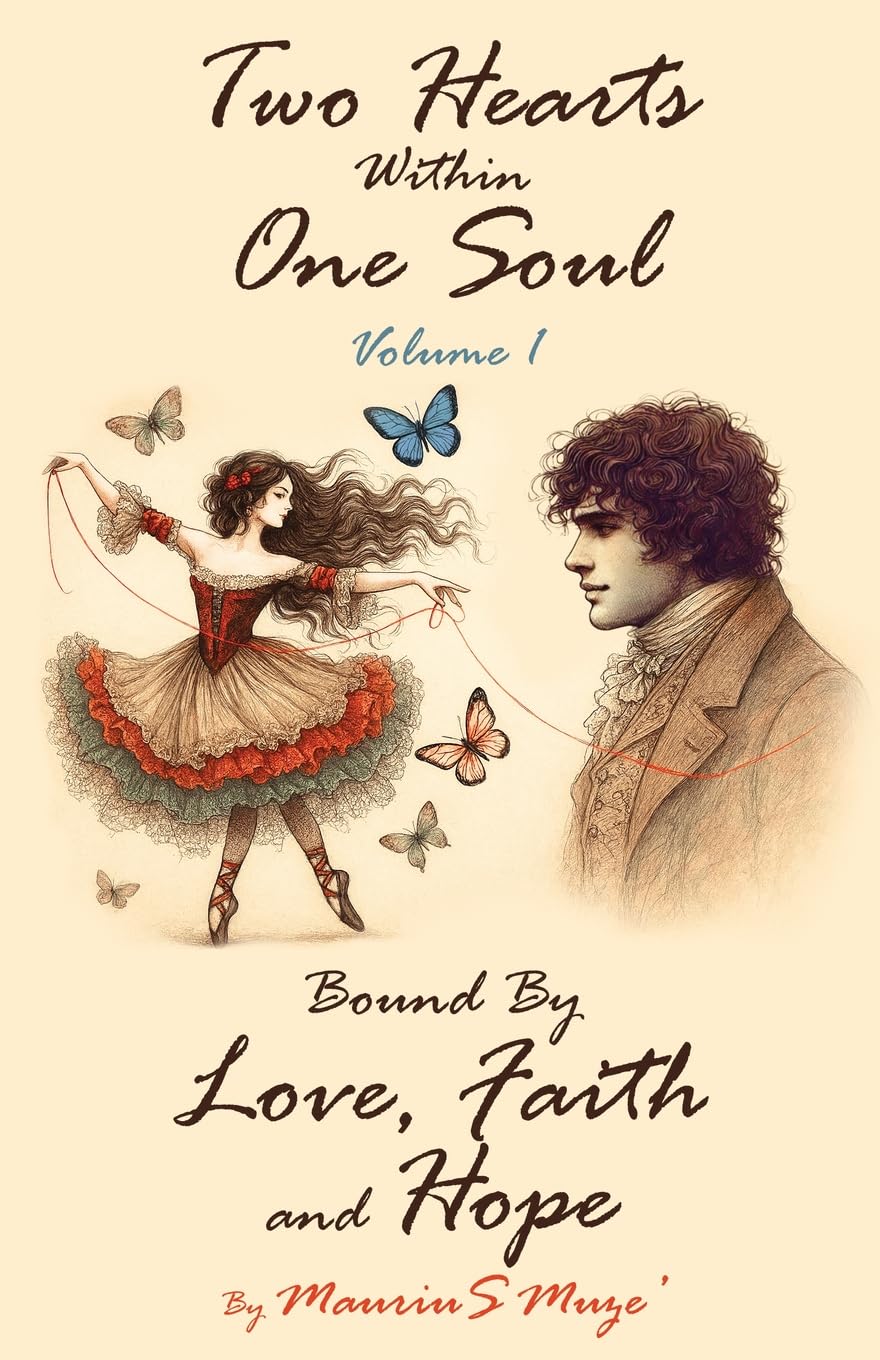
Two Hearts Within One Soul: Volume 1 is a lavish, operatic romance about grief-struck souls drawn together by fate, music, and the invisible red thread of divine love. King Marici’O, shattered by the death of Queen Gelsomina, and Dahli’a, a Roma gypsy ballerina devastated by the sudden loss of Marco, become twin figures of sorrow before the universe steers them toward one another. The book moves through Italy, ballet, moonlight, poetry, classical music, and spiritual longing, building a love story that treats romance not as coincidence but as cosmic decree.
The book doesn’t whisper about love; it opens the palace doors, lights every candle, summons Bach and Mozart, scatters roses across the floor, and lets grief speak in thunder. The prose feels less like conventional fiction than a long, perfumed aria. That intensity can be overwhelming, but it’s also the novel’s signature pleasure: every emotion arrives adorned, ceremonial, and unashamed.
I was also drawn to the way the novel links love with recovery. Marici’O and Dahli’a are not simply romantic leads; they are wounded people trying to become habitable to themselves again. The repeated images of butterflies, moonlight, dance, flowers, and music give the story a mythic texture, as if ordinary heartbreak has been translated into stained glass. I did sometimes wish the book were a bit less wordy., but I admired the book’s devotion to feeling. It believes, completely, in the grandeur of the heart.
The target audience is readers who enjoy romance, historical fantasy, ballet fiction, metaphysical love stories, and poetic literary romance. Readers who love the emotional sweep of Nicholas Sparks but want something more baroque, mystical, and feverishly lyrical may find themselves at home here. Two Hearts Within One Soul is for readers who want a love story that feels big, emotional, and unforgettable.
Pages: 140 | ASIN : B0GTJVXR12
Across A Starlit Sky

Across A Starlit Sky by Susan Shalev is a WWII historical novel that follows Mirjam Coelho, a young pianist in Amsterdam whose life becomes entwined with the Jewish Meijer family as Europe moves toward catastrophe. The story also reaches back to seventeenth-century Portugal through Amelia, a converso woman living under the shadow of the Inquisition, so the book becomes more than a wartime survival story. It is about hidden identity, inherited memory, music, faith, family, and the long echo of persecution across generations.
Shalev clearly enjoys building rooms, streets, cafés, synagogues, riverbanks, and train stations with patient detail. Sometimes I felt the descriptions slowed the pace, especially early on, but they also gave the novel its texture. Amsterdam feels lived in before it becomes endangered, which matters. The warmth of music lessons, the smell of cafés, the shine of a piano, the ordinary pleasure of a young woman beginning work, all of that makes the later threat feel more personal. The war doesn’t arrive in an abstract way. It presses into an already full life.
I also found the double timeline a thoughtful choice. At first, I wondered whether the Portugal sections would pull me too far away from Mirjam’s story, but they ended up deepening the book’s central idea: that history does not vanish just because people are forced to hide it. The connection between Jewish persecution during the Inquisition and Nazi Europe could have felt heavy-handed, but Shalev mostly lets the parallels build through objects, family stories, and emotional discovery. The novel is candid about fear and loss, but it is also interested in tenderness, rescue, and the stubborn human need to belong. It’s not a spare book. It leans into feeling. For me, the emotional openness gave the story its heart.
I would recommend Across A Starlit Sky to readers who enjoy historical fiction with strong family themes, Jewish history, dual timelines, and a clear emotional arc. It will especially appeal to people who like WWII novels that widen the lens beyond the battlefield and look at identity, ancestry, and survival across centuries. It’s reflective, accessible, and sincere, the kind of book I would hand to a friend who wants a moving historical novel with both sorrow and light.
Pages: 288 | ASIN : B0GNS6Q76T
Unfollow the Leader

Unfollow the Leader by Reem Borrows is a reflective leadership book built around a clear central conviction: the old, performance-heavy model of leadership is no longer enough, and real leadership now begins with self-awareness, health, emotional intelligence, and values-led action. Borrows frames this through her Health, Head, and Heart approach, moving from self-leadership and purpose to courage, gratitude, relationship intelligence, flow, and practical execution tools like S.T.O.P. What gives the book its pulse is the way she folds personal stories into the framework, from the bruising early career experience of being told it was “my way or the highway,” to the family reunion after war, to the waterfall story where surrender becomes not weakness but wisdom.
Borrows writes best when she lets leadership leave the boardroom and return to the body, the home, the nervous system, the quiet ache of ordinary life. The coffee made for a wife after two years apart stayed with me because it says more about leadership than many polished business models do. It reminds us that presence isn’t soft. It’s strenuous, sacred work. I also appreciated her insistence that health isn’t a decorative add-on to ambition. That idea feels earned, especially when she connects burnout, ego, and disconnection to the way people actually behave under pressure. The book’s ideas are familiar in places, drawing from coaching, mindset work, emotional intelligence, and purpose-led leadership, but Borrows gives them warmth and moral weight.
Stylistically, the book has a generous, conversational quality, almost like sitting with a coach who won’t let you hide behind busyness. The book’s reflective rhythm gives its ideas room to settle, and the recurring themes create a sense of reinforcement. The prompts invite pause and self-examination, which feels fitting for a book so devoted to inner leadership. Borrows is not writing from a distance. She’s writing as someone who has been shaped by mentorship, grief, pressure, faith, mistakes, and hard-won clarity. That emotional openness gives the book its texture. I especially liked the moments where she admits the ego still rises, even in a boardroom, because that honesty keeps the work from becoming glossy or unrealistic.
I came away from Unfollow the Leader feeling challenged and moved. It’s not a book for readers looking for a ruthless corporate playbook or a dense academic treatment of leadership theory. It’s better suited to leaders, coaches, founders, managers, and thoughtful professionals who sense that success without inner alignment has become too expensive. I’d especially recommend it to anyone feeling stretched thin by responsibility, or anyone beginning to understand that influence without presence eventually rings hollow. This is a warm, reflective, and practical book for people who want to lead with more courage and care.
Pages: 226 | ASIN : B0F6Q2WXNG


