Blog Archives
Obadiah and the Last 100 Prophets of Edom
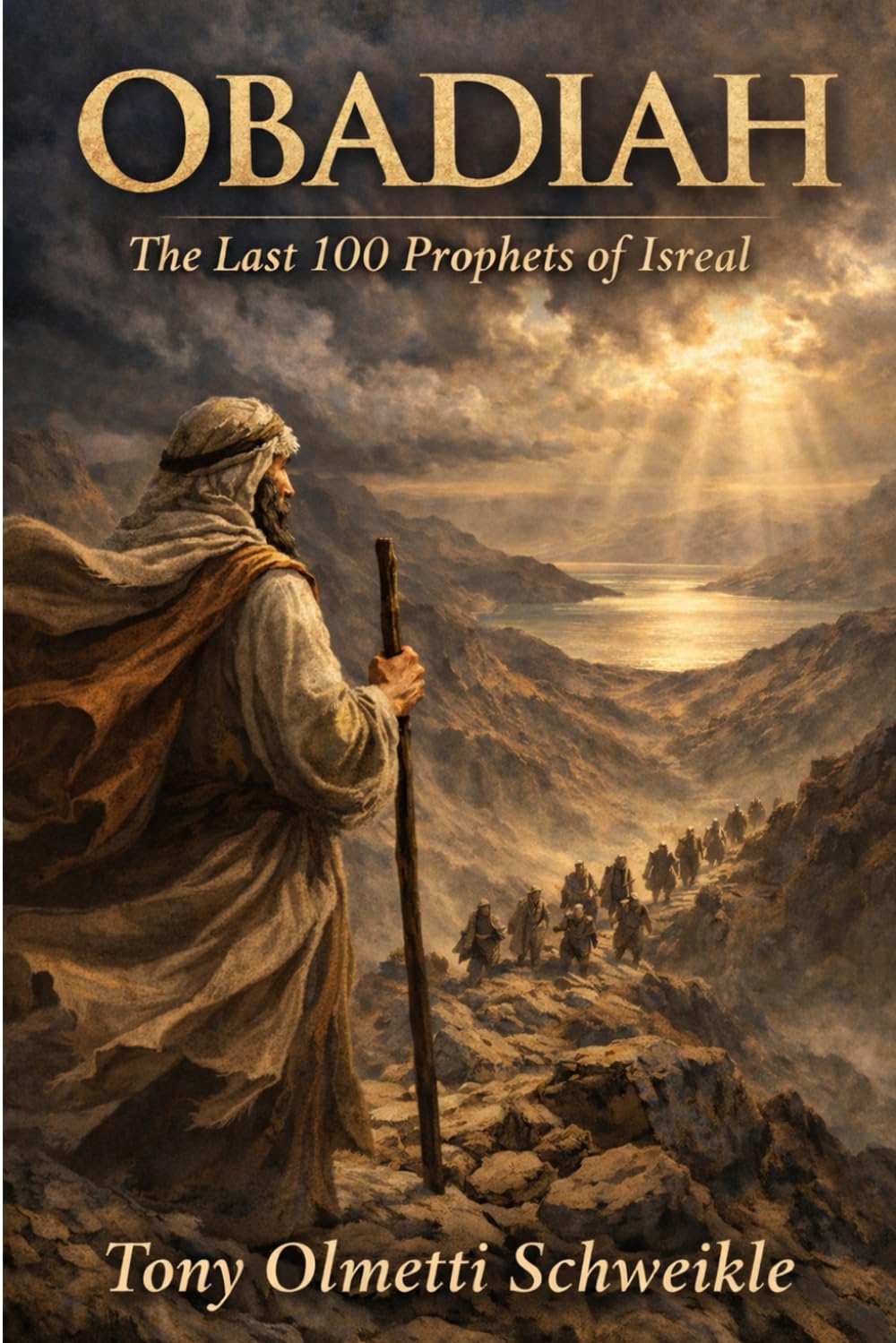

Obadiah and the Last 100 Prophets of Edom, by Tony Olmetti Schweikle, is a biblical historical novel that reads like a sustained act of witness. It takes the world around Ahab, Jezebel, Elijah, Naboth, and Obadiah and turns it into a landscape of drought, persecution, flight, and stubborn belief. From the opening battle scenes to the cave hideouts and tense village encounters, the book keeps returning to one central conviction, stated again and again in different emotional keys: “There is only One God.” That refrain gives the novel its spine and its sense of purpose.
What makes the book work is its seriousness. The author isn’t treating this material like a distant legend. He writes it as immediate, physical, and costly. Crosses line the road into Jezreel, Naboth’s vineyard becomes a site of both injustice and sacred memory, and Obadiah’s loyalty is measured in hunger, grief, and risk. The novel is full of kings, soldiers, priests, shepherds, traders, and villagers, so faith never feels abstract. It’s social, public, dangerous, and tied to land, bread, water, and survival.
I also liked how the book handles its characters in moral terms without flattening them into symbols. Ahab is brutal, but he’s also uneasy. Jezebel is cold and forceful, and the book gives her a real presence whenever she enters a scene. Obadiah, though, is the center of gravity. He isn’t drawn as flashy or invincible. He’s steady, grieving, practical, and quietly persuasive. That matters because it lets the novel become not just a story about defiance, but a story about endurance and teaching, about how belief gets handed from one frightened person to another.
The prose itself is direct and emphatic. It uses strong images, sharp confrontations, and declarative endings. Sometimes that gives the book the feel of oral storytelling, and sometimes it leans toward something almost cinematic, especially in the long middle stretch where action, dialogue, and visual staging take over. That hybrid energy turns out to be part of the book’s identity. It feels like a novel written by someone who can already see the scenes onscreen. Even when the language is simple, it’s aiming for momentum, clarity, and conviction rather than ambiguity.
What I liked most was that the book understands faith as something lived under pressure. It’s there in the markets, in whispered conversations, in stories told by lamplight, and in the refusal to surrender what is holy. A line like “The truth remained, unchallenged and eternal” captures the book’s posture. This is a novel of declaration, pursuit, and testimony, and it knows what story it wants to tell. If you’re open to a fervent, dramatic retelling of biblical conflict with a strong devotional core, this book has a clear voice, and it commits to it completely.
Pages: 142 | ASIN : B0GPLSLY4P

The Diaries of a Teenage Pilgrim: The Early Journey
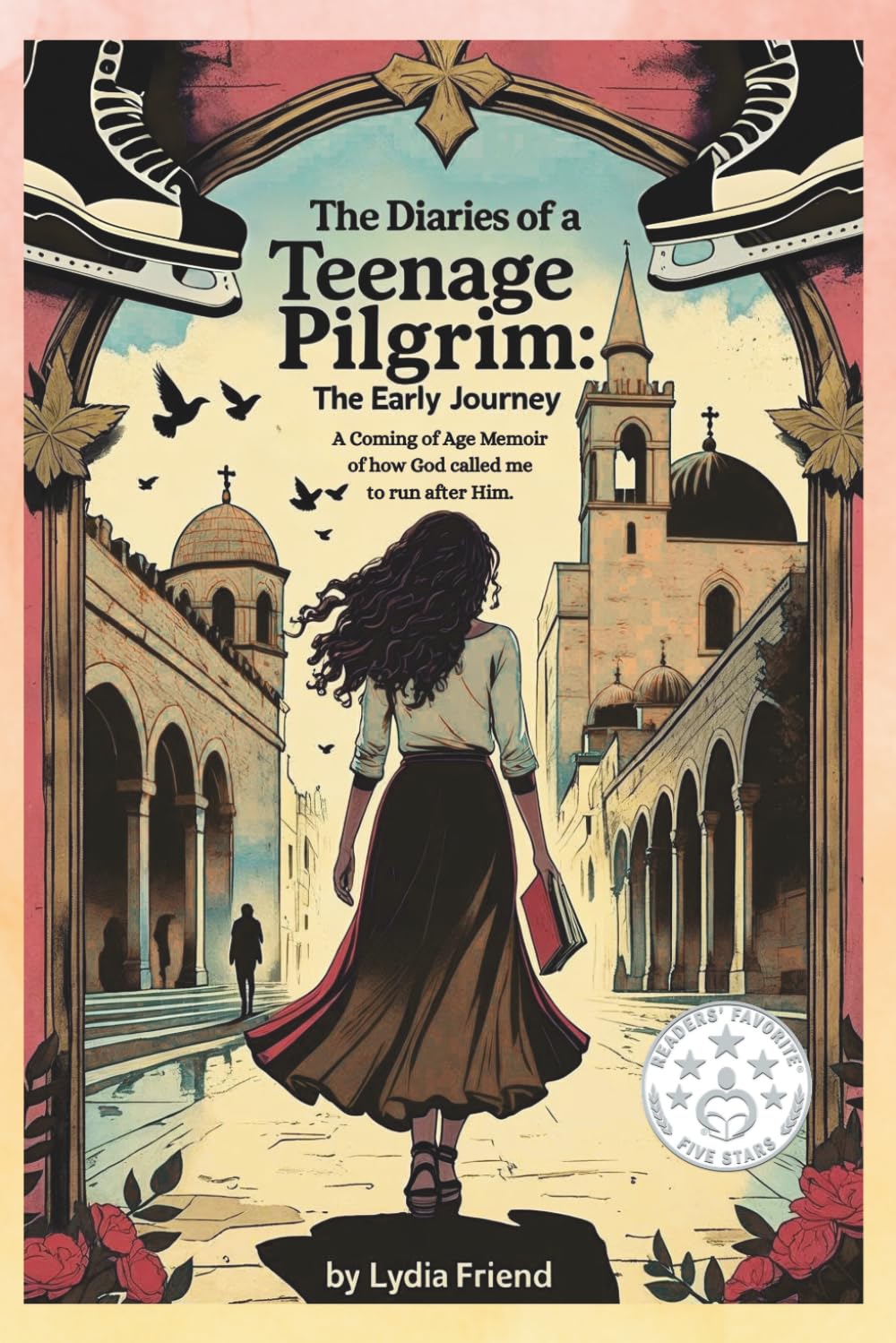
I found The Diaries of a Teenage Pilgrim: The Early Journey to be, at heart, a coming-of-age memoir about spiritual identity under pressure. Lydia Friend begins in the warm, enclosed world of Spooner, Wisconsin, then is swept into a family move to Israel that feels at once providential and deeply destabilizing. What follows is not a tidy overseas faith ministry narrative but a long, uneven apprenticeship in exile: Jerusalem and Metulla, homesickness and fervor, poetry and loneliness, the ache of being pulled between the Ozarks and the Galilee, and finally a devastating car accident that becomes a hinge point rather than a climax. The book keeps returning to one question in different forms: what does it mean to belong when every earthly home feels provisional, and when faith asks not for certainty but for surrender?
I liked the book’s emotional candor. Friend has a gift for rendering memory through texture and atmosphere, so that a white cat in an airport carrier, a farewell quilt from a small church, or a frantic run through Atlanta with a harp on her back can carry real emotional voltage instead of merely serving as anecdote. I admired the way she lets adolescent intensity remain intense. She doesn’t flatten her younger self into someone wiser or more ironic than she was. That gives the memoir a rawness I found moving, especially in the sections where she feels caught between two worlds and can’t tell whether she’s being formed or simply undone. The prose has a luminous, devotional quality. It lingers over rain, cedar, songs, hospital fear, and the strange tenderness of being cared for after catastrophe. There were moments when the language tipped toward repetition or overstatement for me, but even then I felt the pressure of a real inner life behind it.
I also found the book’s ideas both compelling and specific. Friend’s central vision of pilgrimage, displacement, and what she calls being “Stranger Lovely” gives the memoir its theological spine. She reads exclusion, longing, and even creative repression as part of a larger divine romance, and whether or not a reader shares every article of that belief, it’s hard not to feel the force of how fully she has lived inside it. I was especially struck by the way the accident and recovery chapters reframe suffering not as abstract lesson material, but as something bodily, terrifying, and humiliating before it becomes meaningful. That sequence gave the book real gravity.
The Diaries of a Teenage Pilgrim is a sincere memoir, and sincerity here is not a small thing. What I valued most was its refusal to separate spiritual formation from embarrassment, adolescence, longing, family history, art, or pain. Friend writes like someone trying to recover her own song while she’s still hearing its echoes, and that gives the book an intimacy I found affecting. I’d recommend it especially to readers who are drawn to faith memoirs, overseas faith ministry childhood narratives, and stories of displacement that are as inward as they are geographical. It will likely speak most powerfully to readers who have felt out of place in the world and have tried to make meaning of that estrangement without denying its cost.
Pages: 322 | ISBN : B0FP31B2LW
What is Home?

The Girl from Korn follows an eleven-year-old Mennonite girl leaving Russia for Oklahoma in 1903, who exsperances a harsh new land and strict community that tests her courage, faith, and understanding of what it truly means to find home. What was the inspiration for the setup of your story?
This story is inspired by my grandmother’s family memoir. She was born in Corn, Oklahoma, and often spoke about her grandparents’ move to Corn and what life was like during that time. One day, after visiting Corn and seeing my ancestors’ gravestones in the cemetery, the idea for this story began to take shape in my mind. I started researching what life was like back then and created a strong-willed, curious character named Tillie as part of the DeFehr family.
How does Tillie’s journey resonate with modern immigration stories?
There are so many heart breaking stories right now about immigrants and the way they negative ways they are treated. For this reason, I wanted to include Tillie’s arrival to New York City and her seeing the Statue of Liberty, as a simple reminder that most of us descended from immigrants and the U.S. has a history of welcoming others from across the globe. We need to keep finding ways to take care of each other and treat each other with respect and kindness.
Family bonds are a major theme. Which relationship was most meaningful for you to write?
I appreciate Tillie’s relationships with several characters in the story. I admire how she struggles to understand her mother but ultimately comes to terms with her. I also love her bond with Preacher; he is kind, humble, and genuinely listens to Tillie. However, the most significant relationship is with her sister, Teenie. Tragically, Teenie passes away at the end of the book, and Tillie and her family each navigate their grief in different ways. This resonates with me personally, as my own sister passed away last year after a long illness. Therefore, Tillie’s relationship with Teenie reflects my experiences with my sister in many ways.
The idea of “home” evolves throughout the story. What do you hope readers take away about belonging?
I think our ideas of what is home changes over our lifetime, especially if you grow up in more than one culture. Tillie’s home kept changing, but ultimately it was always where her family was. However, she had to learn a new language, live in different houses, experience a new way of life. She had to contiually adapt in order to belong. Many of us do that thoughout our lives as well.
Author Links: Facebook | Website
At the turn of the century, Anna Mathilda DeFehr, known as Tillie to her friends and family, sets off on a life-changing journey from Europe to America. Immigrating with her Mennonite family, Tillie braves the open sea, a long train from the shining New York harbor to the rolling plains of Oklahoma, and the strange new world she finds herself in.
As her family journeys from the cramped and crowded steerage of a ship to the bustling crowds of Ellis Island, then again to settle in a quiet community that doesn’t understand her way of life, Tillie faces countless challenges: Learning a brand new language. Adjusting to life in a sod house. Confronting the elements and unsuitable living conditions. And, most of all, finding out how on earth she can call this place her home.
This historical fiction story explores how one girl’s faith, hope, and love for her family can propel her through a storm of obstacles to claim her rightful place within her own heart. With allies like Julius, a book-loving new friend, and Crazy Wolf, a member of the local Arapahoe tribe who introduces her to a new world, Tillie learns that home is something you build—it’s who you are and the people you belong to.
A captivating tale of the might of innocence to break barriers and adapt to change, The Girl from Korn inspires young readers to embrace their cultural roots while exploring the beauty of discovery in brand new places.
The Girl from Korn

Set in 1903, the story follows Anna Mathilda “Tillie” DeFehr on a long, perilous passage to a new life. She leaves Russia with her family and arrives in the United States. A brief glimpse of the Statue of Liberty marks the threshold. Then the journey continues to Oklahoma, where they settle among a strict Mennonite community.
From there, the book becomes a clear-eyed record of Tillie’s new reality. The American plains feel stark. Daily life demands grit. Adaptation comes slowly and often hurts. Hard lessons land early and keep coming. Yet the narrative never turns bleak. Warmth appears in ordinary moments. Joy shows up in family bonds, small victories, and shared routines. The result feels grounded and honest, capturing the immigrant experience at the turn of the nineteenth century into the twentieth.
The Girl from Korn, by Eileen Hobbs, reads as young adult historical fiction. It will likely resonate most with readers around ages 9–12. At times, it carries echoes of the Little House on the Prairie books. Familiar in the best way. Rooted in place, work, and family.
The novel unfolds as Tillie’s first-person account. She begins on her eleventh birthday, still aboard the ship, nearing her new home. Fear shapes those early pages. Homesickness presses in. Disorientation feels inevitable. She is leaving everything behind during a formative stretch of childhood, right on the edge of adolescence.
Once in Oklahoma, the detail becomes the book’s strength. The days are long. The labor is relentless. Community rules tighten the world even further. Tillie endures it with stubborn courage. She stays resourceful. She stays determined. Most of all, she stays connected to her family, and that connection steadies the story.
In the end, Hobbs delivers a strong and satisfying YA historical novel, with crossover appeal for older readers. The prose is vivid without being fussy. Scenes come into focus quickly and linger. The author’s inspiration, stories passed down from her great-great-grandparents, adds texture and conviction, giving the book the feel of a lived memory rendered into fiction.
Pages: 250 | ASIN : B0FZG1B334

Life-Long Impact

The Legacy of the Twins Platoon follows a group of young Minnesotans who enlist as Marines in 1967 and find themselves facing some of the most horrific battles of the Vietnam War. Where did the inspiration for this novel come from?
It was my calling. But due to the perceived difficulty of writing a book about 150 Marines and their experiences, it took 6 years before I set out to do what seemed to me to be an overwhelming task.
What draws you to this period in US history?
I am drawn to this period in history because it is unforgettable and is forever etched into memory. To have experienced and witnessed how the Vietnam War forever changed the lives of those who served in the military, and the life-long impact it had on their families and loved ones, is something I felt compelled to write about.
Can we look forward to more work from you soon? What are you currently working on?
My focus now is to bring awareness to the book, so that the life experiences of those I have written about can benefit other people. At a time when new books are like a “blizzard in a snowstorm,” my challenge now is to weather the storm.
Author Links: GoodReads | Facebook | YouTube | Website | The Legacy of the Twins Platoon | Amazon
They were sworn in on television at a pregame ceremony and were guests of the Twins at the game. By the end of the fourth inning, the recruits were hustled to buses whisking them to the Wold-Chamberlain Field Airport, and they flew to San Diego. Before dawn the next day, the Twins Platoon met their drill sergeants at the receiving barracks of the Marine Corps Recruit Depot. By the end of the year, the Marines were in Vietnam sprinkled across the length and breadth of the Marine Corps operating areas of I Corps, the northernmost part of South Vietnam where they experienced some of the toughest combat of the war. Khe Sanh and Hue City were just a few of the hot spots they encountered as the 1968 TET Offensive rolled across the country. Not all members of the Twins Platoon came home in one piece. Some did not come home at all. In The Legacy of the Twins Platoon, author Christy Sauro Jr. tells their complete stories from baseball to combat and their lifelong readjustment to civilian life.
Conflict & Peace: At Home with Jesus
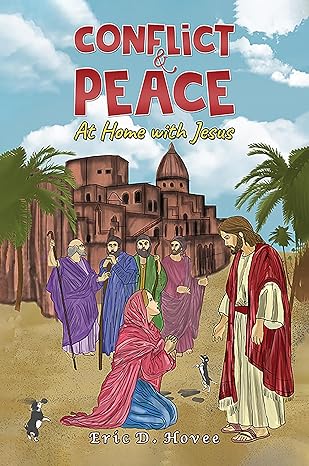
When I first opened Conflict & Peace: At Home with Jesus, I expected a familiar retelling of biblical stories, but instead I found something far richer and more layered. The book walks through twelve figures ranging from Matthew and Mark to Constantine and Luther and explores how each shaped, struggled with, or even fractured the Christian story. Eric D. Hovee doesn’t shy away from pointing out contradictions, tensions, and the uneasy balance between faith and evidence. What emerges is less a polished theology and more a raw chronicle of pioneers wrestling with belief, doubt, politics, and power. The book argues that Christianity has always lived at the crossroads of conflict and peace, heresy and orthodoxy, struggle and hope.
The writing style surprised me. It’s not slick or overly academic, and that’s what makes it work. Hovee mixes scholarship with a kind of candid storytelling that feels personal and searching. He admits where his own faith has faltered, where scholarship has raised more questions than answers, and where interpretations may lean too heavily in one direction. I appreciated this honesty. The detail can be overwhelming at times, with deep dives into language debates or church history that slow down the flow, but even then, I never felt the effort was wasted. It gave weight to his central claim that truth isn’t always clean or easy.
What I liked most, though, was the emotional undercurrent. This isn’t just about doctrine, it’s about Hovee’s father, about legacy, about the ache of wanting faith to feel real in a world of contradictions. I felt that ache with him. When he points out Matthew’s overreach on prophecy, or the way Constantine’s empire-building warped Christianity, I didn’t just learn facts, I felt the tension of a man trying to reconcile devotion with doubt. The book left me inspired. It made me look at my own beliefs with sharper eyes and a softer heart.
I think Hovee’s work is best for readers who want faith that is not easy, neat, or dogmatic. It’s for Christians wrestling with the weight of history, skeptics curious about the roots of belief, and anyone who values honesty over certainty. If you want a book that stirs you, challenges you, and leaves you thinking long after you close it, then Conflict & Peace: At Home with Jesus is well worth the read.
Pages: 401 | ASIN : B0F5641XR1
A Tribute and Legacy

Rainbow of Promise follows the budding romance between a confident and vivacious young woman and a soft-spoken Southern gentleman in the middle of WWII. What was the inspiration for the setup of your story?
My parents, Sadina and W.E., had wonderful chemistry. I wrote the story as a tribute to them as well as a legacy for my family. It’s more of a memoir than historical fiction; it’s as true and factual as I could write it.
There is so much to be said about love in this book. What do you hope your readers take away from your story?
These two had a lot in common and a lot that wasn’t. They became a great team out of loyalty, dedication, romance, desire, and understood unconditional love. I consider them my greatest role models in all that they portrayed.
What was your favorite scene in this story?
W.E. was such a romantic; Sadina was exuberantly fun as well as practical and frugal. When W.E. surprised her with yellow roses and gifts of all sorts, her life lit up like a child at Christmas. My favorite surprise was when he gave her the beautiful soft silky pink robe. Chapter 14. I still have her robe hanging in my closet.
What is the next book that you are working on, and when will it be available?
I’m writing the story of my Volga German grandparents who emigrated from Kutter, Russia, in 1913. My grandmother faced many tragedies, including WWI and II, each sadness garnering strength. I plan to publish the book in 2026 during March–The Month of Strong Women.
Author Links: GoodReads | X | Facebook | Website
Rainbow of Promise: A World War II Romance

Rainbow of Promise is a heartfelt, old-fashioned love story set in the midst of World War II, following the budding romance between Sadina “Sadie” Wagner, a confident and vivacious young woman, and W.E. “Bill” Walraven, a soft-spoken Southern gentleman stationed in Enid, Oklahoma. The story unfolds slowly but sweetly, capturing all the nervous first encounters, jitterbug dances, longing glances, and yes, plenty of sizzling chemistry. It’s nostalgic in all the best ways—like slipping into a vintage movie where the world is complicated, but love is pure.
What stood out to me first was the writing style. It’s simple but rich with period detail and genuine emotion. The dialogue pops without trying too hard, and there’s this easy rhythm to the prose that makes the whole book feel like you’re listening to someone tell a story.
Now, Sadie. She’s a force. Flirty but grounded, fun but not flaky. She’s bold enough to joke about being picked up on a street corner and sweet enough to bring a man to his knees with just a smile. Her scenes with W.E. practically crackle with energy, especially their first dance. I appreciated that the author gave her complexity—she’s not just waiting around for a man; she’s got her own hobbies and she’s protective of her independence. There’s a particularly lovely scene where Sadie turns down an impromptu dinner date with W.E. because of a club meeting—and you can just feel the tension. Her wanting to say yes. His quiet heartbreak. That push-pull dynamic is so well done.
And then there’s W.E.—Bill. This man is a walking romance novel. Polite, a little shy, smells like Old Spice, and dances like a dream. But he’s not just charming. The author gives us these lovely inner monologues where he questions whether he’s “good enough” for Sadie, whether it’s right to fall in love with war looming overhead. That kind of vulnerability made him real for me. And when he takes her to dinner at the Skirvin Hotel and orders champagne and lobster I swooned a little. But my favorite part was the way he watched her dance. That kind of longing—that ache—you can’t fake that in writing.
This book is for readers who love slow-burn, tender romance with real emotional stakes. It’s for anyone who’s ever believed in fate or had their heart flip over a well-timed glance. It might be a little idealistic at times but that’s kind of the point. Life is hard. War is brutal. But falling in love—falling madly in love—makes all of it worth it. I’d recommend Rainbow of Promise to fans of historical romance, lovers of the 1940s vibe, or anyone just needing a little hope and heart right now.
Pages: 369 | ASIN : B08BRBZMKY


