Blog Archives
A Delicate Dance

Wings of the Gods centers around two friends thrown into a time-bending mission where old myths are tangled in a cosmic war. What is the most challenging aspect of writing a series?
Honestly, it’s been all fun and games so far! No, really. I’ve had an absolute blast creating these first two books, and I can’t wait for the next one. One of the things I wanted to pay attention to is sprinkling enough information into the first couple of chapters of Wings of the Gods so that someone could pick up this book without reading the first one and not be lost, while also not spoiling anything if they want to go back and read The Emerald Tablets. Once we get further into the series, every book will be a delicate dance of weaving everything together in a way that feels complete and satisfying. But I think I’ve set myself up well and I’m not too worried about that right now. I’m just enjoying the ride and looking forward to book No. 3, which is going to be a horror/mystery set in Enlightenment England.
What first inspired the idea of blending ancient Greek mythology with science fiction and cosmic warfare?
Everybody asks this, and, honestly, I wish I had a better answer, but … it just came to me. That’s right! One day, my weird brain was like, “What about time-traveling, teleporting teenagers battling Evil Lizard Aliens?”
In truth, it was probably an amalgamation of my love for science fiction and fantasy space epics like Star Wars and Star Trek, my experience falling in love with The Chronicles of Narnia as a young reader, and how my own daughter and one of her childhood friends were thick as thieves.
I’ve always loved mythology, to the point of studying it as a fascination, and I’m intrigued by the possibility that we’re not alone in the universe. So many civilizations have stories of gods and goddesses that sound a lot like encounters with extraterrestrials. So, I wanted to ask the question: what if all those stories are just glimpses of a larger picture? What if the “gods” aren’t gods at all? And, what does that mean for humanity?
How did you approach reimagining figures like Athena, Hermes, Hades, and Zeus in a way that still felt surprising?
I’m just trying to have a good time and write something that would interest me.
Obviously, so much has been done with Greek Gods, specifically—most famously with the Percy Jackson series—but I think what’s allowed me to bring a fresh take to this story is the fact that I’m not thinking of them as Greek Gods, per se. I’m engaging with these characters on a more holistic level, imagining how they fit into the larger, cosmic story I’m creating. So, while all of them exist within the myths of the Olympian Gods, they also have stories outside of those stories about how they got here, what they’re doing at this particular point in history, and how they’re perceived by the populace. It’s all just a slice of the larger pie, which I can’t wait to reveal layer by layer as we get deeper into the story!
What kind of reader did you imagine while writing Wings of the Gods?
I’m writing these stories for my own teenage daughter, and all the boys and girls who will pick them up along the way. Guardians of the Cosmic Clocks is a love letter to the next generation, and I hope they’ll feel the same kind of wonder I felt while reading The Chronicles of Narnia. This book, in particular, addresses some of the core emotional battles that adolescents face every day, and I hope that, through this story, they’ll learn what it means to be a Guardian and rise to the challenge in their own lives.
Beyond that, the beauty of Guardians is that it’s made for dreamers of all ages. Just like Narnia is a magical land I can come back to over and over again, no matter where I am in life, I believe Guardians of the Cosmic Clocks has the same kind of cross-over appeal as The Series That Shall Not Be Named. I’ve already had 30, 40, and 50-year-olds reading and loving it! And, I hope, if you’re reading this, you’ll be the next one to fall in love with Zya and Elijah.
Author Links: GoodReads | Instagram | Guardians of the Cosmic Clocks | TikTok | Jabril Yousef Faraj | YouTube | X (Twitter) | Cosmic Clocks | Facebook | Wings of the Gods | Website | Amazon
TWO FRIENDS. ONE GLOWING PORTAL.
When tragedy strikes at home, teenagers Zya Nicole Jenkins and Elijah Morgan escape through a portal, once again donning their magic timepieces. The Evil Archons have reclaimed Earth, declared war on the galaxy and are rumored to be developing a weapon that will tilt the balance of power.
Dive into an adventure of epic proportions, as the Guardians brave the Greek Underworld, commune with the Oracle of Delphi and face their fate on Mount Olympus. Encounter Plato, Heracles and the ghost of Pythagoras as our champions sail the Aegean and battle mythical beings in this sprawling Young Adult Fantasy.
A finalist for the 2026 Children’s Book International Award in Fantasy, Guardians of the Cosmic Clocks: Wings of the Gods is a story about love, trust and blooming adolescence. Our heroes will be put to the test, pushing their bond to the limit as Zya and Elijah are forced to confront their own inadequacies.
Wings of the Gods takes us from the depths of despair to the heights of true friendship and back. Can the Guardians overcome their demons and emerge victorious? The fate of humanity depends on it.
A QUEST THROUGH TIME AND SPACE TO SAVE HUMANITY.
Zya and Elijah’s first battle might be in the books, but the adventure is only beginning. Once again, the 13-year-old best friends are swept up in the Archons’ millennia-long conquest of the Milky Way.
This time, it’s personal. While Elijah wrestles feelings that could threaten to derail their mission, memories of her father leave Zya more vulnerable than ever.
Unlikely allies, the second ancient talisman and an epic mystery await in 363 BCE. Rumors are that Zeus, who governs Earth from his seat on Mount Olympus, is constructing a secret weapon that will spell certain doom for the galaxy. On top of it, the Lumerian captain Maroun has gone missing.
The Guardians meet Plato and Aristotle, commune with the Oracle of Delphi and tangle with mythic monsters in this high stakes quest across Classical Greece. Our heroes traverse land, sea, the Fifth Dimension and the dreaded Underworld, encountering Hermes, Hades, Medusa and the deadly Minotaur.
As their weaknesses surface and failure rears its head at every turn, the Guardians find there’s nothing more powerful than the love of a friend.
WILL THEY UNLOCK THEIR TRUE POWER BEFORE IT’S TOO LATE?
Faraj’s debut novel, Guardians of the Cosmic Clocks: The Emerald Tablets garnered the 2025 Literary Global Children’s Book Award for Best Young Adult Novel, was a finalist for the Children’s Book International Award in Fantasy and runner-up at the New York Book Festival.
Moonlight Desires


Moonlight Desires is a Gothic, moon-drenched Cinderella retelling that begins in familiar sorrow and then slips somewhere stranger, sadder, and more haunted. Aurelia, abused by her father, stepmother Julia, and stepsister Lysandra, is lifted out of drudgery not by a fairy godmother but by Princess Kipira, a royal figure cursed into spider form after an act of pride and cruelty. What follows is a tale of enchanted web-woven dresses, silent spectral coaches, a courtship with Lord Samuel, and a surprisingly weighty meditation on forgiveness, selfishness, and the difficulty of true kindness. What stayed with me most was the book’s doubleness: it offers the pleasure of romance and transformation, but it also keeps pressing into darker moral territory, especially through Kipira’s confession and Charlotte Sophia Janicker’s closing reflections on the old Cinderella pattern itself.
I admired the atmosphere almost immediately. Tocher writes as if he wants the fairy tale to keep its ceremonial bones while letting rot, grief, and desire show through the silk. The image of Aurelia being carried over the ground on Kipira’s web, laughing into the speed after years of misery, is one of those moments that feels both eerie and liberating. The spider-silk gown, alive with the shifting Ingridelite Weave, is gorgeous in exactly the right unsettling way, and the coachman’s macabre delight in how “the dead travel fast” gives the whole transformation sequence a morbid charge that separates this book from sweeter, safer retellings. I also liked that the prose is unafraid of lushness. Sometimes it leans almost incantatory, then suddenly turns intimate or severe. That tonal elasticity gave the story real texture for me.
What interested me even more, though, was the book’s moral and emotional argument. Aurelia’s repeated return to her mother’s little poem about goodwill and forgiveness could have felt merely dutiful, but here it becomes the story’s beating heart. Her mercy toward the people who degraded her is moving precisely because the novel does not pretend forgiveness is easy, clean, or instinctive. The most fascinating character in the book for me is Kipira. Her letter transforms the story from a dark fairy tale into something more searching because she understands that even her generosity has been contaminated by self-interest. That idea, that a good deed can be hollow if its hidden motive is restoration of the self, gives the novella a spiritual unease I genuinely appreciated.The erotic honeymoon passage plus Charlotte’s explicit feminist afterword create a sharp shift in register. For me, though, that oddness was part of the book’s identity. It doesn’t smooth itself into one thing. It remains a little thorny, a little hybrid, and more memorable for it.
I found Moonlight Desires sincere, peculiar, and unexpectedly compelling. It’s a fairy tale retelling that blends romance, horror, theology, sensuality, and a self-aware literary sensibility. That mix makes the story feel distinct. I came away feeling that the writing is at its best when beauty and dread are touching, and that the book’s deepest idea is not enchantment but the hard, almost painful mystery of becoming good. I’d recommend it to readers who enjoy darker fairy-tale revisions, Gothic textures, and stories that are willing to be earnest about mercy, longing, and moral struggle.
Pages: 72 | ASIN : B0GDHV1151

Feathers of Wisdom

Feathers of Wisdom is a lavish, wide-ranging collection that gathers forty-four legends, myths, and historical portraits of Indigenous women across many nations and traditions, pairing each retelling with cultural context and luminous illustration. Authors Leigh Podgorski and Kait Matthews frame the book with a moving concern for language, survival, and cultural continuity, then build a mosaic of women who are not flattened into a single ideal but appear as warriors, lovers, creators, protectors, mothers, visionaries, and divine figures. Reading it, I felt the book was trying to do two things at once: preserve story and kindle reverence. That dual ambition gives it its shape, from the harrowing prologue about residential schools and the Sixties Scoop to the recurring chapter pattern of historical background, legend, and reflective “speaks” passages that invite the reader into contemplation.
What stayed with me most was the emotional range of the women gathered here. The book can move from fierce sacrifice to tenderness in a heartbeat. Aliquipiso stepping forward to save her people has the stark clarity of myth at its most elemental, while Blue Flower’s refusal to betray her promise gives her story a quiet, almost painful dignity. Later, Buffalo Calf Road Woman charging into battle to save her brother and then riding into the legend of Little Bighorn brings a different force altogether, one rooted in nerve, momentum, and defiance. I admired how insistently the book resists any small, ornamental idea of womanhood. These figures are not decorative symbols. They act, endure, create, rescue, foresee. At its best, the book made me feel the old power of story as moral weather, something you don’t just observe but stand inside.
The book is earnest, incantatory, and often quite beautiful. Podgorski clearly favors a heightened, devotional register, and sometimes that lyric intensity works wonderfully, especially when it leans into image and transformation, as in Aliquipiso becoming honeysuckle and woodbine, or in Spider Woman learning to weave the geometry of the universe from the night sky itself. The illustrations deepen that dreamlike quality and give the book much of its atmosphere. The reflective “speaks” sections occasionally felt more prescriptive than the legends around them, as though the spell of the narrative was being translated into a lesson. I respected the sincerity of the impulse. The ideas here about language as identity, story as continuity, and women as bearers of cultural memory are not casually offered. They come freighted with grief, repair, and conviction, and that gravity gives the whole project real heart.
I came away from Feathers of Wisdom less interested in judging it by the standards of a conventional anthology than in recognizing what it is trying to hold together: beauty, homage, loss, resilience, and remembrance. I don’t think every page lands with equal force, but the book’s spirit is generous and unmistakable, and its strongest passages have a solemn radiance that stayed with me. I’d recommend it to readers drawn to mythology, Indigenous storytelling, women-centered spiritual history, and illustrated books that invite slow, reflective reading rather than quick consumption.
Pages: 294 | ISBN : 978-1966187059
Gods of Glenhaven
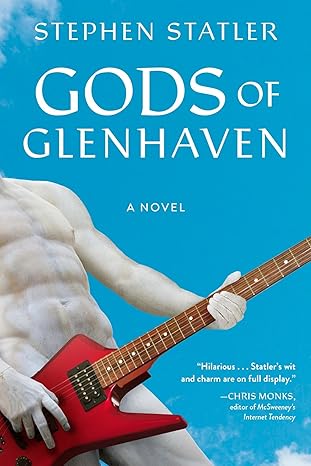

Gods of Glenhaven is a raw, darkly funny, and deeply human story about people falling apart and trying to stitch themselves back together. It follows Christian Orr, a man sliding into middle age with a broken marriage, sexual dysfunction, and a pile of humiliations that somehow keep getting worse. His wife, Sloan, is a driven attorney who mistakes dominance for control until her life unravels, too. Their teenage daughter Francesca floats between them, trying to make sense of the wreckage. Around these three, the town of Glenhaven buzzes with gossip, longing, and absurdity. It’s a small world full of big emotions, where humor and despair share the same seat.
I found Statler’s writing disarmingly sharp. Every line feels alive with awkward truth. He doesn’t flinch from embarrassment or pain, and he writes humiliation with the kind of precision that made me both laugh and squirm. The dialogue is quick and biting, but the silences hit harder. Christian’s spiraling self-awareness feels almost too real at times; I could feel the claustrophobia of his failures and the absurd hope that something, anything, might still redeem him. Sloan, on the other hand, made me furious and fascinated in equal measure. She’s brittle, proud, often terrible, but undeniably human. The novel moves like a tragic comedy that keeps threatening to tip either way.
What really struck me was how the book keeps shifting tones without losing its rhythm. One page had me laughing at Christian’s disastrous attempts at self-improvement, and the next left me staring, a little shaken, at how much loneliness the humor covered up. Statler writes like someone who has seen both the joke and the wound and refuses to pick one. The story feels like real life that’s been turned just slightly toward the absurd, so everything painful also glows with a weird kind of beauty. It’s messy, brave, and very alive.
Gods of Glenhaven is a brutal but compassionate look at failure and forgiveness. I’d recommend it to readers who love flawed people written with empathy. Fans of writers like Richard Russo or Jonathan Franzen will probably feel at home here. If you’ve ever felt lost, humiliated, or ridiculous and still had to get up the next morning, this book might hit uncomfortably close to the truth.
Pages: 378 | ASIN : B0F8KPGH67
Wrath of the Storm Lord

Wrath of the Storm Lord is a sweeping tale of rebellion, memory, and the volatile cost of power. Set in the richly drawn world of Ver’Sut, the story follows Jerith, an outcast turned warrior-myth, as he rises to challenge the empire that crushed his people. What begins as a slow-burning character study morphs into a full-blown elemental war, with storms summoned by raw emotion and loyalty forged in blood. The novel weaves together political tension, intimate relationships, and supernatural forces to deliver a dark and layered fantasy that feels both timely and timeless.
What hooked me from the jump wasn’t the lightning-slinging protagonist—it was Harrison, the scribe. That guy is terrified, skeptical, and deeply human. Through his eyes, the reader gets a front-row seat to power that feels too big, too raw, and too dangerous to be trusted. The scene early on when he’s literally watching the ink on his page move was chilling. Like, I actually paused and thought, “Okay, Herod’s playing a deeper game here.” It’s not just about recording history, it’s about how power can warp even the telling of it. Harrison’s fear is real. You feel it.
Jerith, though. That’s where the book cuts deep. He’s not your clean-cut hero. The dude is powered by grief, rage, and something ancient. The scene where he finds out about his father’s death is wild. He literally becomes a storm. Not figuratively. He is the storm. I couldn’t stop reading as lightning turned the room to chaos, windows exploded, and he claimed the title “Storm Lord” like it was his birthright. It’s intense, and you believe it because Herod builds it slowly. You feel every loss, every scar. The relationship with Valeria was painful, honest, and beautifully tragic. She’s the daughter of the tyrant he’s sworn to destroy, and yet she stands with him. That kind of emotional tug-of-war hit hard.
The writing style is bold, cinematic, and a little unhinged in the best way. Herod doesn’t play it safe. There’s a rhythm to the prose that feels like it’s vibrating with energy, especially when Jerith taps into his power. Whole pages hum with electricity, figuratively. But it’s not just flash. There’s meat here. The philosophical backbone about whether power corrupts or reveals had me underlining entire paragraphs. Like the line, “Power doesn’t corrupt. Power reveals.”
If you’re into morally complicated characters, revolution brewing beneath snowy forests, and a storm god with daddy issues—this one’s for you. It’s not light reading. It’s charged. Heavy. But damn if it doesn’t leave a mark. Wrath of the Storm Lord is perfect for fans of Brandon Sanderson’s grit, Patrick Rothfuss’ poetic edges, and readers who want their fantasy with teeth. Highly recommend for anyone ready to get swept up in a storm.
Pages: 187 | ASIN : B0DVLGKL8F
Skull’s Vengeance (Audiobook)

Skull’s Vengeance, the fourth installment in Linnea Tanner’s Curse of Clansmen and Kings series, unfolds against the dramatic backdrop of the Roman Empire. This gripping tale follows Catrin as she embraces her destiny to become the fierce Celtic warrior queen her people desperately need, fulfilling the prophecy her father foresaw. Facing overwhelming grief and betrayal, Catrin must confront her half-brother, King Marrock, in a battle for survival. To prevail, she seeks alliances from unlikely places, including a cunning druidess who once deceived her and her Roman husband, Marcellus. Yet Marcellus is ensnared in a perilous political web, where one wrong move could doom them both. Their love stands on the brink, will they find a way to stand united, or must they part to survive?
The novel’s opening chapters moved slowly for me. While some elements intrigued me, the pace didn’t fully engage until the story hit its stride around chapter six. One contributing factor may have been the male narrator’s delivery, which progressively improved throughout the audiobook. The female narrator’s voice consistently shone.
Despite the gradual start, the plot is masterfully crafted. Action pulses through the narrative, weaving a complex tapestry of events that held my attention. Linnea Tanner skillfully navigates multiple perspectives, all while centering Catrin and Marcellus as the heart of the writing. The balance between their viewpoints enriches the depth of the tale.
Catrin herself is a powerhouse of resilience and determination. Her journey from mourning the loss of her stillborn daughter to leading her people with unwavering resolve was profoundly moving. She stands as a testament to the fact that fictional characters can inspire as deeply as real ones. Marcellus, too, captured my imagination. Trapped in a treacherous political arena, his every action demanded precision and cunning. I found myself holding my breath, fearing for him as much as for Catrin.
In Skull’s Vengeance, Tanner delivers a stirring blend of action, intrigue, and emotion. The characters feel vividly real, their struggles and triumphs resonating long after the final page. The story’s rewards make the audiobook’s journey worthwhile. I recommend this book to fans of historical fantasy who will find much to admire in this immersive and powerful tale.
Pages: 402 | ASIN : B0BC2GCFGG
History and Heritage

The Word of Y’Neshu: Heart of the Ijeya follows the journeys of J’Kana, a steadfast Kanawe, and his son Kamari as they navigate the complexities of familial bonds, spiritual trials, and ancient traditions. I think this original idea is intriguing. How did you come up with this idea and develop it into a story?
It all began with J’Karo. I spent 2023 researching a plethora of African cultures and languages to develop the concept of Y’Neshu, and even discovered my own Mandinka, Fulani, Kpelle, and Mende heritage in the process. From there, it was about creating a language using linguistic commonalities from across the African continent and building in historical occupations and concepts from tribes in my own heritage and others. I figured that the best way to accomplish the learning of the culture and the language was through a story all about a Master and Apprentice, so I wanted to tell the story in two parts. The Past, which shows J’Kana’s training under Kanawe Y’Sawe, and the Present, where we find that J’Kana is teaching his son Kamari about the history of their family (more on that later). I wanted to write something that could be appreciated by everyone, but also bring to light the beauty of African cultures that are oftentimes ignored in the stream of 21st-century literature. I also realized along the way that there are other people like me at the start, who were Black and wanting to reconnect with their heritage in a way that they previously couldn’t have. So this is as much a gift to the Black community as it is to those who just love a good fantasy.
I find the world you created in this novel brimming with possibilities. Where did the inspiration for the setting come from, and how did it change as you were writing?
Y’Neshu is actually a J’Karo word that means “Divine Crown,” and I pulled from a number of different geographical fixtures in the African continent. Deserts, plains, shorelines, grasslands, mountains, volcanoes, and forests that span the entirety of the continent were important so that it could truly feel as realistic as it was fantastic. As I went through the story, though, it forced me to think about the finer details and how Y’Neshu itself fits into the grander scheme of the War of the Ancients, the training of the ijeya, and the cultures that blossom all across the Four Empires.
What were some themes that were important for you to explore in this book?
Identity is a huge focus for this story. When J’Kana and his Father, Y’Sawe (Spoiler Alert but I guess not really) are first introduced in the Prelude, they’re nameless characters with a lot of personality. You see the love between a father and son, you feel the heartache when Shifi burns, and even though J’Kana turns into J’Foja on the streets of Memifi, something in him remains joyful and playful despite it all. The exploration of the Kanawe, the struggle over the J’Karo and Batabari languages, and the backstories of other characters like Nihani, Chishashi. and J’Chera all play into that theme of identity.
Through Mahute the Dagger and the Kanawe, there also comes a thematic focus on Education vs. Tradition that brings up the questions of 1) Should we accept tradition at the expense of heritage, 2) Is educating ourselves on our history and heritage worth it if it costs us who we have become, and finally, 3) Who can be trusted to teach the history of groups whose heritage has been denied them?
Is this the first book in the series? If so, when is the next book coming out, and what can your fans expect in the next story?
This is the first book in the series, and the second book is almost done! The next book continues J’Kana’s story, with more J’Karo lessons, more exploration of Y’Neshu, and a deeper connection to the ike overall! Also, it should be noted that J’Kana’s story is only one of the trilogies that I have planned in Y’Neshu! Every protagonist has already been revealed, so definitely stay tuned.
Author Links: GoodReads | Instagram | Threads | Facebook | Website | Amazon
New Worlds and Adventures

Children of the Ancient Heroes: Dreams and Nightmares follows two siblings who stumble upon a forbidden book of childhood legends, bending reality and sweeping them into a realm bursting with magic. What was the inspiration for the setup of your story?
My children are the inspiration for this story and the coming series. Many years ago, when they were still small, I was trying my hand at a few different story ideas when they asked me to write them a story. My daughter, as my eldest, was especially fond of stories like Narnia and The Hobbit. I wanted to create a story where they went on adventures. Over time, the story grew and the names changed. More characters were added and how they arrived in the Lighted Lands changed. I am a big believer in the magic of books and how they transport us to new worlds and adventures, so I became a bit literal in this story. I wanted a story that children everywhere would love and to create a world where they could escape to whenever they needed.
What character did you enjoy writing for? Was there one that was more challenging to write for?
I loved every one of my characters so much. Each one surprised me in ways I wasn’t expecting. I had based Tirza and Eli off of my own children, but they took on their own agency and showed me that they were much like my own children, but also unique in their own ways. I love Tirza’s boldness and adventurous spirit and her desire to be a protector. I also love Eli’s wit and piercing intuition. He also has a vulnerability that makes him so honest and dear.
Probably the most challenging character was Tirza. She had undergone a lot of change from my original drafts to who she is now. Mostly due to feedback from beta readers. I didn’t want her to be cliché or wooden. I think I was trying too hard to write her rather than let her be who she is. When I let go and simply watched, that’s when her true self shone. I cannot wait to let everyone see who she becomes as the series continues.
What were some themes that were important for you to explore in this book?
I think that family is an especially important theme that I was surprised by as it took shape in this story (and in the stories to come). Exploring what family truly is and how it shapes us. Faith is also something that weaves its way into anything I write, intentionally or not. It was important for me to show that faith cannot simply be something we receive from our parents or grandparents, although they do play important roles, but it must be wholly experienced and chosen by us. The children needed to embrace it as their own and not something they hold to simply because that’s what they were taught.
Can you tell us where the book goes and where we’ll see the characters in the next book?
The next book is scheduled to come out on April 8th, 2025. I originally wrote the two books as one whole. It was a bit on the long side, so my publisher and I agreed that we would split it into 2 books. There will be more beyond this, though. The plan was on a trilogy for Tirza and Eli, with a prequel to follow. There might be more now.
The next book will see Tirza and Eli as they go on their separate quests to find the cure for Queen Penelope. They will meet new characters and face new dangers that will change them forever. This is where the heart-pumping action and emotional hurricane really hit.
Author Links: GoodReads | Instagram | Facebook | Website | Linktree | Amazon
Is it a world of their dreams… or their worst nightmares?


