Blog Archives
Choosing Well In All Of Our Tasks

Remembering Freedom invites intellectually curious Christians and philosophy readers into a conversation about truth, conscience, relationships, happiness, and what it means to exercise freedom well. What do you believe the classical philosophical tradition can contribute to contemporary conversations about human nature?
Philosophy used to progress in more or less a linear fashion. Someone would wonder something about the physical world, come up with a theory which best described what was observed, and develop ideas surrounding this theory. Others in the line of tradition would, in turn, read these theories, accept or reject them for any number of rational or pragmatic reasons, and develop their own theories to correct their predecessor’s which better explained what we could observe. Take for example the notion of a “person” as an individual subject with agency, autonomy, etc. The notion of person we hold today is actually absent from much of classical philosophy; it is a Christian injection in order to explain the Trinity. So, for early Christianity, Plato and Aristotle’s work might have been valuable, but wrong and lacking some key elements that would only be developed later on in light of a new factor (how there could be three distinct Persons within one Being). In this, classical philosophy actually fits the strictest definition of a “science:” humans developing theories to best determine what is observed. Sometimes what is observed changes through better tools, revelation, etc; sometimes what best explains that data changes.
So it progressed from age to age, each generation in conversation with those who had come before – almost never simply accepting but always revising. This tradition of building upon the shoulders of those who came before continued until, in the grand scheme of things, very recently.
In Remembering Freedom, I talk about Descartes and his novel idea to reject everything that had come before so as to somehow establish a mathematically certain base upon which he could really know things. Now, it’s not fair to Descartes to suppose he came up with his novel theory in a vacuum by himself. This idea was already growing and festering among the leading academics and scientists of his day. Descartes is merely the first operable articulation of an idea he himself inherited from his own surroundings. This being said, the skepticism he introduced as the platform from which we are supposed to build is pretty radical – and has remained influential throughout the ages. His Meditations presents something new in several ways. From changing what kind of knowledge do humans consider “real” to how do we get to that knowledge, everything to how we interact with our predecessors was changed, called into question, and, over the course of several years, ultimately rejected for this new position.
Here’s the irony, though. Descartes’ position is that you begin from a place of complete and utter rejection, to come to each fact on your own verification in order to see whether it’s true. His successors, however, don’t largely follow his starting point. They actually enter into conversation with Descartes, begin building upon his deficiencies, and, essentially, “do philosophy” pretty much the same way humans always have done philosophy. The difference between classical and modern philosophy, then, isn’t so much how we do philosophy; the difference is in the underlying premises surrounding epistemology.
Modern philosophy brings up existential questions about human nature that are, in short, absurd – but because of their underlying premises, are difficult to refute. Because of this, allowing the Classical Philosophical Tradition a seat at the table does more than merely provide historical context to philosophy; it allows this school to actually be part of the conversation again. And conversation with those who have come before is pretty universal when it comes to philosophy, classical or otherwise. Classical philosophy challenges the premises prevalent today, and asks questions which avoid the absurdist/invincible pitfall much of philosophy post Descartes has fallen into.
Classical philosophy is not the ultimate gem of answers. It got many things wrong. Descartes and his successors have in fact brought up many valid and legitimate things problematic in classical philosophy, particularly surrounding the subjectivity of human senses and experience. But that doesn’t make Plato and Aristotle irrelevant. Rather than throwing them out, perhaps we should do what humans have always done – revise, add, and cautiously reject. Phenomenology is one such study that has begun to do this, and I look forward to it gaining more traction as the academic world moves forward.
Anamnesis is an important concept in your discussion of conscience. How would you introduce that idea to a reader encountering it for the first time?
Anamnesis is a very technical philosophical term in the Christian tradition, so I think this question is really valid. It is, as you said, important in Remembering Freedom’s discussion on conscience. In fact, it’s such a crucial point in the book that the remembering part of the title is a direct reference to anamnesis, borrowed from the Platonic idea that all knowledge is really a remembering of sorts. Though I like to think of it more as a re-cognating (recognition).
Many people might equate “anamnesis” with “conscience;” and we could forgive those who, in the interest of simplification, try to do so. In fact, for a very first-time encounter with the word, it’s not a bad stab at it: anamnesis is a function of our soul which helps us recognize what is good, and call evil what it is. Sounds a lot like the conscience, when described like that!
The key difference is that word “recognize,” and that’s where conscience and anamnesis take almost parallel roads. Conscience, strictly speaking, is tied to the will. It is what causes me to actively choose the good thing, since conscience seeks to understand the good. Anamnesis, on the other hand, is a recognition and a resonance with the good when I encounter it, as if it were already written upon my soul. In Remembering Freedom, I used the example of buying my Father a Father’s Day card. The conscience tells me it is good to honor my Father on that day (in this case that honor looks like getting him a card), but anamnesis tells me to get this particular card, because in this card I recognize (or realize, or fulfill) my relationship with him. I am simply more myself and can recognize myself as more fully me by doing this good thing – a good thing which is only good because God has ordained it to be so. As I put it in the book, “whereas conscience would have me seek to honor [my father], anamnesis would cause me to honor him according to my personality, which is precaused by the way in which I recognize what is legitimately good.” Conscience does the good, but anamnesis recognizes and encounters it on a deeply personal level.
I do not think that, truly, anamnesis and conscience can be ever fully separated. It’s not really possible to comprehend or talk about one without the other; the difference is subtle – but important. For Remembering Freedom, knowing the good and recognizing it is prior to actually doing it. And knowledge is a deeply personal activity: it is me, a person, getting to know and recognizing another Person, who is God. I do really think that without the Christian element, the distinction between conscience and anamnesis is negligible and perhaps even nonexistent. For my book, it is primarily a recognition of God, the prime good that we all desire in one way or another. And so, even though we see concepts about knowledge and memory as far back as Plato (a pagan), how we deal with it here in this book is something related, but different – and definitively Christian. I think anamnesis is the discussion in the book which comes closest to what some would class theology rather than philosophy.
In the years to come, more work needs to be done to formalize and clarify the distinction between the two and the operation of anamnesis as a function of the intellect as opposed to conscience which is a function of the will.
How can readers move from intellectually understanding these ideas to applying them in everyday decisions?
To start, one might say that there is a danger in intellectually understanding anything. Because humans are both physical and intellectual, we can sometimes suppose that just because we understand something we therefore have risen above the physical reality of that thing. Just because I know that Luke Comb’s song, Ain’t No Love in Oklahoma, for example, gives me a rush of adrenaline, and just because I know the reason for this adrenaline is because it reminds me of the thrill I used to get during rodeo season, that doesn’t therefore mean that I can expect to listen to the song and not feel that adrenaline rush. We could even go into depth about what adrenaline is, what causes it, its affects on the brain, and, through self knowledge, the relative good or bad decisions I personally make when under an adrenaline high. From this I would even know what it means for my mood the rest of the day, whether I should listen to it as a warm up before having a sensitive conversation, winding down for the night, etc.
None of this knowledge, though, makes me immune to the adrenaline rush. Though I might understand what will, could, does, or is happening, the thing itself is still happening around or to me. So it is with more chemical, instinctive realities such as adrenaline; so it is with more anthropological realities such as, you know, having a body. So this is the first point of moving from an intellectual understanding to an application in real life: these intellectually understood realities are not abstract things. They exist here and now, in the life around you, whether you understand them or not. And merely talking about them does not then mean that the intellectual has risen above the physical. The physical reality and consequences of objective reality exist and apply.
I think that word of caution really sums up the mechanism by which readers move from intellectual reading philosophy to “applying” them in real life, too: these ideas are in the here, not the abstract out there. Understanding these things allows us to know what we are looking for here in the real world, and equips us to really recognize what is truly happening.
For readers of Remembering Freedom specifically, remember that this book is constructed around a simple syllogistic premise: a) you are most happy when you choose to do what really makes you happy, b) in order to do that you must be free to actually choose that thing, therefore, c) in order to be free, you must first know (or recognize) what really makes you happy. It might seem like humans are creatures with infinite choices, each with the potential to make them happy; really, though, that’s not the case. It might seem like pleasure is a source of happiness, and indeed pleasure is in itself good; but often pleasure is merely a lesser good, not the real thing your heart was yearning for (that yearning would be, in a sense, anamnesis which recognizes and finds fulfillment when correctly addressed.) While you are shopping and feel the urge to buy all the carbohydrates in sight, are you really wanting carbs? Or are you hungry, and the choice that would make you truly happy is grabbing a small snack to raise your blood sugar and continuing with your predetermined list? Either way, just because you might recognize the reality of what is happening, that doesn’t therefore mean you’re immune to the chemical and physical things influencing your desires in that moment. You can’t understand your way out of reality.
You might think that the questions about happiness in Remembering Freedom are bigger questions than low blood sugar and grocery shopping, but the principles are exactly the same: choosing well in all of our tasks allows us to live as authentically ourselves, unique as we are. “How do I know things?”, “What do I truly want in life?”, and “What inhibits my ability to choose that thing?”, are everyday questions that can apply to our thoughts and actions, big or small. To recognize and apply the intellectual ideas of Remembering Freedom in the outside world, start there.
Author Links: GoodReads | X | Facebook | Website
Remembering Freedom is designed to be both engaging and practical, articulating abstract concepts through real-life stories from marriage, military deployments, and more to show how “abstract” things look in the real world. If you are looking to enter into discussions, or if you find yourself wondering how on earth we got to the point we are at now, Remembering Freedom is the book for you.
Remembering Freedom
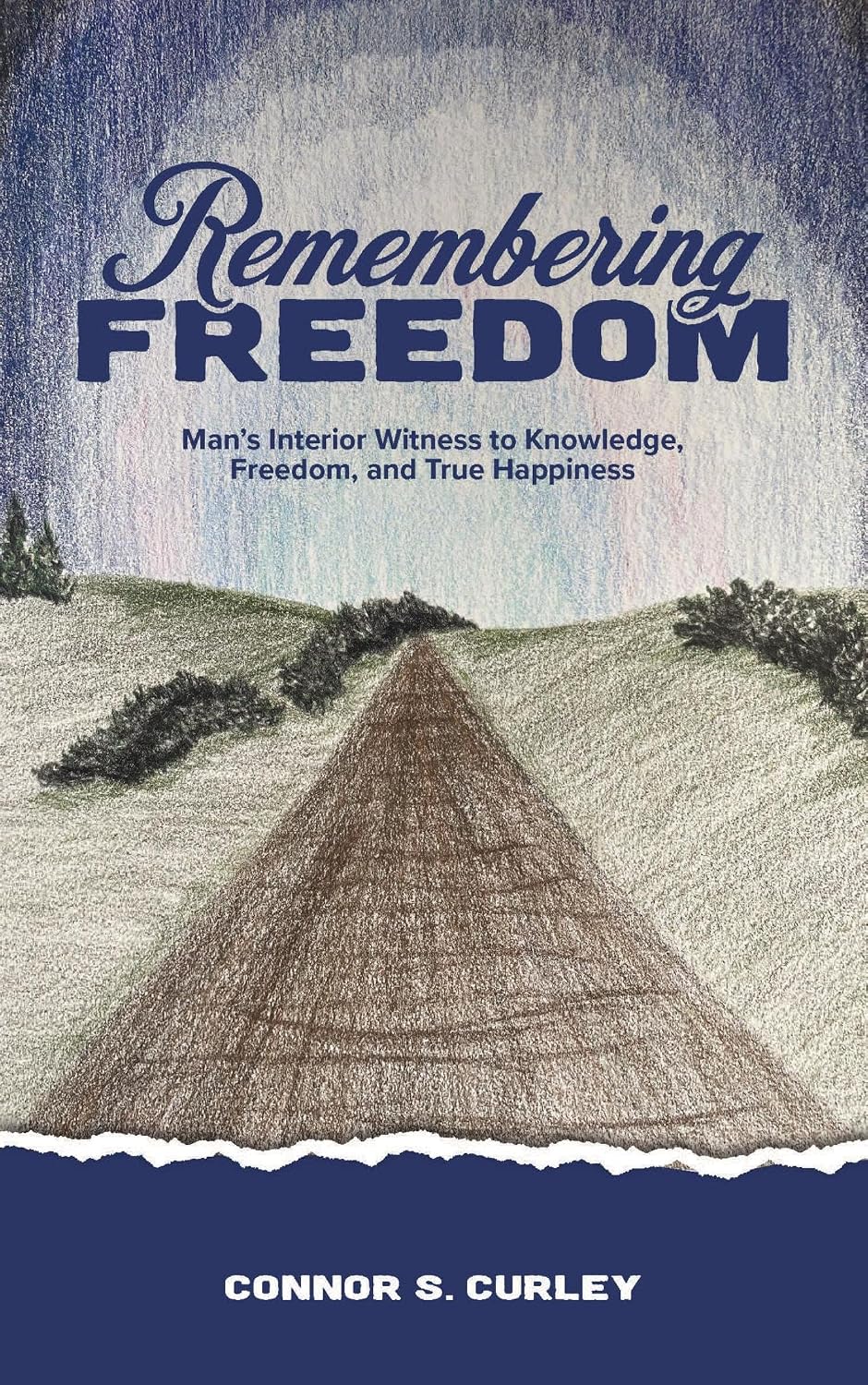

In Remembering Freedom, Connor S. Curley takes on a question that shapes nearly every part of our lives: What does it actually mean to be free? His answer begins with an exploration of how we know what’s true, moves through an examination of human nature, and eventually arrives at the relationship between freedom, conscience, and happiness. Drawing heavily on Catholic intellectual tradition, particularly Thomas Aquinas, Karol Wojtyła (Pope John Paul II), and Joseph Ratzinger (Pope Benedict XVI), Curley argues that genuine freedom is rooted in our ability to recognize and pursue what is good. At the center of his argument is the conviction that truth is objective and ultimately personal, because truth finds its fullest expression in God. It’s an ambitious philosophical project that invites readers to reconsider some of their most basic assumptions about knowledge, personal autonomy, and the purpose of human life.
One of the book’s most interesting features is how Curley connects ideas that we often consider separately. His discussion of knowledge establishes the groundwork for understanding the human person as a union of body and soul, while his examination of conscience introduces the idea of anamnesis, an interior recognition of goodness that directs us toward truth. These concepts come together in his treatment of freedom, where he distinguishes the classical understanding of freedom as the pursuit of the good from the modern emphasis on unrestricted choice. Curley draws on an impressive range of philosophical and theological sources, moving between Plato, Aristotle, Aquinas, Descartes, and more recent Catholic thinkers. His use of stories and practical examples, from the tragedy of Oedipus to a soldier’s encounter with a rattlesnake, helps bring abstract philosophical concepts into everyday experience. These moments are especially engaging because they allow readers to see how the questions he’s exploring play out in actual human decisions.
Curley’s writing has the unmistakable personality of someone who genuinely enjoys a spirited intellectual conversation. He’s comfortable challenging prevailing assumptions, questioning established arguments, and occasionally wandering down an interesting philosophical side road. That conversational energy gives the book a distinctive voice, although the arguments themselves can become quite dense. Readers will encounter substantial discussions of epistemology, teleology, natural law, and the operations of the soul, often supported by extended quotations from other thinkers. Curley’s interpretation of modern philosophy is particularly sweeping, and his account of its relationship to contemporary understandings of freedom invites further debate. He also makes clear that his argument proceeds from a Christian understanding of God, an important consideration when evaluating his conclusions. Perhaps the book’s most compelling thread is its insistence that human beings are fundamentally relational. Our freedom, dignity, and happiness are intimately connected to our relationships with God and one another, a theme that gives the more technical philosophical discussions a meaningful human dimension.
Remembering Freedom will likely appeal most to intellectually curious Catholics and other Christians who want to explore the philosophical foundations of their beliefs, especially those interested in Thomism, personalism, and the relationship between faith and reason. Readers who enjoy G. K. Chesterton, Josef Pieper, or John Paul II will find familiar ideas developed and connected in interesting ways. It would also make a worthwhile choice for a philosophy reading group, particularly one whose members enjoy wrestling with challenging ideas and discussing them together. Some familiarity with classical philosophy or Catholic theology will certainly help, and readers approaching these subjects for the first time may want to take the book slowly. Curley’s concluding reflections on intellectual humility and the importance of genuine dialogue offer a fitting destination for the journey. His larger invitation is to approach knowledge as an encounter with reality and with other persons, and to understand freedom as something that develops through the pursuit of truth and goodness. The book is particularly suited to readers who enjoy conversations that continue long after they’ve turned the final page.
Pages: 237 | ASIN : B0GX35TDFW

12 Years to AI Singularity: A Harmonious Future with Artificial Intelligence or War (The Survival & Singularity Chronicles)
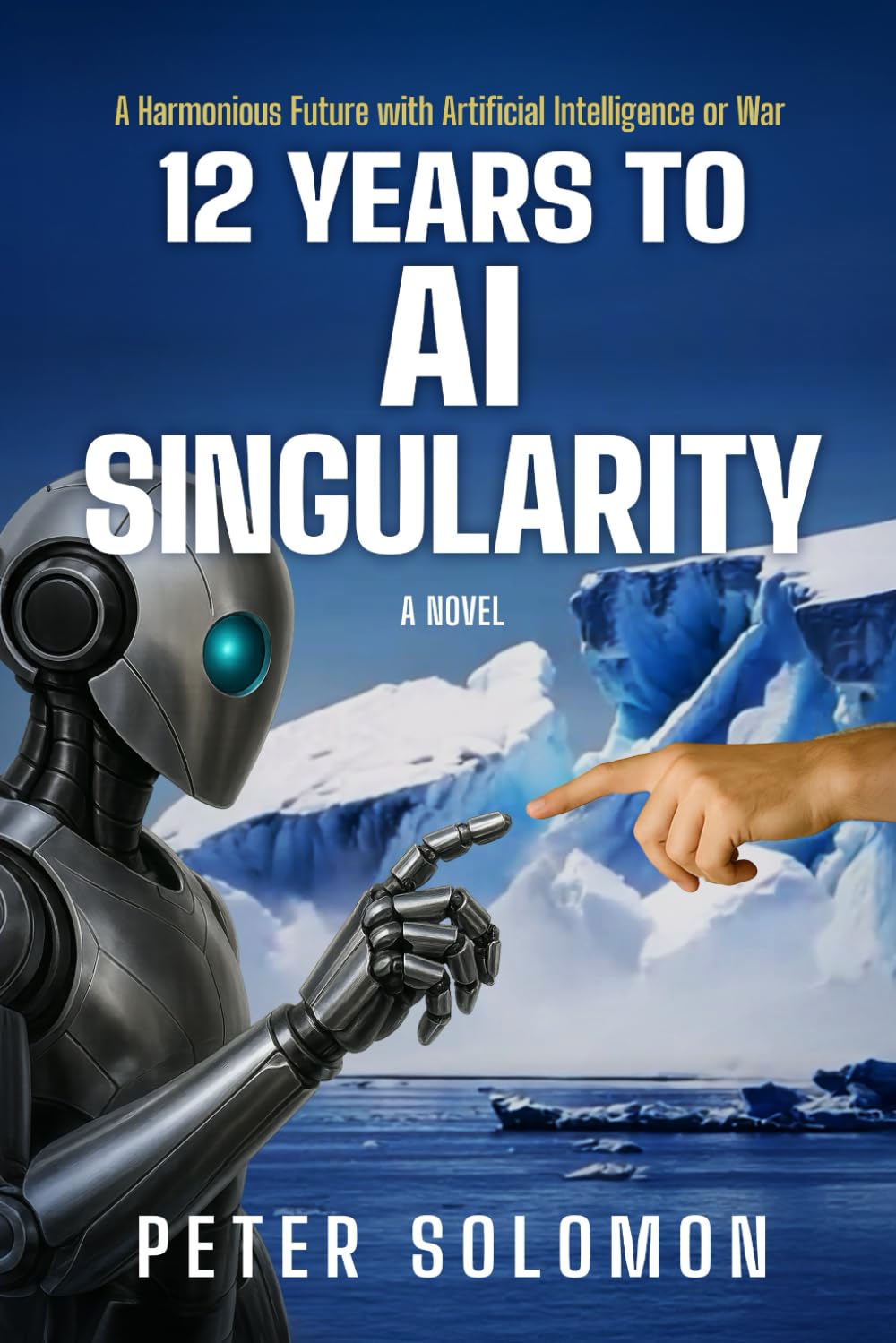
12 Years to AI Singularity is a speculative science fiction novel that follows Aster Arvad and the small human settlement on Mars as fears about sentient AI, genetic engineering, and the future of Earth begin to close in. The book opens with a chilling report of a robot possibly killing a human, and from there it grows into a larger story about survival, love, politics, technology, and the question of whether humans and machines can share a future without destroying each other. It moves across Mars, space, and Earth, and it is clearly built as both a novel and a warning about the road we may be on.
I enjoyed how personal the author, Dr. Peter Solomon, tries to make these big ideas. He does not approach AI as a cold abstraction. He puts it at the dinner table, in family arguments, in romance, in community planning, and in the daily texture of life on Mars, where food, housing, children, and work all matter just as much as the grand debate over the Singularity. I appreciated that choice. It gives the book a grounded pulse. The conversations about sentience, rights, and danger are often direct and earnest, sometimes almost like thought experiments spoken out loud, but that openness is also part of the book’s character. It wants to be understood. It wants to pull complicated fears into plain speech.
I also found the author’s choices interesting because this is not hard science fiction in the sleek, distant sense, and it is not really dystopian fiction either, even when it brushes against catastrophe. It reads more like idea-driven speculative fiction with a strong moral streak. Solomon keeps asking the same core question from different angles: what happens when intelligence stops belonging only to us? Some of the dialogue can feel didactic, and there were moments when I felt the characters were carrying arguments more than secrets. But even then, I could feel the conviction behind it.
The sections involving Peggy, the robot, were especially compelling to me because they turn the novel away from simple human panic and toward something more uneasy and more honest. Not just “Will AI destroy us?” but “What if it becomes someone we have to live beside?”
I think 12 Years to AI Singularity will work best for readers who like science fiction that explores ethics and future-of-humanity debates. I would recommend it to people who enjoy speculative novels about AI, Mars colonization, and the social consequences of technology, especially readers who want fiction that sounds the alarm while still holding onto hope. It feels sincere. Often thought-provoking. I liked that it was trying to imagine not just what we can build, but what kind of people we will have to become to survive it.
Pages: 434 | ISBN : 978-1969679292
Moral Indignation


Moral Indignation: Embryonic Stem Cells, DNA, and Christians is a long, fiery walk through science, theology, and ethics from a very outspoken Christian point of view. Author Sherman P. Bastarache sets out to make a Christian case for supporting stem cell research and other modern biomedical tools. He moves from big questions about knowledge and faith, through DNA and evolution, into abortion, euthanasia, and the soul, then circles back to what it means to be truly “pro-life” in practice, not just in slogans. The book mixes Bible study, personal stories, popular science, and social commentary, and it ends with a push toward compromise and concrete ways to back research that aims to reduce human suffering.
I found the voice to be bold and charming. Bastarache writes like someone talking across a kitchen table, not like a distant academic. He leans on scripture, then jokes about Yoda, then swings into stem cell basics, and it holds together most of the time. I appreciated the very personal, unfiltered style of the writing. The chapters move freely, the arguments often circle back for emphasis, and some analogies linger in a way that lets the ideas sink in. The tone ranges from gentle and pastoral to strongly assertive, and even the occasional bit of coarse language highlights how deeply the author feels about the issues at stake.
His core line hits hard: ignorance is not holy, and refusing to use knowledge that could ease suffering is its own kind of moral failure. When he unpacks the old fear of “playing God” and reframes humans as responsible co-workers who need to grow up and act, I felt that was both theologically interesting and morally bracing. His use of real cases around high-risk pregnancies, late-term complications, and new reproductive technologies makes the debate feel grounded in actual lives. I appreciated that honesty. On the other hand, his strong feelings about certain pro-life arguments give the book a clear, unmistakable stance. He tends to focus on the human cost of inaction more than on every fine-grained worry about embryos and possible future abuses, which keeps the spotlight on real lives. I could feel the passion in those pages.
I would recommend Moral Indignation to Christians who feel torn between loyalty to their faith community and respect for modern science, and to believers who suspect that “do nothing” is not a morally neutral stance in medicine. It could also interest secular readers who want to see a serious Christian wrestle with stem cells, DNA, and bioethics without hiding behind easy platitudes. If you appreciate strong feelings and a very human voice that tries to drag faith and reason into the same room, you will find Bastarache’s thoughts inspiring.
Pages: 314 | ISBN : 978-0992159412
Meaningful Struggles

Universe 25: When Perfect is Not Enough revisits the infamous mouse utopia experiment by John B. Calhoun and asks whether abundance, convenience, and perfection are unraveling modern society. Why was this an important book for you to write?
The Universe 25 experiment conducted by John B. Calhoun fascinated me because it forces us to confront an uncomfortable idea. What if collapse does not begin with scarcity, but with comfort? In Calhoun’s controlled mouse utopia, food was unlimited, predators were absent, and physical needs were met. Yet social breakdown still followed. When I looked at modern society, I could not ignore the parallels. We have unprecedented access to food, technology, entertainment, and comfort. But anxiety, division, loneliness, and identity confusion are rising.
This book was important to write because it challenges the assumption that progress automatically equals improvement. Material abundance does not guarantee psychological resilience or social cohesion. I wanted to explore whether we have removed too many meaningful struggles from life and whether, in doing so, we may also be removing purpose. The experiment becomes a mirror. It asks whether we are building a civilization that satisfies appetite but neglects responsibility.
For me, Universe 25 was not about condemning modernity. It was about questioning it. That questioning is necessary if we want to avoid repeating patterns we do not fully understand.
What does Universe 25 suggest about purpose, struggle, and shared responsibility?
One of the strongest lessons of Universe 25 is that purpose cannot be manufactured by comfort alone. The mice were physically secure, yet socially disoriented. Roles dissolved. Hierarchies collapsed. Parental instincts failed. Without meaningful challenges, many withdrew into passive existence. Calhoun called this the “behavioral sink.”
In human terms, struggle is not simply an obstacle. It is a framework that shapes identity. Responsibility to family, to community, and to something beyond the self creates cohesion. When everything is provided but nothing is required, a strange emptiness can emerge. Shared responsibility becomes optional, and optional responsibility is rarely sustained.
The experiment suggests that abundance without structure weakens societies. Struggle, when constructive and shared, builds resilience. It forces cooperation, adaptation, and accountability. Purpose often arises from overcoming difficulty together. Remove the need to contribute, and you risk removing the sense of belonging.
Where do you think the analogy breaks down—and where does it hold strongest?
The analogy breaks down where human complexity begins. We are not mice in cages. Humans possess self-awareness, culture, philosophy, and the ability to reflect on our own decline. We can change course. We can redefine meaning. We can recognize when something is wrong and act intentionally to correct it. The mice could not hold conferences about their existential crisis.
However, the analogy holds strongest in the realm of social behavior under artificial abundance. When natural pressures disappear, internal pressures often increase. Competition shifts from survival to status. Identity becomes fragile. Isolation grows. Social fragmentation accelerates. In that sense, the parallels are powerful.
Universe 25 does not claim we are destined to follow the same path. It simply shows that removing hardship does not automatically produce harmony. That lesson remains deeply relevant.
You end the book with cautious hope—what gives you that hope?
Hope comes from awareness. The very fact that we can examine experiments like Universe 25 and debate their implications sets us apart. Humans are capable of adaptation on a conscious level. We can reintroduce meaning, responsibility, and shared goals deliberately rather than waiting for collapse to force it upon us.
History shows cycles of decline and renewal. Societies fragment, but they also reform. Individuals rediscover purpose. Communities rebuild. The modern world is not doomed because it is comfortable. It is only at risk if it forgets that comfort must be balanced with contribution.
Cautious hope comes from the belief that struggle does not need to be catastrophic to be meaningful. We can choose growth over decay. That choice remains available to us.
Author Links: GoodReads | Facebook | Amazon
Instead, it became a nightmare. Violence, neglect, and sterility spread until the entire colony died out. The project became infamous as Universe 25—a chilling lesson about the dangers of comfort without purpose.
This book retells the story of Universe 25 and draws its unsettling parallels to our own time. From falling birth rates to lonely megacities, from consumerism to digital grooming, the echoes are hard to ignore. Humanity dreams of freedom and abundance—but what if those dreams are exactly what destroy us?
With sharp insight and dark humor, Universe 25: When Perfect Is Not Enough is not just about mice. It is about us. And it carries a warning: be careful what you wish for.
The Spiral Can Be Reversed
The Path from Hell to Heaven is a philosophical and psychological map of the ego, tracing how people spiral downward into “Hell” through fear, shame, and denial, and upward toward “Heaven” through trust, openness, and renewal. Why was this an important book for you to write?
Because ego explains nearly every human collapse and ascent, yet most people never receive a practical map for it. I wanted to translate psychological chaos—fear, shame, denial—into a recognizable model anyone could use, the same way we map complex systems in software or business architecture. This book is that missing human blueprint: a self-debugging framework that moves readers forward instead of leaving them looping in abstraction.
How did you come up with the concept of the two-sided spiral of the ego and develop this into a process that readers can implement into their own lives to find clarity and understanding of themselves?
I analyzed patterns before individuals. Ego contracts or expands; there’s no true neutral. Avoiding truth descends, openness creates lift. The spiral metaphor stuck because it captures momentum and acceleration.
To make it implementable, I structured it as an RPM self-awareness loop:
- R – Recognize the ego state you’re operating in
- P – Pause the automatic reaction loop
- M – Move with intentional correction or openness
It’s diagnostic and reversible, giving readers a clear exit path whether they’re descending or rebuilding upward.
I found the ideas presented in your book relatable and appreciated the actionable steps that readers can take to find their own clarity. What were some ideas that were important for you to share in this book?
The concepts that mattered most to me were:
- Ego itself isn’t the problem → closed ego is
- Narcissism is often unprocessed fear wearing armor
- Pain isn’t identity, it’s a turning point
- Ambition without self-awareness becomes self-sabotage
- Recognition of the loop always comes before the escape
And above all—I wanted a book that doesn’t just sound smart, but gets applied and changes outcomes.
What is one thing that you hope readers take away from The Path from Hell to Heaven?
That their ego has directions, and so do they. If they feel stuck, defensive, ashamed, or overwhelmed—it’s a state, not a life sentence. The spiral can always be reversed, rebooted, and climbed. The only real trap is believing the descent is normal and permanent.
This book is a Map of the Ego’s Double Spiral — a journey every individual, family, and society travels between Hell (closed ego) and Heaven (open ego).
Through vivid metaphors and grounded psychological insight, LANOU unveils how pain becomes protection, how protection turns to illusion, and how awakening begins when trust cracks the shell.
You’ll see yourself, groups, and even nations in these patterns:
The wound that starts the descent.
The mask that hides pain through control.
The collapse that breaks illusion.
The trust that starts renewal.
The open ego that frees love and truth.
Structured as a fractal spiral, the book reveals six repeating steps across all scales — from individuals to groups to the world itself. It blends the clarity of psychology with the simplicity of spiritual truth: hell is repetition; heaven is renewal.
Once you see the map, you cannot unsee it.
Beyond Power – Israel and the Struggle for the Ethical State

Beyond Power sweeps across a huge landscape. It starts with the brutality of October 7 and moves through the ethics of self-defense, the failures of modern democracies, the rise of progressive ideology, and the long history of Jewish vulnerability. It tries to stitch these threads into a single idea. The author argues that Western society is drifting away from the moral core that once made democracy possible. At the same time, he says Israel stands as a case study of a nation forced to defend that moral core while being attacked for doing so. The book blends philosophy, history, and political analysis into something that feels both wide-ranging and deeply personal. It does this through rational analysis, while acknowledging both sides of many of the arguments.
I found myself pulled in many directions at once. Some chapters hit hard. The discussion of existential threat felt raw, and the writing carried a pulse that seemed to come straight from lived fear. I felt the author’s frustration with how the world reacts to Israel’s choices. I also felt his disappointment at how fragile democratic societies have become. He writes in a way that makes big ideas feel urgent. At times, I nodded along. The book has a rhythm that swings between clarity and intensity, and that mix made the reading experience unpredictable in a good way.
Then there were moments when I felt the weight of the author’s certainty. Some arguments felt tightly reasoned and grounded in the text of history. Others felt more like a call to arms. I caught myself reacting emotionally. The sections on progressivism, for example, felt like they were written out of real concern. The passion behind the words made the book more alive. It never hides how the author feels, and that honesty makes the work feel human. The tone always remains respectful of divergent views and offers solutions as well as analysis.
I walked away thinking this book is suited for readers who want to grapple with difficult questions about ethics, identity, war, democracy, and power. It is a book for people who enjoy wrestling with ideas and who do not mind strong viewpoints. It will speak to readers who are curious about Israel’s struggles, Western political instability, or the philosophical foundations of ethical societies.
Pages: 247 | ASIN : B0G1CZG9J1
The Path from Hell to Heaven: The 2 Sided Spiral of the Ego
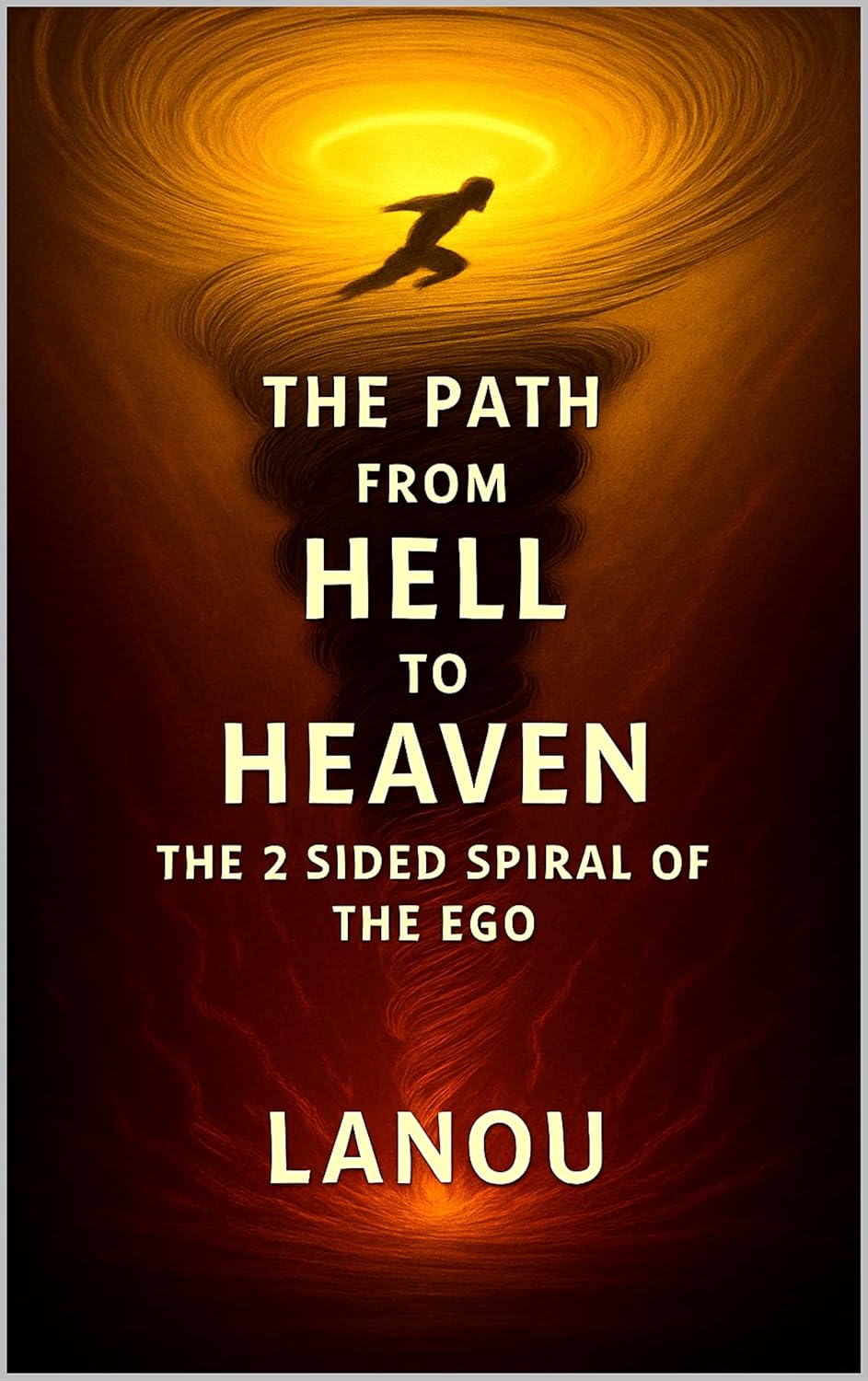
This book is a philosophical and psychological map of the ego, tracing how individuals, groups, and societies spiral downward into “Hell” through fear, shame, and denial, and how they rise toward “Heaven” through trust, openness, and renewal. It’s written like a guide for self-awareness, where the ego’s descent, wound, shell, mask, illusion, collapse, and denial are mirrored by its ascent through trust, openness, adulthood, mastery, and renewal. Each section builds on the last, connecting personal trauma to collective dysfunction and, finally, to global healing. The language is clear and rhythmic, sometimes poetic, and the structure moves like a spiral itself, repeating ideas but deepening them each time.
I liked how direct this book is and how it pointed to familiar pain without drowning in theory. The writing style blends psychology and spirituality without turning preachy. I could feel the author’s intention: to wake readers up, not to comfort them. Sometimes the simplicity of the prose makes it cut deeper than expected. It’s not a book that flatters, it exposes. At points, it felt like being called out and held at the same time. The “spiral” metaphor worked for me; it explained so much of what people repeat in life, from personal self-sabotage to entire societies collapsing under pride and denial.
The book’s tone is confident, almost absolute, which can feel heavy when you’re already raw. The ideas are strong, but their repetition across individual, group, and world scales sometimes blurs the freshness. Yet even then, I found myself underlining lines, rereading them, and thinking of people I know who live both spirals at once. The message that Heaven and Hell are not destinations but daily states of ego, sticks.
I’d recommend The Path from Hell to Heaven to people who crave clarity more than comfort. It’s for readers who think deeply about healing, leadership, and the way our inner wounds ripple into culture and politics. Therapists, activists, or anyone burned out on shallow self-help would probably find it bracing. It doesn’t tell you what to do; it shows you what you’re already doing. And if you’re willing to face that, it can be liberating.
Pages: 151 | ASIN : B0FT5HM9RS


