In Open Water, you share the details of your difficult upbringing, your struggles with mental health, and the mysterious medical condition that ultimately changed your life. What inspired you to share your story with readers?
The goal in writing this book was and is still to help others in any way possible. That could mean just being able to spread awareness of this condition in hopes of eventually finding a cure for people, or also hopefully preventing others from having to go down the dark road that I did in order to find an answer. I am also hopeful that this could reach people or their families with this specific disorder or any other similar diagnosis and make them feel less alone and let them know that there is always hope.
I appreciated the candid nature with which you told your story. What was the hardest thing for you to write about?
I think that while it was honestly quite difficult and emotional to revisit some of those darker places and times, like my stay in Haliston Hospital, the hardest thing about writing all of this was honestly emotionally reconciling all of the difficult family aspects of this and coming to terms with the best way to tell the story 100% truthfully while telling of some of the more difficult moments with family and people that I will always love dearly!
How important was it for you to convey a sense of hope to your readers?
That sense of hope is absolutely critical. Getting through my own struggle or any even remotely similar, requires understanding that there is always hope and you can always persevere no matter what. I can’t think of a more important message to get across and I very much aim for that sense of hope to be something that readers definitely take with them.
What is one thing you hope readers take away from your experiences?
As all of these answers hopefully suggest, raising awareness for this disorder, as well as being able to help others in anyway possible are certainly the main goals. As far as a take away that I would love to be able to relay? Always persevere, always try to press on no matter what, and using the metaphor in the book, always swing, knowing that there is always hope.
This memoir tells of Alex’s medical journey, an insanely bumpy ride that goes to unimaginable extremes. In searching for a diagnosis, incorrect results of genetic testing and many other issues resulted in absolute confusion for him and his family. That confusion led to wild searches for answers throughout his teenage years and well beyond, which included multiple months-long stays in various inpatient psychiatric facilities, treatment centers, and other medical attempts at successful intervention. When all else seemed to fail, they even turned to extreme spiritual interventions, such as time spent at faith-healing churches, one-on-one sessions with radically religious counselors, and multiple exorcisms.
Open Water details that journey and communicates many of the lessons that he learned from it and hopes others can benefit from as well. The goal is to ensure that those who might be dealing with similar conditions never have to feel as darkly alone as he did at times, going through his own many-years-long search for a diagnosis and learning to live with a disability. Alex stresses that if reading this can help just one person going through anything even remotely similar to what he went through to feel less alone or desperate or afraid, it will all be worth it to him. He hopes that any such individual’s family or close friends are able to process and understand better what is happening as they move forward as well.
The title, Open Water, is a visual comparison carried throughout the story. Like open water, life can be absolutely beautiful and sometimes terrifyingly stormy as well, with moments when the only choice is just trying to swim and stay above the surface. Times of relative serenity still bring with them the fear of the unknown, not knowing what lies below the murkiness around us. The only thing to do is keep pressing on in hopes of eventually finding clarity.
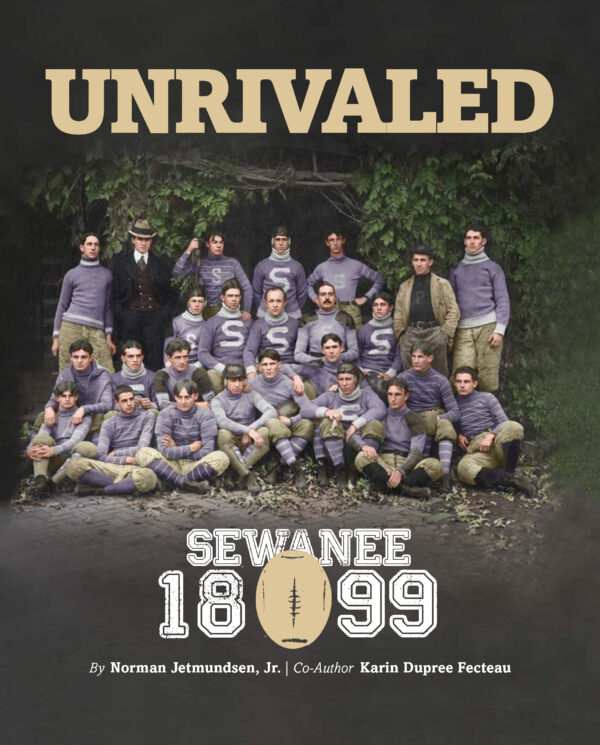
Unrivaled: Sewanee 1899 tells the story of a football team from a small college in post-Civil War Tennessee and their incredible accomplishments. What inspired you to share this story with readers?
I was a student at Sewanee in the 1970’s. Everyone there hears about this team. It’s a truly amazing story. Over the years, I kept thinking someone would do a documentary film about this team, but one never appeared. So, my classmate, David Crews and I decided to do it ourselves. Later, after the film came out, I realized we had a lot of original paintings and a unique music score, as well as a great deal of archival information. We decided this should also be preserved in a high quality coffee table book.
How much and what kind of research went into putting this book together?
We spent almost 5 years researching this story and doing interviews. This involved hours in the Sewanee Archives, as well as meeting with people who knew about the story, and doing research online as well. It also involved contacting the schools Sewanee played that year to see what information they had. Then, my co-author, Karin Fecteau, and I spent another two years creating this beautiful book to further preserve the history of this incredible accomplishment.
Did you learn anything surprising during your research process?
Yes, we thought we knew the story, but it was far richer and more layered than we ever imagined. We also uncovered materials and photos no one had discovered before, which was exciting. Finally, we thought we’d mainly explore the lore of the 1899 team, but what we learned was that the facts were even better than the lore.
Can we look forward to more history selections from you in the future? What are you currently working on?
Would love to but right now I’m focused on selling these books.
Finding Sutton’s Choice follows a young writer who confronts old memories when she returns home to face her father’s declining health and deal with the family’s struggling newspaper. What was the inspiration for the setup of your story?
I’ve witnessed so many loved ones impacted by Alzheimer’s disease—beloved mentors, friends, friends’ parents or spouses, and even one of my own family members who has shown early signs of dementia. As I researched the topic, it became more and more important to weave a plot that unobtrusively but positively raises awareness of the disease and provides caregivers with a relatable story. As a past journalist of a family-owned Pittsburgh publication, I was drawn to the idea of incorporating a community newspaper. Setting the story in Lakeside Chautauqua, the very real place where I live, also allowed me to offer a snapshot of a closeknit, small Ohio town, not unlike the farming community where I grew up in Coshocton County, Ohio.
Which character in the novel do you feel you relate to more and why?
I have all the feels for Charlotte, as complicated (and sometimes annoying) as she may be. She’s a very, very distant version of myself… an insecure, immature, dutiful but damaged, sometimes angry, and inherently messy version. But aren’t we all a little messy when we’re 10? 20? Older? It takes time to work out the kinks. Charlotte holds onto old hurts far too long, but for good reason. As is seen through her memories, her childhood was complex. I can relate to that. I killed some personal demons in the writing of this book, and, like Charlotte, I’ve grown into a more self-aware human during the process.
Now, if you were to ask me what character I aspire to be, that would be The Surly Sturgeon’s barkeeper, Bea, who is a Boss Lady and completely unconcerned with what others may think. My new motto? Be like Bea.
What were some themes that were important for you to explore in this book?
Finding Sutton’s Choiceexplores complicated parent-child relationships, failing mental health, forgiveness, and the domino effect family choices have on who we become.
I am fascinated by how our perceptions of the past can shade and shape our future. Note that I say “perceptions.” Our personal histories are only as factual and reliable as our memories of those moments in time. And, though we are a product of our past, our future is what we make it. We can choose a new path to produce different outcomes. As my character Chuck Sutton would say, “It’s the final inning that really matters.”
Can we look forward to more work from you soon? What are you currently working on?
In the past six years, I’ve completed multiple first drafts during National Novel Writing Month in November. Though I’ve got a healthy stack of potential projects, I’m currently editing a sequel to Finding Sutton’s Choice. The follow-up, tentatively titled Sutton’s Second Chance, is set 15 years in the future. You can expect a few of the same quirky characters and many new ones, all living their best (but equally messy) lives in the little Lake Erie town of Lakeside, Ohio. Additionally, I’ve been working on personal essays about my lake life. I hope to bundle them for future publication.
It’s been ten, long years since her abrupt departure, and, with a cryptic voicemail, 28-year-old writer Charlotte Sutton finds herself back in her hometown of Lakeside, Ohio. Only this time, her estranged father doesn’t recognize her, and a surprise half-sibling has taken her place.
Chuck Sutton-newspaper editor, retired baseball player, and the town’s most beloved celebrity-is thought to have Alzheimer’s disease. The community newspaper is also on the verge of closure, and a childhood friend holds a decade-long grudge. Despite all this, there is Lakeside. The quaint waterfront community, flush with ivy-covered cottages and vintage charm, hasn’t changed even as everything else in Charlotte’s life has shifted. She intends to stay only long enough to get her father’s affairs in order.
But, to reconcile her past and unearth family secrets, Charlotte must reconnect with Chuck through his Alzheimer’s diagnosis and reevaluate her own misconceptions about growing up in the small Ohio town that still holds her heart.
Mother’s Ruin is a brutally honest and heartbreaking memoir that shares with readers your tumultuous childhood and early adulthood life as you coped with the effects of your mother’s alcoholism and emotional instability. Why was this an important book for you to write?
Definitely for my own healing and for that of those facing similar circumstances. My mother’s addiction and untimely passing have long since overshadowed me, and I needed to share my story to achieve full emotional freedom from this.
Despite what the stigma may have you believe, addiction is a trauma-response and never a choice. Nobody wakes up one morning and decides to pick up a bottle of alcohol or similar, and this was something that I was desperate to convey through my writing.
How did you decide what to include and leave out in your memoir?
This was something that I struggled with: the fine line between oversharing and undersharing. I wanted my writing to be rich and emotive, but to also not read like a personal diary, and I hope that I have achieved this.
I do believe that having already outlined my second memoir at the time also helped in choosing what to include (alongside endless rounds of editing, of course!).
What was the most challenging part of writing your memoir, and what was the most rewarding?
The flashbacks and the fear of being perceived were equally challenging. Long-suppressed memories were suddenly boiling to the surface, and not only did I have to address and write about these, but I also had to learn to do so in a safe, controlled and healthy manner, without reverting to previous toxic coping mechanisms.
Though my mum may not have been my protector, I have spent my life believing that I should be hers. With this in mind, I was worried that people would believe that I was villainising her in some way, when this could not be further from the truth.
That said, Mum may well have been poorly, but this is no justification for her actions, and I am tired of living a life enshrouded in secrets and lies to protect a collective.
The most rewarding aspect has definitely been the feedback that I have received. Though it pains me to know how many people can relate to my story, I am also proud of and thankful for those who have reached out to me whilst on their own healing journeys.
What do you hope is one thing readers take away from your story?
That healing from trauma may be painful, messy, and never linear, but it is always possible.
Raw, hard-hitting, but, ultimately, a true memoir of survival.
Raised fatherless on a ’90s poverty-stricken council estate, in the East Midlands, Belle details the struggles faced as she shared the role of young carer with her older brother, and the difficult transitional period as their relationship changed from brother and sister to child and caregiver, following court-approved legal guardianship.
MOTHER’S RUIN is an honest account of the devastating long-term impact of a mother’s addiction, dangerous actions and untimely death, just before her daughter’s eleventh birthday.
Rough Diamond, Rough Justice follows a former professional photographer turned MI5 surveillance agent who winds up in the diamond trade, where killing is not optional; it is the only way to survive. What was the inspiration for the setup of your story?
Real life experiences was the inspiration. As it says at the beginning of Rough Diamond, Rough Justice: This book is a work of fiction, inspired by several real-life events and real people. Names, characters, incidents, and places are the product of the author’s imagination. Any resemblance to actual events, locales, or persons, living or dead, is coincidental.
There was a lot of time spent crafting the character traits in this novel. What was the most important factor for you to get right in your characters?
Reality was the most important factor. As it says in Rough Diamond, Rough Justice when Cain was talking to his best friend:
‘We will have to write that book when we retire,’ Cain suggested.
‘All those secrets,’ said Detective Sergeant Jerry Davis (a member of The Royal Protection Team). ‘Perhaps we will.’
In real life, my best friend unexpectedly died, so I wrote our book alone.
I felt that the action scenes were expertly crafted. I find that this is an area that can be overdone in novels. How did you approach this subject to make sure it flowed evenly?
In real life action can only go so far. Seeing too much in movies, TV series – and having a karate black belt – plus a couple of personal experiences helped me craft the action.
Is this the first book in the series? If so, when is the next book coming out and what can your fans expect in the next story?
This is my first book. I have written an initial 40,000 words of a sequel about Cain, set in South Africa & England. Will I finish it? Time will tell.
After a first kill, MI5 Agent and erstwhile photographer Cain becomes an undercover, extra-judicial killer for a secret Bureau. Recovering from injuries sustained protecting the Royal Family, Cain embraces a new life and romance in sun-drenched Australia, leaving his past life behind. But when tragedy strikes, he is on the move again. This time to a new career in the world of diamond dealings in Florida. Curiosity takes Cain to the diamond world in South Africa, where his past finally catches up with him, the criminal world allies against him and he becomes a killer again.
In Cain’s action-packed escapades, a spectacular betrayal takes him into the rigours of a Chinese prison where the truth about his past begins to unravel. Aided by a loyal band of friends from the shadowy world of intelligence, he delivers his own particular brand of rough justice. However, with enemies closing in on all sides, will Cain prevail?
In Unconverted, you share with readers the surprising journey that resulted from your unexpected marriage to an Episcopal priest. Why was this an important book for you to write?
This was an important book for me to write because, beginning around the time I started going to church every Sunday with my children, I was thunderstruck by the feeling that my life had changed enormously, and in a way that I hadn’t fully anticipated before marriage. I realized that falling in love with a particular person, who was on a particular trajectory, set in motion a whole chain of events that brought me into unfamiliar territory: The Church, really, Any Church. I needed to figure out who I really was: how much I could shift around inside myself to accept some degree of religion, even as a bystander; how much my well-being depended upon my staying the secular person I had always been. Sitting in a pew, time after time, watching my husband up front performing his duties, I became fascinated with both the covenant and the daily reality of marriage – what it asks of us, how it enables us to grow and sometimes to merge with another person, how much room it allows for maintaining individuality.
I appreciated the candid nature with which you told your story. What was the hardest thing for you to write about?
Since this is a book about our marriage, I had to be careful throughout with any scenes depicting my husband’s actions or words; I needed his buy-in, his memories of these particular scenes, for accuracy. It was important to me that, overall, he comes across as the very decent and loving person that he is. And I couldn’t make the mistake of assuming I knew what his feelings were in particular moments, either – only what I observed (unless he wanted me to know). Probably the hardest parts of the book to write were the episodes when I stand apart, in some way, from engaging in the full experience of a church service. Specifically, the section when I remain in the pew at communion time, watching my kids go up for the wine and wafer, feeling a kind of necessary isolation; also Chapter 36 — “At the Consecration,” because that event was so celebratory in nature, with many people looking at me, I knew that my internal anxiety pegged me as someone swimming against the tide. And yet, that feeling was precisely what made the scene worth depicting in a book. It was in my Memoir Incubator class at Grub Street that I got the idea to begin this chapter with a childhood memory of lying in a field, seeing the crows circling; I’m proud of the honesty in this writing.
What is one misconception you believe many people have regarding mixed-faith marriages?
Mixed-faith marriages have become increasingly common over the past 50 years or so, part of the cultural landscape that most of us accept as normal. And yet, people continue to gather data on these unions, trying to discern how much impact this particular kind of difference makes over time, in the life of a couple, especially when it comes to divorce rates. From my perspective, a common misperception that is still prevalent is probably that couples spend a whole lot of time wrangling over matters of faith, trying to come to agreement about their individual beliefs. In the case of my marriage, we had probing conversations on the topic through our courtship, owing to the fact that we each knew we were falling in love and so needed to bring it all out into the open: the fact that he was devoting his life to serving the Church, while I wasn’t even sure what I believed! My willingness to have our children be brought up Episcopalian meant that we didn’t need to disagree about a key element in how they were raised, or what holidays we celebrated, etc. Over time, while we continued to explore our diverging beliefs (many being already in synch) we discovered that the key challenges we faced in maintaining daily harmony had more to do with how we were each “built” – his introversion and need for quiet, my extroversion and need for connection – than any specific doctrines we embraced. How well we managed a long drive to Nova Scotia together, for instance, wasn’t determined by anybody’s faith tradition, or lack thereof.
What is one thing you hope readers take away from your experiences?
As they finish Unconverted, I hope readers will take away a sense of tenderness about what’s involved in living out any long-term commitment between two people, especially one in which a fundamental difference is baked right into the relationship. I also hope that they’ll consider how such a difference can actually enrich a union, rather than threaten it, with each person being able to see and respect and learn from “another way” followed by a beloved without fully adopting that other way. Perhaps many readers will have had some kind of a similar experience – when they’ve felt the need to retain their own true nature, stay loyal to their roots, while also making space for someone else’s next to them – and therefore they will take away encouragement that the effort is worth the challenge. In addition, I hope readers might reflect upon how falling for and staying with another person always takes some degree of courage as well as vulnerability; you are taking a risk, putting yourself on the line, opening yourself up to many potential kinds of changes. So long as you don’t give up a sense of your own integrity, your heart can grow in surprising ways.
As soon as Polly and Rob meet, there is electricity between them, despite the fact that Rob is a devout Divinity student and Polly does not practice a religion. When they fall in love, she begins to wonder if their union can survive their theological differences. Over time, they build a multilayered life of family and community, and Polly manages to create a comfortable space as a clergy wife. In lyrical prose that is reflective, candid, and warm, this is the story of how an extroverted agnostic remained true to herself through three decades of marriage, three children, and four relocations. As Polly’s husband rose through the ranks to become an Episcopal bishop, she stayed steadfast in her love of literature, sports, nature, and her family, while deepening her understanding of herself, her husband, and marriage itself.
Hunting the Red Fox follows an aspiring writer who is collecting interesting life stories, who winds up interviewing a smooth-talking Southern gentleman with a lifetime of secrets to tell. What was the inspiration for the setup of your story?
I decided early on that I wanted the story to revolve around a fictional character during the 1950’s who was first and foremost a gentleman in the traditional, grandest manner in which that term used to exist. I also wanted him at his core to be one of the “strong, silent types” as they used to be called. I wanted a guy who was recognized by others as a “man’s man” and “ladies’ man,” in a non-piggish sort of way, without a hint of ego or self-promotion. Above all, Perry had to be likeable.
Also, I wanted in the character of Perry someone who was very good or above average at virtually everything he did without being the best at anything. At the same time, I didn’t want everything he did to necessarily be good. I wanted him fundamentally to be principled and seek to do good and right even if that was not technically the legal course of action. In other words, I wanted the internal struggle between the right thing to do and the legal thing to do. The last thing I wanted Perry to be was someone who was flawless. Quite the contrary as it turns out.
Lastly, I wanted a character who seemed by circumstances mostly out of his control to plausibly meet the most bewildering array of real folks or pop up in the oddest of places throughout the 1940’s and 1950’s.
Was there anything from your own life that you put into the characters in your novel?
Let me start out by saying that no character in the book is a take-off of anyone in real life. They are all figments of my imagination. I’m sure most of them are cobbled together pieces of real folks from my own life experiences but I didn’t take any one person in my life, change the name and insert them into the fray.
I did, however, use the name of a few deceased family members sort of in tribute to them. For example, my mother’s maiden name was Mace. Hence, Roger Mace, the aspiring writer. My father’s father was named, believe it or not, Solomon Goldsborough Tyler. Hence the jeweler in Savannah named Solomon Goldsborough.
Having said that, to a limited extent my father served as a partial inspiration for Perry Barnes but only as it relates to the time in which he lived. My father was born in 1925 which coincided almost exactly with Perry’s age because that was the time frame I wanted to cover in the book. Using my father as a reference for timing made it easier in affixing dates to the happenings in the book. My father was a great man in my mind. However, Perry is not at all based on my father.
There were no other real-life figures who inspired Perry unless you consider where I got his first name to be “real life.” I have always been a tremendous fan of the old Perry Mason series. I suppose I borrowed the main character’s first name from this fictional television character. The rest of the traits or characteristics of Perry Barnes are an amalgam and/or composite of qualities and features contrived in my mind.
When you first sat down to write this story, did you know where you were going, or did the twists come as you were writing?
In a big picture sense the direction of the narrative from the beginning was always intended to be a work of fiction. Plain and simple. I was going to make it up. All of it.
Gradually, over the course of an hour, before a word was committed to paper, this morphed into a work of historical fiction. As such, by definition, the totality of the story was going to involve mistily melding fictional characters, times and places with real people, times, events and localities in a plausible way so the reader can’t immediately discern fact from fiction. On some level the book was successful at this because I have had more that one person relay to me that they spent more than a little time researching while reading to figure what was real and what was made up.
I think it’s important to understand that this was my first attempt at writing a book. I didn’t know how to write a book. So, I made an outline of about three or four ideas for character names and a potential story line in the briefest of terms. I don’t know about others, but I found out quickly that’s not how I write. It’s not really a conscious thing with me. I can’t sketch out a story in advance then try to write to that plan. I sit down at a computer and simply type and attempt to describe the movie that is playing in my mind. My fingers often have a difficult time keeping up with what I see in my brain in picture form.
When I start typing at the top of a page, I literally have no plan or idea as to what may fall out of my head by the end of the page. This often results in characters, events or places that had not previous come to mind on any prior level. I can’t explain it more simply than that.
Oddly enough, the thing I was most concerned about in the beginning was my ability to write dialogue between characters. Once I started typing the motion picture scenes playing in my head the conversations were simply there and seemed to write themselves. I just tried to write how people speak in real life. I think my second book benefits from this “technique” even more because it is more dialogue driven. I’m only a third of the way through book number three and I think that may be true for that one as well.
Back to that very first day. I sat down to start this book I stared at the first line of the first page and eventually, without any other preconceived plan in place, typed out “The last jewel heist of my career was the biggest and best by far – the Mecklenburg Diamond. Ever hear of it?” It was an effective attention grabber. To this day I don’t know where that came from.
I liked it. That one line led me to create a conversational narrative between Perry and Roger Mace whereby the story was going to be revealed more or less in a confessional style. It was also going to involve at least one jewel theft from which I thought I could build some action and tension in the story.
This sentence also gave the impression that Perry was something he really was not in the end: a bad guy, desperado, rogue, habitual criminal, etc. The eventual story would set the record straight on that score and Perry was later revealed to be more of a Robin Hood type thief, not that it makes things any better I suppose but I think the readers think otherwise.
From that first day forward I ditched any preconceived plans or ideas and just typed the movie playing in my head. I don’t consciously feel inspired, happy, melancholy or any host of other emotions while I write. I don’t try to include any messages, hidden motivations, build tension or have an agenda of any kind. My head fills with ideas while my fingers struggle to get it all down on paper before the thoughts and pictures vanish, which they eventually do. I do go back numerous times to edit the text naturally but it’s less about content than grammar, word choice or phrasing.
What is the next book that you are working on, and when can your fans expect it to be out?
I have written a second book that has been completed since November 2024. My publicist wisely told me to let it sit on a shelf until Hunting the Red Fox has had a chance to run its course. It most likely won’t be out until this time next year for that reason.
This second novel, called “An Invitation to My Past,” is a time travel story taking place back and forth mostly between current days and the late 1970’s. At the time I shelved that novel this past November, I felt the narrative was at least as captivating as Hunting the Red Fox. It is mostly a love story with a palpable level of tension related to the consequences of the time travel. I believe I got better the second time around and the writing is tighter, and the relationships are compelling and entirely believable.
A third novel is about a third of the way done. I can’t exactly tell you yet what this is about because my brain hasn’t yet shown my fingers the entire movie of the story.
I have also received numerous requests from readers of Hunting the Red Fox for a sequel. Significant consideration is now being given to a potential sequel which is going to wreak havoc with my tee times and ongoing retirement.
This is the story of Perry Barnes, a multi-talented man who made one bad teenage mistake in the weeks leading up to his high school graduation in 1942. On a lark he “borrowed” some jewelry that wasn’t technically his. The local judge took it personally and gave Perry the choice of an assignment to a newly formed Army special operations unit at the start of World War II or go to jail for 15 years. As a result he winds up being trained by the United States government in the skills and arts of sabotage, killing, self-preservation, espionage and ultimately how to be a first class jewel thief.Along the way he finds himself in the movie business in the Hollywood of the 1950’s, then uses his immense physical skills in pursuit of excellence as a journeyman golfer on the PGA tour of that era with the likes of Ben Hogan, Jimmy Demaret and Arnold Palmer. Before the adventure is over Perry has stolen the world famous Mecklenburg Diamond from a known jewel thief, worth a fortune, with the intention of returning it to the authorities for love, of all things. All the while he is befriended by the most bewildering array of characters, some real, some not, who add marvelous vignettes of clever humor, situational intrigue, and steamy romance as he earnestly pursues the one goal he covets most: finding true love, martial companionship and family.
Living the Dream is a raw and detailed memoir that chronicles your journey through the Thames Valley Police’s Direct Entry Detective program, sharing insights into the bureaucracy, exhaustion, moral conflicts, and the emotional highs and lows. Why was this an important book for you to write and share?
I felt it was important to write this book because I know I’m not alone in this experience. Many good people join the police determined to make a difference, but after only a few years they leave disillusioned and burnt out. I wanted to shine a light on why the system isn’t working, and the most powerful way to do that was by sharing my own story.
What were some ideas that were important for you to share in this book?
I wanted to highlight some of the issues within British policing, particularly with regards to training of new recruits, but also in the wider culture and processes of the organisation. It was equally important for me to share a realistic picture of policing—not the glamour and heroics portrayed on TV, but the reality of the work, with all its pressures and complexities.
What was the most challenging part of writing your memoir, and what was the most rewarding?
The most challenging part was revisiting certain events in detail, some of which were quite upsetting. That’s why I couldn’t begin writing immediately after leaving the police—I needed time and distance from the more difficult memories. The most rewarding part has been seeing the finished book, which I’m incredibly proud of. On top of that, receiving such positive feedback has been hugely rewarding. Even close friends and family have said they now understand much more clearly what I went through.
What do you hope is one thing readers take away from your story?
I hope readers find the book both insightful and engaging—a genuine look behind the scenes of real police work. More than that, I hope it gives people a sense of just how demanding the job is, and why we should value the officers who do it every day. Finally, if the book reaches those in positions of influence, I hope it offers an honest insight into the urgent changes needed to repair and strengthen the policing system.
When Jade finally achieved her dream of becoming a detective, she discovered that the reality wasn’t quite as she’d imagined. Living the Dream: Confessions of a Trainee Detective offers a gripping and unfiltered look at the hidden realities of life as a detective in training. With unflinching honesty, Jade pulls back the curtain on her journey within Thames Valley Police, exposing the camaraderie and conflicts, the pride and frustrations, the adrenaline-fuelled moments, and the thankless tasks.
This powerful memoir will captivate, enlighten, and take you far beyond TV’s glamour and heroics. Join Jade on a journey that is eye-opening, deeply personal, and profoundly human—as she discovers what it truly means to live the dream.





 LITERARY TITAN