Author Archives: Literary_Titan
Finding Joy

The Joy Molecule is a soulful blend of memoir and life guide that follows your journey from achievement-chaser to purpose-driven connector, revealing how real joy grows from self-awareness, compassion, and meaningful relationships. Why was this an important book for you to write?
For most of my life, I’ve seen personal growth as an ascension ladder. We climb through experiences, challenges, insights, and relationships. And wherever we are on that ladder, we have two responsibilities: to reach down and help those coming up behind us, and to reach up and learn from those who have already climbed higher.
At certain points on that ladder, something shifts. Instead of stepping onto the next rung, we feel called to build a platform, something sturdy enough for others to stand on, something that can support more than just our own next step. The Joy Molecule came from one of those moments for me.
I realized that the concepts in this book, understanding what we are, who we are, and why we are here, and how joy arises from conscious connection and purpose, were too important to keep climbing quietly with. They deserved a platform. They deserved to be shared in a way that could help others navigate their own journey, especially those who, like me, spent years chasing achievement while longing for something deeper.
Writing this book was my way of building that platform: a place where people can pause, reflect, reconnect with themselves, and find a more joyful, aligned path forward.
What moment or relationship first made you realize that joy and achievement weren’t the same thing?
There wasn’t a single moment, there were dozens. But the clearest shift happened during my trip to Africa in 2012. I met people with far fewer material resources than I had ever known, yet they radiated a depth of joy and connectedness that I couldn’t quite understand. Meanwhile, I had all the “achievement boxes” checked and still felt empty. That contrast shook something loose in me. It exposed the illusion that achievement automatically leads to fulfillment. Becoming a father to two extraordinary children deepened that lesson. Their struggles, and my desire to support them without projecting my own expectations, also showed me that joy comes from presence, compassion, and connection, not accomplishment.
How did writing this book change your own understanding of joy, if at all?
The title of the book came from the concept that Conscious Connection + Purpose (C2P) = Joy. When I started writing the book I thought I would focus on the concept of connection, yet when I started digging and reviewing the people that I know who have deep, meaningful joy, they all had something in common. They all knew What they were, Who they were and Why there are here. That concept came after I started writing the book, so that was a huge piece of awareness I didn’t have before writing this book.
For readers who feel stuck in their careers or identities, what’s the very first small step you’d urge them to take toward reconnecting with joy?
I think joy is about connection and knowing What you are, Who you are and Why you are here. The metaphor I use in my talks is a closed door. Most of us live in a very comfortable room, especially here in the US. We live for ourselves, rugged individualism, raising our children as isolated families rather than in community. With this in mind, if we want to find more joy we don’t need to look outside of ourselves, this is an inside job. By opening the door to a journey to finding self, we begin to shed the identity we’ve created since our birth and seek connection. Finding ourselves allows us to connect more deeply with others and I believe that is one of the biggest reasons we are here. The Harvard Study on Happiness over the past 85 years is clear that those who have deep meaningful relationships at 50 will be happy at 80. To me it all comes down to connection and connecting to self is the first step.
Author Links: GoodReads | Facebook | Website
In The Joy Molecule, author Larry Kesslin introduces a simple but powerful idea:
Joy comes from knowing What you are, Who you are, and Why you are here. And it is deepened by personally connecting with others. Joy is not something to chase … it is something to live.
Kesslin reveals that joy isn’t about perfect circumstances. It’s about clear alignment.
Within these pages, he shares the stories of individuals who have taught him the most valuable lessons of his life.
Most spend their lives trying to succeed, impress, and keep up. But deep down, what they are really searching for is joy.
Through personal stories and the lives of remarkable individuals—from blind athletes to social impact leaders—each became the lightning rod for him to see a path to joy. Now he shares them with you. Their stories are profound. Their resiliency, creativity, and courage to take another step forward when no steps were readily apparent will leave you with wonder. Their lives are to be celebrated … as yours is.
Joy is rooted in deep human connection. It is a journey to love yourself, your life and surround yourself with peace that enables you to breathe with clarity and vision.
If you’re ready to live with more purpose, more connection, and more joy—
The Joy Molecule is your invitation to begin.
Blurred Lines Between Reality & Nightmare

The Dreaming at the Drowned Town follows a haunted Filipino translator whose nightmare-plagued diary unravels a deadly expedition to a newly risen island where history, paranoia, and ancient horrors collide. What was the inspiration for the setup of your story?
We’ve always been drawn to overlooked corners of Philippine history, especially the transitional period of the 1920s, when cities like Cebu were rapidly modernizing under American rule while remaining at the cultural crossroads that decided the modern Filipino identity–between the legacy of three centuries of Spanish-style hacienda communalism and the enduring influence of the Church, the new American nation envisioned by the suit-wearing, English-nicknamed Sajonistas, and the vision of a country free from both that endured in places like Eastern Visayas. We’ve wanted to write a story in that setting for the longest time, portraying the interaction between people trapped between any of or perhaps none of the paths the Philippines was on the verge of walking, and the conflict that would arise from the clash between their different values and cultural contexts.
The core of the novel, however, came from two major sparks. The first was a love for early 20th-century cosmic horror, particularly the works of H.P. Lovecraft. Kyle has been a devoted fan for years before we ever started writing professionally, and he always wanted to craft a proper homage grounded in our own cultural landscape. The second—and more unexpected—inspiration came from real life. Around the time of the 2024 Manila International Book Fair (MIBF), when we launched our debut novel, Answering the Human Question, Kyle had come up with the concept of a protagonist troubled by vivid and terrible dreams, inspired partly by his own string of nightmares that he had been dealing with at the time through journaling. This entered the story as the main character and narrator of Enrique, who would write about his dreams as Kyle did. It also shaped in some aspects the book’s dream logic–its many false awakenings and the often blurred lines between reality and nightmare.
We also pulled from real historical curiosities like the desolate, sunken town of Pantabangan, the very real Drowned Town that exists here in the Philippines. It’s located in Luzon and in the province of Nueva Ecija, and it resurfaced during the El Niño droughts of both 2020 and 2024. We also combined the aesthetic of that place with Dawahon Islet, which, like the titular Drowned Town, is found near Leyte. Dawahon is a tiny yet densely packed community built on a reef that Kevin often flew over during pilot training. The distant glances and later images of empty, almost liminal spaces in both locations created an uncanny timelessness. It immediately planted in our minds the place where the book’s central mystery would unfold: a drowned town rising again after centuries beneath the sea.
The atmosphere is incredibly vivid. What research or techniques did you use to capture the sensory overload of the island and Enrique’s nightmares?
Much came from layering real-world observation with psychological insight. Research and a little bit of Kevin’s background in biology gave us a foundation for sensory detail—how bodies react to exhaustion, how coastal environments smell, sound, and move. Our travels to parts of the Visayas gave us firsthand experience of environments that feel both crowded and isolated, which helped shape the island’s suffocating atmosphere.
On Kyle’s end, his study of psychology—as well as a few readings of old court decisions for Philippine Law—taught him how perception breaks down under stress. Around the time of MIBF 2024, he was having recurring nightmares, and journaling them became the seed for Enrique’s dream sequences. Those dreams were chaotic, absurd yet vivid, and he translated that rawness into the book’s “dream logic.”
In addition to being partly inspired by Kyle’s own journaling, we employed Enrique’s diary as a framing device. In doing so, we hoped to keep the nightmares disorienting but maintain that they were narratively coherent. The diary form lets us narrow the focus to Enrique’s senses: the heat sticking to his skin, the sulfur that burns the throat, the texture of the drowned town rising from the sea. When those sensory details begin to distort or repeat, the reader feels Enrique’s unraveling in real time.
How did you approach blending real historical tensions of the American-occupied Philippines with cosmic or supernatural horror elements?
We began by grounding the story firmly in Philippine history. The 1920s was a pivotal transitional period in our hometown and province—Cebu was rapidly modernizing under American rule, yet memories of the Philippine-American War and the Revolution before it still lingered. A younger generation of Sajonistas emerged, eager to embrace American culture and modernity, and they often clashed with their elders, who had been shaped by centuries of Spanish influences and even hateful opposition to the betraying, conquering Americans themselves. Naturally, we wanted readers to feel that political and cultural tension in every scene, long before the supernatural appeared.
From there, the horror grew from two sources: Lovecraftian atmosphere and Filipino folklore. Lovecraft shaped the tone and structure—the slow unraveling of sanity, the tension between logic and the unknowable. But we never wanted to imitate Western cosmic horror wholesale. Filipino folklore, possessing tales of otherworldly spirit realms and the phantasms of the restless dead in spades, also played an important role in shaping the story’s identity. In our culture across its history, dreams have often held great power and importance, heralding either auspices of fortune or warnings of a coming malevolence. The sea has long been the place of both the dead as well as the living, and so it seemed natural as well as Filipino for us to portray the water with that same mystic aura.
When these folkloric themes collide with the real political tensions of the American occupation, they amplify each other. The characters themselves reflect this clash–to name a few, the American who believes he brings enlightenment and progress, the Western-educated Filipino guide plagued both by nightmares and generational trauma brought on by war, the old revolutionary who compromises his morals by relying on the wealth of his oppressors, and a corrupt constable armed by the law of a distant empire to fulfill his personal depravities. All of them come together in a chaotic misalliance of pathologies and dysfunctions beneath the cross of a condemned Spanish village, in the caves where the ancestors before told their stories, and above the depths of what came before them all.
Lita’s character goes through some of the most surprising twists. What was your process for constructing her arc?
When we were constructing the original skeleton of the story for Drowned Town, we wanted to explore imperialism—not just as the domination of one country over another, but on a smaller, interpersonal scale through the abuse and conflict that occurs between people. Every character written in this story speaks to or personifies that concept in some way, and Lita began as no different. The age gap between wife and husband, the bursts of passion punctuated by periods of ignorance from one side and betrayal from the other—she represents the country in her own way, a young and beautiful person being taken advantage of by a much older figure. We wanted another victim of imperialism, and in her case, we told the story of a kind of sex tourism and all the sordid perceptions that come with being someone in that world. However, we also wanted her to be aware of that dynamic, so she could play that game and defeat those who would take advantage of her or hold her in low regard. She needed to bear an innate refusal to be victimized, so that by the end she could be the true writer of the story—the architect of her own fate—rather than simply a supporting role in someone else’s narrative. That’s where her most surprising twists come from: the realization that she was never the object of the story, but its author all along.
Author Links: GoodReads | Facebook | Website
When an ancient town mysteriously emerges off the coast of Leyte, Enrique has no choice but to follow his employer to investigate. But as the expedition unravels, so too does the boundary between dreams and reality. With the island’s dark secrets coming to light, Enrique must face the horrors of its past before he too is claimed by the Drowned Town.
Bringing Magical Worlds to Life

Little Creatures follows a science-loving twelve-year-old girl who recently moved from the city to a quiet town and discovers that her backyard and bedroom wall are hiding a magical mystery. What was the inspiration for the setup of your story?
“From an early age, I was captivated by tales of fairies and elves—”Peter Pan” was my favorite. Alongside my love for stories, I had a deep passion for art, often spending hours sketching in my room. Around the age of twelve, I dreamed of writing a story about tiny elves hidden within the walls of a house. Life moved on, and that idea remained just a dream.
Today, as an author of adult fantasy, I decided to challenge myself by creating a children’s book. Instantly, my imagination returned to that twelve-year-old version of me—the one who longed to bring magical worlds to life. Now, I’ve finally fulfilled that dream and proudly checked it off my bucket list.”
In fantasy novels, it’s easy to get carried away with the magical powers characters have. How did you balance the use of supernatural powers?
“Because “Little Creatures” is a children’s story, I aimed to keep the supernatural powers simple and the narrative easy to follow—engaging young readers without overwhelming them with excessive detail.”
What were some themes that were important for you to explore in this book?
“The central theme of “Little Creatures” is that good always triumphs over evil. In a world often filled with chaos and destruction, I believe it’s important for children to experience stories with hopeful, fairytale endings—nurturing their imagination and reinforcing the power of positivity.”
Will this novel be the start of a series or are you working on a different story?
“Absolutely! I’ve already completed the sequel, “Rise of the Thramgrim,” and I’m excited to share that a third installment, “Curse of the Sandman,” is also in the works. This series is just beginning to unfold, and I can’t wait for readers to experience the journey ahead.”
Author Links: GoodReads | X | Facebook | Instagram | Website
Can a science-loving girl save a place where magic rules?
When twelve-year-old Zowie Lillian Saintclair moves from bustling Houston, Texas, to the quiet town of Greenwood, Arkansas, with her family, everything seems normal until she begins to spot little creatures that only she can see hiding in the shadows of her backyard.
And just as she thought things couldn’t get any more bizarre, she discovers something otherworldly living within her bedroom walls. That’s when she realizes her life is about to change in ways she never imagined.
Perfect for readers of all ages who love fantasy, adventure, and a smart heroine who isn’t afraid to explore the unknown.
Open the Mind of Some Poor “Nitwit”
Revolutionary Women A Little Left of Center, weaves together your personal history with your artistic, and ideological journey, starting with your early life in Toronto to your awakening as a gay artist and the experiences that shaped your identity and worldview. Why was this an important book for you to write?
“The book, Revolutionary Women, a Little Left of Center, is meant to be a work of revolution and revolt. Rejecting stale outdated notions and inspire people to think and see things differently.”
“The old dysfunctional thinking wasn’t working and needed to be laid bare. I wanted to create humorous imagery for all people, who were craving “phycological relief” and “counter-balance,” to the endless outpouring of “agony” and “hate” from the “extreme right.” I wanted to lift up the “left” and show it too, was an important human ingredient.”
“Women, more often than not, embody the left; more subtle in tone, soft, gentle, caring, uncanny intuition, creative and intelligent. These are the same characteristics shared by artists, musicians, gay people and any intelligent free-thinking person. What’s needed is real acceptance by society at large of people who are different. The standing order from idiotic religious & xenophobic ideologies is…. “You’re different and our leaders are telling us who to hate & to join-in their agenda of taking power by suppression and annihilation of others.”
“Let’s look at it from a gay women’s point of view and learn to lean a little to the “left.”
Your book expertly blends memoir with satire, offering readers a dash of humor alongside serious topics that impact modern day women. What is one thing that you hope readers take away from your story?
“What’s happening in the United States right now, sickens and horrifies me. It is my heart felt wish to connect and ease the hearts that ache for the planet and all its living creatures.”
“The “Left” is often attacked, and certainly regarded as less important than the ideas associated with extreme masculine notions of the “Right.” The extreme right rigid binary people are stuck in their own conflict of what is right and what is wrong. Unfortunately, they’ve been misinformed.”
“So, let’s laugh in the face of the ridiculous societal norms. Lay bare the faulty logic in religious beliefs and open the mind of some poor “nitwit” saturated in bigotry and speak out for those who cannot!”
What part of the book did you have the most fun illustrating? Was there one particularly hard section?
“I had the most fun actually drawing all the illustrations. The first four illustrations really set the tone. Firstly, imagine a fantasy of women cleaning up a war scene in WOMEN DO ETHNIC CLEANSING. Or next, envision a 3,000-year-old scene, at the ancient monument STONEHENGE, where women are included in the construction and joke about a huge fear known to all mankind.”
“Thirdly, a reenactment of the famous first moon landing, with women astronauts in MOONWALK. And fourthly, I introduce the character of Mother Nature in the illustration called GOD AND MOTHER NATURE DO THE REVIEW.”
“I suppose THE PHOBE FAMILY was a particularly hard section to finish, as it took me 10 years to resolve the problem presented in THE PHOBE FAMILY and answer it in WHY MAKE IT LEGAL? In the “Phobe Family,” I wanted to hi-light the fear, isolation & denial families go through, when it turns out they have a Gay child. It’s funny but hints of dark undercurrents.”
What is the next book that you are working on, and when can your fans expect it to be out?
Work in progress.
Step into a world where sharp wit meets unapologetic truth. A collection of full color illustrations/cartoons delivers a fierce and funny feminist punch, from the absurdity of gender roles to the hypocrisy of historical myths. With a clever commentary of edgy humor, and a wink into gay culture. These pages don’t just make you laugh; they make you think. Whether poking holes in patriarchy, challenging religious relics or spotlighting modern day madness, these cartoons are radical in the best way. Some are satirical, some are heart felt and sincere. All of them are drawn with a love for justice a questioning spirit and a mischievous pen. Perfect for anyone who’s ever rolled their eyes at the status quo or laughed in its face..
Laura M. Duthie was born in Toronto. Attended the Ontario College of Art from 1976 to 1980. Studied Fine Art. Worked in Real Estate Graphics, Woodworking and Carpentry. Also worked in property management and Security. Recently retired to become a full-time artist.
About the Author:Laura M. Duthie was born in Toronto and studied Fine Art at the Ontario College of Art (1976–1980). Her diverse background spans real estate graphics, woodworking, carpentry, security, and property management. Now retired, she has returned to her true passion as a full-time artist—using her art to speak truth with humor and heart.
What Happens Next?
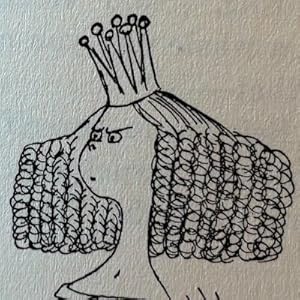
The Countess and the Spatula follows a disheveled noblewoman who finds solace in baking after her husband’s death until her peaceful life of flour and philosophy is upended by a melodramatic opera singer. What was the inspiration for the setup of your story?
The Spatula of Power came first. The characters of the countess; Claudio, the Man with the Black Mustache; and Isabella of Alberthane followed.
What inspired your characters’ interactions and backstories?
Once you know the characters, their interactions follow more or less logically.
I found this novel to be a cutting piece of satire. What is one thing that you hope readers take away from your novel?
I hope readers take away the desire to read the sequel and find out what happens to the countess next.
What is the next book that you are working on, and when can your fans expect it to be out?
The sequel to THE COUNTESS AND THE SPATULA is called NOBODY EXPECTS THE SPANISH INQUISITION. It’s about an inquisition that is also a soap opera.
Author Links: X
We Are All Travelers
The Hundred Lives of Ashfern the Fox follows the journey of a wise fox from an enchanted forest who, from the moment of his birth, is marked by innate wisdom and an awareness of the past lives he has lived.
The writing in your story is very artful and creative. Was it a conscious effort to create a story in this fashion, or is this style of writing reflective of your writing style in general?
Though The Hundred Lives of Ashfern the Fox is only my twelfth publication, my path has already wandered through many genres. For years I have been drawn toward a more lyrical, breath-like style of writing—words that move with the quiet rhythm of wind through leaves. This book felt like a natural deepening of that evolution.
So yes, the artistry was intentional, but it was also instinctive—my prose simply following the currents it was always meant to follow.
Was it important for you to deliver a moral to readers, or was it circumstantial to deliver an effective novel?
My intention was to illuminate the gentle spirit of animism—the understanding that every stone, river, creature, and tree carries its own life and dignity. I hoped readers might feel a tender reverence for the world around them.
Additionally, the deeper messaging of The Hundred Lives of Ashfern the Fox rose from a very personal place: I wanted to write the book I have needed to read my entire life. I have died a thousand deaths in my own ego, heart, and mind to bring this story into the world, fully illustrated and fully alive.
Beyond its lessons, the book is meant as a lantern for the wandering heart: a source of quiet comfort, a glimmer of hope, and a reminder that we are all travelers in this strange, marvelous, ever-unfolding world.
What is the next book that you are working on, and when can your fans expect it to be out?
My next children’s book, Delilah’s Dreamlight Candles, will arrive on December 1st—a small offering of light for the winter season. Alongside it, I am shaping Books Two and Three of my Godslayer Trilogy, both set to be released in 2026.
The first book, The Infinydon, was my debut novel and was honored with the Literary Titan Silver Award in 2022, a milestone that still fills me with quiet gratitude.
Author Links: GoodReads | Facebook | Website
“IN A FOREST older than thunder and younger than sleep, where moss whispered secrets and the stars forgot to wink, a silver-furred fox was born beneath a lunar eclipse…”
So begins the unforgettable journey of Ashfern the Fox, a creature both wild and wise, born of starlight in a lush, enchanted forest. In this luminous, thought-provoking tale, award-winning author and artist MC Lorbiecke invites readers of all ages into a world where every river stone, fern, and fallen feather holds a spirit of its own.
Told in lyrical, poetic prose and brought to life with rich, fantastical illustrations, The Hundred Lives of Ashfern the Fox gently explores the beauty of impermanence and the eternal rhythm of life, death, and renewal. Rooted in the indigenous concept of animism, the story reminds us that nature is not a backdrop but a living, breathing presence, one that sees, remembers, and loves.
As Ashfern moves through a hundred quiet lifetimes , forgetting, remembering, and becoming, readers are offered a comforting vision of a world where loss is not an ending, but a transformation. This book speaks softly to those carrying grief, reminding them that nothing is ever truly lost; it is only changed.
A perfect companion for quiet moments, thoughtful hearts, and curious minds, The Hundred Lives of Ashfern the Fox is a timeless fable for anyone learning how to let go while holding on to wonder.
The Spiral Can Be Reversed
The Path from Hell to Heaven is a philosophical and psychological map of the ego, tracing how people spiral downward into “Hell” through fear, shame, and denial, and upward toward “Heaven” through trust, openness, and renewal. Why was this an important book for you to write?
Because ego explains nearly every human collapse and ascent, yet most people never receive a practical map for it. I wanted to translate psychological chaos—fear, shame, denial—into a recognizable model anyone could use, the same way we map complex systems in software or business architecture. This book is that missing human blueprint: a self-debugging framework that moves readers forward instead of leaving them looping in abstraction.
How did you come up with the concept of the two-sided spiral of the ego and develop this into a process that readers can implement into their own lives to find clarity and understanding of themselves?
I analyzed patterns before individuals. Ego contracts or expands; there’s no true neutral. Avoiding truth descends, openness creates lift. The spiral metaphor stuck because it captures momentum and acceleration.
To make it implementable, I structured it as an RPM self-awareness loop:
- R – Recognize the ego state you’re operating in
- P – Pause the automatic reaction loop
- M – Move with intentional correction or openness
It’s diagnostic and reversible, giving readers a clear exit path whether they’re descending or rebuilding upward.
I found the ideas presented in your book relatable and appreciated the actionable steps that readers can take to find their own clarity. What were some ideas that were important for you to share in this book?
The concepts that mattered most to me were:
- Ego itself isn’t the problem → closed ego is
- Narcissism is often unprocessed fear wearing armor
- Pain isn’t identity, it’s a turning point
- Ambition without self-awareness becomes self-sabotage
- Recognition of the loop always comes before the escape
And above all—I wanted a book that doesn’t just sound smart, but gets applied and changes outcomes.
What is one thing that you hope readers take away from The Path from Hell to Heaven?
That their ego has directions, and so do they. If they feel stuck, defensive, ashamed, or overwhelmed—it’s a state, not a life sentence. The spiral can always be reversed, rebooted, and climbed. The only real trap is believing the descent is normal and permanent.
This book is a Map of the Ego’s Double Spiral — a journey every individual, family, and society travels between Hell (closed ego) and Heaven (open ego).
Through vivid metaphors and grounded psychological insight, LANOU unveils how pain becomes protection, how protection turns to illusion, and how awakening begins when trust cracks the shell.
You’ll see yourself, groups, and even nations in these patterns:
The wound that starts the descent.
The mask that hides pain through control.
The collapse that breaks illusion.
The trust that starts renewal.
The open ego that frees love and truth.
Structured as a fractal spiral, the book reveals six repeating steps across all scales — from individuals to groups to the world itself. It blends the clarity of psychology with the simplicity of spiritual truth: hell is repetition; heaven is renewal.
Once you see the map, you cannot unsee it.
Accidental Book
Killing Brumbies is a strange and moving book that weaves fact and fiction with art into a story that roams from love and art to politics and moral outrage. This is an intriguing setup to a novel that is high in social commentary. What was your moral goal when writing this novel, and do you feel you’ve achieved it?
My novel ‘killing brumbies’ could just as easily be named ‘accidental book’. In 2009 After my last major art shows in Melbourne and in Cairns at the James Cook University about global warming species extinction, I was offered an undergrad position in fine art to ‘catch up. The library staff (God bless them) taught me how to turn the computer on and what an email is. Up to that point I wrote letters and shopping lists by hand or used a quaint old Remington typewriter. The kind where your fingers get stuck between the keys. After a semester of ‘art techniques up to impressionism’, there were no other art subjects on offer, incredible to think art as being cancelled at university level. I changed to Literature, did a semester of ‘writing a play’.
When starting a new body of art, it’s like being taken over by an external force, not a sinister poltergeist, an unstoppable force that until that body of work is all out and finished there is nothing else you can do. The writing happened the same way. It was raw and powerful and in many ways better dialogue than in the book. At first the university was thrilled to have writing talent in the class, even put me on a writer’s program with the local theatre company.
At the first reading of the play the supervising person proclaimed the work banned as too controversial, I refused to stop writing it and was kicked out of university.
It’s not a book I wanted to write; you’d be crazy to want to write a book like this.
I rewrote it as a play, that was banned. I went into a creative coma hiatus for a few years and played with my dog and my horse and did a series of work about Barbie caught in a cave unable to get out. Then I saw a Utube video of someone claiming to have painted my side of the tram, sent him a solicitor’s letter which he laughed at, his response, ‘You don’t exist’.
I got angry, bought my first laptop and began the five-year anguish of writing my book.
‘killing brumbies’ is the statement of my existence. I hope through all the dirt and grime of the storm shines a hopeful message, ‘Horses are sacred and Dogs are Angels’.
What were some themes that were important for you to explore in this book?
I could say something lofty, hopefully witty or tell you the truth. After laying out the plan of the book from the play. I engaged a dramaturg to help me learn to tell a story. It was worse than marriage, I bled on the pages, he criticised everything stabbing into my soft underbelly. Finally, he said I would be jailed when the Aboriginal arts council (which he worked for) got hold of this. It is a fictionalised true story to overcome over 300 hundred pages of censorship imposed by the Australian government on non – indigenous writers.
I started again on my own, realized, I had not gone deep enough into my memory, I needed to see the characters from all angles to understand them. I bought a very large bag of marijuana (illegal in Australia) and spent six months getting in as deep as I could to memories lost or deliberately forgotten.
I ran out of the nice drugs and on the third day of being clean, I experienced symptoms of a heart attack, the ambulance rushed me to emergency, hooked up to life saving equipment, tested for everything… well almost everything. After four hours the doctor came in and asked if I had ‘smoked’, I nodded, THC withdrawals he said. He unhooked me and quietly sent me home, don’t come back he said.
What was one scene in the novel that you felt captured the morals and message you were trying to deliver to readers?
Now that I live the clean saintly life, I can say the chapter I like most is No. 9 City Dingo.
I’d like to think it is that satisfying moment when another wild creature recognizes, accepts and invites you into the pack. The deep primal need to see the stripes of another zebra or hear the call of another wolf. For me as an artist I found a home, another artist, a gentle pure place for a little while. I still howl at the moon calling for him.
What is the next book that you are working on, and when can your fans expect it to be out?
Next underway now, is the Catalogue book of all exhibitions over a 35-year time span. Including short stories, photographs and new work. ‘killing brumbies’ includes a selection of work. The Catalogue book is the complete sequence of paintings so far.
Also, next. I’m mapping out a children’s book with new illustrations.
Freddie the horse and two dogs, something dogs and horses and trails, roads, pathways leading somewhere. People and situations that are not what they seem. I like the original Star Trek episodes of a situation, problem and unlikely resolution.
Having learnt how to write it’s irresistible to keep going, im looking forward to getting into the studio and see what happens, where the story goes…next.
A fictionalised novel by Sue Andrews
Two artists. One love story. A thousand wild horses. And a nation divided by who tells the story.
killing brumbies is a haunting, illustrated fable that explores the collision between creativity and identity, politics and love. Set against the brutal reality of Australia’s wild brumby cull, it asks: Who owns culture? Who speaks for the land? And can we ever separate art from the bloodlines beneath it?
Through raw prose, original artwork, and satirical lyricism, this novel traces the author’s own evolution—from innocent maker to politicised creator—while inviting readers into a deeply personal journey of love, land, and loss.
At once a political allegory and a spiritual reckoning, Killing Brumbies is for anyone brave enough to ask what is art actually worth—and what will we destroy to protect it?



 LITERARY TITAN