Blog Archives
Beneath The Rings


The Doha 2040 Summer Olympics promise spectacle and grandeur. That illusion shatters fast. Twelve Lebanese and Israeli athletes vanish, seized by a shadowy organization known as the Obsidian Hand. Their demand lands like a thunderclap: a ransom of $500 billion. Veteran journalist Nova Mendelsohn steps into the chaos, and the stakes spike with every passing hour. The Olympic Village becomes her launching point, yet the real peril lurks beyond its perimeter. The desert holds secrets. Vengeance brews. Lives hang by a thread. Unless Nova unearths the truth, the kidnapped athletes will not survive.
Beneath the Rings, by Joe Battaglia, evokes echoes of Argo while carving out its own identity. Set in a near-future landscape that feels disturbingly plausible, the novel imagines a world only a few steps removed from our present timeline.
At its center stands Nova Mendelsohn. Once the narrative machinery locks into place, the spotlight rarely shifts from her. Intelligent, relentless, and remarkably resourceful, she becomes the ideal guide through this pressure cooker of danger. Readers may catch glimmers of Dan Brown’s puzzle-laced adventures or the high-velocity grit of the Jason Bourne films, yet Battaglia builds a narrative ecosystem all his own, one defined by crisp storytelling and an inventive delivery of essential clues.
Momentum never lags. Once the plot kicks into gear, it drives forward with remarkable speed. The mystery elements hook the reader early, while the dialogue sharpens the tension. Mini cliffhangers pepper the chapters, each one engineered to tug the reader deeper into the story. Putting the book down becomes a challenge.
The Obsidian Hand also stands apart from typical thriller antagonists. As their identity and purpose come into focus, their motives, while extreme, gain a faint, unsettling logic. This complexity grants the novel an unexpected emotional undercurrent, prompting readers to consider where justice ends and fanaticism begins.
The result is a high-stakes thriller with international scope and literary ambition, a potboiler elevated by thoughtful execution. Battaglia delivers a gripping ride, and further stories featuring Nova Mendelsohn would be more than welcome.

Promise of Mercy

Promise of Mercy pushes the Dreamscape Warriors saga into darker, sharper territory as the long-idle Utopian Founders wake after six centuries and move to seize power by force. Their plot spirals outward fast. Liam O’Connor is kidnapped and flung through an ancient portal into the unknown, the Temple priestesses are drugged and held hostage, and the O’Connor children are thrust into a frantic rescue operation that tears across worlds. The book mixes political upheaval, telepathic warfare, and tight family bonds in a story that never stops moving.
While reading, I found myself pulled in by the heart of the book, which is not the action, but the relationships. Springs writes family moments with a warmth that caught me off guard. A quiet conversation between Liam and Deirdre over pastries feels as gripping as any firefight. Even scenes of chaos keep circling back to loyalty, fear, duty, and love. I liked how the story makes room for softness inside a hard universe. The writing itself is straightforward, sometimes almost plain, but the plainness works. It lets the emotions land without dressing them up.
I also caught myself getting fired up during the more intense chapters. The Founders’ arrogance, their cold talk of “genetic purity,” and their plan to eliminate Liam or “correct” his children stirred real anger in me. On the flip side, the fight inside the Temple hooked me completely. Seeing Bayvin take a hit, Aisling and Deirdre charging in, Celinia steadying herself even while drugged, and the arch priestess trying to hold everything together made the stakes feel personal. The author writes these scenes with a quick rhythm that kept me flipping pages and muttering under my breath. The book might lean heavily on lore sometimes, but even then, I didn’t mind. It felt like being swept into a world that genuinely believes in its own history.
By the end, I walked away feeling surprisingly moved. This is a story where the characters’ courage matters more than their weapons, and where mercy is treated as a kind of power. The book would be a great fit for readers who enjoy sci-fi adventures with real heart, for fans of military space opera with family drama baked in, and for anyone who likes telepaths, portals, and rebellions, all mixed with warmth and humor. If that sounds like your style, Promise of Mercy delivers.
Pages: 446 | ASIN : B0DBBBNN5P

Tales of Adventure

Slickrock weaves together the paths of a loner who discovers a body in a granary and a college student who is roped into a scheme by a crew bent on revenge. Where did the idea for this story come from?
The remote wild country in Canyonlands National Park seemed like a great place to store a kidnap victim while waiting for the ransom, and it was also perfect for the intervention by “Relic,” the moonshining hermit of Canyonlands.
How do you balance story development with shocking plot twists? Or can they be the same thing?
One builds naturally into the other, especially when a character is cornered by circumstance and their own choices.
Do you have a favorite moment in Slickrock? One that was especially fun to craft?
That’s a tough question. Maybe the scene where Relic fools the shooter into thinking the deputy is already dead.
Can we look forward to more work from you soon? What are you currently working on?
Yes, I really enjoy writing about the moonshining hermit and tales of adventure and intrigue in the desert outback!
Author Links: GoodReads | Facebook | Website | Amazon
Malia is kidnapped and held in an old trailer in a remote canyon. When a gin-brewing recluse named Relic rescues her, an investigating deputy teams up with a hunter who is not who he claims to be… Malia and Relic must survive a deadly shoot-out, evade their pursuers, and warn the deputy before it’s too late. But someone in town is helping the bad guys. And a trip-up in their plan only makes them more determined and lethal…
Too Complex: It’s a (Enter Difficulty Setting Here) Life
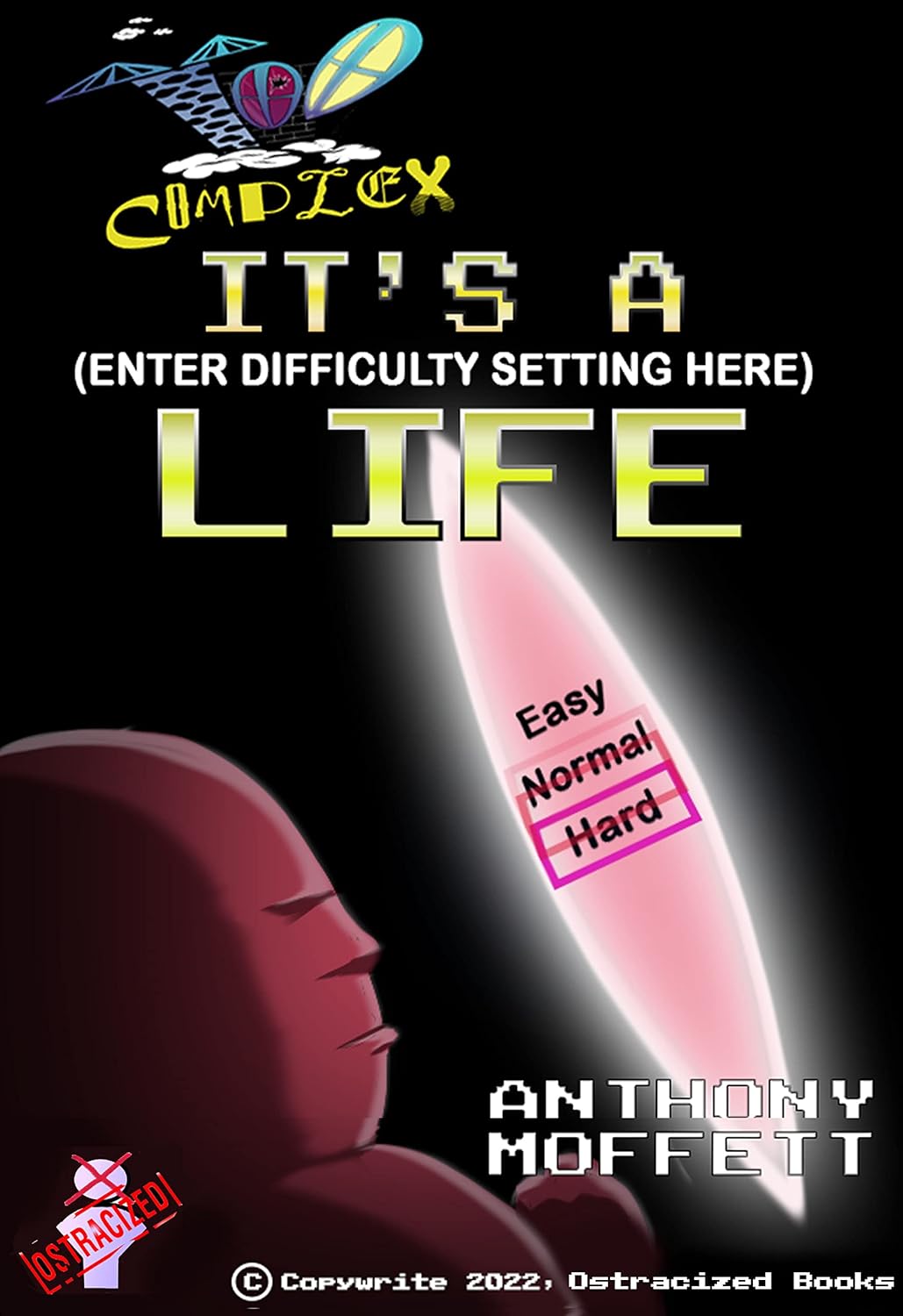
Cody Redbond lives to game. Addiction defines him. His fixation centers on Fantasy Estate, an online battle royale that consumes his days and erases everything else. Hours disappear. Priorities collapse. The game becomes his only reality, while the world beyond his screen loses all appeal. Employment slips away. Social skills erode. Eventually, eviction follows. Even then, Cody refuses to move on. He is too deeply embedded in the digital realm to disengage on his own.
Enter leasing agent Mavirna Holmes and property manager Corey Dwellen. Their task is simple in theory and nightmarish in practice: reach Cody and reclaim the apartment. Doing so requires navigating a living space that has deteriorated into absolute chaos, a physical manifestation of Cody’s inward retreat.
Too Complex: It’s a (Enter Difficulty Setting Here) Life, by Anthony Moffett, is a compact and sharply comic work that blends prose with illustrations. It occupies a space somewhere between novella and graphic novel, using visuals to punctuate its humor and heighten its absurdity.
At its core, the book is an absurdist adventure tailored to video game enthusiasts, but its reach extends further. It functions as a satire of modern adulthood, skewering burnout, disconnection, and the quiet despair that drives escapism. As Cody’s story unfolds, sympathy becomes inevitable. He has not merely abandoned reality; he has replaced it with something brighter, louder, and more responsive. Ironically, the so-called real world offers little incentive to return. It appears dull, unforgiving, and deeply uninspiring by comparison.
This contrast captures the enduring appeal of video games. They promise immersion without consequence, excitement without monotony. When everyday life feels hollow or exhausting, fantasy becomes irresistible. Mavirna and Corey, the unfortunate duo assigned to retrieve Cody, find themselves on a quest of their own, one that mirrors the very games Cody adores. The ultimate irony lies in the aftermath of his obsession. The artificial world he clung to has reshaped reality itself, transforming his apartment into a grotesque, pest-ridden dungeon.
The result is a book that is unabashedly fun. It is silly, unhinged, and gleefully excessive. Beneath the humor, however, lies a pointed warning. Too Complex entertains first, but it also lingers, offering a sharp and thoughtful reflection on escapism, avoidance, and the cost of choosing fantasy over life. I highly recommend this humorous and highly relatable tale to gamers and non-gamers alike.
Pages: 73 | ASIN : B0BR4J3L9Y
Engineering the Puzzle

The Asset Within follows a CIA case officer who receives life-altering intelligence from an Iranian defector during a routine debrief, resulting in her alignment with a team that includes the man who once broke her heart. What was the inspiration for the setup of your story?
I’m a Black woman and a former CIA officer, and I wanted to write a thriller that felt emotionally true to that world. The seed of the story came from what it felt like to be the only Black graduate in my training class. I carried both pride and pressure at the same time, and constantly navigated the unspoken dynamics that come with being “the only.”
From there, I wanted to explore a kind of love story I don’t see often enough: the complicated patriotism many Black Americans live with—serving a country you believe in, even when you’ve also been asked to endure its blind spots. The Iranian defector and the intelligence drop are the spark, but the heart of the setup is what happens when duty collides with history…and Andy is forced back into close orbit with the man who once broke her heart.
What do you find to be the most challenging aspect of writing a thriller? The most rewarding?
The hardest part is engineering the puzzle aspect of a thriller. I’m not a natural outliner, so I draft by instinct first, and then I have to go back and make sure every twist is earned, the clues are seeded, and the pacing stays tight without cheating the reader. Continuity is the invisible work in thrillers.
The most rewarding part is immersing myself in the story. When it’s clicking, I feel like I’m inside the scene with the characters. My heart races, I feel what it’s like to make impossible decisions, and when readers tell me they couldn’t put it down or were shocked about twists and turns they didn’t see coming – that is the best feeling.
What was the inspiration for the love story and the connection the characters have?
The love story came from watching what this kind of work does to people. Espionage isn’t just dangerous—it’s isolating. It demands secrecy, long absences, and a level of emotional compartmentalization that can strain even the strongest relationships. And yet I’ve seen couples make it, but the bond has to be more than chemistry. It has to be trust under pressure.
Andy and Cameron’s connection is rooted in history and in shared understanding: they both know what it costs to serve, and they both carry scars from how that service shaped them. Their story is also personal for me. It’s inspired by a relationship from my own life—one that didn’t last—but I used that emotional truth to write the version of the love story that could survive in this world.
I find a problem in well-written stories, in that I always want there to be another book to keep the story going. Is there a second book planned?
Absolutely. Book Two in the Global Security Series is planned for Spring 2026, and it takes Andy and Cameron into an even bigger operation—higher stakes, deeper consequences, and a relationship that has to hold under real pressure. They’ll get one more book to complete their arc, and then Theo gets his moment. His story kicks off with a teaser at the end of Book Two, and I can’t wait for readers to meet him in a bigger way.
Author Links: GoodReads | Facebook | Website | Amazon
CIA Officer Andy Lynam returns home after an intelligence operation goes horribly wrong. When she becomes the target of the insidious international terrorist network Solaris, one with the power to manipulate fractures within her own agency, she realizes her badge alone can’t protect her.
To survive, Andy aligns herself with a covert team of global security officers to expose corruption at the highest levels and bring the terrorist organization down.
But when that team includes her ex-boyfriend, GSO Cameron Landry, old flames reignite. This romantic spy thriller is packed with second chances, forced proximity, workplace tension, and soul-deep romance.
Discovering Her Courage

Flee follows a Marine Reserve and librarian-in-training, who, while on a bus journey to a family reunion, ends up in a desperate fight for survival after a nuclear catastrophe devastates Washington State. What was the inspiration for the setup of your story?
In Escape, the first book in the Haven series, survivors make their way to Haven in waves—some travel alone, some in groups, some are injured, and some barely hold on. As I wrote the story, I realized that not everyone could reach safety at the same time. Some characters are close, while others are far away, trapped in the chaos when the world ended. This opened the door for individual stories of struggle, loss, and survival to unfold simultaneously.
While I worked through book one, Sadie’s absence lingered as a question—for me and, eventually, for readers. Flee grew out of my need to answer it. I wanted to explore the survival of someone without immediate shelter, someone caught in transit when everything collapsed, and someone forced to fight—both physically and emotionally—to make it home.
Sadie is a woman with strength and incredible intellect. What do you think makes her a valuable and worthy heroine?
In Escape, I introduced the “five musketeers.” Three of the women are entering adulthood, and Sadie has always been the instigator. While Beth is quieter and still discovering her courage, Sadie knows her own strength and intellect—and isn’t afraid to use them. She may possess the drive to take what she wants out of life, but she falters with love and vulnerability. Sadie challenges the control men in her life exert upon her, pushing her to rebel. Her journey is about finding balance—between strength and trust—and that evolution truly defines her as a heroine.
I felt that the action scenes were expertly crafted. I find that this is an area that can be overdone in novels. How did you approach this subject to make sure it flowed evenly?
I’m a visual person, so to write action scenes with weapon elements, I needed to first understand fighting techniques and the moves involved. Watching my son earn his junior black belt in Taekwondo taught me a lot in real time—especially about defending yourself in various positions and how hard it is to fight for your life. Understanding the difference between weight classes and genders was also crucial. You can be small and still cause damage, but at what cost? Then there’s the added layer of weapons and the types that may be involved. As Sadie says, “Knife trumps stick.” She knew there would be a cost, though.
I hope the series continues in other books. If so, where will the story take readers?
Even though the women are my protagonists, my two secondary characters, Donovan and Hoss, stayed at the forefront of my mind during these two books. Donovan is an open book to my readers. He craves control to maintain stability in his life and demands it from his children and everyone around him. Hoss, on the other hand, is a laid-back, “you do you” kind of man. My readers know little about him—something I intentionally kept vague—but there are breadcrumbs scattered throughout if they look closely enough.
After doing their family trees, I realized I gave Donovan more daughters and Hoss more sons. I researched which gender was easier to raise, and the results were interesting, so I played on that. (Sons are easier, it appears.)
Beth isn’t blood-related, so I started with her story first in Escape. The found-family trope is strong throughout my stories. In Flee, we circle back to follow Donovan’s oldest, Sadie, as she battles to reach Haven. Donovan’s second oldest, Gina, appears in Beth’s story and continues her journey in the second book. In the third and fourth books, Hoss’s family becomes my focus, revealing more about Hoss’s background. Though he might sport funny sayings on his t-shirts and love recon, Hoss has many layers to peel back.
Author Links: GoodReads | X (Twitter) | Facebook | Website | Amazon
Facing the collapse of civilization, a feisty and independent young woman embarks on a perilous adventure that pushes her to her limits and challenges her long-held goals.
The missile marked the beginning of Sadie’s nightmare. The demands of a crumbling society, dangerous terrain, and her own weakening, feverish body will test her courage.
Sadie wants to flee to the safety of her family’s compound, where Liam waits, and the ache in her chest is a constant reminder of her feelings for him.
Despite his calm exterior, Liam anxiously awaits Sadie’s arrival. More questions than answers remain: Where is Sadie? Why hasn’t she made it to Haven like the fortunate few?
Hunter has his own plans. Escaping the taint of his family’s criminal past puts him in Sadie’s path. She struggles to trust him. Forced together, their connection deepens, placing her family and all of Haven in extraordinary danger.
Survival depends on Sadie taking control of her own life and deciding whom to trust and whom to love. Her decision could set her free…or destroy her and everyone she loves.
Embark on an unforgettable adventure to Haven with these memorable characters, experiencing twists and turns you look for in a fast-paced, gripping read.
A tangled web of love, shifting loyalties, and explosive conflicts drives the Haven series forward, with the same intensity and passion as Kyla Stone’s Edge of collapse saga.
Literary Titan Gold Award Winner
Soul of the Saviour

Soul of the Saviour drops you into a wild mix of brutal training grounds, smoky alleys, ancient magic, and the strange heat of Hell itself. The book follows Saxon Payne as he crawls back into life after years in a mystical retreat. It weaves through his past, the rise of lethally gifted assassins, demonic lovers, grim prisons, tender memories, and the looming clash between Heaven, Hell, and everything in between. It moves fast and swings between action, horror, and raw intimacy. Sometimes it feels like half spiritual odyssey and half grindhouse myth. I found myself swept up in the momentum because the story rarely slows down enough for you to catch your breath.
The writing goes for broke. Scenes in Hell’s kitchens shimmer with disgusting brilliance, and scenes of training in the mountains bristle with physical grit and stillness. There is a real commitment to showing bodies under strain and souls under pressure. The prose jumps from grim to tender in a heartbeat, and it gave me that sense of watching someone flip through different emotional filters just to see what hits hardest. The violence is bold. The sensuality is bold. The humor sneaks in with a wink. I liked how messy it all felt, because it made the characters feel lived-in and not staged.
The whole thread around becoming more than human through suffering made me uneasy and fascinated at the same time. I found myself rooting for characters who should have terrified me and shaking my head at choices that were obviously doomed. The story loves duality. Hope beside despair. Faith beside hunger. Love beside something darker and stranger. Sometimes it veers into excess, and sometimes the emotional beats come so fast I had to take a moment to reorient. But even then, I felt drawn along by the sheer confidence of the storytelling. It feels like the author trusts you to surf the chaos, and I liked that.
By the end, I felt satisfied and also curious because the book leaves a lot of questions humming under the surface. I would recommend Soul of the Saviour to readers who enjoy high-energy dark fantasy, intense character arcs, sharp edges, and worlds that bend myth with modern grit. If you like stories that mix heart with horror and beauty with brutality, this one will keep you turning pages long after you planned to stop.
Pages: 325 | ASIN : B0FCDT2J11
Between Eros

When I first picked up Chris Neo’s Between Eros, I thought I was stepping into a straightforward love story, but it opened up into something bigger. The book follows Aris, an older, seasoned man juggling a collapsing marriage, unpredictable friendships, and a dangerous ocean voyage that turns into a survival fight. What begins as a romantic adventure quickly spirals into storms, sabotage, and tangled emotional loyalties. The story blends romance, action, and psychological tension, giving it the feel of romantic adventure fiction tinged with thriller energy.
As I read, I found myself reacting as if I were listening to a friend tell me wild stories over coffee, pausing every so often to say, “Wait… what?” The writing leans into momentum rather than subtlety. Neo moves quickly through conflict, argument, seduction, and danger, rarely lingering on inner reflection. The fast pace kept me turning pages. I didn’t expect the mix of interpersonal drama and near disasters at sea to feel as chaotic as it did, but it fits the book’s emotional landscape. Aris is constantly pulled between desire, responsibility, ego, and fear, and the writing mirrors that turbulence.
Aris is written as both admirable and deeply flawed, and the women around him range from seductive to volatile to tender. The tone sometimes slides into melodrama, but in a way that feels intentional for the genre. What stood out most to me were the moments when characters dropped their masks. A single line of vulnerability from Kay, or a burst of insecurity from Uri, did more for me than some of the larger plot swings. The book seems to ask whether love is a force of destiny, a psychological illusion, or something we build through trial, error, and sheer stubbornness. It doesn’t hand you a tidy answer.
By the time I closed the book, I had the sense that Between Eros would appeal most to readers who enjoy high drama, fast movement, and a blend of romance and danger. If you like romantic adventure fiction that leans into passion, betrayal, big emotions, and bigger twists, this one delivers exactly that. It is bold, emotive, and unafraid to swing for the fences.
Pages: 390 | ASIN : B0D6BTYFNZ



 LITERARY TITAN