Blog Archives
Art
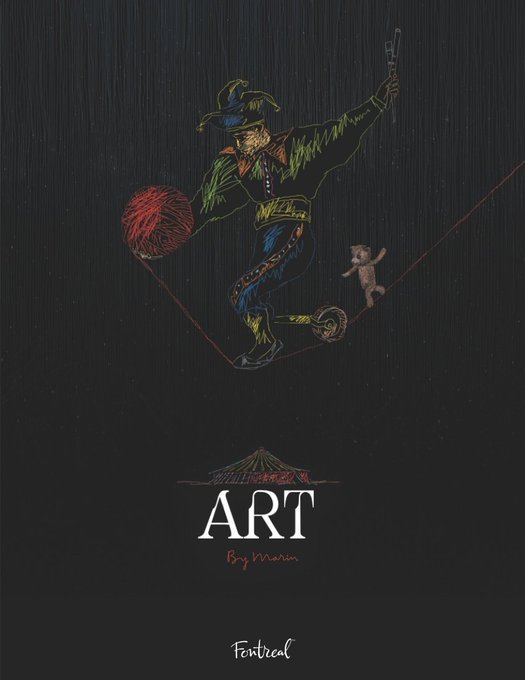

Art is a wordless picture book that speaks volumes with its stark line drawings. Calling it a line drawing is a disservice to the art pieces themselves because, when the lines come together, they transcend the descriptor and culminate into vivid yet dark pieces that are magnificently evocative.
The story follows a circus performer, and his teddy bear. We start off in the performers home and follow them to the circus tent where they will put on a show for royalty. I’m explaining what happened in a single sentence but the author conveys this simple one line event with eight marvelous art pieces. Each one drawn in simple lines but that betrays the complexity and beauty of the pieces. I was mesmerized by each one. With no words throughout the story, I was left lingering on each page for a few minutes, following the lines, understanding the image and picking out the nuances. I was absolutely captivated.
We get to the circus and we see an audience filled with royalty. The line drawings accomplish much complexity in these scenes while keeping the art style consistent. I was blown away but the crowds in these scenes because every person in the crowd is unique and can exist in its own space and seemed to have their own backstory.
Then we move onto the performance. What starts as a normal circus act slowly evolves into a surreal performance that I liken to what one would see at a Cirque Du Soleil show. Each dream-like performance expertly utilizes the artists unique style in dramatic new ways that was stirring. What I appreciated most was the attention to specific details in each piece. Not that every detail was provided, but instead the details that are provided bring the readers focus to where the action and emotion is.
Art is a mesmerizing wordless picture book that will inspire the imagination of both children and adults with its brilliant and expressive imagery.
Pages: 28
Fontreal.com
Using Japanese Paper for Digital Printing of Photographs
You may never understand the beauty of photography until you read Using Japanese Paper for Digital Printing of Photographs by Carl-Evert Jonsson. Carl-Evert Jonsson writes extensively on photography, focusing on Japanese paper for the digital printing of photographs. The author is intentional in his explanations and describes every detail for those not familiar with Washi.
The images in Carl-Evert Jonsson’s book tell a compelling story. The pictures are stunning, distinct, and aesthetically pleasing. The photos are classed into four groups; Places, Persons, Varia, and Mixed. Each of these categories tells a unique story that the reader connects with. I loved going through the images under Persons as one can see the different features in humans and how individual people are. Images of places are striking because of the locations the author drew his inspiration from. Varia and Mixed pictures are also eye-catching and impactful.
One of the best things about this book is that the author uses few words in the description and leaves the reader to form an opinion on the images without being influenced. Under the Mixed category, the image displaying the Notre Dame de Paris and the Vehicle. Brown ochre, primary blue was my favorite. Varia had a lot of impressive figures, but the image displayed Egg oil x1. Underneath: yellow ochre subjects were my best. The sense of illusion when one looks at the picture is satisfying. It feels authentic for a minute, then one feels a certain sense of imagination the next minute.
Carl-Evert Jonsson shares a personal touch throughout the book. Anyone reading this book will appreciate the author more as they keep flipping the pages. I loved reading the preface as the author gives a little background information about himself and the book. Carl-Evert Jonsson’s story is fascinating and increases one’s interest in photography. The author also enlightens the reader on techniques for digitally printing photographs on Japanese paper in the introduction. The short text was helpful, especially to readers that may not have been familiar with different photography techniques. The modest way of expounding on concepts and creativity displayed by the author is inspiring enough for one to delve into photography and related subjects.
Using Japanese Paper for Digital Printing of Photographs is a captivating book that photography students, lovers of nature, and individuals who fancy capturing objects and printing them will love. Any photography enthusiast will appreciate this work, especially the content under Places and Persons. Every image under this category was unique in its own way.
Pages: 54 | ASIN : B0998MKMTD

American’s Misconceptions

White Lies Matter: Decoding American Deceptionalism explores issues facing America and provides thought-provoking commentary using art. What inspired you to write this book?
I have previously stated that, “Years ago, noted art critic Robert Hughes lamented the fact that America had never had a Goya. That notion apparently remained in my subconscious because by 2013, I realized that my art was focused more and more on revealing the lies and misconceptions that were abundant in American history.
In addition to that motivation, my education includes minors in mathematics, foreign language and art history. And, my professional background goes well beyond teaching classes in art and art history. I have also taught in the University of Florida College of Engineering, created and taught in the Master of Business Administration degree program in UF’s College of Business Administration, and taught Art Law at UF for fifteen years along with Distinguished Service Professor of Law, E. L. Roy Hunt. And, for more than ten years, I worked with Professor of Medicine, Dr. James Cerda studying and writing about the health hazards affecting actors, artists, dancers, and musicians. I was also made quite aware of all of the issues beyond the arts that face our society through my founding of the nation’s first arts policy center, the multidisciplinary UF Center for the Arts and Public Policy and its many subsequent diverse programs.”
What were some themes that were important for you to explore in this book?
The book primarily deals with American’s misconceptions of their country’s history––especially in the areas of politics, law, and journalism.
What do you hope is one thing readers take away from your book?
Far too many people today, and Americans in particular, have no real sense of history––theirs or their country’s. I hope that the reader of this book will finally begin to rethink what he or she really knows about the United States. This issue has become far more important in the 2020s than, perhaps, ever before. Both the text and the plates provide a new and different way of approaching this objective.
What is the next book that you are working on and when will it be available?
I began working on White Lies Matter Two: Myth America in April 2021. I hope that it will not take eight years to complete as the first book did, and I am enough of an optimist at almost eighty-two years of age to think that I can complete it by December 2022.
Author Links: Amazon | GoodReads
Trusting One’s Creative Voice
The Glimpse follow a rising artist who becomes pregnant and is determined to be a good mother and a good artist while facing the harsh realities of a male dominated world. What was the inspiration for the setup to your story?
This book hit a number of curiosities. I’ve always been drawn to the Abstract Expressionist movement and wanted to delve into what this era was like for a woman artist. It was considered taboo to have a child if one wanted to be successful. Also, I was interested in exploring what happens to someone who is successful early in a movement, then disappears. What happened and why?
Liza Baker is an intriguing and well developed character. What were some driving ideals behind your character’s development?
I modeled Liza loosely on Joan Mitchell, my favorite painter from the Abstract Expressionist times. Like Joan, Liza is a very talented artist, fiercely devoted to her work. She also has a troubled relationship with her father whom she never could please. Mitchell’s biggest regret was that she never had a child. Liza did and she longed to be a good mother, even as she was desperate to re-establish her early success. Problems in pursuing both were inevitable.
What were some themes that were important for you to explore in this book?
Difficult mother/daughter relationships (as most are) and how hard it is for women artists working in a male dominated arena, especially if they choose to be mothers. Also the value of persistence and trusting one’s creative voice.
What is the next book that you are working on and when will it be available?
This next is quite different. It’s about a boy who survives a punitive childhood (adopted by Christian fundamentalists) by becoming one of the first Christian ventriloquists. I’m titling it Raised in Captivity. Won’t be out for a bit as I write around a full time job.
Author Links: GoodReads | Twitter | Facebook | Website
She takes a job teaching at a college and comes up against the harsh realities of the male-dominated art world. Unable to build a successful career, she watches as her former lover, whose work resembles hers, skyrocket to fame. Liza develops a drinking problem and often brings home artist lovers she’s met in the city. When Rouge meets Ben Fuller, one of Liza’s discarded lovers who subsequently fosters Rouge talent in photography, the complexity of the mother-daughter relationship takes on the added charge of a competition between the two, one that Liza tries to sabotage.
THE GLIMPSE is a moving, unsentimental tale of the charged New York art world of the 1950s and the relationship between a mother and daughter as they grapple with their relationship that becomes pivotal to their artwork.
PHANTOM BULLET’S
![PHANTOM BULLET'S by [Andrew Avra]](https://m.media-amazon.com/images/I/513nfBksKpL.jpg)

Phantom Bullets by Andrew Avra is a collection of paintings and journal extracts depicting the mental health issues faced by Lilly. Through the visual representations of her internal battle as well as images showing parts of her past, the reader is able to follow along and get an intimate understanding of Lilly’s mind. Interspersed throughout are short extracts from her journal which further helps the reader to keep track of how Lilly is feeling and follow the flow of the artwork.
Going through each stage of her life and her struggles, you can clearly see the changes that take place. One aspect which varies drastically is the colors used to paint the watercolor images, in the beginning, although you can tell there is a lot going through her mind, the colors used are quite vivid shades of pink, purple and blue. As you move through her life the colors gradually become duller and there are much darker shades used which may represent the different mental health problems she is dealing with. It is also done well as you get to see both her external reality beside what is happening internally.
Phantom Bullets is a fantastic representation of the wide variety of mental health problems a person can experience, and in many paintings, demons are depicted which makes it clear the journey you are following. I think it would work better as an art collection, both as a way of telling the story or as one-off pieces of work. I would’ve liked a little dialogue to get a better sense as to what Lilly was feeling in the moment. The images can be interpreted a different way then what the author intended. But I suppose this is also the point of art isn’t it? The reader does get a more in-depth insight into how someone can be struggling internally and the different ways they try to express their emotions.
Phantom Bullets is a unique graphic novel with interesting art pieces all throughout the book that tell a thought-provoking and impassioned story in vivid color.
Pages: 131 | ASIN: B09CN45D8N

Where Paint Goes

Where the Paint Goes by Larry Lewis, is an authentic and cleverly written autobiography of the life of Larry Lewis. Throughout his life, Lewis embraced the places he lived and the diversity of the people he met. Both played an important role in shaping his artistic growth. From an elementary student’s misrecognition of his work in an art competition, through adolescent gaffes, to an innovative sculptor and married man, the reader perceives each of Lewis’ life experiences and their effect on his art. Lewis vividly covered the topic of how his art, through his eyes, affected his life and how his life affected his art. Throughout the book, the reader experiences the delights and calamities of Lewis’ life, all as he paints a persistent balance between the style of art he is creating while growing as an artist. He wrote, “Sometimes, one’s vision can be as important, possibly more important, than the sum of knowledge gathered and synthesized in regards to that specific discipline.” (225)
The structure of Where The Paint Goes is focused on a casual, form-flowing style. Lewis begins the story in his childhood, moves on to confesses his teenage blunders, and matures into adulthood fluidly. All the while he shows how he’s grown from an insecure want-to-be painter to an accomplished artist. To add a bit of romance to the story, Lewis shares his clumsy adolescent encounters with girls and his fledgling artwork, to then meeting the woman with whom he wants to spend the rest of his life and his growth as an artist.
Where Paint Goes, The Art That Affected My Life, And The Life That Affected My Art is smoothly written, captures the reader’s attention from the beginning, and is a delight to read.
Pages: 238 | ISBN: 1637281161
Great Britons of Stage and Screen: In Conversation

Great Britons of Stage and Screen: In Conversation shares the intriguing and profound interviews author Barbara Roisman Cooper has had with a long list of film and theater stars. The interviews are often candid and provide deep insight into overlooked aspects of being an actor, and what is really required of a professional actor, which will appeal to anyone interested in the dramatic world of film and theater.
Author Barbara Cooper has interviewed a great many actors and provides readers with a long list of interviews to dive into. Some of the actors I recognized, while others I did not. Which is why it was helpful to have the introduction to each actor as this helps readers appreciate their accomplishment and get to know them before reading the in depth interview.
Each interview has a candid and casual feel and Barbara asks interesting questions that really brings life to the interview and gets the most out of the interviewees. My favorite interview was with Simon Callow, CBE, possibly because I’m more familiar with his work, but also because I just found the interview, and him, to be fascinating.
I really enjoyed the images that are included throughout the book, because when I didn’t recognize a name I would often recognize a face, and it helped put a face to the words when reading the interview.
Great Britons of Stage and Screen: In Conversation provides a rich and detailed look into the different lives of revered and celebrated British actors. Barbara has a way of turning an interview into a penetrating conversation that will delight both film and theater enthusiasts and anyone that wants to learn more about their favorite actors. This is an illuminating book that captures a magnificent history and provides an enlightening reference to anyone interested in film and theater arts.
Pages: 424 | ASIN: B014ZT5SPI
Drawing, Politics and Graphic Propaganda
White Lies Matter explores the deceptions and cynicism of America while exploring the “alt- facts” that permeate contemporary society. Why was this an important book for you to write?
Years ago, noted art critic Robert Hughes lamented the fact that America had never had a Goya. That notion apparently remained in my subconscious because by 2013, I realized that my art was focused more and more on revealing the lies and misconceptions that were abundant in American history.
In addition to that motivation, my education includes minors in mathematics, foreign language and art history. And, my professional background goes well beyond teaching classes in art and art history. I have also taught in the University of Florida College of Engineering, created and taught in the Master of Business Administration degree program in UF’s College of Business Administration, and taught Art Law at UF for fifteen years along with Distinguished Service Professor of Law, E. L. Roy Hunt. And, for more than ten years, I worked with Professor of Medicine, Dr. James Cerda studying and writing about the health hazards affecting actors, artists, dancers, and musicians. I was also made quite aware of all of the issues beyond the arts that face our society through my founding of the nation’s first arts policy center, the multidisciplinary UF Center for the Arts and Public Policy and its many subsequent diverse programs.
There was a lot of history you covered in the book and examined in different ways. How much research did you undertake for this book?
It took eight years to complete the book, and every part of it was researched in depth over and over again. As an artist, I was convinced that it was imperative for me to take greater pains than a historian to ensure the accuracy of the text.
What is a common misconception you feel people have about the modern American political system?
As I researched material for the art images, I re-learned a great deal about American history. It also became apparent to me that far too many Americans did not know, did not understand, or did not believe our history. I first noticed this in the 1990s with the polarization of students in several of the art law classes. A significant number of the third year law students were politically to the far right, espoused Evangelical Christianity, and even admitted that they were studying art law in order to learn how to better censor art. In the early 2000s, I created an art class titled Drawing, Politics and Graphic Propaganda focusing on the editorial cartoon. For the several years that I taught this class, students literally split into two separate, polarized, opposing groups. This situation was most apparent during the class critiques when students presented their completed editorial cartoons. Half of them––literally––lined up on the right side of the room, the other half on the left. And that division was completely reflected by the views they espoused during the critique session.
You convey facts with metaphors and various storytelling devices. Was this intentional or incidental to your writing style?
I attempted to inform the viewer-reader both visually and through my written analysis. I recognized that the small slate was the chalkboard of education in the nineteenth century, but it also reminded me of today’s iPad. This double interpretation was important as I began to utilize the image of a small slate as the vehicle to “educate” viewers about this dilemma. The written accompaniment to this digital art series was inspired by a former student of mine, Patrick Grigsby, who observed––during one of my New Year’s Day celebrations with many friends––that when I talked about my digital art accompanied by the images of the slates on my computer monitor, people could begin to understand it.
As far as either the written and art style is concerned, it is quite eloquently summed up in art critic Peter Frank’s 2003 essay on my work entitled “How you see it, how you don’t.” Frank wrote, “Like an opera singer who has carefully cultivated a dramatic stage presence as well as a golden voice, and who has done so in part to be able to pass on such crucial ambidexterity as part of his or her legacy, O’Connor trains us by showing us by example–example that has not been dumbed down, but cleaned up. He entices us into his intellections not by making them less elusive (or for that matter allusive), but by making their elusions (and certainly their allusions) more inviting. If Americans can learn to eat spicy food, they can learn to ‘read’ art.”
Author Links: Website


 LITERARY TITAN