Blog Archives
Depth, Honesty, and Context

Through the Lens of an Ancient Yisra’elite Bible Study walks readers through the history, language, culture, and theology of the ancient Yisra’elites. What inspired you to write this theological guide?
Writing a book was never my original intention. My goal at first was simply to research, gather data, and develop a study I could teach in local churches or through online platforms. Over time, people who attended those studies offered thoughtful feedback and repeatedly encouraged me to publish the material in book form.
What ultimately inspired me was a growing concern that much of modern teaching approaches Scripture through a Western lens that ignores the linguistic, cultural, and historical world of ancient Yisra’el. I saw pastors avoiding difficult topics and doctrines being taught without a solid scriptural foundation, often because that ancient context was missing. The more I studied, the more I realized how much meaning is lost without it.
After prayer and reflection, it became clear that transforming the study into a book was the right choice. My intention is not to argue for novelty, but to help readers engage Scripture as its earliest communities would have understood it—with depth, honesty, and context.
Did you learn anything that surprised you during your research for this book?”
Absolutely. The research process was full of surprises. One of the most eye-opening discoveries for me was realizing how differently ancient Yisra’elites understood concepts we often take for granted—things like covenant, identity, honor and shame, communal responsibility, ritual purity, and even time itself. These ideas do not translate neatly into our modern Western categories, and I was often surprised by how much meaning is lost when we try to fit them into our own frameworks.
I also encountered linguistic surprises. Hebrew names, idioms, and expressions that modern translations flatten—sometimes for readability—carry layers of meaning that change the tone of a passage entirely. For example, understanding terms tied to covenant language, marriage imagery, or the “appointed times” of Yahweh revealed connections I had never been shown in church settings. Even the way ancient Yisra’el measured days and months reshaped familiar timelines, such as the biblical festivals or the crucifixion and resurrection accounts.
Another area that surprised me was how much clarity emerges when we consult non-canonical literature—not as Scripture, but as cultural context. Works like Ḥanok (Enoch), Jubilees, or Jasher reflect the worldview, vocabulary, and assumptions of Second Temple Judaism. These writings don’t replace the Bible, but they help us understand how ancient communities thought about angels, the afterlife, judgment, marriage customs, and cosmic order. When you combine that with linguistic study and the biblical text itself, the result is a fuller and more coherent picture of the ancient world.
All of this taught me how much beauty and continuity live beneath the surface when Scripture is allowed to speak from within its original cultural world. Passages that once seemed disconnected suddenly fit together with remarkable clarity. That realization humbled me and reminded me that the Bible was written within a real historical context, to real people who shared a worldview very different from ours. Honoring that world not only deepens our understanding but also brings us closer to the heart of the text itself.
What is one thing you hope readers take away from your book?
If there is one thing I hope readers take away from this book, it is a deeper appreciation for how transformative Scripture becomes when we honor its original context. The Bible did not emerge in a vacuum, and when we approach it through the language, culture, and worldview of ancient Yisra’el, we begin to see truths that modern traditions often overlook or soften. That awareness can bring both clarity and curiosity—clarity in understanding what the text is actually saying, and curiosity to keep asking hard questions without fear.
At the same time, I hope it renews a sense of awe for the God who reveals Himself within that context. My prayer is that readers walk away not only with stronger historical and linguistic insight, but with a deeper faith—one rooted in truth, not assumption. If this book encourages believers to read with fresh eyes, greater humility, and a sincere hunger for the heart of Scripture, then it has accomplished its purpose.
Author Links: Goodreads | X (Twitter) | Facebook | Website | Amazon
More than a devotional guide and more grounded than a theological essay, this book functions as a lens-cleaner for students of Scripture who want to see the biblical text on its own terms. With clarity and accessibility, it explores how concepts such as honor and shame, communal identity, covenantal relationships, Hebraic idioms, and ancient Near Eastern worldview shaped the original meaning and intent of biblical passages.
Written from within a Hebraic worldview, and with a commitment to both historical integrity and discipleship, the study reframes familiar themes through the eyes of the ancient Yisra’elite community. The result is not speculation or novelty, but restoration—helping modern readers hear the biblical message as its first audience would have understood it.
In this study you will explore:
How the ancient Yisra’elite worldview differs from modern Western assumptions
Why concepts like honor, shame, covenant, kinship, and communal ethics are essential for understanding Scripture
The impact of Hebraic language and idioms on meaning and interpretation
How the Bible communicates through patterns, cycles, and narrative structures rather than abstract doctrines
The difference between covenantal relationships and modern contract-thinking
What happens when Scripture is read within its own cultural soil rather than through later philosophical frameworks
Ideal for readers who:
Want to understand the Bible in its historical and cultural context
Sense a disconnect between ancient Scripture and modern Western interpretation
Teach or lead Bible studies, small groups, or discipleship courses
Are exploring the Hebraic roots of the faith
Desire a deeper, more grounded approach beyond commentary-driven theology
Are curious how honor-shame culture shapes biblical narratives and ethics
What It Really Means To Give

Tithing and Giving: A Biblical Study guides readers through an in-depth exploration of biblical tithing, contrasting Old Testament mandates with New Testament freedoms, structured around the idea that the commonly accepted modern practices of tithing, especially monetary, are misunderstood and not supported by Scripture. What inspired you to write this important book?
That is a good question. In truth I had no intention on writing a book about tithing and especially had no plans to teach on giving. This all began with the idea to take some study material I had already done on biblical tithing and do a short study on it for my family.
The title was literally A short Study on Tithing. However, when I began to type things out I felt that the Holy Spirit was leading me to write a book. It was some what terrifying for me as I did not feel qualified and was not looking forward to the heavy pushback that I would get. Since this was not the first time I have had this experience with the Holy Spirit as far as being inspired to teach as he instructed me, which is what happened with The Beauty of Tribulation, I decided not to fight. Once I gave in it felt more like he was using my fingers to convey the message he desired and I was just along for the ride. It did not even feel like time was passing at a significant rate as my fingers danced across the keyboard. Then the next scary thing happened, he had me teach on giving. I was not prepared to do such a thing and did not really want to do so, who in the world am I to teach anyone on financial stewardship? Again, I yielded and the rest is officially history. I am learning more and more that it is not about being comfortable, competent or prepared when God desires you to obey.
What is the most common misconception you feel people have about tithing in today’s world?
This is not an easy question since I feel the misconceptions are all equally concerning. One that God taught me through writing this book is that Christians should not expect God to give them a reward just because they have done as he has commanded. God owes us nothing but is greatly moved by obedience. Even so you will not get like for like as a precedent set in stone regardless of how much you give or do. The reason that this one is so damaging is that it is used greatly in so-called messages about prosperity.
What were some ideas that were important for you to share in this book?
As I was writing these are some of the important ideas that God brought to my attention in this teaching.
· What Paul taught about when not to give.
· What it really means to give hilariously or cheerfully.
· What sacrificial giving actually is?
· That the act of giving is the blessing not what you get because you gave.
What is one thing that you hope readers take away from Tithing and Giving?
One thing I pray that readers take away from Tithing and Giving is the freedom to give to God from their heart not out of obligation, fear, tradition or because they feel that they must so that they can truly experience his blessedness as well as the understanding that giving to God is also looking out first for those who are members of his body and then those who are without.
Author Links: GoodReads | X | Facebook | Website
What does the Bible really say about tithing, giving, and Christian stewardship?
Is tithing a command for today—or a misunderstood tradition?
Tithing and Giving: A Biblical Study is a comprehensive guide for believers who want to understand God’s plan for finances, generosity, and blessing. With clarity and compassion, author J.A. Cox explores what Scripture actually teaches about biblical tithing, New Testament giving, and the difference between religious obligation and Spirit-led generosity.
✅ Inside this Bible-based study, you’ll discover:
What the Bible says about tithing in the Old and New Testaments
The difference between biblical stewardship and church tradition
How to discern truth from myths in Christian financial teaching
Whether Christians are still required to tithe today
What it means to give with faith, freedom, and love
The true connection between giving and God’s blessing
This book is written for thoughtful believers who want to grow in faith while also handling money in a way that pleases God. If you’ve ever asked, “Is tithing biblical?” or “Should Christians tithe today?” — this study is for you.
By the end of your journey, you’ll gain a deeper understanding of scriptural giving, a renewed appreciation for Christian generosity, and practical guidance on how to walk in biblical financial stewardship—free from guilt and full of grace.
Tithing and Giving A Biblical Study
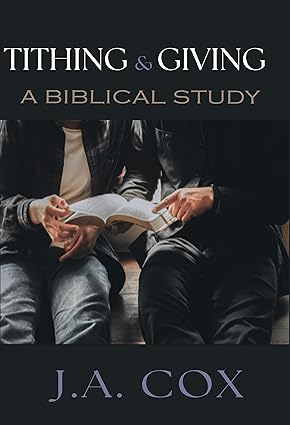

In Tithing and Giving, J.A. Cox walks readers through an in-depth exploration of biblical tithing, contrasting Old Testament mandates with New Testament freedoms. The book is structured around the idea that the commonly accepted modern practices of tithing, especially monetary tithing, are deeply misunderstood and not supported by Scripture under the new covenant. Cox builds his argument with a step-by-step examination of Hebrew terms, priestly duties, Old Testament law, the sacrificial system, and its fulfillment in Jesus Christ. He stresses that obligatory tithing, once rooted in supporting the Levitical priesthood, has no place in the life of a Christian after the death and resurrection of Christ, who he argues has fulfilled and replaced the entire priestly system.
I admired Cox’s commitment to sticking with Scripture, often going to great lengths to explain each passage and how it fits within the larger biblical story. At times, the repetition felt heavy, but it also showed just how passionate he is about getting this point across. I didn’t always agree with every conclusion, but I couldn’t deny the depth of thought behind it. Cox’s argument that many churches today push tithing based on verses taken out of context was uncomfortable but also thought-provoking.
I did find the writing style to be pretty raw at points. There were parts where I wished for smoother transitions. But then again, that direct and sometimes urgent tone also gave it character. It read less like a theology textbook and more like a heartfelt letter to fellow believers who might be misled. The emotional weight behind his convictions was clear. You can feel his frustration over what he sees as false teaching, and also his deep care for the truth of Scripture. That kind of honesty gave the book power, even when the prose didn’t always flow easily.
I think Tithing and Giving will really connect with readers who are looking for a strong biblical case against mandatory tithing in the modern church. It’s not light reading, and it’s certainly not trying to sugarcoat anything. But if you’re a pastor, a Bible teacher, or just a Christian who’s tired of feeling guilty over giving, this book will give you something to think about. I’d recommend it to anyone open to rethinking what the Bible really says about giving.
Pages: 121 | ASIN : B0F9TZCK7W

System Upon Systems in the Bible


System Upon Systems in the Bible, by William OuYang, offers a reflective and detailed examination of how the Bible connects various aspects of Christian life and thought through interconnected “systems.” The book spans multiple areas, from analyzing human rights in light of biblical teachings to exploring complex theological issues such as the shift in worship practices from the Old Testament to the New. Through scripture references, personal anecdotes, and practical applications, the author unpacks the systems that, according to him, shape both the divine and human experience. It is written in two parts, each exploring distinct biblical themes, with questions and outlines provided for group discussions, making it suitable for educational or study settings.
The writing presents a heartfelt exploration of various topics, though it covers a wide range of themes within each chapter. For instance, in Chapter 1, OuYang discusses Philippians 2 and reflects on how Jesus relinquished His divine rights out of love for humanity. This theme is significant, but the inclusion of a list of 39 human rights may seem broad compared to the central biblical text. Examples such as animal rights and capital punishment are introduced alongside the main theme, creating a diverse range of topics within the chapter.
The chapter on contentment stood out to me as one of the book’s strongest. OuYang contrasts contentment with the materialism and dissatisfaction that plague modern life, using vivid examples of famous individuals who, despite their wealth, lived discontented lives. I resonated with his mention of Amy Winehouse and other celebrities who tragically ended their lives despite apparent success. His blend of scripture and contemporary examples effectively communicated the timeless lesson that joy cannot be bought.
The concept of “systems” itself was a fascinating framework throughout the book. I often felt that the connections were implied rather than explicitly developed. The questions for reflection at the end of each chapter are helpful and guide the reader toward applying these insights in real life, which I found very effective.
Chapter 8 was intellectually engaging for me, as it explores the shift in God’s presence from the Old Testament to the New Testament in a way that felt both thought-provoking and insightful. OuYang’s explanation of how God’s relationship with humanity evolved was presented with clarity and depth. I enjoyed how the chapter traced these changes through scripture. It made me reflect on the continuity of God’s plan throughout the Bible. The blend of theology and practical application in this chapter was both enlightening and relatable.
I recommend System Upon Systems in the Bible to those looking for a contemplative study guide that weaves together theology, personal reflection, and practical lessons. I think it’s especially suitable for small groups or church study classes, where the open-ended discussions could make the abstract connections clearer. Overall, it’s a passionate work that presents biblical principles in a way that invites both introspection and discussion.
Strengthened During Times of Abundance

The Beauty of Tribulation is a thought-provoking exploration of the Christian faith, delving into the role of suffering and hardship in spiritual growth and offering insights into biblical teachings. Why was this an important book for you to write?
This book was important for me to write because God laid it upon my heart to bring this book into the world. I was not in a place that it would make sense for him to do such a thing during that time in my life, at least not in a carnal perspective. I questioned if it was him, but he made it very clear to me that it was. I was awakened many times at odd hours and spent many hours writing the things that he put upon my heart. Even to this day, I struggle with accepting that I was the one who wrote the words on its pages. I say that with all humility. I am very thankful to have the opportunity to help other Christians realize that first, God is not the author of their tribulation and second, yes, he does have a powerful purpose for allowing it. The important takeaway is to trust him always and not get so fixated on trying to understand the why. The why is, he has allowed it, and it is not important for us to always know the reason.
Could you share any personal experiences or realizations that significantly influenced your perspective while writing this book?
What significantly influenced my perspective while writing this book was my own tribulations from my very bad decisions at that time. What I mean is, that God helped me to realize that I can and must trust my failures to him as well. Also, he helped me to learn that while I will surely reap the consequences, through repentance he can and will use my failure for his glory. The remedy for our sin will never change; therefore: God is more concerned about our repentance so that he can use our hindsight to help others rather than punish us. God only punishes unrepented sin and must, because he is holy.
What do you hope readers take away from your exploration of Jesus’ suffering and the broader context of God’s plans?
I pray that my readers will realize that suffering is an unavoidable part of the Christian experience. It is also a very necessary part of the experience. The reason is because Jesus has explained that the student is not greater than the master. Because suffering was a necessity for him, it is so for us. However, since Christ continued to have confidence in the Father and never forsook him, he was never alone in that suffering, until he became sin for us. Likewise, as long as we place our confidence in Jesus, we too will never be alone and have strength in all things. Paul understood this and proclaimed, “I know how to be abased, and I know how to abound. Everywhere and in all things I have learned both to be full and to be hungry, both to abound and to suffer need. I can do all things through Christ who strengthens me.” Philippians 4: 12,13. I will end with this point; he could not learn about being strengthened in Christ without experiencing all those things. I will leave it to others to pray and ponder why it is necessary to be strengthened during times of abundance. If you have read The Beauty of Tribulation, you already know the answer.
What is the next book that you are working on, and when will it be available?
I have about 3 books I will be working on which are in different phases. As far as faith-based literature, the next book is Flawless. It will likely be an e-book and audiobook due to its small size but will not lack in sating the spiritual appetite. In a nutshell, it has to do with how we properly identify with Christ. Don’t be thrown off by the name. I am not sure when I will complete it at this moment but hopefully, it will be available early next year if not at the end of this year.
Author Links: GoodReads | Twitter | Facebook | Website | Amazon
Reasons why it is necessary.
How God uses it for our edification and his glory.
How God is not the author of our tribulation.
At the root of it, the greatest purpose is to depict the beauty of our painful, frustrating, and most hopeless moments when we allow God to complete the work he is trying to accomplish through them. As you turn the pages of this book you will be taken on a journey that will delve you deep into the tribulation process and come away with a firm understanding of it, perhaps like never before. Every premise is backed with scripture, focused on what the bible says rather than my own ideas.
J.A. Cox hopes that all who read will walk away with a greater appreciation and devotion toward the Lord in regard to this troublesome subject and inevitable part of our lives.
The Making of a Man of Faith


The Making of a Man of Faith by Dale Heil is a compelling compilation of some of the author’s teachings derived from his transformative time in prison. Throughout his incarceration, Heil assumed the role of an evangelist, spreading the Gospel and explaining biblical scriptures to his fellow inmates. At the core of his numerous teachings was unwavering faith in God.
In his infamous faith teachings, he draws inspiration from the exemplary journey of Abraham, the father of faith in the Book of Genesis. Chapter by chapter, he adeptly relates Abraham’s actions and inactions, weaving powerful lessons on the significance of unwavering faith, the art of walking steadfastly in that faith, and the consequences of straying from the divine path. Through this narrative, he imparts the essence of living by the Word of God and embracing a life anchored in faith.
Dale’s The Making of a Man of Faith offers a deep and enlightening journey, catering to new Christians seeking to strengthen their faith and seasoned believers grappling with doubts. Amidst the challenge of interpreting the Bible’s profound wisdom, Dale’s work, guided by the Holy Spirit, unravels intricate verses, seamlessly aligning them with God’s overarching plan. His unparalleled spiritual insights offer clarity and understanding of God’s purpose.
Dale’s concise and direct approach cuts through complexity, offering readers a clear path to connect with the essence of divine teachings. This book is an invaluable guide for Christians seeking spiritual nourishment and a profound connection with God’s promises, illuminating the path to a strengthened, unwavering faith.
Pages: 67 | ASIN : B08X1JZTFX
MYSTERIOUS OCEAN WALKERS

In an era where modern science grapples with profound existential questions, Mysterious Ocean Walkers by Pastor Manu Philip steps in to address the tantalizing enigmas of our existence. How did the universe come into being? What, indeed, is the meaning of life?
Philip delves fearlessly into these ‘unresolved’ riddles, highlighting the constraints of scientific theories such as the Big Bang and evolution. He draws our attention to the subtle miracles that weave through our daily lives, often unnoticed. The narrative seamlessly blends biblical tales with contemporary concerns through relatable analogies, offering insights into how to maximize our brief existence.
Pastor Philip paints the biblical narratives with vivid and evocative imagery, transporting the reader right into the heart of the tales. Beyond its spiritual insights, Mysterious Ocean Walkers is an enlightening fusion of religion, geography, and history. It plunges into diverse themes, from the cosmos to natural phenomena, showcasing Philip’s exhaustive research and expertise. Those skeptical of religious narratives might find their perspectives challenged by the compelling evidence presented.
The author’s unique narrative style, characterized by the occasional omission of articles and a poetic departure from conventional syntax, lends the book a distinctive charm. However, this can, at times, demand more attentive reading. Heed Philip’s suggestion: this is not a light read. Approach it in intervals, allowing ample time for introspection and absorbing its profound messages.
As the pages turned, I found myself immersed in Pastor Philip’s spiritually uplifting words, culminating in a rejuvenated reverence for life. By encouraging readers to confront mortality and ponder their place in eternity, Philip instills a sense of urgency to cherish every fleeting moment on this Earth.
Pages: 191 | ASIN : B0C888KTK4
The Voice of God

B. V. Lightsey’s, The Voice of God is a fascinating book that delves into the author’s personal encounters with God and provides guidance on how readers can also establish communication with the divine. Through vivid narratives of spiritual conversations with God, B. V. Lightsey shares insights into the ways in which God interacts with humanity.
The author’s journal-like account of his experiences is fascinating, especially given that he is a layman. His unique encounters with the almighty are both captivating and inspiring. In addition to the author’s personal anecdotes, the book also offers guidance on how to lead an honorable life in contemporary times.
The book’s first chapter, which tackles the contentious question of God’s existence, is particularly intriguing. Lightsey provides a convincing argument for the reality of God through numerous bible verses and compelling evidence. The author’s writing style is relatable and engaging, making the book a pleasure to read. From defining Christian terminologies to breaking down the meaning of biblical texts and events, the author provides helpful tools for readers.
I found the author’s personal stories particularly engaging, providing a unique perspective on spirituality. One of the book’s standout features is the inclusion of numerous bible scriptures from both the New and Old Testaments. The verses are directly relevant to the topics discussed, making them a useful reference point for readers seeking to deepen their understanding of the Bible.
The book’s structure, with short paragraphs and point-form lessons, makes it easy to read and comprehend. The author’s heartening and affirming words make The Voice of God a life-changing Christian book. It left me with a renewed sense of purpose and commitment to strengthening my relationship with God.
Pages: 429


