Blog Archives
Literary Titan Silver Book Award

Celebrating the brilliance of outstanding authors who have captivated us with their skillful prose, engaging narratives, and compelling real and imagined characters. We recognize books that stand out for their innovative storytelling and insightful exploration of truth and fiction. Join us in honoring the dedication and skill of these remarkable authors as we celebrate the diverse and rich worlds they’ve brought to life, whether through the realm of imagination or the lens of reality.
Award Recipients














Visit the Literary Titan Book Awards page to see award information.
Rough, Rough Country


Josh Jensen’s Rough, Rough Country is a hard-charging action thriller with a strong neo-Western spine. Graham Hayes, a former Army Ranger and recon operator, is trying to rebuild his family’s outfitting business in Payson, Utah, while knowing that old violence is still circling him. The book opens with mountain mornings, family dinners, dogs, firearms, and unfinished grief, then steadily pulls Graham back into a fight with a cartel boss who has turned obsession into strategy.
What gives the novel its pull is how grounded Graham feels even when the action gets big. He’s highly trained, dangerous, and watchful, but Jensen doesn’t let him become just a weapon in boots. His bond with his mother, brother Colt, niece Lily, and longtime friend Luis gives the story emotional weight. The family scenes give the book a lived-in warmth that makes Graham’s dangerous world feel personal instead of just action-driven.
The action is sharp, tactical, and easy to visualize. Jensen writes firefights, ambushes, escapes, and close-quarters violence with a clear sense of space, which keeps the bigger set pieces from turning muddy. The Mexico sections, especially Graham and Luis moving through cartel territory and relying on instinct, training, and each other, give the book a larger scope without losing the personal stakes. The line “The shooter is way more important than the gun, kid” neatly captures the novel’s practical, old-school attitude toward skill, discipline, and survival.
Luis is one of the book’s strongest assets. He brings humor, loyalty, and an emotional openness that balances Graham’s guarded nature. Derek, also known as D-Mac, adds a different kind of competence, and his shift from tech support to being pulled closer to the danger gives the back half of the story a fun change in energy. The villains have a mythic, decaying-cartel quality, especially Montezuma, whose rituals and paranoia make him feel less like a simple criminal and more like the rotten center of a collapsing world.
Rough, Rough Country is a confident, fast-moving thriller about legacy, brotherhood, trauma, and the cost of being the person everyone calls when things go bad. Jensen blends small-town Utah, military brotherhood, cartel violence, and family history into a story that feels both rugged and personal. It’s the kind of book where the quiet scenes matter because they show what the violence is protecting, and that gives the gunfire more than just noise.
Pages: 355 | ASIN: B0GYPLXB6T

The Genesis of a Powerful Story

Arctic Fire follows a former Marine as she battles PTSD, corruption, and hired violence in the Alaskan wilderness, where a fight over land and oil becomes a brutal test of duty, survival, and truth. What were some sources that informed this novels development?
The genesis of a powerful story must always start from within. For me, that started with my year-long deployment as a Squadron Commander in Kandahar, Afghanistan flying combat missions. I was making life-or-death decisions. Setting up defense against the Taliban while forward deployed. Sending men out on missions from which they didn’t return. Now I wasn’t in constant danger, but I worked with men and women who were. Then I came home. Everything that should be normal felt so foreign. I immediately went to Air War College and continued to reconnect with my wife and three children, all under 5 years old at the time.
That disconnect is the core. The violence you carry in your heart versus the peace you’re supposed to inhabit. This became Zoe’s core struggle. She lost. She lost big. But she also survived when others did not. This does something indescribable to people. It breaks them through grief and regret.
Now, the Alaska setting came from family. My parents spent years living in Alaska when they were young. They were on the same skydiving team there (it’s how they met). I grew up hearing stories about jumps, bush pilots, and remote locations. One day they told me about the land lottery of the 1970s and it sparked an idea. One that mirrored the current political pressure to open more federal wildlife refuges in order to access energy. I knew this was a concept that would be a never-ending conflict of ecology and power.
The collision of these led to Arctic Fire. Zoe’s not just fighting oil companies. She’s fighting the parts of herself that can’t reconcile. The external conflict mirrors the internal war.
The novel moves from Afghanistan’s heat to Alaska’s brutal cold. What drew you to that contrast, and how did setting shape the emotional tone of the story?
First, irony is at the heart of every great story. Conflict. Duality.
Afghanistan and Alaska are these wonderful opposites. One is a scorching desert and the other is frozen wilderness. But in the end, they are both the same: unforgiving. Each demands constant vigilance. These harsh environments punish mistakes with death.
That parallel felt essential for Zoe’s arc. In Afghanistan, she made decisions under fire and duress. I cannot emphasize how hard these kinds of decisions are to make in real time. We have soldiers, sailors, and airman making them constantly. This is also Zoe’s life, to her core. It is common for operators to claim they were forged in the heat of combat.
In knifemaking, you take heated metal and supercool it in oil or water to forge a weapon. Alaska is the second half of this process. If done correctly, it makes a hardened and formidable blade. If done incorrectly, the shaft will shatter and snap.
I fought with the concept of how to portray this to the reader. In my early screenplay versions, I kept her wound hidden for a release at the end of the book. I, like so many screenwriters, was thinking about the surprise. But a surprise only lasts for a second. That’s why I changed my mind and moved the core injury forward to the beginning of the book. I wanted the reader to know and feel the agony over the length of the novel. To squirm under the knowledge of what had happened to Zoe, especially as many characters were unaware.
That made everything click. The cold now became metaphorical. Zoe’s grief had frozen her. She was self-medicating and avoiding human connection. Alaska’s landscape became a mirror of her emotional state. Lethal and isolated. The reader needed to inhabit pity and fear, not confusion.
Zoe couldn’t outrun the cycle that broke her. She could only learn to function within it.
Duty seems to run through the novel in several forms: military duty, family duty, civic duty, and duty to the truth. Was that theme central from the beginning?
Duty is at the center of the book.
Zoe’s defined herself through duty her entire adult life. Duty to her Marines. Duty to her family. Then she loses both. Her unit is decimated through command failure. Her family, through a car accident she wasn’t there to prevent. Now she’s left without identity.
I’m a student of psychology. And one of the most amazing things about humans is that we need to know who we are and how we fit in society and life. When these are ripped away, it leaves someone unable to reconnect with what they lost. This, above all, leads to more suicides than anyone suspects.
Alaska forces Zoe to choose new duties. Duty to the Masons, who remind her what families fight for. Duty to Daniel Reeves, who’s pursuing truth when institutions have failed. Duty to the land itself, which represents something that endures and represents our frontier heritage. Duty to her position and as a representative of the federal government.
But what happens when these duties conflict? When protecting one duty means harming another? When two right answers conflict, now you’re in a dilemma. For someone who has also lost their connections in life, this can be a fatal problem.
Zoe’s military training taught duty as absolute. Real life often treats duty as a negotiation of conflicting values. That tension drives this novel.
What do you hope readers take away from Zoe’s fight to stay functional, protect others, and confront forces that want to erase both land and truth?
I hope readers see that broken doesn’t mean finished.
Zoe’s drowning in PTSD and alcohol. There is no worse combination, yet we see it all too often. She’s barely functional at first and then gives up. People try to be there for her, they just don’t know how to help. The real takeaway is that healing and fixing someone are not the same thing. One is about endurance, the other is convenient fiction.
We all need purpose. When the Masons need someone who understands their problem, she’s the only option. And for her, stepping back up to the plate is difficult. The novel asks if you can be shattered and still show up? Can you lead when you don’t trust yourself?
The novel tries to say yes. But it isn’t on the usual Hollywood timelines. Zoe doesn’t magically get better after someone gives her a dramatic speech. No magic pill. She doesn’t even really get closure. She just learns to function despite the damage.
That’s the hardest truth to grasp: you don’t fix trauma. You carry it. Always. But it does become easier with time, support, and purpose.
I want readers to recognize courage isn’t absence of fear or pain. It’s action in the presence of both. Zoe’s fight isn’t about becoming whole again. It’s about protecting others even when it hurts. When it costs her something. But in the end, that same thing is what makes her strong once more.
Author Links: GoodReads | X | Facebook | Website
Zoe Nichols came to Alaska to bury her past. It didn’t work.
A damaged Marine Major haunted by survivor’s guilt, Zoe is drowning in whiskey at a dead-end government job with the Bureau of Land Management. In the middle of nowhere, she’s not looking for a fight. She’s looking for oblivion.
But when a rigged land lottery sparks a war between a legacy homesteading family and a ruthless natural gas executive, Zoe is dragged into a conflict she wants no part of. Sebastian Fisher has built an empire by stepping on the throats of his enemies, and the Masons are the last obstacle on his path to a global energy monopoly.
When Fisher’s mercenaries launch a brutal assault that leaves the valley stained with blood, the war becomes personal.
Outgunned, cut off from help, and betrayed by the law she swore to uphold, Zoe must become something more dangerous than a soldier. She must become a reckoning. Allied with Guwaii Stonefoot, a Haida survivor haunted by his own lost tribe, she will learn a hard truth: in the Alaskan wilderness, you don’t outrun your past. You turn and face it with a gun in your hand.
Some wounds don’t heal. They just stop bleeding.
In the far north, justice isn’t found. It’s taken.
AUTHOR’S NOTE: Arctic Fire is a Literary Neo-Western Noir set in modern Alaska. It is written for fans of Wind River, Yellowstone, C.J. Box, and Craig Johnson, but with a darker, grittier edge.
Minority And Female Action Characters

Address follows three sharp, secretive investigators as a campus murder tied to nanotechnology spirals into a geopolitical conspiracy threatening the President’s State of the Union. What was the inspiration for the setup of your story?
My inspiration was a negative inspiration. I noticed the lack of minority and female action characters in the literature who are also intellectuals (I am a Brown Belt in Taekwondo and fancy myself a developing scholar). I also noticed in the literature the marginalizing and trivializing of minority and female voices and achievements. I therefore set out to create larger than life minority and female characters who would in the end, save America.
Henry, Braum, and Camilla have very different voices and temperaments. Which character came to you first, and which was the hardest to write?
Camilla came to me first because I am a young African-American woman, fluent in Spanish and a student of Hispanic culture. Braum was the hardest voice to write simply because I am not a male Navy Seal law professor in his mid to late 30’s.
The novel balances grief, banter, violence, and political danger. How did you approach tone in a story that moves between personal loss and geopolitical stakes?
That is a wonderful question. I didn’t think about it as I was doing it. It seems that the following process happens for a lot of the writing that I have done. I simply put myself in the moment (inside the head of the character, the physical location of the character etc) and then the writing happens. The next time I write finds me in a different moment. The tone is therefore defined by the moment in the book that I happen to be writing about at that time. Once I’m done with Moment A, the next time I write, I will be in Moment B. I have never found myself trying to write in Moments A and B simultaneously.
The book has a very cinematic sense of escalation. Were there particular thriller writers, films, or real-world events that influenced its structure?
The most important real world event that is relevant to the book is the political tension that exists between the US and Russia/China. That tension drives the novel. “A Few Good Men” is one of my favorite movies and I feature it in the book. Other than that, I wrote the book against a mental backdrop of a lifetime of watching the standard action thrillers (e.g., James Bond, The Avengers etc). I wrote the book in the hopes that it will be adapted into a movie.
Author Links: Amazon | Website
The Weight of Cold Things

Lisa Towles’s The Weight of Cold Things is a meticulously paced psychological thriller that seamlessly bridges the rugged expanse of a Wyoming ranch with the desolate, industrial purgatory of Deadhorse, Alaska. The narrative follows Deputy Sheriff Gree Gooding, a woman already drowning in a “new religion” of avoidance six months after the mysterious disappearance and death of her geologist husband, AJ, in the Arctic. Her fragile status quo shatters when her boss and mentor, Teton County Sheriff Peter Barrett, vanishes, only for his wallet, stuffed with five thousand dollars, to surface on the frozen tundra of Prudhoe Bay next to an unidentified body. Forced into an uneasy alliance with her polarizing ex-lover, Woody, and a stoic Alaska State Trooper named Matt DeGuerre, Gree journeys north into a labyrinthine corporate cover-up. What begins as a missing person investigation quickly spirals into a dark reckoning involving a decades-old black-ops viral contagion, an elusive serial killer known as the Caretaker, and a devastating web of familial lies buried right in her own childhood pasture back home.
Reading this book felt like watching a slow-motion avalanche: quiet, heavy, and utterly unyielding. Towles expertly utilizes the claustrophobic, sub-zero atmosphere of the North Slope as a physical manifestation of Gree’s internal landscape. The perpetual semi-daylight and the biting “death’s breath” of the arctic wind wrap around the reader, making the sense of dread almost tactile. I found myself captivated by the dual layers of the mystery; the clinical investigation of the “Methuselah” virus and the missing oil workers perfectly balance the intimate, agonizing unraveling of Gree’s family history. Towles avoids cheap jump scares, choosing instead to distill a pervasive, gothic unease from the vastness of the setting.
The intricate labyrinth of shifting alliances and peripheral characters from shady airport supervisors to sudden forensic psychologists adds a rich, multi-layered texture that beautifully expands the scope of the mystery without derailing the narrative’s velocity. Gree’s voice remains a masterclass in hard-boiled vulnerability. She is fiercely competent yet emotionally fractured, a “watcher” who operates with a jaded precision that feels bracingly realistic. Her complex, thready interactions with Woody add a realistic friction, ensuring the human drama never takes a back seat to the labyrinthine black-ops plot.
This chilling psychological thriller will resonate with fans of procedural mysteries and arctic noir who crave existential depth alongside their adrenaline. Reminiscent of Peter Høeg’s Smilla’s Sense of Snow in its absolute reverence for the menacing, secretive property of ice, Towles delivers a story where geography is destiny. The Weight of Cold Things is a haunting exploration of generational trauma and corporate malice, proving that while secrets can be preserved in the deep freeze of time, the truth eventually thaws.
Coming August 2026
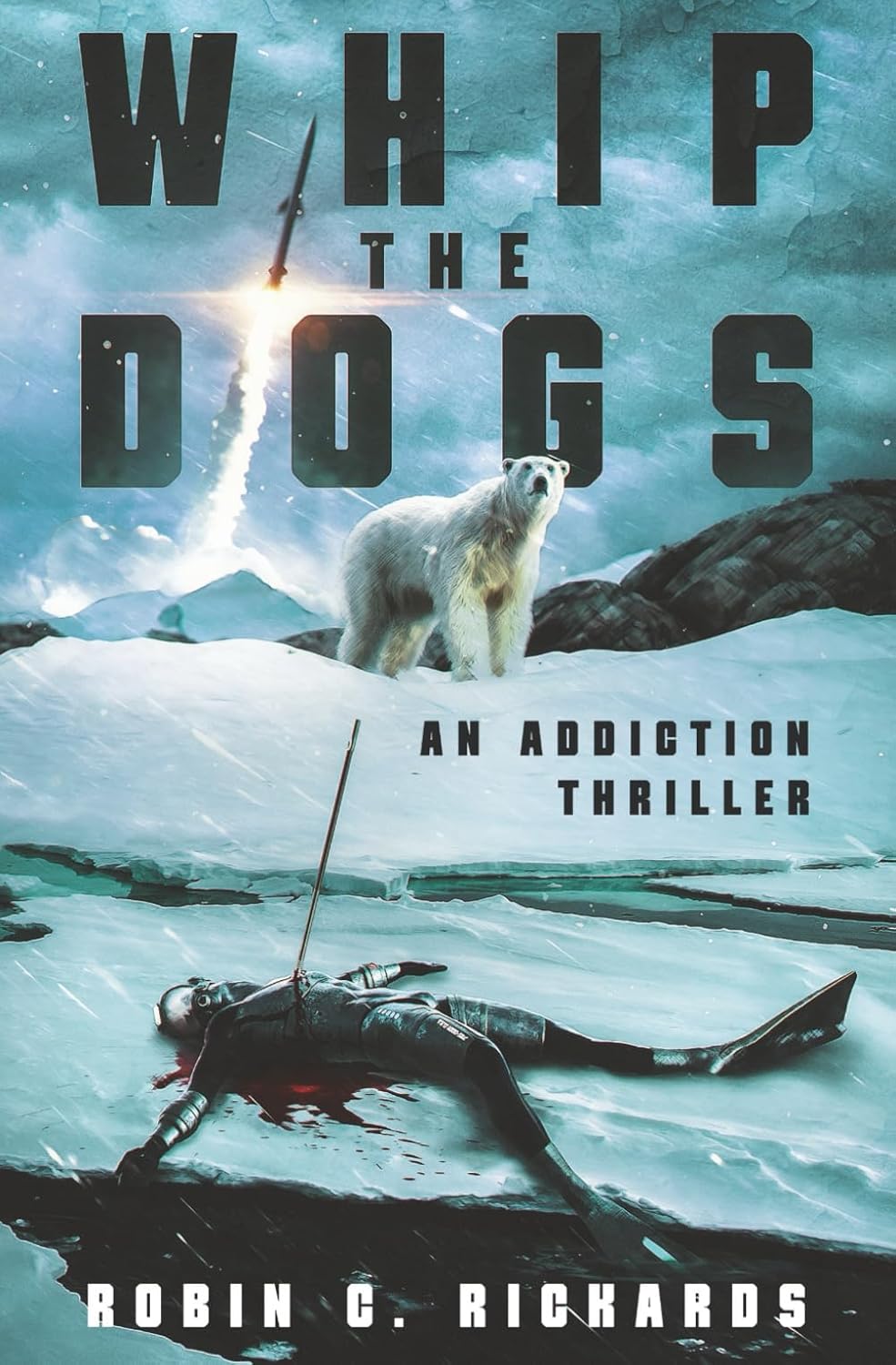
Whip the Dogs: An Addiction Thriller
Robin C. Rickards’ Whip the Dogs is a cold, brutal medical thriller about Dr. Michael Andross, an anesthetist whose own opioid addiction is bound to the grotesque research of Wilfred Tait, a disgraced geneticist obsessed with turning addiction into a weapon. The story moves from operating rooms and lecture halls to South Africa and the Arctic, where medical science, military ambition, trauma, and survival knot together in increasingly dangerous ways.
A specific scene I liked was the early lecture scene where Dr. Michael Andross explains addiction to the medical students while visibly unraveling himself. On the surface, he’s giving a clinical talk about dopamine, dependence, tolerance, and the “hedonic” pathway, but underneath the lecture his own body is betraying him: sweating, shaking, craving, and trying to maintain professional authority while addiction is already in the room with him. What makes the scene work is the double exposure. He’s both teacher and evidence, expert and casualty. The medical language gives the chapter intellectual weight, but the tension comes from watching Andross describe addiction as a brain disease while fighting the exact disease he’s explaining.
I found the book most compelling when it treated addiction not as a moral failure but as a trap with teeth. Andross isn’t a perfect or easy hero; he’s frightened, compromised, ashamed, and still capable of courage. That friction gives the novel its pulse. Rickards’ medical background shows in the clinical detail, especially in the scenes involving anesthetics, narcotics, withdrawal, and the terrifying thin line between treatment and harm.
The book is often harsh, sometimes lurid, and not shy about cruelty. Its villainy can be operatic, but the extremity suits the story’s frozen landscapes and fevered ethical questions. What I liked most was the title’s emotional echo: the image of a creature driven by need, punished for hunger, and misunderstood by those holding the whip. Beneath the thriller machinery, the novel has a mordant sadness about control, who has it, who loses it, and who profits from another person’s craving.
I would recommend Whip the Dogs to readers who enjoy addiction thrillers, medical thrillers, scientific thrillers, Arctic suspense, conspiracy fiction, and morally dark action novels. Fans of Robin Cook’s medical suspense may recognize the blend of science, danger, and institutional corruption, though Rickards pushes his story into rougher, more visceral terrain.
Pages: 457 | ASIN: B0GJKJKR1S
Sleeper Code: A Novel

Sleeper Code by Kevin McGuire is a cyber thriller about a hidden digital weapon called Phantom, planted deep inside America’s critical systems and designed to wake when the country is most vulnerable. The story follows Max Shaw and his team inside the Vault as they race to understand, contain, and fight a threat that can hit power grids, water systems, transportation, finance, and public trust all at once. As thrillers go, it has a clean, urgent hook: the enemy is already inside, and the clock is already running.
I enjoy thrillers most when they make ordinary life feel suddenly unstable, and this book does that well. A flickering lamp, a strange smart meter, a quiet anomaly on a screen. Small things start to feel dangerous. McGuire leans into the genre’s pressure points: countdowns, hidden enemies, insider threats, rooms full of worried officials, and the person in the middle who sees the pattern before everyone else wants to believe it. Some of the technical language is heavy at times, but the book usually keeps its feet on the ground by tying the threat back to people. Hospitals. Families. A daughter waiting for a call. That human layer matters.
I really liked the author’s choice to treat code almost like a living adversary. Phantom isn’t just a tool in the plot, it becomes a presence. That makes the book feel bigger than a standard chase thriller. It’s also clearly shaped by real concern about how connected everything has become. The ideas in the novel are intriguing: convenience has a cost, security is fragile, and how modern life depends on systems most of us never see until they fail. The book uses the government and tech thriller tools well, especially the tense briefings, urgent warnings, and pressure-filled leadership decisions that fans of the genre expect. Those familiar beats give the story a solid, satisfying rhythm, and the pacing keeps everything moving with confidence.
I would recommend Sleeper Code to readers who like cyber thrillers, military suspense, and high-stakes stories where the danger is invisible but the consequences are physical. It’s a good fit for fans who want less “who pulled the trigger?” and more “what happens when the whole machine turns against us?” I would hand it to someone who enjoys fast-moving thrillers with a realistic edge and doesn’t mind a strong dose of cybersecurity detail along the way.
Pages: 292 | ASIN: B0G22TH51V
Adrenaline Rush

Adrenaline Rush by Bevin Goldsmith is a gritty crime thriller with strong elements of psychological drama, military fiction, and trauma fiction. The book follows Detective Kate Molsin, a former Army Military Police officer whose work with the JCIA pulls her into violent cases while her own past keeps clawing its way into the present. At its center, this is not just a detective story about murder, abuse, and justice. It is a story about survival, grief, faith, anger, and the dangerous ways a person can learn to live on adrenaline when peace feels impossible.
Kate narrates with a blunt, bruised honesty that does not try to sound polished or pretty, and that choice gives the book its raw power. She’s sharp, sarcastic, wounded, sometimes funny in a dark way, and often hard to sit with. I appreciated that Goldsmith does not soften her into an easy heroine. Kate can be brave and cruel in the same scene. She can be insightful one moment and reckless the next. That made her feel less like a symbol and more like someone still fighting with herself while trying to fight for other people. The writing has a pulse to it. Fast. Angry. Restless. It fits the title.
The book blends crime scenes, flashbacks, therapy sessions, military memories, romance, and faith in a way that can feel messy, but I think that messiness is partly the point. Kate’s mind doesn’t move in neat lines, so the story doesn’t either. The intensity rarely lets up. Still, the emotional core stayed with me. The scenes with grief, especially around Alex, give the book a softer ache beneath all the gunfire and bravado. Goldsmith seems most interested in the question of what happens when pain becomes a person’s normal weather.
I would recommend Adrenaline Rush to readers who like dark, character-driven crime thrillers and do not mind heavy subject matter. This is not a cozy mystery or a clean procedural. It’s rough and personal. Readers who appreciate damaged protagonists, military backstories, faith woven into trauma recovery, and stories that lean more on emotional force than quiet subtlety will probably connect with it most.
Pages: 199 | ASIN : B0CSN3MQ1H


