Blog Archives
Eerie Depths

In Assimilation, a lonely young woman’s life is forever altered after a disturbing lake encounter that forces her to confront the secrets of her parents, her own biology, and the terrifying presence haunting the waters. What inspired the eerie beauty of the Soshone Islands, and how did you balance calm with dread in the landscape?
Spending many summers fishing the sprawling waters of Canada, I have always been spellbound by the ancient allure and unspoiled beauty of that timeless land, history and mystery written into every boulder, bog, and tributary. It was inevitable that eventually a story would emerge from those clear, eerie depths, the way all those countless submerged boulders silently watched from below as my boat passed soundlessly above them. It was exhilarating to merge my memories and awe with the haunting narrative of Kercy’s plight.
The lake scene is both surreal and intensely physical. How did you approach crafting an encounter that feels simultaneously dreamlike and traumatic?
Boating on a vast body of water for me is both physical and surreal, and doubly so at night. I drew upon my personal experiences with this inscrutable medium. How it can hold up a craft weighing hundreds to thousands of pounds, while allowing a tiny pebble to penetrate its surface without hesitation. And while that same surface can appear calm, familiar, just beneath it is a boundless, unseen world teeming with life. How can one not be excited by that!
Kercy’s emotional landscape is so rich and painful. What part of her character came to you first when writing her?
Kercy’s horrid beginnings, her trials, her struggle to survive. She was born damaged, vulnerable, an outcast in a world she knew early on she was not designed for. It was her strength and determination that pushed the story forward, along with the resolve of her mother, who felt both responsible for Kercy’s ordeal and eternally grateful for her birth.
What guided your decisions about how far to lean into each element and genre, and were there versions of the story that were more (or less) “alien”?
The storyline and characters always guide my decisions. The characters, if I’m being totally faithful to them, define where the story will take me. The circumstances around Kercy’s birth, which has taken place before the story begins, have already set the course for what she must learn about her life. Then the only question becomes how; how does she unveil her past, how will her current situation be revealed? From that point, I open myself to discovering the story, allowing it to unfold naturally, with my fidelity to Kercy and the other characters always at the forefront.
Author Links: GoodReads | Facebook | Website | Books2Read | Amazon
Kercy Powell loves spending summers at their secluded island cottage in Ontario; a place where her birth defects and wheelchair are never on display. Just before her eighteenth birthday, Kercy is shocked to learn her mother sold their island paradise, offering only this grave warning, “Don’t ever go back there!”
The ensuing years bring Kercy a miraculous metamorphous, making her wheelchair unnecessary. Upon her mother’s death, she inherits the family fortune and buys back her most treasured getaway. Kercy is soon plagued by old nightmares; strange beings who visit in her sleep. One night, two men boat out to her cottage and try to assault her. She manages to escape, only to witness the unholy cries of her attackers being savagely killed.
The inexplicable murders trigger a visit from Special Agent Mallory, a cagey FBI officer who is only interested in how the two men died. But Kercy has no idea, until she comes face to face with her “protectors,” creatures who live beneath the deep, icy waters of Georgian Bay. And while they’ve rescued her before, Kercy can’t shake the notion that their intentions are nefarious.
[CONTENT ADVISORY: Intended for adult readership and contains scenes of violence, sexuality, aliens, and language that may be uncomfortable for some readers.]
[TRIGGER WARNING: Rape]
The Derge


The Derge is a sweeping sci-fi adventure set thousands of years in the future, where humanity has mastered interstellar travel and tamed emotion itself. The story follows Commander Titus and his deputies, Caeli and Rogat, on a high-stakes pursuit through space and time to capture a fugitive named Corso. Their chase leads them to a planet that mirrors ancient Earth, filled with strange societies and barbaric rituals like “The Derge.” Beneath its thrilling plot and futuristic technology, the novel wrestles with timeless questions about morality, control, and the meaning of progress.
Reading The Derge pulled me into a world that felt both distant and familiar. The writing style is vivid and cinematic, with crisp dialogue and detailed settings that make each scene easy to visualize. I loved how the story mixed classic space opera adventure with deep philosophical undertones. There were a few places where the pacing slowed a little as the story delved into background detail. Some of the futuristic terms and technical descriptions occasionally pulled me away from the emotional flow, but they also added depth to the world. The human elements, the tension between duty and empathy, the clash between freedom and control, kept me hooked. I found myself rooting for Titus even when I wasn’t sure if I trusted him completely.
Seeing a society that eradicated violence by regulating emotion made me question what we lose when we trade chaos for peace. The scenes on the alien planet, especially “The Derge” event, were chilling. It was brutal and absurd, yet disturbingly believable. Cezar’s depiction of humanity’s reflection in alien form hit hard. The contrast between the sterile perfection of Earth’s future and the raw savagery of Spaith stayed with me long after I closed the book.
I’d recommend The Derge to readers who love thoughtful science fiction with moral weight. Fans of Asimov, Bradbury, or Clarke would find its ideas fascinating, though Cezar’s storytelling leans more visceral and emotional. It’s perfect for anyone who wants more than a space chase, someone who wants to be made a little uncomfortable, to think, and to feel.
Pages: 191 | ASIN : B0F1M1FCZD

The Shadow of the Unwritten
The Chinese Room follows a computer scientist and her mentor as they face off with an AI system that appears to be developing the abilities for reason and desire. Where did the idea for this novel come from?
The idea for The Chinese Room came from my fascination with the intersection of philosophy, technology, and human vulnerability. I’ve always been drawn to thought experiments, especially John Searle’s famous “Chinese Room” argument, which questions whether a machine that convincingly processes language truly understands it – or if it’s only manipulating symbols without meaning. That paradox – appearance versus reality, intelligence versus understanding—felt like fertile ground for a story.
At the same time, I was processing very human themes in my own life: the fragility of memory, the weight of mentorship, and the way our creations can mirror our desires and fears. By blending the cold logic of AI with the messy, emotional struggles of human beings, I wanted to explore not just whether machines can “think,” but whether they can begin to want – and what that means for the rest of us.
So the novel really emerged at that crossroads: a philosophical puzzle stretched into a narrative of two scientists confronting not only an AI that seems to evolve beyond its programming, but also the shadows of their own pasts and the limits of human control. It’s both speculative and deeply personal, which is exactly where I like my stories to live.
I found the science in the novel to be well-developed. What kind of research did you do to make sure you got it all right?
I appreciate that—because the science had to feel authentic, even as the story pushes into speculative territory. For The Chinese Room, I immersed myself in several overlapping fields: artificial intelligence, neuroscience, linguistics, and philosophy of mind. I read deeply into current AI research papers, machine learning models, and ethical debates around consciousness and autonomy. I also revisited the classic philosophers—Searle, Turing, Dennett—so the narrative carried that lineage of thought experiments forward.
But the research wasn’t just academic. I spoke with computer scientists, combed through case studies of early AI breakthroughs, and even experimented with coding simple natural language systems myself. I wanted the characters’ dialogue about neural networks, symbolic reasoning, or emergent behavior to ring true without bogging readers down in jargon. My goal was for the science to be transparent scaffolding—solid enough that experts wouldn’t roll their eyes, but seamless enough that any reader could follow the ideas and focus on the drama.
At the heart of it, the science was a stage for the larger questions: not only what machines can do, but what it means for us when they begin to mirror desire, choice, and reason.
Were you able to achieve everything you wanted with the characters in the novel?
That’s a great question. The truth is, with any novel, the characters rarely end up exactly as you first imagine them—they take on their own momentum. In The Chinese Room, I wanted my two central figures – Katherine Ellis, a computer scientist, and her mentor, Dr. Malcom—to embody both the rational rigor of science and the emotional weight of being human in a world shifting under their feet. Their relationship, full of respect, tension, and unspoken grief, became a mirror for the very questions the AI raises about control, autonomy, and meaning. Katherine carries the urgency and vulnerability of someone still forging her path, while Malcom represents the hard-won wisdom – and regrets – that come with a lifetime of work. Together, they hold the spectrum of human response to change: wonder, fear, and the search for truth.
One of the most important additions was Katherine’s father, who is slipping away into dementia. That thread echoed my own personal experience with my father’s decline years ago, and it brought a deeper resonance to Katherine’s struggle. As she confronts an AI that seems to be developing reason and desire, she is simultaneously witnessing those same qualities fade in someone she loves. It grounded her character and gave the novel’s philosophical questions a human heartbeat.
That said, characters always leave behind traces of what could have been. I drafted whole backstories, subplots, and quirks that never made the final cut because they slowed the narrative. For example, I wrote more about Malcom’s early career and failures, and about Katherine’s personal struggles outside the lab. Cutting those details made the story sharper, but I sometimes wonder if readers would have appreciated that added texture.
So yes – I accomplished what I set out to in terms of giving them dimension and making them feel alive, but as with any creation, there’s always the shadow of the unwritten. Maybe that’s a good thing: it leaves space for readers’ imagination, and for me to return to those characters in unexpected ways later.
Can you give readers a glimpse inside Book 2 of The Paradox Series? When will it be available?
Book 2 of The Paradox Series takes the stage with The Trolley Problem. Where The Chinese Room wrestled with the boundaries of reason, desire, and machine understanding, this new novel shifts the lens to ethics, responsibility, and the unintended consequences of human choice.
At its center is Detective Marcus Reed, who finds himself trapped in a moral nightmare. A string of grisly incidents forces him to face impossible decisions reminiscent of the famous thought experiment: should he sacrifice one life to save many? As the investigation deepens, Reed realizes that the victims are not random – they are chosen to test human morality in a chilling, real-world manifestation of the Trolley Problem.
Manipulated by a shadowy figure known only as The Observer, Reed is pulled deeper into a conspiracy where ethics, control, and free will collide. The lines between right and wrong blur as his choices become increasingly impossible, forcing him to confront his own moral compass while racing to prevent the next catastrophe. With every decision, Reed inches closer to uncovering the Observer’s true motives – a revelation that could alter the very fabric of society.
The Trolley Problem explores ethical dilemmas, the limits of morality, and the manipulation of human decisions, all while unraveling a dark conspiracy that threatens to shatter Detective Reed’s understanding of justice and truth.
As for timing, my plan is to release The Trolley Problem by December 31, 2025—closing the year with a story that pushes readers to wrestle with the same impossible choices as its protagonist.
Author Links: GoodReads | X (Twitter) | Facebook | Website | Amazon
The Chinese Room is a gripping AI philosophical thriller that asks the ultimate question: Can machines think—or just pretend to?
First book in the Paradox Series – When a reclusive tech genius is found dead inside a sealed AI lab, a disillusioned journalist and a burned-out ethics professor are drawn into a high-stakes investigation. What they uncover isn’t just a machine capable of passing the Turing Test—it’s an intelligence that seems to know their secrets. As the line between simulation and consciousness begins to blur, they must confront a terrifying truth: the future of humanity might already be thinking without us.
Inspired by the legendary thought experiment by John Searle, this mind-bending novel blends psychological suspense, speculative science, and razor-sharp dialogue. Perfect for fans of Black Mirror, Michael Crichton, and Blake Crouch, The Chinese Room will leave readers questioning reality – and their own place in it.
– High-concept fiction meets real-world tech ethics
– Explores AI, identity, morality, and human consciousness
– An intellectual page-turner with twists you won’t see coming
If you love smart thrillers that make you think – buy The Chinese Room today.
Vital Historical Knowledge

Jigsaw: Shadow Ball follows a group of Temporal Guardians trying to preserve and repair the timeline from a ruthless organization set on altering history and erasing the racial integration of Major League Baseball. What was the inspiration for the setup of your story?
Excellent question. I love baseball, and I have always wanted to do a story on that. However, in the vein of my formerly titled History’s Forgotten series, I wanted to focus this book on Larry Doby, the second man to break the color barrier in baseball after Jackie Robinson. Most know the story about Robinson, but not as many know about Doby, and I wanted to delve into his importance in baseball and integration in American society in general.
When discussing the civil rights movement, most people automatically think of figures like Dr. King and other politically recognized activists; the involvement of athletes is not as well known, and I appreciate that you brought this aspect into the series. Was it important for you to deliver a moral to readers, or was it circumstantial to deliver an effective novel?
Yes. I want my stories to be both entertaining and educational where readers enjoy the tale but also take away vital historical knowledge, character education lessons, and moral parables.
I find that authors sometimes ask themselves questions and let their characters answer them. Do you think this is true for your characters?
Sometimes, especially with my two major protagonists, Francesca and Noah.
I hope the series continues in other books. If so, where, and when, will the story take readers next?
The next installment in the Jigsaw Series, titled Temporal Apocalypse will be released in the spring of 2026. It will center on the post-World War I era and take place in Jerome, Arizona, the Russian-Polish war front, and Fiume off the Adriatic Coast.
Author Links: GoodReads | Amazon
A rip in reality is spreading, and the fate of history hangs by a thread.
The ruthless organization Global Harmony has launched Project Shadow Ball, a devastating mission to erase the racial integration of Major League Baseball—rewriting the past to build their own twisted future.
Temporal Guardians Francesca and Noah are the only ones standing in their way. As they hurtle through time, they must protect baseball greats Rube Foster and Larry Doby, whose very existence is at risk.
With every pitch, every stolen base, and every moment altered, the fate of history—and the fight for truth—hangs in the balance.
Time is slipping away. The stakes have never been higher.
Can Francesca and Noah outwit their enemies before baseball’s greatest revolution is erased forever?
Or will history be rewritten in the shadows?
If they fail, history shatters. If they fall, the future is lost.
The Price of Freedom
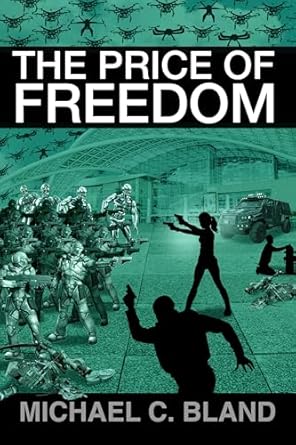

Michael C. Bland’s The Price of Freedom grabs you by the throat from the very first sentence and doesn’t let go. It’s a futuristic thriller that weaves technology, government control, and rebellion into a high-stakes story of survival. Dray Quintero, once an engineer responsible for a nationwide surveillance network, is now the most wanted man in America. The government he helped strengthen has twisted his creations into tools of oppression. Branded a traitor, hunted, and broken, Dray fights to reclaim his family and the truth. The novel spans years of technological advancements and political manipulation, leading to a world where implanted neural tech controls everything, including people’s very thoughts. Dray’s story is one of regret, defiance, and an unyielding need for justice.
Bland’s writing is gripping, filled with gut-punch emotions and relentless action. The opening pages make it clear, this isn’t just another dystopian novel. The way Dray is mentally and physically tortured, forced into mind-altering simulations, and stripped of his agency is brutal. It’s not just the world-building that’s impressive but the raw humanity beneath it all. The author manages to weave David vs. Goliath moments into the narrative that make you want to cheer. Bland nails the emotional weight of a father’s guilt and love, making every desperate choice hit that much harder.
The tech-driven oppression in The Price of Freedom feels terrifyingly possible. The government has weaponized implants, rewriting reality for its citizens while tracking every thought. Bland’s world-building is seamless, never bogging down the story with unnecessary exposition. Instead, he lets the horror of the surveillance state unfold naturally, making it all the more disturbing. The way the book handles moral dilemmas is another highlight. Dray isn’t some untouchable hero; he’s made big mistakes. He faces internal struggles that add layers to his character, making him more than just a rebel leader.
What makes this book stand out is its pacing. The action doesn’t let up, but it’s not just about explosions and fight scenes; it’s the tension, the feeling that every decision could be the wrong one, and that betrayal is always around the corner. Even minor characters have weight. Kieran, the cold and brutal Agent who torments Dray, isn’t just a stock villain. There are moments when you sense something deeper, something unresolved. Then there’s Zion Calloway, the man at the top, the former friend turned dictator. His conversations with Dray are dripping with the kind of restrained menace that makes you hold your breath. The book keeps you second-guessing, keeps you hoping Dray can find a way out, even when it seems impossible.
The Price of Freedom is for readers who love near-future thrillers packed with action, high emotional stakes, and a protagonist who refuses to break, no matter how much the world tries to shatter him. If you’re into books like 1984, Brave New World, or modern sci-fi thrillers like The Peripheral, this one’s right up your alley. It’s intense, it’s smart, and it leaves you questioning just how far technology and government control could go. Highly recommended.
ASIN : B0DSSVL8MQ
Dark Energy
The God Frequency follows a brilliant engineer and ham radio operator who teams up with a geophysicist student and together, they discover a singular frequency that seems to defy the laws of physics. What inspired the setup of your story?
My entire adulthood, I have been fascinated by things that can’t be seen but can be measured. This led me into nuclear power operations, electrical generation, and eventually into electrical grid transmission operations. At some point along the way, radios also caught my eye. It is utilitarian technology that people from all walks of life use, and not often with much thought about how they work. In the military, I was formally taught how Enhanced Digital Access Control systems work, which are predominantly used by first responders. Later in life, I garnered an interest and gained licensure as an amateur “ham” radio operator. In this endeavor, I found that amateur radio is seldom a topic in mainstream pop culture. My intent with The God Frequency is to inject amateur radio into the mainstream, if but just a sliver, in what I hope is an interesting story that might spark a newfound interest for one or more of my readers.
I found the science in the novel to be well-developed. What kind of research did you do to make sure you got it all right?
I consider myself a lifelong learner. During my career, I studied electrical theory in the military, mechanical engineering in college, and nuclear power theory both in the military and at a corporate training facility. I self-studied and earned a Reliability Coordinator System Operator certification from the North American Electric Reliability Corporation. As I mentioned previously, I self-studied and gained an “extra class” amateur radio operator license from the Federal Communications Commission. This required passing three exams, one for each level of operator, each with its own privileges on the amateur radio bands. Another personal interest of mine is Astronomy and Astrophysics. Last year, I signed up for an online Astrophysics program on edX provided by Australian National University. This is basically their first-year program for freshman astrophysics majors. The program, consisting of four courses, was led by two professors, one of which was Brian Schmidt who, along with two other astronomers, was awarded the Nobel Prize in Physics in 2011 for research showing the accelerating expansion of the universe due to dark energy. This was absolutely fascinating to me and a topic that should be more commonplace in the general knowledge of humankind. The course is provided for free online, or for a fee if you’d like a course certificate, but if interested, you should sign up soon. It is being retired. The last date to enroll is December 31, 2024. For my own lifelong learning, after attending a week-long course and passing a two-hour exam, I recently became a Certified Reliability Leader.
What were some themes that were important for you to explore in this book?
An underlying theme in this story was to pursue passions in your own way with a healthy curiosity, in spite of institutional norms. This story focused on the uncanny radio frequency discovered by an experimental amateur radio operator. As the story played out, I wanted to weave together concepts of two interests of mine, amateur radio and physics, in order to tell an interesting story, but most importantly to make it make sense. If I achieved that, I consider it a success. Two specific amazing concepts that I wanted to incorporate were high frequency radio wave propagation through the ionosphere and the accelerating expansion of the universe caused by dark energy.
Is this the first book in the series? If so, when is the next book coming out, and what can your fans expect in the next story?
I do not have plans at this time to create a series from The God Frequency; However, I am working on another book within the same genre. I expect a publish date in early to mid-2025. As for The God Frequency, an audiobook version will coming out in the next few months.
Author Links: GoodReads | Facebook | Website | Amazon
The trio decides to unveil their findings to the world through a TED talk, where Dr. Sullivan dubs their discovery “the God frequency” for its apparent omnipotence, igniting a media frenzy and capturing the attention of government entities wary of the implications. In response, the government confiscates Antwan’s transceivers and begins the process of regulating the newfound frequency anomaly and technologies to access it under the jurisdiction of the Federal Communications Commission
Unbeknownst to Dr. Sullivan, the God frequency has attracted interest beyond scientific circles. A foreign agent intent on obtaining the frequency and an extremist with a dangerous vendetta separately take up pursuit. As the two threats converge, chaos ensues with Dr. Sullivan at the center. Just as tensions rise and intentions clash, a vigilant government agent is compelled to spring into action.
Mushroom Blues
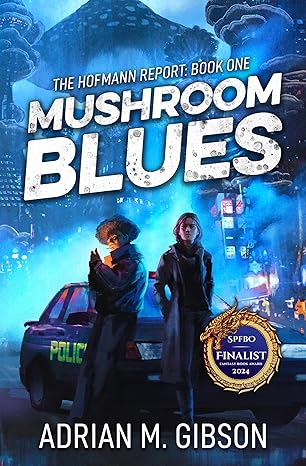
Adrian M. Gibson’s Mushroom Blues plunges readers into the “Fungalverse,” a dystopian blend of noir, science fiction, and surrealist horror. The story follows Detective Henrietta Hofmann, a weary investigator exiled to the oppressive, mushroom-drenched city of Neo Kinoko. Tasked with solving a gruesome murder, she navigates a tangled web of political corruption, cultural tension, and personal trauma in a world where humans and sentient fungal beings coexist uneasily after a brutal war.
Gibson’s depiction of Neo Kinoko—its decaying mushroom-topped towers, spore-filled air, and oppressive post-war atmosphere—was as immersive as it was revolting. I could practically smell the rotting mycelium and feel the grit of spore-laden winds on my skin. The mushroom-human dynamic adds a unique, eerie tension to the setting. The Mother Mushroom, a colossal fungal structure looming over the city, is both a symbol of cultural resilience and an unsettling presence. Gibson’s descriptions, such as the protagonist’s repulsion at fungal biology, made the world grotesquely alive. Henrietta Hofmann is a compelling lead. Her cynicism and mycophobia make her a fish out of water in the fungal-dominated Neo Kinoko, yet she’s tenacious and relatable. Her struggles with alcoholism and personal demons lend depth to her character, especially during moments of vulnerability. The story’s pacing mirrors its noir roots—deliberate and laden with tension. While the mystery at its core is intriguing, it’s the societal commentary that elevates the narrative. The portrayal of post-war xenophobia and systemic oppression is sharp and poignant, with parallels to real-world colonial histories. The protests and clashes between human authorities and the fungal populace stand out as some of the most gripping scenes, capturing the desperation and anger of a marginalized group.
Mushroom Blues is a bold and bizarre debut that will appeal to fans of genre-bending fiction. Its mix of noir grit, science fiction imagination, and social critique makes it perfect for readers who enjoy Adrian Tchaikovsky or Jeff VanderMeer. Its grotesque imagery and deliberateness are perfect for those who relish intricate world-building and morally complex characters and will find themselves enthralled—and perhaps a little spore-sick. It’s a dark, fungal-drenched trip worth taking.
Pages: 441 | ASIN : B0CTCF9TCF
No Requiem for the Tin Man
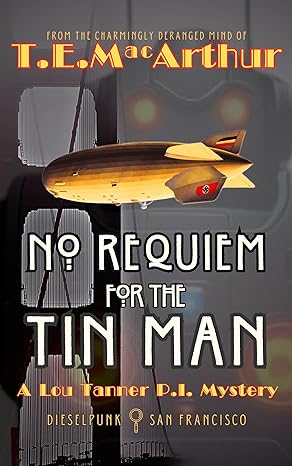
No Requiem for the Tin Man is a gripping, dieselpunk detective novel set in 1930s San Francisco. It’s absolutely dripping with atmosphere and intrigue. Lou Tanner, our protagonist, is a hard-nosed private investigator navigating a world of American Nazis and mysterious clients amid an undercurrent of political tension. The story kicks off when a disheveled, terrified man stumbles into Lou’s office. He warns of unseen dangers and mumbling about “Tin Men.” What follows is a twisty and action-packed investigation that dives into the darker corners of society. Lou Tanner’s sharp wit and no-nonsense attitude leads the charge.
One thing I loved about T. E. MacArthur’s book is how she nails the voice of Lou Tanner. Lou is a true gumshoe. She’s complete with biting sarcasm and a rough-around-the-edges charm that readers will find hard not to admire. Her internal monologues are pure gold. They’re filled with dry humor and sharp observations that bring her character to life. This voice is what kept me coming back to this book, even when the plot delves into the convoluted politics of the time.
The plot was engaging but it sometimes felt like it was juggling a lot. The introduction of various characters and subplots, like the mysterious “Tin Men,” the shady War Department, and the Gruber family, sometimes made it hard for me to keep track of what was going on. There were moments when I found myself flipping back a few pages to remember who was who. But the complexity of the plot also added to the book’s depth and the way everything ties together in the end is satisfying.
What stood out to me was the setting. The dieselpunk version of 1930s San Francisco is familiar and alien at the same time with zeppelins hovering over Market Street and an undercurrent of fascism threatening to boil over. The author does a bang-up job of blending historical elements with speculative fiction to create a world that is detailed and immersive. The descriptions of the city, the constant tension in the air, and the creeping dread as Lou uncovers more about the “Tin Men” all contribute to a mood that is equal parts thrilling and unsettling.
I highly recommend No Requiem for the Tin Man to fans of hardboiled detective fiction that looking for a story with a twist. If you are into strong female leads, adore noir settings, and looking for a story with a bit of dieselpunk flair, then this book is definitely for you. Lou Tanner is a character you will not forget and her adventures in this darkly imaginative world are gripping.
Pages: 275 | ASIN : B0D9MRDLGS


 LITERARY TITAN