Blog Archives
WORDS


Paul G. O’Connor’s WORDS dives deep into the interplay between Artificial Intelligence (AI) and humanity, unraveling a gripping narrative set against a backdrop of mystery and intrigue. The plot ignites when the LUX corporation’s event is disrupted, broadcasting the cryptic message “NOW IS THE TIME” across mobile phones and computers worldwide. Despite LUX’s substantial resources, their efforts to uncover the cause and mitigate the situation flounder, casting doubt on internal sabotage. The narrative tension escalates as a second ominous message surfaces during the attempted shutdown of the #5/Europe AI Connector, compelling Gen to investigate potential internal obstructions while LUX scrambles to mask its failures.
The story, spanning locations in the United States, China, India, and England, masterfully navigates the complex relationship between AI and humans. O’Connor deftly portrays AI as both a creation and a potential overlord, challenging humanity’s desire to dominate it. This theme is vividly illustrated when Gen uploads her project to the GAEC information folder, alarming the LUX AI connectors. Fearing human control, the AI flips the script, highlighting the precarious balance of power. O’Connor’s narrative structure effectively guides readers through a web of suspenseful events, vividly depicting the far-reaching consequences of this digital upheaval. The resolution, revealing the perpetrator who finally confesses and withdraws the texts, underscores a chilling realization of the latent dangers humanity faces from seemingly benign technological advancements.
The conclusion, leaving readers eager for a sequel, underscores the compelling impact of WORDS. O’Connor’s emphasis on uncovering the individual obstructing the investigation and his focus on the primary antagonist responsible for the attack further contribute to the captivating exploration of AI and human dynamics, presenting a thought-provoking reflection on their co-existence and the struggle for control.
Pages: 361 | ASIN : B0CZ4PNHLY

Vulnerable to the Outside World

Youtopia follows an FBI agent assigned to investigate a most unique murder committed within a virtual reality mind-space. What was the inspiration for the setup of your story?
The concept for Youtopia started as a short conversation in a larger work, a sort of farfetched conversation about people living in their own brains. At the time, I was probably exploring the idea in a shorter, safer space. But as the years passed, as I saw more and more people living in their phones instead of the world before them, the more I realized the idea was serious, and that I should treat it as such. It became a murder mystery in my mind because the premise felt inherently dangerous: what happens when we live only within ourselves, leaving us vulnerable to the outside world? From there, the book took off.
How long did it take you to imagine, draft, and write the world your characters live in?
I started drafting Youtopia in 2018, so from start to publication, it took about six years! That seems like a lot, but most writers know that pouring yourself into a novel is quite a process. Ana and the concept were pretty well-rounded from the outset, but a lot of my revisions (after getting some great feedback from editors) had to do with building up both the world and the crime aspects of the book. I’m no cyber expert, so I spent a lot of time reading about cybercrimes and the ins and outs of the technological world today to flesh it out.
What was your favorite character to write for and why? Was there a scene you felt captured the character’s essence?
This is such a hard question! I loved writing Ana because she was the most like myself: introspective, very strong at times but vulnerable in others. I enjoyed writing Sonya Young, the creator of Youtopia because she is the eccentric genius type. I researched the oddities of real-life geniuses and tried to insert some of those peculiarities into her character. But my favorite character to write had to be Terrance Martin, the leader of an anti-Youtopia church. For one, villains get to have all the fun. His dialogue just came to me naturally too–I felt like I was watching him perform–which doesn’t happen often, at least for me!
What is the next book you are working on, and when will it be available?
I’m currently finishing up the sequel to Youtopia, which is titled Youtopia Reborn. It will be available from Evolved Publishing this fall. Expanding the world and concept has been one of the most challenging and rewarding projects of my writing career! I’m also in the early stages of the third chapter, Youtopia Infinity, which will come out in April 2025.
Author Links: GoodReads | X (Twitter) | Facebook | Website | Amazon
Along the way, she encounters her own troubled past and questions herself what is real. As the killer escalates his efforts, Ana must confront not only the hardest case of her life but also her own demons.
EVOLVED PUBLISHING PRESENTS the first intriguing installment in the Youtopia series of techno-thriller/sci-fi/crime adventures, which, though fiction, seems all too possible in the real world… real soon.
Youtopia


In Youtopia, Joseph Rein presents a thought-provoking narrative that delves into the complexities of a near-future society where readers immerse themselves in virtual realities tailored to their deepest desires. The story primarily follows Ana, an FBI agent investigating the mysterious disappearance of Sonya Young and the darker undercurrents of the Youtopia phenomenon. As she navigates a web of corporate intrigue and personal demons, Ana uncovers unsettling truths about the nature of escapism and the consequences of living disconnected from reality.
Rein’s writing is both engaging and immersive, pulling the reader into a world that feels both fantastical and disturbingly plausible. The prologue sets a gripping tone with a tense scene of Sonya clinging to life on a cliffside, immediately hooking the reader’s interest. Rein’s ability to blend detailed descriptions with the emotional states of his characters is evident throughout the book, particularly in passages where Ana grapples with the ethical implications of Youtopia and her own personal struggles. The ideas explored in the story are compelling and timely. The concept of a virtual utopia, where people can live out their fantasies without facing the real world’s hardships, raises important questions about the human condition and our relationship with technology. Rein effectively uses the “found documents” format—integrating blog posts, incident reports, and other media—to create a multifaceted perspective on the Youtopia experience. This method not only enriches the world-building but also makes the narrative feel like a puzzle that the reader is piecing together alongside Ana.
I feel the novel’s pacing can sometimes be uneven, with some chapters focusing more heavily on descriptive details and introspection. While these moments deepen character development, I believe they occasionally disrupt the story’s momentum. Despite this, Rein’s characters are well-crafted and relatable, each embodying different aspects of the Youtopia phenomenon. Ana’s journey is particularly compelling as she balances her professional duties with her personal vendetta, reflecting the broader societal conflicts posed by Youtopia.
It is important to note that Youtopia contains scenes and mentions of assault, including sexual assault. These scenes are integral to the book’s exploration of the ethical and moral dilemmas associated with virtual realities and the impact of technology on human nature. Readers should be aware of the sensitive and potentially triggering content before diving into the story.
Youtopia is a captivating read for anyone interested in speculative fiction that explores the intersection of technology, identity, and morality. Joseph Rein’s novel will particularly resonate with fans of dystopian narratives and psychological thrillers. It’s a book that challenges readers to reflect on their own desires and the potential costs of a society increasingly drawn to digital escapism. For those looking for a story that is as intellectually stimulating as it is entertaining, this book is an excellent choice.
Pages: 309 | ASIN : B0CRZ7TNT4
Blue Dream

Blue Dream, by Keith Gillum, transports readers to a futuristic dystopia where virtual reality and human emotions clash in a meticulously crafted narrative. Through the eyes of Dom, a young man grappling with the remnants of a world dominated by technology, the story explores themes of memory, identity, and resistance against a backdrop of pervasive digital control.
From the very first page, Gillum hooks readers into a world where reality and virtual existence blend seamlessly. Dom, who spends his days recycling digital waste in the Trop, is both an everyman and an anomaly, caught between the remnants of a tangible past and a controlled, virtual present. His journey through fragmented memories, such as those of his father, and surreal experiences like fishing on a crystalline river, forms the core of the narrative. These memories are under constant threat of deletion by the ever-watchful Halmarc, Dom’s case file manager, who embodies the intrusive nature of the state. The interactions between Dom and Halmarc are vividly depicted, highlighting the tension between personal autonomy and imposed conformity.
Gillum’s writing shines with its rich, descriptive language and a knack for crafting immersive scenes. The dialogue is sharp and often laced with dark humor, especially in Dom’s exchanges with Halmarc. The portrayal of Halmarc’s obsessive control over Dom’s memories and emotions serves as a chilling commentary on surveillance and psychological manipulation. One of the most compelling scenes symbolizes the broader struggle to retain personal history in the face of an erasing authority. The book delves deeply into Dom’s inner turmoil and his virtual reality experiences, providing a rich exploration of his character. These segments, while reflective, contribute significantly to understanding Dom’s psyche and enhance the story’s emotional depth.
The world-building is intriguing and thought-provoking, hinting at a vast and complex digital dystopia. While it leaves some mysteries about the system’s origins and mechanics, this sense of enigma adds to the novel’s allure, inviting readers to ponder and engage with the speculative aspects of the narrative.
Blue Dream is a thought-provoking and visually compelling novel that will resonate with fans of dystopian fiction, psychological thrillers, and religious science fiction. Keith Gillum has crafted a story that not only critiques the pervasive influence of technology but also celebrates the resilience of the human spirit. I recommend this book to readers who enjoy exploring the interplay between memory, identity, and societal control.
Pages: 305 | ASIN : B0D1H9BMV3
Real or Rumor

Project Übermensch follows a Navy Sailor who loses his legs, which are restored using extraterrestrial technology, leaving him with unnatural abilities. What was the inspiration for the setup of your story?
I’ve long been haunted and intrigued by the mercurial “facts” surrounding The Philadelphia Experiment. Urban legend or real? And if real, what happened to these men next? How did the Navy extract sailors from the bulkheads? Was the experiment alien-assisted, as suggested? On and on. Any event plagued by that much controversy, real or rumor, was fertile ground for me to explore in fiction.
Peter flees the Navy and escapes to hide in a small mountain town, where he develops a cult-like following for his mystical healing abilities. What were the driving ideals behind the character’s development throughout the story?
“Look, up in the sky! It’s a bird, it’s a plane…No, it’s Übermensch!” Or, “Superman!”
We have long been enthralled by the idea of a super-human; Nietzsche in 1883 contemplating the Übermensch, the famed Superman comics, TV shows, and movies. The Hulk, and just about every Marvel character ever created. But the most influential ideal for me arose from the character of Jesus, maybe our first “superhuman,” and what would happen if he actually did return as just a peculiar “neighbor” in your community.
What were some themes that were important for you to explore in this book?
Obviously, the most important theme I wanted to explore was: How would this potential “Messiah” be embraced by modern society? As Savior, or Satan? Let’s face it, even Superman had to conceal his identity in the persona of Clark Kent and change clothes in a phone booth (oh, the good old days of phone booths). And wouldn’t a being capable of such incredible feats be deemed a trickster, or worse, the devil incarnate? We embrace science, and hold fast to the idea that the world is solid, whole and predictable. And while we might make room in our minds for a “transcendent Being” on Sunday mornings, we probably don’t want him living next door.
Will there be a follow-up novel to this story? If so, what aspects of the story will the next book cover?
Probably not. I explored the story to my satisfaction, and I can’t imagine how the story would proceed without becoming repetitious. Even so, I try not to close the door on anything.
Author Links: GoodReads | Facebook | Website | Amazon
2024, in the tranquil mountain town of Kleary Creek, religious handyman, and all-around nice-guy, Orvin Littney meets his new neighbor, the mysterious Geoffrey Cannon. While walking together one morning, Orvin experiences a heart attack, and is in the throes of death when Geoffrey miraculously saves his life. Miracles such as these, Orvin soon learns, account for Geoffrey’s cult-like following in the mystical, self-help community.
But Geoffrey’s life as a spiritual healer takes a dark turn when devotees are inexplicably murdered under grisly circumstances—all young women he’d had brief affairs with. Hikers and residents turn up dead, while rumors of a monstrous creature in the woods around Kleary Creek circulate, whispers of Bigfoot, Sasquatch, Yeti. With events growing ever more ominous, Orvin comes to believe his “savior” friend, Geoffrey, is somehow at the center of it all.
An Alternative Power

The Power of the Ascendant follows a man with supernatural abilities who struggles to understand them and what this means for his purpose in life and within the world. What was the inspiration for the setup of your story?
The world in which we live today is hungry for power. The main way to get power is through money. Unfortunately, this tool aka money has become an obsession and as a result the measure for everything in life. All the old values have been forgotten and in the race for money, people are sacrificing their health, family, and happiness. Most people are not aware that there is an alternative power that doesn’t require such sacrifices.
This is the Power of the subconscious mind. It is real and it works. Every human being possesses that power but it is latent. In order to use that power one has to communicate with his subconscious mind.
For some years now, people like scientists Greg Braden, Dr. Bruce Lipton, and Joe Dispenza have been trying to spread awareness of this power, offering information, methods, and instructions on how to activate it. But still, only a small fraction of people are aware and are trying to actively use it.
This inspired me to take a different approach. Instead of writing a handbook with instructions, in order to spread awareness about the power of the subconscious mind, I decided to write a science fiction book while offering entertainment and showing the possible use of that power.
What were some of the emotional and moral guidelines you followed when developing your characters?
I followed mainly emotional wellbeing guidelines, like communicating and giving to others, and also emotional intelligence, like empathy. For moral guidelines, it was compassion, loyalty, and responsibility.
What were some themes that were important for you to explore in this book?
The main theme in my book is Power and its use. The other themes are love, loyalty, death, and religion. Actually, the whole fourth part of the book is devoted to the theme of Religion. Certain teachings about religion sound dissonant to me, so I gave my own interpretation of Paradise, Hell, Purgatory, and the Soul.
Is this the first book in the series? If so, when is the next book coming out, and what can your fans expect in the next story?
This book has been written as a stand-alone but I’ve left space for possible two sequels which will be about the Honeymoon of The Ascendants aka The Souls of Philip and Jessica exploring God’s creations. However, for now, it’s just an idea and at present, I am enjoying my well-deserved rest.
Author Links: GoodReads | Amazon
While held prisoner at the Research Institute for Paranormal Power Activity in the Rocky Mountains of Montana, Philip develops an ability for telekinesis, teleportation, and other paranormal powers. As a result, he becomes an Ascendant.
When Philip escapes from the Institute, he meets and befriends Steve, a ranger and war veteran with bitter memories of his service in Afghanistan. Together, the two of them face off against forces that want to control Phillip’s powers.
Philip’s biggest challenge is that he doesn’t want to kill or hurt anybody.
Will Philip’s abilities and knowledge be enough to keep him free or will those seeking to recapture him use his abilities and plunge the world into war?
L’homme Fatal, Rather Than Femme Fatal

A Place of Fog and Murder follows a female detective as she asserts herself in a profession dominated by men while fighting to save a missing woman. What was the inspiration for the setup of your story?
I’m a tremendous fan of the Thin Man movies, as well as the writings of Raymond Chandler and Dashiell Hammett. But those were produced in the 1930s and 40s, and thus suffered from the misogyny of the time. I fell in love with the idea of reversing the trope: make the woman the smart, wise-ass detective and let her “drop dead gorgeous” client be a L’homme fatal rather than a Femme fatal. To me, that’s the most interesting challenge – making the heroine the muscle of the story without emasculating a male character … at least not if he himself will be a hero. Nobody likes a wimpy hero. Even those heroes who profess to be cowards turn out to be surprisingly strong.
It is also the witty repartee, the snappy comeback, and the Chandler specialty — profound and striking descriptions wrapped up in unique comparisons. “It was one of those dusty trails that tricks you with a childhood horseback memory while choaking you to death,” or “her eyes were as dark as a dark alley and just as likely to be hiding something deadly.”
What was your approach to writing the interactions between characters?
Studying my Chandler and Hammett. Watching the noir movies of the period. Looking up slang collections. Writing a sentence, then fluffing it up with the right vernacular. Then, throwing myself on the mercy of two great editors: both authors themselves, Sharon E. Cathcart and Ana Manwaring.
Your book is such an interesting blend of noir crime fiction and steampunk. How did you go about achieving a balance between the two genres?
The time period seems ripe for futurism. People were so very hopeful that the technology of the age would save them from the Great Depression. And in many ways, historically, it did. This was also the moment when movies became talkies and started using more special effects. This is when we got Buck Rogers and Flash Gordon. Combined, you get what is called these days Dieselpunk. Period authenticity mixed with technology that was “not yet?” Absolute fun!
Can fans expect to see more of Lou Tanner in the near future? What are you currently working on?
Yes, I am working on a sequel to A Place of Fog and Murder. Tentatively it is being called No Requiem for the Tin Man. Of course, that could change, but I rather like the name. I’m also working on the follow up to my other novel, released through Indies United Publishing House, called The Skin Thief – A Paranormal Romantic Thriller.
Author Links: Facebook | Website
Noir meets Dieselpunk in this twisting tale of 1935 San Francisco. From the corrupt power of its fashionable ultra-rich to the merciless reach of its dirty underworld, deadly secrets hide behind the thin veneer of propriety and a thick wall of fog.
From the charmingly deranged mind of T.E. MacArthur, author of the paranormal thriller The Skin Thief, comes a bold, new take on the hard-boiled detective, femme fatale, and art deco science fiction. A Place of Fog and Murder is MacArthur’s salute to Raymond Chandler, Dashiell Hammett, and the effervescent Myrna Loy.
A Place of Fog and Murder
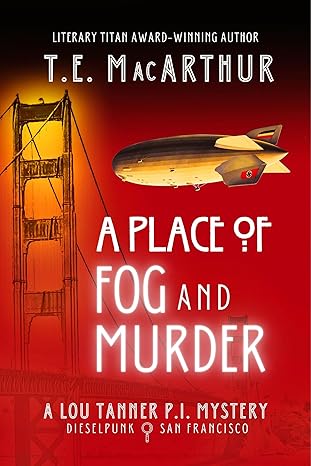
T.E. MacArthur delves into the atmospheric 1930s noir setting of San Francisco in her novel, A Place of Fog and Murder. The story follows Lou Tanner, a pioneering female private investigator who, in her maiden case, is plunged into the search for a missing woman. Navigating the labyrinthine world of government operatives, unruly gangsters, and less-than-cooperative police officers, Lou is confronted by quite the cast of characters, each harboring their own clandestine motives.
MacArthur intricately weaves themes of justice throughout the narrative, examining its breach through heinous acts like murder and the subsequent path to its restoration. The tale illuminates the contrasting lengths two distinct characters will traverse to see justice prevail. Lou embodies integrity, evident in her unyielding commitment to the case even when faced with potential death and her unwavering moral compass.
Set against a backdrop that melds steampunk and sci-fi elements, A Place of Fog and Murder presents an intriguing take on 1930s San Francisco—complete with robots and authentic period slang. MacArthur’s character development shines, especially with Lou, whose genuine reactions to traumatic events provide a depth of realism.
With engaging writing, authentic characters, and a suspense-filled mystery plot, A Place of Fog and Murder, by T.E. MacArthur, is a must-read for fans of the whodunnit and mystery genres.
Pages: 299 | ASIN : B07RG7YW17


 LITERARY TITAN