Blog Archives
A Society Divided By Technology
Christine Z. Miller Author Interview
Tools, Totems, and Totalities is a striking and expansive critique of modern technology and its pervasive role in shaping culture, institutions, and identities. Why was this an important book for you to write?
To bring together a society that has been divided by technology.
What is a common misconception you feel people have about how technologies impact culture and individuals’ identities?
We feel that we are the masters of the technology, when in fact we are enslaved by it.
What were some ideas that were important for you to share in this book?
First, that “technology” is not a human universal, but rather is a specific creation of the industrial revolution, and second that “technology,” like industrialization generally, has its pluses and minuses.
What is one thing that you hope readers take away from Tools, Totems, and Totalities?
That we collectively should be thinking about a world beyond technology, a world in which human connections and conviviality are more important than the tools we use.
Author links: GoodReads | Website
Tools, Totems, and Totalities: The Modern Construction of Hegemonic Technology, the 2024th Edition


Tools, Totems, and Totalities is a striking and expansive critique of modern technology and its pervasive role in shaping culture, institutions, and identities. Allen Batteau and Christine Z. Miller craft an ethnographic and philosophical journey through the social ecosystems technology inhabits, evolves within, and often dominates. Rather than viewing technology as a neutral tool, the authors challenge us to see it as a deeply embedded hegemonic force—one that organizes power, redefines human interaction, and reshapes meaning in the modern world. The book blends anthropology, design theory, engineering insight, and cultural criticism to show how tools become totems, and how both can culminate in totalizing systems of control.
What grabbed me right away was the authors’ raw honesty in grappling with our blind trust in “progress.” The opening chapter sets the tone, arguing that our imagination of technology—our deep faith in it—is more fantasy than fact. We treat smartphones, space probes, and electric grids as if they magically better our lives, when in truth, many of these devices mask deeper social problems or even create them. The idea that technology acts as a form of modern magic, filling the spiritual and communal voids of contemporary life really resonated with me. We reach for the newest device like it’s a talisman against chaos, and in doing so, we lose sight of the human behind the machine. That sense of disillusionment is something I’ve felt before, but the book gave me the language and history to make sense of it.
But it’s not all doom and gloom. I found myself surprisingly moved by Chapter 6, where the authors introduce “convivial technology.” Here, they offer a hopeful, even beautiful vision of tools designed to enhance human relationships and community life, not just productivity. It was a breath of fresh air. They celebrate thinkers like Ivan Illich and Victor Papanek, who envisioned technology that’s adaptable, human-centered, and a little slower. Their critique of modern design culture—its obsession with speed, efficiency, and control—felt deeply personal. As someone who’s worked in tech, it made me pause. Maybe the point of innovation isn’t always to push forward, but to step back and ask, “Who is this really serving?”
Tools, Totems, and Totalities is a mirror held up to our techno-utopian fantasies. It doesn’t offer easy answers, but it does offer clarity. The writing is at times dense but always thoughtful, weaving scholarly insight with a conversational rhythm that kept me engaged. The authors don’t pretend to speak with a single voice—they embrace their differences, and it works. The book doesn’t preach. It pokes, it nudges, and sometimes it throws cold water on our comfort zones. But I appreciated that. I finished the final chapter with a weird mix of dread and inspiration. I wanted to change something. Or at least think differently.
This book is for people who aren’t satisfied with buzzwords. If you’re curious about the social and cultural consequences of technology—and especially if you’ve ever felt unsettled by your own reliance on it—this book will challenge and reward you. Scholars, designers, engineers, sociologists, and everyday readers who are just plain tired of the hype will find something meaningful here.
Pages: 231 | ISBN : 9819787076

Kids Being Kids

Better Be Home When the Streetlights Come On: Remembering the Summer of 1963 follows three eleven-year-old boys as they spend their summer going on adventures and making memories. There was a lot of time spent crafting the character traits in this novel. What was the most important factor for you to get right in your characters?
The three main characters and most of the supporting cast are loosely based on my childhood friends. Brain, the Jewish kid, was the smartest among us and Chief an African American kid was simply our friend – we didn’t care about race. The important traits are just ”kids being kids” and navigating the challenges and landscape of 1963.
What were some themes that were important for you to explore in this book?
I wanted to give the reader a sense of what it was like growing up in Braddock 1963. Beginning with a macro view of Braddock as a steel town shaped by Andrew Carnegie, steel-making technologies, and the environmental advantages of proximity to the Monongahela River and the rich coal seams. Next, I focused in closer on the neighborhood, stores, and the culture of the times. From then on through the rest of the book I follow the major events of their summer vacation. Another theme is the challenges of aging with the older versions of the friends as they reflect on the childhood memories.
What is the next book that you are working on, and when will it be available?
I am going to go in a completely different direction and write a non-fiction book. I had the honor and privilege to serve in Chief Information Security Officer (CISO) roles in several iconic organizations including but not limited to the Naval Nuclear Program, US House of Representatives, American Red Cross (from 9-11 to Hurricane Katrina), and AMTRAK. Over 40 years of experience, I will write about the evolution of the CISO vocation in the context of meteoric advancements in technology and the means to protect the organization against internal and external threats. As to when it will be available, TBD.
Author links: GoodReads | Facebook
Better Be Home When The Streetlights Come On
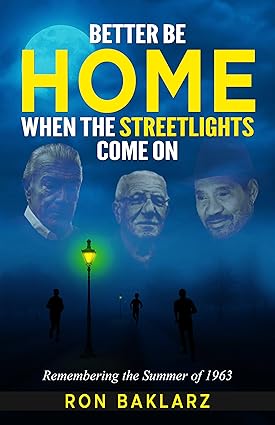

Better Be Home When the Streetlights Come On: Remembering the Summer of 1963 by Ron Baklarz provides an evocative journey into the lives of Jack and his teenage companions during the vibrant era of the 1960s. This narrative, which can best be described as a fictional biography, is rooted in the lively exploits of these young lads, all set against the backdrop of Braddock, Pennsylvania, following their academic year at St. Brendan Catholic School.
Caught in the tumultuous throes of adolescence, Jack, along with his inseparable friends Brain and Chief, grapple with their increasing curiosity. Whether it’s dodging the intimidating Buster or embarking on secret escapades their parents should remain oblivious to, their summer is nothing short of eventful. From spirited accounts of their Catholic school experiences to their eager anticipations of the Boy Scout camp, their tales encompass the universal thrills of teenage years – the intrigue surrounding girls, firearms, fireworks, and camping adventures.
Baklarz does an admirable job of immersing readers in the 1960s, interweaving the narrative with cultural and historical references pertinent to the era. Vivid episodes, such as a delightful picnic escapade with their mothers or a daring attempt at firearm smuggling, consistently engage the reader.
While the novel’s focus remains sharply on 1963, there are moments when I feel the pacing feels slightly rushed, making it a tad challenging to trace the connectivity between certain events. I think a deeper dive into the perspectives of the supporting cast would have further enriched the tapestry of this story. While the extensive detailing of historical events is informative, its relevance to the central narrative occasionally feels overstated.
Better Be Home When the Streetlights Come On promises a delightful read for those with an affinity for tales that blur the lines between fact and fiction and who relish a trip down memory lane.
Pages: 225 | ASIN : B0CG7KF43V
MARCHING THROUGH TIME: THE POLICE BAND’S SARAWAK DEVELOPMENT AND EVOLUTION

Marching Through Time: The Police Band’s Sarawak Development and Evolution by Frankie Tadius is a scholarly yet vibrant examination of the compelling history and evolution of police bands in Sarawak, Malaysia. The author’s in-depth research and fervent storytelling come together to enliven the journey of these unique musical ensembles, uncovering their influential role in the sociocultural tapestry of the region.
Frankie Tadius expertly constructs a chronological narrative of the growth and transformation of police bands in Sarawak, from their inception during colonial times to their flourishing in the modern era. He artfully interweaves historical contexts with individual experiences, casting a spotlight on the hardships, triumphs, and pivotal events that have molded the police bands’ identity and mission.
A notable aspect of this work is the meticulous analysis of the cultural influences shaping the music and traditions of the police bands. Tadius delves beneath the surface, uncovering a rich fusion of indigenous rhythms and colonial-era compositions. This creates an extraordinary musical landscape that reflects Sarawak’s diverse and multifaceted heritage. While the primary focus is historical, the author’s ardent love for music permeates the prose, adeptly elucidating musical concepts and terminology to enrich readers’ appreciation of the underlying artistry.
Marching Through Time is more than a mere historical recounting; it also stands as an eloquent homage to the men and women who have shaped the development of the police bands. Tadius’s commitment to preserving their narratives guarantees that their legacy will echo in the hearts and minds of future generations.
Marching Through Time: The Police Band’s Sarawak Development and Evolution serves as an enthralling odyssey through Sarawak’s musical lineage. Frankie Tadius’s palpable enthusiasm, coupled with his captivating storytelling and comprehensive research, culminates in a work that is both enlightening and moving. As a significant addition to the cultural studies literature, this book enhances our understanding of Sarawak’s cultural heritage and affirms the lasting impression of police bands on the community. It is a must-read for those interested in the intersection of history, culture, and music.
Pages: 400 | ASIN : B0CBQ82HQ2
The Konar and the Apple

Babak has lived in Ahwaz, Idaho, London, Iran, Japan, and now California. At age 11, Babak and his family relocated to Iran. Initially, life was easy and he spent his days making memories with his friends there. They worked together to found their own secret society and went seeking avenues to fund their club. However, things took a drastic turn when the war between Iran and Iraq broke out. First, Babak had to leave his friends behind and relocate again with his family amidst the insistent bombings to another town. Then worrying about having to enlist in the military if he failed the national college entrance examinations was a growing concern. Thriving as a growing boy in Iran, Babak encountered some roadblocks, heartache, breakthroughs, and also falling in love.
The Konar and the Apple by Babak Hodjat is a compilation of events from the author, Babak Hodjat’s time living and growing up in Iran during a war. He shares with us the peace his family enjoyed before the war the happy times that were carefree. When the war started, his family experienced fear and anxiety as they relocated away from the fighting. Hodjat especially goes into detail about what his time living and schooling during and after the war looked like. Living through a war did not change him. At heart, he was still that adventurous and daring child before the war.
Babak aimed to share all his core memories as a growing boy in the form of storytelling and he has successfully done this. At times Babak did describe serious memories but he also managed to keep the tone lighthearted. Babak’s stories bring back a feeling of nostalgia and takes us back to the time when we were creative. He gives readers undiluted, yet brief access to what his youthful years looked like.
The Konar and the Apple is perfect for younger readers as they will be captivated by Babak’s adventures and quests with his friends. Readers looking to envision what the life of an average Iranian citizen looked like during the war will find this to be an eye-opening read.
Pages: 355 | ASIN : B09QH3Q55S
Unusual Genealogy

Anita Bunkley Author Interview
The Twisted Crown is a fascinating story about a free black woman from the North searching for her mother in the post-Civil War South. What served as your inspiration while writing this novel?
My father’s family is from Moncks Corner, SC, and we still own property there. I was born in Ohio and grew up in the North. I have always been fascinated by stories about our land in Moncks Corner, called Bryan Tract, and how it was acquired, as well as our family’s unusual genealogy. My great-grandfather was a white man from Iowa, who went to South Carolina during Reconstruction, and eventually became a wealthy state senator. I have always felt that period in American history was not well documented from the female, Afro-centric point of view. So, I decided to focus on that time period. Once I began to acquire primary source documents that provided details of my great-grandfather’s life, I wanted to pen the novel from the point of view of a woman from the North who travels into the South during Reconstruction.
This is an entertaining novel that is high in social commentary. What were some themes you wanted focus on in this book?
Romance: My family’s mixed race background demonstrates the crossing of racial lines at that time, as is really evident throughout history. I wanted to present this aspect of society through characters who could see past the racial, cultural, and societal barriers that existed during this time period. Political: I wanted to better define what Reconstruction actually was. It was not rebuilding bridges and constructing new buildings, but an effort to establish a solid political structure and an economic base to replace the defeated Confederate government. Societal: My goal was to showcase the work of the Freedman’s Bureau and underscore its importance in helping freed slaves establish new lives in freedom after the Civil War.
Eva is an intriguing character that continued to develop as the story progressed. How did you capture the thoughts and emotions of a young black woman during this tumultuous time in history?
As a novelist of historical fiction, I have always focused on examining a period in history through the eyes of an African-American woman. My own family experiences, coupled with years of researching the role of black women throughout pivotal periods in history helped me shape Eva.
What is the next story that you are working on and when will it be available?
Writing historical fiction takes time, detailed research, and inspiration. I always spend time traveling to the geographic locations that I plan to use in my books I’m mulling time periods, traveling, and pulling my next story together without any release date in mind.
Author Links: Website | Facebook | Linkedin
![The Twisted Crown by [Richmond Bunkley, Anita]](https://images-na.ssl-images-amazon.com/images/I/510vwG6og9L.jpg)
The Twisted Crown takes readers from the bustling streets of Boston at the height of the Abolitionist movement to the war-ravaged landscape of Reconstruction-era South Carolina.
In 1867, Eva Phillips, who was born a slave yet lived in freedom, travels across the chaotic landscape of South Carolina in search of the mother who gave her away. During her journey, she is befriended by a black political activist promoting the rights of the newly freed slaves, a wealthy northern Carpetbagger, and a gutsy lady gambler who teaches Eva how to survive in the tumultuous Post-war environment.
When the spirited young widow’s quest draws her into a dangerous web of theft, lies, and murder, she becomes the target of a long-awaited confrontation that forces her into a fight for her life.




 LITERARY TITAN