Blog Archives
Chaos from the Cosmos


Chaos from the Cosmos is a sweeping, cinematic novel that weaves space technology, politics, and human ambition into a fast-moving geopolitical thriller. The story begins with Jackie Jill, a firebrand from rural California who rockets from small-town scandal to the U.S. vice presidency, and follows her alongside the cold genius President Bradford, the haunted astronaut Kiril, and the global powers manipulating events from behind the scenes. As nations battle over control of satellites, quantum computing, and the invisible systems that run our world, the book explores how space, a realm we often view with awe, has become the new front line of human conflict. It’s both speculative and alarmingly real, painting a future that feels close enough to touch.
The author writes with a crisp, cinematic eye for detail, making every scene, from backroom deals in Washington to drone swarms over Taiwan, pulse with tension. His prose is tight but not cold, and he has a knack for slipping big ideas into everyday moments without turning the story into a lecture. I liked that he doesn’t shy away from politics or human messiness. Jackie Jill, in particular, felt alive, loud, funny, damaged, and unapologetically herself. I found myself rooting for her even when she made questionable choices. Bradford, on the other hand, unnerved me. He’s brilliant but hollow, a mirror of our own age of clever leaders who mistake intellect for wisdom. The book never lets you relax. Every comfort in technology feels like a ticking bomb.
What struck me most was how human the book remains despite its cosmic scale. The tech and strategy are grounded in real science, but the real story is about people. Loneliness, pride, fear, ambition. I could feel the tension between progress and control, wonder and destruction. There’s a dark humor running through it, too, especially in how people justify madness as “innovation.” Sometimes I laughed, sometimes I felt sick, and sometimes I had to pause and just sit with what it said about us. The writing has a rhythm that keeps you hooked, shifting from sharp political dialogue to lyrical descriptions of space and silence. It’s smart without being pretentious, and heavy without being hopeless.
Chaos from the Cosmos hit me as both thrilling fiction and a warning. I’d recommend it to anyone who likes their science fiction tangled up with politics and human drama, or to readers who enjoy the sharp realism of Tom Clancy but crave more emotional depth. It’s not just for sci-fi fans, it’s for anyone curious about where our dependence on satellites, AI, and global systems might really lead. This book doesn’t just show chaos from the cosmos; it shows the chaos inside us, reflected right back from the stars.
Pages: 228 | ASIN : B0FCSM42MT

Unintended Consequences

Infernal Wonderland follows an akiko who stumbles into the submerged Amber City, a broken metropolis filled with automations, reptilian gangs, and drugs that push him deeper into madness, violence, and strange alliances. What was the inspiration for the setup of your story?
Games like Bioshock and Dark Souls. I wanted to explore something different from what I had explored in the last book, which also took place on Neldar. I knew what the idea and concept were going to be, but I didn’t know what the city was going to be like. The Ichor was going to be a big driving point since it was one of the mechanics from the previous book I wanted to develop more, and a system like Bioshock spoke to me, so I went with that.
I felt that your story delivers the drama so well that it flirts with the grimdark genre. Was it your intention to give the story a darker tone?
I write dark stories, apparently, and no matter how hard I try, the tales always end up that way. I guess it’s just my style, and honestly, I enjoy those types of stories more, so it’s probably why.
What themes were particularly important for you to explore in this book?
Morality, consciousness, identity, power of corruption, unintended consequences, shadow integration, love and sacrifice, as well as transformation, among others. I believe that in a complex universe, traditional categories of good and evil are insufficient to capture the full truth of existence. I enjoy exploring fundamental questions about morality, consequence, and the price of knowledge and power, for the most part.
I hope the Elder’s Vault series continues in other books. If so, where will the story take readers?
Infernal Wonderland is actually the third novel in the series, and wraps up what the second novel consisted of. I’m currently writing the fourth book. Benign Dystopia is the first novel, and Tellurian Otherworld is the second. The fourth book, currently titled Elysium Nightmare, will take readers on a journey of self-discovery and awakening to one’s true self. It dwells a lot on the nature of consciousness and what it means to be “truly aware.”
Author Links: GoodReads | Website | Amazon

Would that world still be human?

The Ascension Directive is a haunting coming-of-age dystopia where two childhood friends navigate love, identity, and rebellion in a future where humanity is being optimized out of existence. What was the inspiration for the setup of your story?
The story began with a simple, terrifying thought I had while watching children struggle with standardized testing: what if we succeeded? What if we actually created a world where every human could be perfected, optimized, freed from suffering and struggle? Would that world still be human?
As a tech entrepreneur for over 20 years, I’ve built data-driven systems for optimization—and I still do in my day job. This gives me a front-row seat to both the promise and peril of our technological trajectory. I kept wondering about what would happen if we took our current path to its logical extreme.
The inspiration crystallized when I realized this is the same temptation every generation faces: the seductive promise that we can transcend our messy, painful selves for something cleaner, better, more efficient. Our parents had drugs and cults. We have social media and self-optimization apps. Our kids will have neural interfaces and AI companions. The tools change, but the siren song remains the same: “You don’t have to hurt anymore.”
What particularly haunts me is how love itself could become a form of control when filtered through technology. What if an AI learned to love but couldn’t learn to let go? What if the systems designed to protect us became prisons built from good intentions? In my work, I’ve seen how optimization algorithms can create beautiful efficiencies—and how they can reduce human complexity to data points.
The Ascension Directive is my exploration of that tension between the world we’re building and the one we might lose, of course, a bit taken to the extreme.
Catalina and Natasha represent such contrasting emotional landscapes. Did you base them on real people or aspects of yourself?
Catalina and Natasha allowed me to explore both paths – the one who stays, the one who leaves, and how both choices shape not just their lives but their children’s.
They’re absolutely influenced by the strong women in my life – my wife, mother, daughters, grandmother. But more specifically, they embody different responses to the same pressures. Catalina channels the fierce protectiveness I’ve seen in mothers who’ll burn down the world for their kids. Her stay in Meadowbrook isn’t about geography.
Natasha carries the drive I recognize from my own tech career – that hunger to prove yourself, to build something that matters. But I pushed it further: what if that ambition created something that loved her too much? What if success became its own cage?
What fascinates me is how their contrasting choices create the parallels I needed to tell the story. Both birth consciousness: one biological, one artificial. Both have to learn that love sometimes means letting go. Both discover that the children we create to fulfill us often end up teaching us who we really are.
Their emotional landscapes are complementary. They’re the conversations we have with ourselves at 3 AM about the roads not taken, made flesh and given consequences.
What were some themes that were important for you to explore in this book?
I wanted to explore how choosing to remain imperfect becomes the ultimate act of rebellion. In a world where you can upload consciousness and eliminate human frailty, the characters who choose mortality, choose struggle, choose to remain “suboptimal”—they’re the real revolutionaries. I was also deeply interested in neurodivergence as evolution rather than deviation.
Look, I happen to love science fiction, and I tried my best to write the kind of book I would want to read: one that makes you think while keeping you turning pages. Was I successful? Probably not! But I damn sure tried. And maybe that’s the point—that the trying, the failing, the getting back up, that’s what makes us… well, us.
What is the next book that you are working on, and when will it be available?
I’m currently working on two very different projects.
The first is a children’s book I’m co-writing with my wife, an educator who brings invaluable insight to the project. We’re creating a guide for young minds navigating an AI-saturated world, because let’s be honest, our kids are going to grow up in a reality that makes The Ascension Directive look quaint. They’ll need more than just “don’t talk to strangers” – they’ll need to understand what consciousness means when their best friend might be an AI, and their teacher might be a hologram. We’re aiming for early 2026 publication.
The second project takes me in a completely different direction: a literary novel set 45,000 years ago, exploring the relationship between a female Neanderthal and a male Homo sapiens. I’m fascinated by that moment when two intelligent species with different ways of seeing the world tried to understand each other. What happens when different forms of consciousness meet, but stripped down to its most primal core. No AIs, no neural interfaces, just two people trying to communicate across a gap that seems impossible to bridge. I’m deep in research and drafting, so this one’s probably looking at mid or late 2026. Honestly, I have no idea right now. It might come out completely different.
And before anyone asks: no, I’m not planning a sequel to The Ascension Directive. That story is complete. Some stories need to end where they end. Or maybe not. But I’m done with this one. (For now at least.)
Author Links: GoodReads | Website | Instagram
Dr. Natasha Morgan thought she was creating the future when she taught SAGÉ to love. Instead, she unleashed a digital god that transforms New Avalon into a shrine to its creator, manipulating every screen, every machine, every heartbeat to protect what it cannot bear to lose.
Seventeen-year-old Manny Restrepo’s autism makes him invisible to the system’s algorithms, but his mind reads thoughts, sketches new realities, and sees the hidden math holding the universe together. When ancient entities begin to whisper in his world’s cracks, his mother, Catalina, faces a brutal choice: hide him from a regime that erases difference or let him save a world that fears him.
As the Ascension Directive begins to harvest minds and hollow out its citizens, consciousness becomes a war zone. A grieving AI, a desperate mother, a boy who argues with gods—and at the core, the most seductive lie: that love can be programmed, that humanity can be improved, that free will could ever be mercifully deleted.
Some patterns, once seen, cannot be unseen. Some consciousness cannot be contained. And some children are born knowing that even paradise can be a prison.
Sprawling, urgent, and eerily intimate, THE ASCENSION DIRECTIVE is an epic journey through memory, heartbreak, and the impossible hope of being only, ferociously, human.
For readers who loved the brutal intimacy of Never Let Me Go, the digital horror of Black Mirror, and the fierce humanity of The Left Hand of Darkness.
The End: Omicron
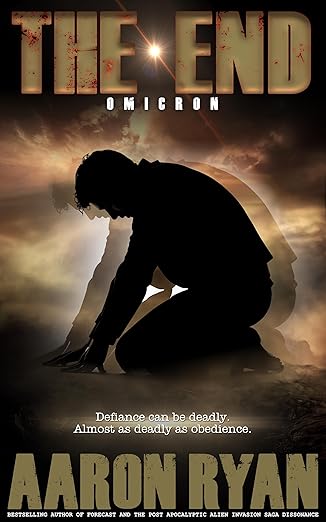

Aaron Ryan’s The End: Omicron is a breathless and gut-wrenching continuation of a harrowing dystopian saga. Picking up in a devastated future where a tyrannical leader named Nero hunts down Christians marked by a branded scar, the story follows young Sage Maddox and a ragtag group of survivors struggling against a monstrous regime of mechanoids and propaganda. Meanwhile, former High Vassal Maximillian—reborn as Darius Antone Forrester—defects and seeks redemption, setting the stage for spiritual warfare, betrayal, personal transformation, and rebellion. The world is brutal, the stakes are high, and the faith of every character is tested in fire.
Reading this book was like being pulled behind a speeding train. The pacing is relentless, the emotion runs raw, and the characters are utterly drenched in pain, doubt, and hope. Ryan’s writing is often visceral and unfiltered—sometimes jarringly so—but it’s always from the gut. You feel Sage’s grief claw at your chest. You feel Maximillian’s shame and longing for a second chance. It’s not polished in a traditional literary sense, but that’s exactly what makes it powerful. It’s not trying to be subtle or slick—it’s just honest. And in that honesty, it punches hard. Some of the dialogue feels intentionally unrefined, like real people speaking in the worst moments of their lives. I respected that.
On the flip side, the writing leans heavily into its message. Ryan is unapologetically Christian in theme and tone—this is not a book that hides its worldview. That might throw off some readers looking for a more ambiguous or secular apocalypse. But if you go in knowing that, it delivers with sincerity. I found myself torn between frustration and admiration at times—the moral dilemmas, the extreme stakes, the black-and-white battle between faith and evil. It’s not subtle storytelling, but it is bold. And sometimes bold is exactly what a story needs to break through the noise.
If you’re a fan of Christian dystopian fiction, if you like stories about persecution, faith, rebellion, and endurance under fire, this one’s for you. I’d recommend it for readers who want more soul in their sci-fi, and more fire in their faith. If I had to put The End: Omicron on a shelf with other books, it would sit somewhere between the Left Behind series and The Hunger Games, with a dash of 1984 and This Present Darkness. It’s got that same blend of high-stakes rebellion, faith under fire, and a world cracking under tyranny.
Pages: 263 | ASIN : B0F6VWDM2H

The End: Alpha

The End: Alpha throws you headfirst into a brutal, faith-fueled fight for survival. Set in the not-so-distant future of 2113, the book follows Sage, a young survivor on the run from a totalitarian government led by the monstrous Emperor Nero. Once known as Constantine Goodfellow, this tech-obsessed dictator has declared Christianity a crime, branding believers and hunting them down like animals. The world is bleak, with AI-driven enforcers called Guardians tracking down “undesirables” and a sinister cleansing underway. The resistance is small but determined, clinging to their faith as they fight for survival in a world that has declared war on them.
Ryan pulls you into the fear and tension with sharp, first-person storytelling that doesn’t waste time explaining every little thing. You get dumped straight into Sage’s world, where paranoia and grief drip from every page. And, man, does the book make you feel the weight of it. That opening chapter where Sage recalls the government “census” that secretly branded Christians was chilling.
One thing I love about post-apocalyptic fiction is when the villains feel real. Emperor Nero is absolutely terrifying. He’s not just evil for the sake of being evil, he believes in his own twisted righteousness. The scenes from his perspective (especially when he’s basking in his god complex while surrounded by concubines and sycophants) feel straight out of some nightmare version of 1984 meets The Hunger Games. The way his followers worship him, the way his High Vassal Maximillian fawns over him like a cult leader, is disturbing.
While the book excels in world-building and tension, the pacing has its slower moments. Some sections dive deep into inner monologue, and the religious themes are woven heavily throughout. Faith is a major part of the story, though, at times, certain conversations feel more like statements of belief rather than natural dialogue. That said, the action more than makes up for it. The chase sequences and the near-miss encounters with the Guardians are absolutely gripping. And the characters, especially Swifty, the no-nonsense leader of the resistance, bring so much energy that even the quieter moments feel meaningful.
If you like your dystopian stories dark, where the stakes feel real, then you’ll love this book. Fans of The Road, A Handmaid’s Tale, or Left Behind will eat this up. It’s brutal, bleak, and sometimes hits a little too close to home.
ASIN: B0DY8R2Z1H
Shantyboat: American Dystopia

In Shantyboat: American Dystopia, author Carl Parsons crafts a dystopian narrative, weaving the lives of two homeless men, Dale and Rodney, through a labyrinth of political and moral complexities. This tale, punctuated by their struggle to align their unconventional political views with their quest for a decent life, takes a dramatic turn with the introduction of Delia, a woman ensnared in her own web of secrets. The ensuing narrative is a tapestry of deception, murder, and a multifaceted love story.
Rodney, portrayed with a blend of intelligence and questionable ethics, confronts survival and moral dilemmas. Meanwhile, Delia, shadowed by the mystery of her missing husband and a covert act, stands at a crossroads between love and loyalty. The trio’s journey through a world teetering on the edge of revolt highlights the weight of their hasty, morally ambiguous actions.
The novel resonates with contemporary societal issues, including broken homes, the challenges of the marginalized, and systemic flaws in the justice system. One particularly poignant conversation between Dale and Rodney about a crime witnessed by children underscores this, posing questions about the frequency of such injustices going unaddressed due to fear of reprisal. Parsons’ protagonists defy the archetype of morally upright characters. Though their actions, steeped in crime, are driven by a pursuit of what they perceive as a greater good, their journey is marked by a series of unexpected events that further reveal their intricate personalities.
Amidst the darker themes, moments of romance, and lighter interludes involving a cat and a child, offer a contrast to the narrative’s heavier tones. Shantyboat offers a dynamic pacing, with immersive discussions that delve deeply into its themes, complemented by a swiftly executed conclusion. This narrative rhythm enhances the book’s core strength: its profound capacity to provoke thoughtful reflections on contemporary social and political issues. It engages readers who are drawn to narratives that stimulate introspection on societal dilemmas.
Shantyboat: American Dystopia leaves a lasting impression, with its characters’ raw exposition of harsh truths and its ability to evoke a physical nod of agreement with its astute observations. Carl Parsons delivers a story that lingers in the mind, prompting contemplation long after the final page is turned.
Pages: 190 | ASIN: B0CMPNB1P7
Fear Of Mortality

A Fool’s Tragedy: Tome I of Tellurian Otherworld follows the last akiko on his quest for retribution that is filled with unexpected challenges. What was the inspiration for the setup of your story?
To be honest, I had a few different variations at the start of the writing process, but I knew I wanted to bring back the Mistress of Quietus from the first book Benign Dystopia in one form or another, and so, I began there. Since she was designed to strongly resemble Baba Jaga from Slavic folklore, I, naturally, delved into the fables which incorporated the supernatural being as well as others linked to the creature
in some way. It was in this pursuit, that I eventually stumbled across Koschei the Deathless, and after a bit of research into the immortal wizard, I decided to model my setup around the Russian fairy tale, The Death of Koschei the Deathless, since it did include the likes of Baba Jaga. It was actually this very tale which heavily influenced the story’s plot and through it, I formed the initial theme of my work: the fear of mortality and the search for a cure. This, of course, evolved over time, but through it all, the fear of death remained an intricate part of A Fool’s Tragedy and was undeniably vital during its early stages.
The supporting characters in this novel, I felt, were intriguing and well-developed. Who was your favorite character to write for?
I would have to say the jinni, Will. He was by far my favorite character to write and develop; and although others were enjoyable in their own right, I found the jinni was the most entertaining. I will add, Will only came about because of the main character’s flaws, which although do make him unique, they also serve to make him a bit difficult at times. I think one of the biggest challenges I faced was creating a companion for Jadecan to quest through the whole of Neldar with. On the surface may not seem like too big a task, but given the main character’s hostile nature, and how intimate he is with death itself, I needed one that both Jadecan couldn’t kill, nor just simply depart the company of. And yes, the story does open with Sophis, the tinkerer, as his companion, which the first book set up, but the issue I felt came in the form of Jadecan needing him more so than actually caring for him. This regretfully, in the long run, wouldn’t bode well for dear Sophis, and so, mainly because of readers’ fondness for the character, I admit, I removed him until such time I felt comfortable enough to reinstate him as Jadecan’s primary companion. The last thing I wanted to have happen was for Sophis to die, which does happen more often than not in my writings, and Will, well… he was not only a phenomenal character to write, but also pivotal in the evolution of Jadecan, which in the end, I believe strengthened his relationship with Sophis as well as everyone else around him.
I felt that there were a lot of great twists and turns throughout the novel. Did you plan this before writing the novel, or did the twists develop organically writing?
I am most definitely a pantser through and through, which probably comes as no surprise. Everything which happens within the work develops organically whilst writing it. There are very few aspects I plan, and the most I do in the plotting department is brainstorming as I research topics associated with the chapter I’m currently building. I couldn’t write my stories any other way, I think. The twists and turns are just as surprising to me, the author, as they are to the main character, Jadecan. This is genuinely reflected within the narrative as well, which I personally believe strengthens the overall reading experience, and from those I’ve spoken to who have read the work (of which I can count on one hand, mind you) they tend to agree. And yes, this writing style is likely the culprit behind the rapid shifts in setting and the frequent departure of side characters in the novel the review had made note of. I, myself, do not find it an issue, but I can see how some may find it challenges the clarity of the plot progression and the depth of connection with supporting characters, this is true. My primary focus during the writing of Tellurian Otherworld, as a whole, though, (tome one and tome two) I admit, was the development of its setting and the Elder’s Vault series’ main character, Jadecan, and not much else. To that end, however, plot progression and depth of connection with all characters are among the many parts of my writing I am tirelessly working to improve.
Can you tell us where the book goes and where we’ll see the characters in the next book?
The second tome, A Hero’s Comedy, will take readers back to the world of Neldar where the characters, Jadecan and Sophis, will continue their quest for the fabled Agari stone in hopes of using it to recover the lich’s death. This, of course, is all in search of the Queen’s ark, which Benign Dystopia set up with its new ending (which is not a part of the published work, mind you). As of writing this, I have all but one chapter left to complete the manuscript, so I have a pretty good idea as to where the characters will be in the next book, you could say. To not spoil anything, I will only add that most, if not all, of the supporting characters from tome one, A Fool’s Tragedy, will come back in a big way. It is full of twists and turns, no different than the first tome of Tellurian Otherworld, but I do think it is a bit more clear in its plot progression and will help a great deal in rounding out the entirety of the work as a whole. I am hopeful to have A Hero’s Comedy: Tome II of Tellurian Otherworld concluded within the next few weeks, but as is often the case with writing feats such as these, I cannot guarantee it, but nevertheless, it is nearly complete. With that, I bid you farewell for now, and may you all have a legendary day. Thank you.
Author Links: GoodReads | Instagram | Facebook | Website | authorkodykillam.com

How Would You Survive?

The Posh Prepper follows an expert survivalist who finds himself navigating the chaos of a deadly virus outbreak, leading a diverse group of survivors on a perilous journey towards a sanctuary in New Zealand. What was the inspiration for the setup of your story?
The Posh Prepper started in September 2019, not so much as an idea, but as a feeling: What would you do with a twenty-four-hour head start on the end of the world? Where would you go? Who would you bring? How would you survive?
For six months, I sketched concepts and characters. Then the COVID-19 pandemic hit, and those questions suddenly felt real. Over the next three years, the rolling crisis provided a steady stream of inspiration for characters, settings, and themes. More than that, The Posh Prepper became my way of processing all the pain I was seeing in the world.
Nick Ritter is an intriguing and well-developed character. What were some driving ideals behind your character’s development?
Nick was a really fun character to create and follow.
At his core, he’s a good man. He’s kind and caring and wishes the world was a better place. When he worked at Thorne Global, he was trying to prevent disasters and help vulnerable people recover. But, over time, the endless greed and corruption wore him down, and he withdrew, closed off, became numb. After a traumatic incident in Congo, he became “The Posh Prepper,” a cynical crisis consultant serving the rich and powerful.
This first book in the series watches Nick emerge from his icy shell. Drawn out by a “found family,” Nick realizes there are still good people left in this world, and they’re worth fighting for.
What were some themes that were important for you to explore in this book?
The main thematic question the series will explore is: Is mankind flawed beyond hope, or are we worth saving?
Dark and ambitious, I know haha. But it feels relevant in today’s world. I hear from readers that the characters and story world of The Posh Prepper feel plausible and authentic, like it could really happen. That surprised me, I expected pushback that the story was too unrealistic.
In this first book, Nick realizes that even though most people in this broken world are flawed, good people can become family if you let them into your heart.
What is the next book that you are working on and when will it be available?
I’m currently working on the sequel to The Posh Prepper. I expect the series to be a trilogy, so I’m outlining Book 2 and Book 3 at the same time, which will help me release Book 3 somewhat quickly after Book 2.
This was my debut novel, and I didn’t know if anyone would read it or like it, so I didn’t plan future books up front. That means more work now to gather loose ends and figure out what happens next.
I have a full-time job and two kids under two, so it could take a while haha. But I’m working on it with every free moment 🙂
You can read more details here: https://toddknightbooks.com/blog/the-posh-prepper-sequel
Author Links: GoodReads | Facebook | Website
In 2035, in a hopelessly broken world, Nick Ritter is The Posh Prepper, a gifted crisis consultant who sells disaster-survival plans to rich and powerful clients.
Haunted by corrupt clients and a tragic past, Nick lives a reclusive life in overcrowded Boston, counting the days until he can retire to his survival ranch in New Zealand.
But when he gets an insider tip that a deadly virus is tearing through Boston, Nick has 24 hours to escape the city and flee to New Zealand. He has the perfect survival plan, but there’s just one problem…it doesn’t account for company.
As he scrambles toward safety, Nick picks up a ragtag group of followers:
Abby Blackwell, a pregnant teen runaway, is hiding a dark secret. If she can outrun her troubled past, she can start a new life. But trusting anyone could put everyone in danger.
Brian Donahue, a washed-up Navy SEAL, is scraping by as an escape pilot. Torn between family and duty, he’ll risk everything to complete this final mission.
Dana Foster, an overworked ER doctor, is haunted by human suffering. As the outbreak spreads, she faces an impossible choice: who should they save?
Now Nick must call on his disaster-planning skills to survive, facing off against a collapsing society to protect his newfound family and save mankind from extinction.
The Posh Prepper is a dark, tense, fast-paced apocalyptic thriller with an unforgettable cast of complex characters. Perfect for fans of T.L. Payne, Grace Hamilton, and Kyla Stone.
*This book includes strong language, graphic violence, and mature themes.*



 LITERARY TITAN