Blog Archives
The Spiral Can Be Reversed
The Path from Hell to Heaven is a philosophical and psychological map of the ego, tracing how people spiral downward into “Hell” through fear, shame, and denial, and upward toward “Heaven” through trust, openness, and renewal. Why was this an important book for you to write?
Because ego explains nearly every human collapse and ascent, yet most people never receive a practical map for it. I wanted to translate psychological chaos—fear, shame, denial—into a recognizable model anyone could use, the same way we map complex systems in software or business architecture. This book is that missing human blueprint: a self-debugging framework that moves readers forward instead of leaving them looping in abstraction.
How did you come up with the concept of the two-sided spiral of the ego and develop this into a process that readers can implement into their own lives to find clarity and understanding of themselves?
I analyzed patterns before individuals. Ego contracts or expands; there’s no true neutral. Avoiding truth descends, openness creates lift. The spiral metaphor stuck because it captures momentum and acceleration.
To make it implementable, I structured it as an RPM self-awareness loop:
- R – Recognize the ego state you’re operating in
- P – Pause the automatic reaction loop
- M – Move with intentional correction or openness
It’s diagnostic and reversible, giving readers a clear exit path whether they’re descending or rebuilding upward.
I found the ideas presented in your book relatable and appreciated the actionable steps that readers can take to find their own clarity. What were some ideas that were important for you to share in this book?
The concepts that mattered most to me were:
- Ego itself isn’t the problem → closed ego is
- Narcissism is often unprocessed fear wearing armor
- Pain isn’t identity, it’s a turning point
- Ambition without self-awareness becomes self-sabotage
- Recognition of the loop always comes before the escape
And above all—I wanted a book that doesn’t just sound smart, but gets applied and changes outcomes.
What is one thing that you hope readers take away from The Path from Hell to Heaven?
That their ego has directions, and so do they. If they feel stuck, defensive, ashamed, or overwhelmed—it’s a state, not a life sentence. The spiral can always be reversed, rebooted, and climbed. The only real trap is believing the descent is normal and permanent.
This book is a Map of the Ego’s Double Spiral — a journey every individual, family, and society travels between Hell (closed ego) and Heaven (open ego).
Through vivid metaphors and grounded psychological insight, LANOU unveils how pain becomes protection, how protection turns to illusion, and how awakening begins when trust cracks the shell.
You’ll see yourself, groups, and even nations in these patterns:
The wound that starts the descent.
The mask that hides pain through control.
The collapse that breaks illusion.
The trust that starts renewal.
The open ego that frees love and truth.
Structured as a fractal spiral, the book reveals six repeating steps across all scales — from individuals to groups to the world itself. It blends the clarity of psychology with the simplicity of spiritual truth: hell is repetition; heaven is renewal.
Once you see the map, you cannot unsee it.
Beyond Power – Israel and the Struggle for the Ethical State


Beyond Power sweeps across a huge landscape. It starts with the brutality of October 7 and moves through the ethics of self-defense, the failures of modern democracies, the rise of progressive ideology, and the long history of Jewish vulnerability. It tries to stitch these threads into a single idea. The author argues that Western society is drifting away from the moral core that once made democracy possible. At the same time, he says Israel stands as a case study of a nation forced to defend that moral core while being attacked for doing so. The book blends philosophy, history, and political analysis into something that feels both wide-ranging and deeply personal. It does this through rational analysis, while acknowledging both sides of many of the arguments.
I found myself pulled in many directions at once. Some chapters hit hard. The discussion of existential threat felt raw, and the writing carried a pulse that seemed to come straight from lived fear. I felt the author’s frustration with how the world reacts to Israel’s choices. I also felt his disappointment at how fragile democratic societies have become. He writes in a way that makes big ideas feel urgent. At times, I nodded along. The book has a rhythm that swings between clarity and intensity, and that mix made the reading experience unpredictable in a good way.
Then there were moments when I felt the weight of the author’s certainty. Some arguments felt tightly reasoned and grounded in the text of history. Others felt more like a call to arms. I caught myself reacting emotionally. The sections on progressivism, for example, felt like they were written out of real concern. The passion behind the words made the book more alive. It never hides how the author feels, and that honesty makes the work feel human. The tone always remains respectful of divergent views and offers solutions as well as analysis.
I walked away thinking this book is suited for readers who want to grapple with difficult questions about ethics, identity, war, democracy, and power. It is a book for people who enjoy wrestling with ideas and who do not mind strong viewpoints. It will speak to readers who are curious about Israel’s struggles, Western political instability, or the philosophical foundations of ethical societies.
Pages: 247 | ASIN : B0G1CZG9J1

The Path from Hell to Heaven: The 2 Sided Spiral of the Ego

This book is a philosophical and psychological map of the ego, tracing how individuals, groups, and societies spiral downward into “Hell” through fear, shame, and denial, and how they rise toward “Heaven” through trust, openness, and renewal. It’s written like a guide for self-awareness, where the ego’s descent, wound, shell, mask, illusion, collapse, and denial are mirrored by its ascent through trust, openness, adulthood, mastery, and renewal. Each section builds on the last, connecting personal trauma to collective dysfunction and, finally, to global healing. The language is clear and rhythmic, sometimes poetic, and the structure moves like a spiral itself, repeating ideas but deepening them each time.
I liked how direct this book is and how it pointed to familiar pain without drowning in theory. The writing style blends psychology and spirituality without turning preachy. I could feel the author’s intention: to wake readers up, not to comfort them. Sometimes the simplicity of the prose makes it cut deeper than expected. It’s not a book that flatters, it exposes. At points, it felt like being called out and held at the same time. The “spiral” metaphor worked for me; it explained so much of what people repeat in life, from personal self-sabotage to entire societies collapsing under pride and denial.
The book’s tone is confident, almost absolute, which can feel heavy when you’re already raw. The ideas are strong, but their repetition across individual, group, and world scales sometimes blurs the freshness. Yet even then, I found myself underlining lines, rereading them, and thinking of people I know who live both spirals at once. The message that Heaven and Hell are not destinations but daily states of ego, sticks.
I’d recommend The Path from Hell to Heaven to people who crave clarity more than comfort. It’s for readers who think deeply about healing, leadership, and the way our inner wounds ripple into culture and politics. Therapists, activists, or anyone burned out on shallow self-help would probably find it bracing. It doesn’t tell you what to do; it shows you what you’re already doing. And if you’re willing to face that, it can be liberating.
Pages: 151 | ASIN : B0FT5HM9RS
Alignment on the Rocks: Reconnect the Work You Do to the Impact You Make


Sean Albertson’s Alignment on the Rocks is a guidebook wrapped in a river metaphor. The idea is simple yet powerful: our lives and our work move like rivers, and the rocks we hit along the way don’t stop the flow, they shape it. Albertson breaks life and business into four rivers: Customer, Career, Community, and Core, and shows how they connect and sometimes clash. He uses stories, frameworks, and personal reflections to show readers how to find alignment when things feel scattered or stuck. The book moves from explaining these rivers to offering tools like the 4ROCKS, FIND, and BREAK frameworks, all building toward a state of FLOW where life and work feel intentional and balanced.
Reading this, I felt both inspired and a little challenged. Albertson doesn’t sugarcoat the reality of misalignment, whether in a company or in a person’s life. I liked how he wove in his own career experiences, from climbing ladders to realizing he was chasing the wrong things. It made the lessons feel real, not abstract. At times, the book leaned into repetition, circling back to the same metaphor of rivers and rocks, but oddly enough, I found that grounding. It drilled the point home in a way that stuck with me. I came away reflecting on my own “rivers,” and it was hard not to pause after certain chapters and scribble notes about where I might be stuck.
What I appreciated most was the practicality. This isn’t a book of lofty slogans that sound good but fall apart on Monday morning. The frameworks, especially the BREAK method for turning obstacles into opportunities, felt usable right away. I could see myself applying them at work and at home. That said, the tone sometimes veered into the motivational-speaker zone, which may not land for everyone. I personally didn’t mind it because it was backed by stories and concrete steps. It gave the book both energy and warmth, and I found myself nodding along.
I’d recommend Alignment on the Rocks to anyone feeling caught in turbulence, professionals trying to reconnect with purpose, leaders aiming to build healthier teams, or even individuals seeking better balance in life. It’s not a dense business manual, nor is it a fluffy self-help book. It sits somewhere in between, with heart and structure working together. If you’re open to reflection and ready to look at the “rocks” in your path, this book will give you both a lens and a set of tools to move forward.
Pages: 121 | ASIN : B0FPGG4SKV

A Bridge
Eagles Fly ABOVE AI is a sweeping and heartfelt exploration of the human relationship with artificial intelligence, told through personal stories, historical reflections, and rich metaphors. Why was this an important book for you to write?
Eagles Fly ABOVE AI isn’t just a book—it’s a bridge. Between humans and machines. Between technical concepts and personal stories. Between confusion and clarity. I wanted to write something that felt like a conversation around a campfire—not a cold lecture hall. A place where metaphors guide understanding, where readers see AI not as an overwhelming force, but as a partner we can shape and work with.
It was important to write because how we relate to AI will define our century—and I wanted to offer tools, stories, and hope that help us rise above fear and thrive through understanding. On a deeply personal level, with five granddaughters of my own, I felt a profound responsibility to help shape a future where they—and all young women—view AI not as a threat, but as a powerful and positive force for their education, progress, and future prosperity.
What is a common misconception you feel people have about artificial intelligence and its use as we advance?
One of the biggest misconceptions is the belief that AI is either a savior or a destroyer—that it’s coming for us, rather than with us.
People often think of AI as some robotic entity “out there”—a black box plotting in the background or a sci-fi villain gaining sentience. But the truth is far more grounded: AI is a reflection of us. It learns from us, it adapts to our inputs, and it mirrors our intentions—flawed, noble, or somewhere in between.
Another myth is that AI will inevitably replace human creativity or wisdom. But AI doesn’t dream. It doesn’t suffer. It doesn’t love or reflect in the way we do. What it can do is amplify our strengths, free up our time, and challenge us to evolve—not into machines, but into better humans. The real danger isn’t in AI’s autonomy—it’s in our apathy.
What were some ideas that were important for you to share in this book?
Several core ideas carried this book like thermals under an eagle’s wing:
The power of story and metaphor: I deeply believe that stories make the unfamiliar feel familiar. If someone can understand binary through light switches or deep learning through kites on a beach, they’re already halfway to understanding AI.
Collaboration over replacement: AI is not here to steal our humanity—it’s here to partner with it. The future is not man or machine. It’s man and machine, working in harmony.
Nature as a guide: From jellyfish to mycelium to eagle flight, the natural world holds blueprints for systems that adapt, evolve, and collaborate. These metaphors aren’t just poetic—they’re instructive stories.
Inclusive & Ethical Design: We cannot program values we haven’t first practiced. Building ethical AI requires that the teams doing the building reflect the diversity of humanity itself. It was essential to me to highlight the contributions of female leaders in the field and model a future where all voices, especially those of women who are currently underrepresented, are central to shaping this technology.
Resilience and reinvention: Just as I adapted from paper maps to GPS, we’re all being asked to evolve. But this isn’t a story of loss—it’s a story of expansion. The eagle doesn’t fear the storm; it uses it to soar higher.
What is one thing that you hope readers take away from Eagles Fly ABOVE AI?
I hope they leave with courage—and a sense of co-creation.
This book isn’t just about AI—it’s about us. How we choose to engage, what questions we dare to ask, and whether we will help steer this unfolding intelligence toward wisdom and shared purpose. If readers finish the last page and feel more curious than afraid, more empowered than overwhelmed, and more human than ever, then this journey will have been worthwhile.
My hope is they’ll look at AI not as something to fight or fear—but as something to fly with and above, using their uniquely human insight as the wind beneath their wings.
Because in the end, it’s not just about artificial intelligence—it’s about intelligent humanity.

Eagles Fly ABOVE AI
Eagles Fly ABOVE AI is a sweeping and heartfelt exploration of the human relationship with artificial intelligence, told through personal stories, historical reflections, and rich metaphors. Lari Spire, drawing on decades as a surveyor, technologist, and lifelong learner, uses vivid nature imagery and accessible storytelling to walk readers through the complex and evolving world of AI. The book is divided into thematic sections that cover everything from the roots of human intelligence to the ethical challenges of modern AI systems. Rather than aiming to turn readers into engineers or coders, Spire focuses on fostering understanding, ethical reflection, and a deep appreciation of AI’s potential to work with us rather than against us.
I liked how Spire anchors high-level AI concepts in deeply personal and emotional experiences. Whether recounting his childhood travels, the awe of surveying sacred land, or witnessing his children grow up with emerging tech, every idea is grounded in lived reality. The writing is poetic and often tender. I loved the story about the light switches. It’s a charming memory that perfectly captures the beauty of binary logic. It’s rare to find a tech-centered book that makes your eyes sting with emotion, but somehow, this one did.
Some chapters feel like detours that might have fit better as stand-alone essays. The blend of memoir and tech can sometimes stretch when it leans heavily on analogy. Still, those moments are forgivable because Spire’s heart is in every word. You can feel his urgency, his reverence for both ancient wisdom and cutting-edge tools, and his hope that we humans don’t forget what makes us human as we build machines that think. I like how this book feels like someone reaching out, trying to help others understand the biggest shift of our time in a way that’s warm.
I’d recommend Eagles Fly ABOVE AI to anyone curious about AI but intimidated by the usual techno-jargon. This book is perfect for educators, lifelong learners, and thoughtful readers who care about ethics, nature, and the soul of progress. If you want to come away feeling both smarter and more inspired, then sit down with this book and let it carry you to the sky.
Pages: 380
It’s Never Been Easier to Hire the Wrong Attorney
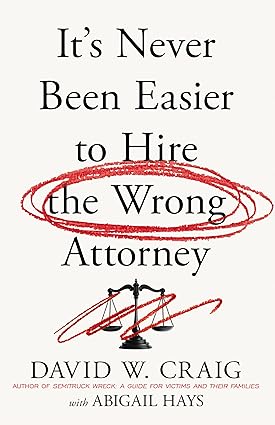
David W. Craig’s It’s Never Been Easier to Hire the Wrong Attorney is a sharp, eye-opening guide that walks readers through the legal landscape of attorney advertising and the pitfalls of picking a lawyer based on flash rather than facts. It starts with a chilling story, a catastrophic injury case that settled for pennies on the dollar because the victim’s family chose the wrong lawyer, and builds from there into a methodical, deeply researched argument about how legal marketing, both traditional and digital, can mislead the average person. Craig uses decades of experience to explain the evolution of legal advertising, why it can be so deceptive, and how to make better decisions when choosing legal help. The book also includes step-by-step guidance on how to identify and vet qualified attorneys.
This book stirred up a lot of frustration for me. Not because of how it was written, the writing is clear, blunt, and well-paced, but because the truth it reveals is maddening. Craig pulls no punches when explaining how law firms use billboards, flashy websites, and even hospital “runners” to scoop up vulnerable clients. The whole system is tilted in favor of those with marketing muscle, not legal skill. It felt a little like being told the magician’s secrets after already falling for the trick. At times, I wanted to shout, “How is this still allowed?” But that’s exactly what makes the book valuable. It’s not just a warning, it’s a toolkit for pushing back. His passion for protecting clients from bad outcomes shines through every page.
What I also liked was Craig’s honesty. He admits that there are good lawyers who don’t meet every “ideal” checklist he outlines and that the process isn’t foolproof. He isn’t selling himself or scaring the reader into hiring him, he’s educating with purpose. I appreciated that. The writing never talks down to you. It respects the reader’s intelligence, even as it challenges common assumptions. Some chapters were dense with stats and legal history, which dragged a little, but the real-world stories and practical advice made up for it. I especially liked the final chapters where he lays out how to actually find the right lawyer without getting tricked by marketing noise.
I think this book is a must-read for anyone who might someday need a lawyer, which, frankly, is most people. It’s especially good for those dealing with serious injury cases, criminal charges, or high-stakes family law situations. If you’ve ever felt overwhelmed by attorney ads or unsure where to turn after something bad happens, this book will be a lifeline. I wouldn’t call it light reading, but it’s certainly essential. Craig’s voice is steady, caring, and often quietly furious about the damage done when people trust the wrong person at the worst time.
Pages: 90 | ASIN : B0F7MYYZMD
Entrepreneurship and Intrapreneurship

Advanced Career Intelligence is a far-reaching, no-nonsense guide for navigating the higher tiers of professional life by examining strategy, emotional intelligence, work culture, & ethical success. What were your goals when writing this companion guide to your first book?
My goal with Advanced Career Intelligence was to build directly upon the foundation established in General Career Intelligence, diving deeper into the more complex and nuanced challenges professionals face as they advance in their careers. While the first book focused on core principles—like personal integrity, foundational traits, decision-making, and soft skills—this second volume takes on the higher-order dimensions of leadership, entrepreneurship, ethical influence, managing diverse teams, and navigating cultural and organizational dynamics.
I wanted to deliver real-world, distilled insights—practical and immediately applicable—without unnecessary fluff, jargon, or abstract theory. The intent was to save readers the countless hours (and dollars) it would take to absorb the same knowledge from a full library of business books, articles, and case studies. This two-volume series is meant to serve as a comprehensive, soup-to-nuts career playbook for the modern professional—whether they’re stepping into management, leading a team, building a business, or simply striving to thrive in today’s fast-paced and often chaotic work environment.
Ultimately, I wrote Advanced Career Intelligence to empower readers with confidence, clarity, and the tools to grow with purpose—professionally and personally—while staying grounded in ethics, emotional intelligence, and long-term success.
What were some ideas that were important for you to share in this book?
Several core ideas were especially important for me to highlight in Advanced Career Intelligence. First, I wanted to challenge the myth that success at higher levels is all about technical skill or raw ambition. Instead, I emphasize that sustainable success depends on emotional intelligence, ethical leadership, cultural awareness, and the ability to manage complexity with clarity and integrity.
I also felt it was critical to tackle real-world issues that professionals often encounter but aren’t always trained to handle—things like navigating toxic work environments, leading diverse and inclusive teams, maintaining work-life balance, and building organizations that prioritize long-term value over short-term gains.
Entrepreneurship and intrapreneurship were other key themes. Whether someone is launching a business or innovating within an existing one, they need practical, grounded advice that goes beyond platitudes. I wanted to demystify those journeys and offer insights that are both strategic and deeply human.
Equally important was the message that it’s completely okay to fail, to stumble, or even to get laid off—because most of us do at some point in our careers. These moments don’t define us. What matters most is how we respond, what we learn, and how we grow. None of us are perfect, and none of us have all the answers. In fact, our greatest strengths often lie in our ability to reflect, to adapt, and to keep moving forward. Flexibility, nuance, and emotional resilience are powerful traits that shape not only what we achieve, but who we become—and they ultimately play a vital role in the fulfillment and meaning we find in our work and lives.
Finally, I wanted to encourage readers to see their careers not just as a ladder to climb, but as a platform to give back—to mentor others, influence positive change, and leave a meaningful legacy.
I really appreciated you sharing your stories about mentoring and role models, and how they played a part not just in your success, but also in how you viewed success. What advice do you have for leaders considering taking on a mentee?
Mentoring is one of the most meaningful and impactful responsibilities a leader can embrace. It’s not just a way to give back—it’s a powerful tool for shaping the next generation of thinkers, doers, and leaders. But in my experience, mentoring also holds up a mirror. It forces us to examine how we lead, how we listen, and whether we’re still growing ourselves.
One key piece of advice: stay humble. As people advance and succeed in their careers, it’s easy—almost natural—to fall into the trap of believing we have all the right answers. That mindset often gives rise to a rigid, command-and-control leadership style that slowly drains the enthusiasm, creativity, and initiative from otherwise exceptional teams. I’ve seen this happen time and again. Confidence is vital, but unchecked confidence can slide into arrogance—and when that happens, mentoring becomes a one-way transmission of information instead of a two-way exchange of growth and trust.
True mentorship is not about telling someone what to do. It’s about helping them uncover their own path, develop their voice, and build their judgment. It requires vulnerability, active listening, and a willingness to let others thrive—even surpass you. That kind of leadership transforms teams. A great team is always more than the sum of its parts, and when every individual is encouraged, equipped, and empowered to reach their true potential, something extraordinary happens. You get innovation. You get trust. You get momentum that can’t be manufactured through control—it has to be nurtured.
And here’s the beautiful paradox: while personal success may boost your self-esteem, it pales in comparison to the fulfillment that comes from seeing someone you mentored grow into their own greatness. Watching someone stretch beyond what they thought possible—knowing you played a small part in that—is one of the most rewarding experiences in any career.
So if you’re considering mentoring, don’t just do it out of duty. Do it because you believe in people. Do it to stay grounded. And do it because, at its best, mentoring doesn’t just change someone else’s trajectory—it changes yours too.
What is one thing that you hope readers take away from Advanced Career Intelligence?
If there’s one thing I hope readers walk away with, it’s the understanding that there’s nothing mystical, unreachable, or reserved about advanced roles like entrepreneurship, team leadership, project management, or even executive leadership. These roles aren’t reserved for the extraordinary few—they’re built on human qualities that we all possess in one form or another. Every one of us brings something valuable to the table. We may think and operate differently, but it’s that very diversity—in background, perspective, temperament, and life experience—that allows us to solve hard problems, lead effectively, and create progress in today’s fast-moving world.
You don’t need to be perfect or have every answer, or tick every box to succeed. In fact, emotional intelligence, strong behavioral ethics, a sense of purpose, and a can-do attitude can more than offset areas where experience or technical skills are still developing. Values matter. Empathy matters. Integrity matters. And more than anything, the willingness to learn, collaborate, and adapt is often what separates enduring leaders from short-lived ones.
I also want readers to walk away with a sense of peace—and purpose. Too many professionals get caught up in chasing validation, trying to meet someone else’s idea of success. But in the long run, what matters most is not what others think of you—it’s how you live, what you stand for, and how you impact the people around you.
Live in a way that serves as a positive example. Make the most of the gifts you’ve been given and the time you have. Use your position—whatever it may be—to lift others up, to make things better, and to leave a trail of encouragement, not exhaustion. We all have a role to play in shaping the world around us. Every day, we get to decide: Are we making things better—or worse?
The beauty of Advanced Career Intelligence is that it reminds us that our careers are not just vehicles for personal advancement, but platforms for human connection, contribution, and meaning. That’s the takeaway I hope stays with readers long after the final page.
Author Links: GoodReads | Facebook | Website



 LITERARY TITAN