Blog Archives
Moonrise


Moonrise is a dark, winding tale that starts off as a corporate retreat and spirals into a visceral horror-thriller packed with strange rituals, power games, and a literal beast lurking in the woods. At its center is Anthony Montgomery, a weary mid-level employee who’s forced to navigate a world where loyalty tests involve taxidermied wolf paws and a monstrous creature might just be real. The book straddles the line between corporate satire and supernatural horror, and the way it flips from mundane work-life nonsense to full-on blood and snow makes for one thrilling ride.
Claiborne starts things off slow, with Anthony being the perfect jaded everyman, reluctantly sipping wine at an awkward office retreat. Then suddenly, we’re howling under the moon with a taxidermy paw full of wine and being told to drink up like it’s a frat party hosted by Satan. The scene with Mr. Morgan and the “Omega” ritual was unhinged. And I loved it. The writing here is sharp and cinematic, capturing that uneasy tension between corporate absurdity and primal chaos. It’s weird, but in the best way.
But it’s not just the gore and weirdness that kept me hooked. The characters—especially Anthony—are written with surprising depth. His interactions with Luna, his sense of duty to his girlfriend Sidney, and that internal battle between temptation and loyalty felt real. And then that scene in the woods? Where Anthony sees the creature for the first time? Pure horror movie magic. The tension was unbearable, and I was genuinely sweating. Claiborne describes the creature in such vivid detail. Anthony’s injury, the adrenaline, the decision to play dead—all of it was so well done.
There were a few moments that felt a bit over the top. Some of the hospital scenes ran a little long, and a few of the jokes didn’t quite match the tone of the rest of the book. There’s also a lot of internal monologue—some lines hit just right while other didn’t. But honestly, that added to the charm in a weird way. It gave Anthony this raw, messy humanity. He’s not a hero. He’s just a dude trying not to die and maybe score a promotion, which somehow makes him more relatable. I won’t spoil the ending, but let’s just say it leaves enough questions dangling to make me suspicious of every CEO with a vineyard.
Moonrise is for fans of offbeat horror, black comedy, and corporate satire. If you like your monsters bloody and your protagonists flawed, this book is for you. It’s not for the faint of heart or anyone looking for a polished, buttoned-up read. But if you’re in the mood for something different—something wild, creepy, and a little unhinged—pick this up.
Pages: 267 | ASIN: B0CLYXKZGZ

Damnatio Memoriae


Somtow’s Damnatio Memoriae is the final, emotionally raw, and beautifully written chapter of the Nero and Sporus saga. It’s a deeply personal journey told through the voice of Sporus, a former slave and imperial concubine, who relives his (and her) rise and fall at the edges of empire, identity, and power. This isn’t your average Roman epic—it’s visceral, surreal, darkly poetic, and hauntingly queer. With Nero’s collapse and Rome’s chaos as the backdrop, Sporus reflects on life, gender, betrayal, and the myth of love, all while waiting to be executed in a packed arena. It’s intense.
What hit me first was how lyrical the writing is. It reads like a fever dream soaked in garum and incense. Somtow doesn’t hold back—there’s real pain here, but also twisted humor and staggering beauty. The opening monologue, for example, where Sporus describes the reek of sand, blood, and beast dung in the arena, while cracking dry jokes about makeup and waiting for a death scene, felt like Oscar Wilde doing Gladiator cosplay. And yet, it’s achingly tragic. And then there’s the ring scene in the marketplace, where a carved image of Persephone triggers a spiritual collapse and sparks an impromptu imperial crucifixion crisis. Absolutely brilliant and brutal.
That said, this book isn’t an easy read. It expects a lot from you—emotionally, intellectually, even morally. Nero is magnetic and monstrous, sometimes at the same time, and the dynamics between him and Sporus swing from disturbing to tender. Somtow nails this complexity. But the heartbreak really comes from how aware Sporus is of their own powerlessness, even while being dressed up as a goddess or cherished as a boy. In “Clipped Wings,” the metaphor of the clipped doves—meant to be freed in a religious ritual but secretly recaptured—just gutted me.
If you like your historical fiction brutal and beautiful, if you’re into mythology reimagined through a queer lens, if you can handle morally messy characters and poetic trauma—this is for you. Fans of Mary Renault, Madeline Miller, or even Game of Thrones at its sharpest will probably find something to love here. But it’s also for people who want to feel something deep and uncomfortable. I’m not gonna lie, it’s sometimes hard to stomach—but I didn’t want to look away.
Pages: 232 | ASIN : B0F2YZ1HRH
The Borealis Queen

The Borealis Queen by Henry Guard is an imaginative adventure set in a speculative Ice Age world, centered around Nin, a resilient young woman marked by a mysterious prophecy. Struggling against oppressive foes and navigating harsh landscapes, Nin embarks on a perilous journey that intertwines survival, destiny, and the forging of unexpected bonds.
I found myself captivated by Guard’s storytelling. His vivid descriptions, especially of Nin’s harrowing encounters with Gore, are so intense and emotional they kept me flipping pages, heart in throat. The opening scene in Chapter 1, where Nin is dragged through the snow by her hair, is brutal but powerfully written. It immediately connects readers with Nin’s defiant spirit despite her desperate circumstances.
One thing that stood out to me was the portrayal of relationships and unexpected alliances. Nin’s bond with Shadow, the fearsome Dagger Mouth Demon, genuinely moved me. The nuanced depiction of their connection—beginning with Nin’s compassionate rescue of Shadow as a pup and later reciprocated through his fierce loyalty—highlighted themes of empathy and interdependence. The moment Shadow saves Nin from Ursang was both thrilling and heartwarming, encapsulating the book’s underlying message about the power of kindness even amid brutality.
While I admired the strong character development, some sub-stories, like the detailed recounting of tribal rituals or backstory expositions, momentarily pulled me away from the main plot. Still, these slower sections offered rich cultural insights, and Guard’s enthusiasm for his created world shone through clearly.
The Borealis Queen is a compelling read with memorable characters and gripping emotional intensity. Guard does a fantastic job creating a world that’s both fantastical and believably harsh, making the stakes feel real and the victories genuinely rewarding. I’d recommend this book to readers who enjoy immersive fantasy with a gritty edge—particularly those who appreciate strong, complex heroines and intricate relationships set against vivid, unforgiving landscapes.
Pages: 395 | ASIN : B0DXH5MT1B
Chronicles of Iron: Thunder Road

Chronicles of Iron: Thunder Road is a gritty coming-of-age tale set against the harsh backdrop of the American frontier, told through the eyes of young Ian, whose life is upended by the sudden suicide of his father. Thrust into adulthood far too early, Ian’s journey begins with trauma and spirals into a rugged path of survival, heartbreak, and ultimately, redemption. From the rural fields of his childhood to the dust-covered roads of salesman caravans and the unrelenting reality of a cowboy’s life, this book weaves together themes of grief, betrayal, hard-earned wisdom, and the search for belonging. Chilson gives us a western that’s as psychological as it is physical, and that’s where its power lies.
As someone who grew up devouring westerns, I didn’t expect this one to hit me the way it did. The tone is raw and visceral. The pain is real, and the opening chapter sets the foundation for everything that follows. And it ain’t just about survival or gunslinging—this story digs into what it means to grow up hard and fast when the world ain’t offering you a single lifeline. Ian’s descent into guilt and self-blame, followed by his attempts to find work, his failures, and the heartbreak of losing Bess, the horse he cared for, made the story feel more like a psychological duel than a shootout. Yet somehow, it still holds onto that cowboy code of grit and quiet honor.
What really got me was the switch in the second half—from broken boy to sharp-tongued hustler under the wing of Silas. That arc reminded me of the classic western trope of the young buck learning the ropes, except here it’s twisted. Instead of becoming a hero, Ian learns how to manipulate, lie, and cheat—and then pays the price. I wanted to shake him when he betrayed Silas, a man who genuinely gave him a shot. Chilson’s writing is sharp in those parts—not flowery, not dressed up—just bare-boned truth. There’s a beauty in that kind of honesty, the kind of storytelling where every misstep matters.
By the time the story shifts to Henry, a more grounded version of Ian trying to find peace and purpose on a struggling farm, you start to feel the tide turn. The relationship between Henry and Lucas brought it all home. It’s the kind of mentorship that defines a man, built not on words but actions. From fixing busted irrigation systems to fighting off rabid wolves with nothing but grit and a stick, these chapters scream classic western, but with soul. Lucas’s line, “There’s a code… a cowboy code,” resonated with me. It wasn’t just about riding tall or shooting straight. It was about keeping your word, being decent when it costs something, and doing right by others even when no one’s watching.
If you’re a fan of traditional westerns packed with dust, blood, moral gray areas, and characters that stick with you long after the fire’s out, Chronicles of Iron: Thunder Road deserves a place on your shelf. But it’s more than a western—it’s a story about being lost and clawing your way back, about learning that being strong doesn’t mean being cruel. This one’s for readers who appreciate depth in their cowboys, who want a story that punches first and comforts second. Kelly Chilson wrote something real here.
Pages: 87 | ASIN : B0F3V99JWV
Ancient Wisdom and Future Technology Collide

The Legacy of Festoria follows five gifted kids, each with a special connection to an element—shadows, wind, water, fire, or earth—who are called to seek out a mysterious sage who holds the key to balancing their ancestral powers with emerging AI technology. Where did the idea for this novel come from?
The idea for The Legacy of Festoria was born out of a deep curiosity about what would happen if ancient wisdom and future technology were to collide. I’ve always been fascinated by elemental magic and the idea that nature holds secrets we’ve barely begun to understand. But I also wanted to explore how modern innovation, especially AI, might not oppose that wisdom but enhance it. The story came to me like a vision: children gifted by nature, living in harmony with the elements, who must journey to uncover not just magical truths but also the role of advanced intelligence in preserving that harmony. It’s a tale of inheritance—both spiritual and intellectual—and the power of unity in a time when the world is at a crossroads between tradition and transformation.
The Legacy of Festoria begins in a traditional way, but then takes a turn that defies the conventional fantasy story, blending fantasy with AI technology. What was your approach to writing the story?
I wanted the story to feel like a gentle unfolding—a familiar beginning in an enchanted village that slowly peels back layers to reveal a far more complex world. My approach was to root the reader in timeless, almost mythological elements—earth, water, wind, fire, and shadow—and then introduce the unexpected: the fusion of those elemental gifts with artificial intelligence. Instead of framing technology as an invasive force, I chose to write AI as something that could coexist and evolve alongside ancient magic. This blend creates a narrative tension that mirrors our modern world’s dilemma—do we abandon the old ways, or do we find ways to adapt and evolve them? Writing this book was about creating harmony between opposites and allowing the characters to be the bridge between them.
What were some themes that were important for you to explore in this book?
At its core, The Legacy of Festoria explores the balance between nature and technology, past and future, and solitude and connection. One key theme is identity—each child must come to terms with their unique gift, their ancestry, and what it means to use their powers responsibly. Unity is another essential thread—though the characters are wildly different in temperament and talent, they are strongest when they come together. I also wanted to explore legacy—what we inherit from those who came before us and how we choose to carry that forward. And finally, the story delves into purpose—not just finding it but forging it, especially when the path is unclear. The fusion of AI with elemental magic became the perfect metaphor for growth: honouring the roots while reaching toward the stars.
Where do you see your characters after the book ends?
When the children step through the portal and meet Solon, it’s just the beginning of their actual journey. I see each of them stepping into a new chapter—not just as individuals mastering their gifts, but as Guardians of a new era. Aria will likely become a Seer of unparalleled wisdom, learning to read not only shadows but the complex moral patterns in the world. Leo might become a Messenger between realms, interpreting the shifting winds of change. Marina could become a diplomat of sorts, mediating between the old magic of nature and the logic of AI. Ember would thrive as a protector, defending their world with passion and courage. And Sage—steady and grounded—might grow into a builder of bridges, both literal and symbolic, between the elements and technologies that shape their future. Together, they’ll form the foundation of a new kind of harmony: one where magic and innovation walk hand in hand.
Eastlanders’ Fall
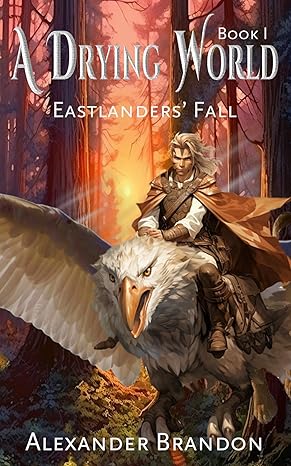
Eastlanders’ Fall, the first book in the A Drying World series, is a sprawling epic that plunges readers into the richly imagined continent of Ananthia. It’s a tale of ancient evil rising again, powerful cults seeking domination, and unlikely heroes trying to stop the world from crumbling—literally. The story kicks off with a chilling prologue featuring a cultist ceremony that goes sideways in a burst of divine justice and continues across time and space with mages, paladins, and political intrigue all grappling with the fallout. Brandon weaves together threads of high fantasy, horror, and philosophical musings about power and knowledge in a setting where the land itself is dying.
What I really loved about this epic fantasy novel was how unapologetically ambitious it is. The prologue alone is cinematic—seriously, the cult scene in “The Black Mass” is intense, grisly, and gripping. The way Brandon sets up Darvis Talsdrum as this menacing, dark priest of undeath is fantastic. I couldn’t stop thinking about that moment when the undead plunges a dagger into the elven girl’s chest just as paladins storm the room. It was horrifying and heartbreaking, but also incredibly effective storytelling. It’s rare to find a villain introduced with that much weight so early. I was hooked.
Some characters, like Milendil—the rogue wizard dabbling in necromancy—really worked for me. He’s a blend of tragic, arrogant, and brilliant, and I couldn’t help but root for him even as he spiraled. His quiet descent and eventual disgrace (and bitter sarcasm during sentencing) felt both earned and kind of sad. I genuinely felt for him, especially during his scenes with Villiena. That tension—knowing he’s doing something wrong, but for reasons that almost make sense—kept me glued. But not every character felt as rich. Maybe because there’s just so much going on that they don’t get as much time to breathe.
Brandon clearly has a massive world in his head, and while that can be a strength (the lore, the politics, the factions—it’s all super cool), it can be a lot to take in. There were chapters where I felt like I was swimming through exposition or trying to decode dwarven history. But then, just when I was about to put the book down, he’d hit me with something awesome—like the mage tower drama, or the way the desert literally eats cities. Those moments made the slower parts worth it. The writing style itself is vivid, sometimes poetic, and definitely leans dark fantasy, which I like.
Eastlanders’ Fall is a wild, sometimes brutal, always thought-provoking ride. If you like your fantasy epic, dark, and packed with morally gray characters, this is for you. Fans of Brandon Sanderson, Joe Abercrombie, or even older D&D-style storytelling will find something to love here. It’s not an easy read, but it’s a rewarding one—and I’m absolutely curious to see where the story goes next.
Pages: 413 | ASIN : B0DNG6RY4Q
The Art Collector’s Wife
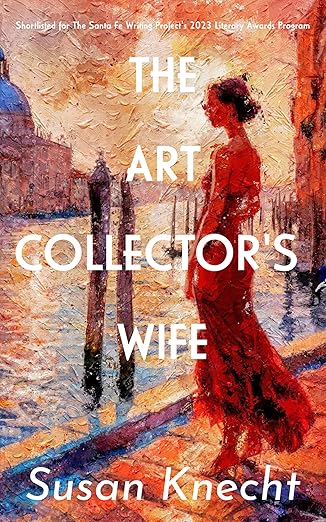
Susan Knecht’s The Art Collector’s Wife is an emotionally rich, time-skipping novel that weaves together post-war trauma, intergenerational secrets, art-world intrigue, and the sharp edges of teenage rebellion. It starts in the horror of Auschwitz, then unfolds decades later in sun-drenched Venice, following the fractured legacy of one family—particularly the women who survived and the granddaughter determined to uncover the past. It’s part historical drama, part coming-of-age, with a steady undercurrent of longing.
The prologue, set on the day Auschwitz was liberated, is devastating and lyrical—just brutal and beautiful all at once. Lila, the mother, trying to keep her friend and a pregnant girl alive, while praying for a glimpse of her son Leo, had me breathless. Knecht doesn’t hold back, and the imagery stuck with me long after I closed the book.
Then we shift to 1960s Venice, and things change gears in a really compelling way. Now we’re with Isabel, Lila’s teenage granddaughter, who’s navigating Catholic school, first love, and the weight of secrets no one will talk about. Isabel is such a great character—sharp, moody, defiant. I loved her scenes with Antonia, her chain-smoking bestie who has all the bad ideas and a heart of gold. When Isabel steals the ruby rosary and starts skipping school to flirt with Niccolo (who is equal parts charming and sketchy), the tension crackles. You can feel her aching for answers about her father and mother, and the way Knecht slowly drops hints about their story is fantastic.
But what really got me was the emotional layering. Knecht has a way of showing how grief and silence pass through generations like DNA. Lila is wrapped so tightly in control and shame, you feel her unraveling even when she says almost nothing. There’s a haunting scene at the cemetery where Isabel confronts her grandmother about her parents—Isabel demands answers, and Lila can’t speak. That silence? It screams. And Miriam, the family friend who carries so much of the emotional glue, is a favorite. She’s got this old-Hollywood flair, but also such deep loyalty and sadness. I kind of wanted a whole book just about her.
I loved this book. It’s heavy but worth it. The prose is poetic without being precious, the story moves through decades without losing momentum, and the characters feel real, flawed, and alive. If you’re into multi-generational family sagas, WWII fiction with a heart, or just crave a book that will grab you by the collar, The Art Collector’s Wife is for you.
Pages: 257 | ASIN : B0F38R8KBV



 LITERARY TITAN