Blog Archives
In Harm’s Way
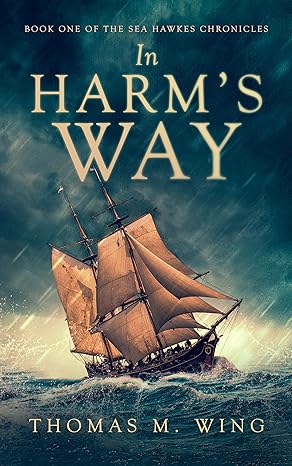

Thomas M. Wing’s In Harm’s Way is a gripping historical novel set during the American Revolution, centering on Captain Jonas Hawke, a privateer navigating the turbulent waters of war and personal loss. When his ship, the Elizabeth, is seized by the British Royal Navy under dubious pretenses, he and his crew are thrust into a battle not just for their freedom but for justice. As Hawke returns home to Norfolk, he finds not only a changed political landscape but also devastating personal tragedy. Wing blends historical accuracy with compelling storytelling, making the reader feel the weight of revolution on ordinary men.
What struck me most was Wing’s ability to bring history to life through vivid and authentic detail. His background as a retired Naval officer shines in the way he captures the rhythm of ship life—sails creaking, the smell of tar and hemp, and the ever-present danger on the high seas. The opening scene, where British forces storm a printing press to suppress rebellious voices, is tense and sets the tone for the book’s theme of resistance against oppression. He delivers a story that feels raw and real, making the reader feel every injustice and triumph.
Jonas Hawke is a protagonist who carries the novel with quiet strength and deep emotion. His return home to find that his infant twins have died is a gut punch that lingers. Wing makes us feel the grief through Mary, Hawke’s wife, whose simmering resentment toward his long absences cuts deep. Their exchange—her quiet fury, his helpless sorrow—was one of the most emotionally impactful moments in the book. The revolution is personal, fracturing families and reshaping lives. Hawke’s struggles reflect the larger battle for independence, making his journey all the more compelling.
The pacing of the novel balances naval battles with quieter moments of introspection. The scenes aboard the Otter, where Hawke and his men are treated as criminals rather than citizens, are particularly enraging. The arrogance of the British officers, especially Captain Squire, is infuriating yet believable, reinforcing the stark divide between colonists and their so-called rulers. The way Wing builds tension, especially during the naval confrontations, had me holding my breath. The book immerses you in history, making the reader experience the frustration, fear, and determination of those who fought against British rule. At times, the historical details, while fascinating, slow the pacing just a bit, especially for readers less familiar with naval terminology or Revolutionary War politics.
In Harm’s Way is an outstanding read for anyone who enjoys historical fiction, particularly those fascinated by naval warfare and the Revolutionary War. Fans of Patrick O’Brian’s Master and Commander series or Bernard Cornwell’s Revolutionary War books will find much to love here. Wing’s storytelling is rich, emotional, and historically grounded, making this book both educational and deeply engaging.
ASIN : B0F1W6GTC4

Heroes of the Empire Book 3: The Emperor


Heroes of the Empire: Book 3 dives deep into a realm of tangled loyalties, sprawling kingdoms, and characters grappling with the shadows of their past. The story picks up with Honzio, a reluctant prince thrust into harrowing circumstances, navigating familial trauma and treacherous politics. With richly painted landscapes and gripping subplots involving betrayal, survival, and personal redemption, author Israh Azizi crafts a saga that’s as emotional as it is expansive. This installment weaves together narratives of hope and heartbreak as characters battle for their lives and destinies.
What struck me most about Azizi’s writing is her vivid descriptions and immersive world-building. The dungeon scenes, where Honzio faces suffocating confinement, resonate deeply. The fear is palpable, and you almost feel the cold stone and sense the oppressive darkness. Azizi skillfully uses these moments to humanize her characters, especially Honzio, whose inner struggles make him both relatable and admirable. I also appreciated the rawness of Natassa’s story. Her attempt to escape captivity while wrestling with her powers is both a highlight and a testament to her strength. These moments of tension are written with such precision that they had me holding my breath.
The characters themselves are the beating heart of this book. Honzio’s internal conflict with his father’s legacy and his reluctant steps toward leadership are a gripping arc. Similarly, Svorgin’s stoic resilience contrasts beautifully with Draven’s arrogance, making their interactions some of the most dynamic parts of the book. For instance, the moment where Svorgin challenges Draven’s privilege with an unforgettable rebuke about hunger stuck with me. This dialogue not only adds depth to the characters but also underscores the broader theme of survival in adversity.
Azizi’s prose is elegant yet accessible, but occasionally, it leans into exposition. Some passages, particularly in the middle, had a lot of descriptions that slowed the pacing. However, these moments are balanced by action-packed sequences and emotional revelations that hit hard. One such instance is Natassa’s confrontation with Yalnos. Her failed attempt to use her Shadow Manos powers to manipulate him not only reveals her vulnerability but also adds layers to her character. It’s these emotionally charged interactions that anchor the story.
Heroes of the Empire: Book 3 is a powerful addition to the series, blending rich character development with thrilling action and intricate political intrigue. Fans of epic fantasy will find much to love here, especially those who enjoy stories about flawed heroes striving against impossible odds. Loyal readers of the series will be rewarded with an unforgettable journey.
Pages: 364 | ASIN : B0CXHTN4RW
Potential to Grow and Change

Afterward follows a woman who finds her boyfriend unconscious in their apartment and is thrust into an emotional maze, forcing her to question love, responsibility, and belonging. What was the inspiration for the setup of your story?
Unfortunately, the story, or something like it, is something you hear more often than one would hope. I heard a version of it had happened to an acquaintance of mine in school (many years ago, and it had happened years before I met her), and it was just something I couldn’t get out of my head. I thought the normal things, such as how bad I felt for what she and the rest of the people affected must have gone through. But then my mind kind of wandered with new questions–about how one becomes equipped to deal with things like that, and what if you weren’t? How would that go? It was really in the course of thinking about those tangential questions that I came up with the story.
Are there any emotions or memories from your own life that you put into your character’s life?
Lauren as a character really didn’t inherit anything from me, but in the course of writing this, I did break my leg and end up in the hospital. I remember being tired and hurt in the ER, and hearing the staff talk about a bad date one of them had had. I remember thinking it was such an odd thing to overhear such an everyday conversation during a day that was so unusual for me. But of course, this was their every day, it wasn’t odd for them, and they should be able to talk with coworkers like anyone else. It just stood out to me in that experience, so I included that moment in the book.
What themes were important for you to explore in this book?
Understanding was a big one. I really don’t even like Lauren in the beginning, but it’s easy to be critical, right? My hope was that by the end, the reader would find a little empathy for a flawed person in a truly horrible situation that wasn’t doing a great job with it. And, I guess, hope for the potential to grow and change. But there are other issues in there that different readers have picked up on as being big to them–friendship/bullying, race, alcohol, insecurity, mental health–and I’m glad different people are finding issues that mean a lot to them, and I hope I handled them okay.
What next book are you working on, and when will it be available?
Actually, I’m very excited to say I am sending my newest book to my publisher tomorrow. It is about a young man whose life events put him in the position to pursue his dream of living in a cabin in Alaska, and what that reality looks like. And I know what that reality is because I spent a lot of time growing up at my family’s homestead, which was not only “off the grid,” but also off the road system. It’s a love letter to, and a cautionary tale about, Alaska.
Author Links: GoodReads | BlueSky | Website | Amazon
Torn from her normal routines—coffee, sex, barhopping, and disc golf—she finds herself in an unfamiliar world of hospital visits and doctor’s appointments, all while navigating an unexpected move to a new apartment and enduring the disapproval of her boyfriend’s mother, as well as the gossip of her friends and coworkers. (Plus the suspicious looks of strangers, and the unbearable strain on her credit card…and did we mention the gossip of her friends and coworkers?) Along the way, she meets every obstacle with…well, not grace, exactly. In fact, pretty much the opposite of grace. Maybe more like bitchiness, truth be told. And all the while, the aftereffects of the tragedy cast a pall over everything she does—and threaten to destroy everything she has.
Bristol Vaudrin’s fascinating debut novel is an engrossing and darkly comedic read with an unforgettable narrator/protagonist. Watching her struggles—real, imagined, and in-between—we too must choose between kindness and judgment, between condescension towards someone who simply doesn’t have a clue, and empathy with a person struggling to deal with something we all must face: the desire to hold on to the things we enjoy when the world around us changes in ways we didn’t expect.
Ripple Effect

Heather’s Journey follows a 19-year-old girl living in a small town in Illinois during the 1930s who dreams of leaving, but tragedy strikes, changing everything about the course of her life. What was the inspiration for the setup of your story?
The year 1930 amazes me. For most of the year, everyone thought the stock market crash would breeze over and they could keep dancing like they did in the Roaring Twenties. They were so vulnerable, and our early Americans have grabbed my heart. Along with this, there was Prohibition, and racism that was considered normal. They were still recovering from World War I and the Titanic sinking. (Similarly, we’re still recovering from 9/11, which was over 20 years ago. Healing takes time.) Heather was a mirror of her father’s dreams in his younger days. He moved north; she wants to go south where the dreams started, but racism, like I said, was normal. I pondered on how unfair that had to have been for a young woman with enough issues to deal with. Racism had such a ripple effect on Heather’s entire life. It really umbrellaed her whole “journey.”
Were you able to achieve everything you wanted with the characters in the novel?
I took 18 months to write the novel. I fell in love with all my characters. I even have some compassion for Sylvia. It took time to develop her character. I withheld good qualities from her. I also discovered a struggle in creating Mae — a comical character who isn’t too annoying. Renato’s character was fun — I built him from younger photos of Marc Anthony. I picture Heather to look like Dorothy Danridge in her younger years. Hugh is a soft version of Denzel Washington. 🙂 I have gazed over the marsh in Savannah and thought, this is what the end of a happy story looks like. And so, . . . So, yes, I achieved everything I wanted to.
What were some themes that were important for you to explore in this book?
One important theme is conflict with independence and family — when are we being selfish, and how much of ourselves should we feel guilty about if we don’t give away? Sylvia suffered this conflict. So did Heather and Mae. Renato keeps the reader in conflict with this. He held back going to his family who could keep him safe to take care of Heather and Mae.
Chasing a dream that seems impossible is another theme. Must we have the skills and resources to walk towards where we want to be in life? Renato had a rough past, but he dreamed of respect.
The power of the ripple effect of racism is embedded before page 1.
What is the next book that you are working on and when can your fans expect it to be out?
I am working on another book set in 1930. The setting is a Chicago hotel. Once again, the protagonist is an unadmirable character in the American eye — an Irishman named Percival Dooley. I am hoping to be done with the story by the end of June of this year.
Author Links: GoodReads | X (Twitter) | Website | Amazon
Nineteen-year-old Heather Randolph longs to escape her small-town life in Sterling, Illinois, and uncover her family’s roots in Savannah, Georgia. But when tragedy strikes, she’s thrust into a world of danger, deception, and forbidden romance.
Caught between a charming Puerto Rican bootlegger, her sharp-tongued 12-year-old sister, and a mother whose cruelty knows no bounds, Heather must navigate the turbulent era of Prohibition, the shadows of World War I, and the harsh realities of racism and lawlessness. With the law closing in and her dreams slipping away, will she find the freedom she craves—or be trapped by the past she’s desperate to escape?
A gripping historical fiction novel set in 1930s America, perfect for fans of sweeping family sagas, unforgettable heroines, and forbidden love.
No Ratulent in Ratatatuvue
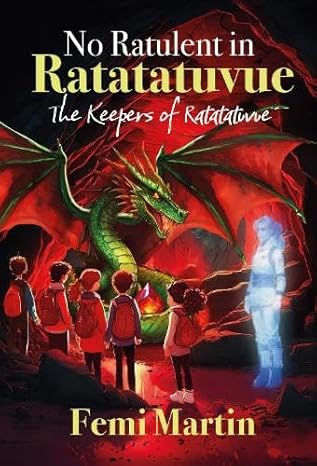
No Ratulent in Ratatatuvue takes readers on a journey to a whimsical realm, blending elements of fantasy, adventure, and a sprinkle of familial dynamics. The story revolves around a pair of siblings, Rolanda and James, who find themselves thrust into the legacy of being “keepers” of Ratatatuvue, a hidden mystical world inhabited by sentient “rattans.” Guided by a family history brimming with secrets and a mysterious key, they navigate their new roles while grappling with their own doubts and the fantastical challenges of their destiny.
The writing is both imaginative and heartwarming. The world-building shines when the characters step into Ratatatuvue itself. The vibrant imagery of cake-like houses and bustling rattan streets made me wish I could visit this sugar-coated wonderland myself. The author’s ability to make a rat-human hybrid society feel relatable is impressive. The story perfectly intertwines its fantastical elements with relatable family tensions. Edward, the father, exudes a mix of enthusiasm and obliviousness, pushing his children into the keeper role without fully preparing them. This dynamic adds emotional weight, especially when James’s skepticism clashes with Rolanda’s budding curiosity. Neila’s bravery in chasing the Mandurat—a rat-man hybrid—into Ratatatuvue shows her determination.
The book’s conclusion leaves readers with a sense of hope and possibility, teasing more adventures to come. The epilogue’s hint at Rolanda and James beginning to embrace their roles as keepers suggests a deeper exploration of their personal growth and the mysteries of Ratatatuvue in future installments.
No Ratulent in Ratatatuvue is for young readers or families looking for a story with lighthearted fantasy and touching family themes. It’s a delightful escape for anyone who enjoys imaginative worlds and tales of unlikely heroes. The heart of the story, the connection between its characters and their adventures, shines brightly.
Pages: 240 | ISBN-10 : 1839528540
Characters Breathe Life

In Provenance of Ashes, a group of students in East Berlin finds themselves deep within an international espionage plot that spans decades. Where did the idea for this novel come from?
The idea sprung from two different threads. I was fascinated when reading about the case of Cornelius Gurlitt (the son of a famous Nazi art dealer), who had a hoard of paintings stashed in his apartment and was caught in modern times on a Swiss train after selling one of the paintings. I was intrigued that paintings with such a sordid past could be hidden for decades and surreptitiously sold in the new millennium. I’ve also done lots of global travel, in the course of which I met people who worked for (or used to, I think!) Israeli intelligence and the Stasi.
Which comes more naturally to you? The plot or your characters?
The plot/broader concept, and then my characters breathe life into the story.
What part of this book was the most fun to write?
Too tough to answer! Perhaps the reminiscing of Werner, the evil former Stasi agent and bastard son of the Nazi who stole and hid art at the end of WWII.
Can we look forward to a follow-up to this novel? What are you currently working on?
Absolutely–I am working on a new novel featuring Marco and Beryl, which will fit into the theme of a Married into the Mossad Thriller but not willing to reveal more just yet!
Author Links: GoodReads | Facebook | Website | Amazon
Realizing jet-set passions are no match for Beryl’s nobler pursuits in hunting Werner, Marco slowly yields to his wife’s batting eyes and steely determination. Love, loyalty, and a quest for restitution drag him into the Mossad’s embrace. When the couple near the truth about Werner’s real identity, they must confront a dark secret of their own buried deep in East Berlin. Will either side risk exposing past crimes to win today’s cat-and-mouse battle? Beryl and Marco plot traps spanning the Mid-East, Silicon Valley, and Holland as modern-day spies counter legendary espionage guile.
Jeff Ulin’s thriller Provenance of Ashes thrusts the weight of haunting history into a marriage grappling with higher priorities. Read it now and travel into a world of shadows where the mantra never forget motivates patriots of good and evil.
Palpable Tension

The Matriarch Messiah follows two women who come from different cultural and religious backgrounds yet find themselves bound by an ancient prophecy and mission to save humanity. What was the inspiration for the setup of your story?
First and foremost, the conflicts over the ages between people of both Zara’s and Rachel’s faiths and cultures inspired the story of how peace needs to be found so humanity could survive and thrive. The more recent conflicts highlight the need for peaceful solutions as violence only begets violence – which both Zara, a former Kurdish soldier, and Rachel, an Israeli Torah historian and archeologist, find out by the ending chapters of The Matriarch Messiah. Perhaps these notions are naïve, but we all must have faith that we can find peace among us all.
The legend of the cavern of the blue light stemmed from a sense of gender equality in mythology. The Matriarch Matrix is based on an ancient story passed patriarchally from grandfather to grandson. Much of ancient literature including faith text is patriarchal. The Matriarch Messiah shows a parallel but even more secretive women’s legend passed matriarchally from grandmother to granddaughter. So, even though Zara and Rachel have their initial conceptual and contextual differences, both their matriarchal ancestors ask they follow the prophecy handed down by their grandmothers. In this, they must find a solution by working together. A parable for our times.
What was your inspiration for their characters’ interactions and backstories?
In The Matriarch Messiah, the reviews so far call out the “raw and realistic” interactions between Zara and Rachel. As I credit in the book’s acknowledgments, their spats are based on years of watching my two daughters, who ultimately love each other, go at it for, as we say in French, “n’importe quoi” or whatever or nothing at all. At their core, Zara and Rachel are more similar than different motivated by the same end-game of finding the cavern of the blue light. But as in real life, the external optics of upbringing and sense of what is culturally or religiously correct trip them up.
And the love triangle that some reviewers have praised? That was inspired by Romance Writers of America craft sessions. A romance story must find the romance characters stumbling over obstacle after obstacle until they finally resolve their differences. Setting up Rachel as someone who Zara would despise, especially if Peter ends up in her bed, fueled the palpable tension felt through the back half of the book.
What were some themes that were important for you to explore in this book?
In both The Matriarch Matrix and the sequel, The Matriarch Messiah, I wanted readers to confront their own prejudices and stereotyping formed by our modern world’s premium on “fast take” and “move on” social media. From the reviews, one can discern those who formed judgment very early and did not accept the later challenges to their preconceived notions. Then one can see other reviewers who embraced the “thought-provoking” nature of the reading experience. Much of the social injustice we see today, the intolerance of different cultures and faiths, comes from biases formed from misinformation and/or misunderstanding. My premise is we need to be open to understanding further before we pronounce judgement.
Second, I created the book’s ancients storyline to show a hypothesis of how the seemingly divergent customs we see in the Abrahamic faiths may have started from one source before the days humanity could codify their faith in writing. Myths and religion were passed down orally from one generation to another. Then around 3000 BCE these stories–history was encoded into durable stone and clay. Hence we see a common “flood story” across faiths. The original matriarch, Nanshe, and her descendants hypothetically formed many of the cultural traditions we see in these Western religions. My intent is to show we are more alike than different by showing both the good in what we see today and the horrible acts of war have roots all the way back beyond the first temple at Göbekli Tepe in 9600 BCE.
Will there be a follow-up novel to this story? If so, what aspects of the story will the next book cover?
Nearing first draft completion is the prequel, The Matriarch Mission. Set eighty years prior to the current two books, it takes place in post-civil war Russia. The story provides the background for Rachel’s pursuit of the truth behind Asherah and how her family became intimate with the legend of the cavern of the blue light as shown in The Matriarch Messiah prologue. The protagonist is Oksana, the mother of Rachel’s great-grandmother, Ariella.
As well, we will learn why Alexander Murometz, the ominous puppet master Russian oligarch in The Matriarch Matrix and The Matriarch Messiah, is driven to find the legendary black object at all costs. His grandfather, Zoran Murometz, plays a role in Oksana’s destiny with Asherah and the mysterious Agartthans, who were in real life sought after by Russian and French occultists.
While The Matriarch Mission goes to beta readers in April, I will outline The Matriarch Mandate while on the shores of Mallorca, which will follow the stories of the first two book’s characters eighteen years later. What is worse than fighting oppressors in deadly combat? Raising teenagers!
Author Links: GoodReads | Facebook | Website | Amazon
The Matriarch Messiah is a thrilling science fiction adventure that will leave you breathless. This sequel to The Matriarch Matrix picks up the story six months later, plunging you deeper into a world of conspiracies, forbidden love, and the fight for humanity’s future.
Zara Khatum, a woman haunted by ancient visions, finds herself drawn deeper into the heart of a perilous quest. Guided by a mysterious voice, she seeks to fulfill an ancient prophecy and find the cavern of blue light – a sanctuary rumored to hold the key to saving humanity. But the path to salvation is fraught with danger, and Zara is torn between her destiny and her heart.
A shadowy organization, known as NiQihs, seeks to exploit the power of the legendary black object, the source of Zara’s visions, for their own sinister ends. They are not alone. The world’s superpowers, driven by greed and ambition, race to control the artifact, threatening to unleash unimaginable devastation.
Joining Zara in this dangerous pursuit is Rachel Capsali, a brilliant Israeli archaeologist driven by a personal quest to uncover evidence of Asherah, a forgotten goddess who held a pivotal place in ancient Israelite faith. Unbeknownst to them, both women are bound by a shared destiny – a prophecy foretelling the cavern of blue light and a final, heartbreaking truth: two women will fight to the death, and only one will save us all.
Adding to the complexity, a passionate triangle forms as Rachel vies for Peter Gollinger‘s affection, a man deeply entangled in the ancient mystery. Zara, torn between fulfilling her destiny and her own feelings for Peter, finds herself caught in a web of conflicting desires.
As Zara and Rachel navigate a treacherous landscape of hidden agendas, betrayal, and relentless pursuit, their rivalry for Peter’s affections intensifies. Can love survive the forces that threaten to tear them apart? Will the quest for salvation lead to a heart-wrenching sacrifice?
Dive into a world where:Ancient prophecies clash with modern technology: Discover a world where ancient legends are woven into the fabric of a technologically advanced future.
Intrigue and betrayal threaten to shatter everything: Uncover a web of conspiracies, hidden agendas, and deadly secrets.
A passionate rivalry for love unfolds: Zara and Rachel’s destinies are intertwined, leading them to a final confrontation where only one will survive, but their struggle for Peter’s love adds another layer of complexity and tension.
The stakes are higher than ever before: With the world teetering on the brink of nuclear war, Zara and Rachel must find the cavern of blue light, uncover the truth behind the black object, and face the ultimate sacrifice to save humanity.
The Matriarch Messiah is a must-read for fans of science fiction thrillers with a touch of romance and a dash of the mystical. Prepare to be swept away by a journey where ancient secrets, forbidden love, and the fate of humanity hang in the balance.



 LITERARY TITAN