Blog Archives
Third Quarter Moon: Matters of the Heart


Third Quarter Moon: Matters of the Heart is a warm, raw, and intimate walk through memories, grief, healing, love, and self-rediscovery. Simone moves through vignettes of childhood, family bonds, romantic entanglements, heartbreak, and renewal. The book weaves poetry, reflection, and storytelling into a journey about shedding what hurts, holding on to what heals, and learning to see oneself with new eyes.
As I read, I felt myself sinking into her honesty. The writing hit me in a tender way, almost like sitting with a friend who tells the truth even when it stings. Her memories of growing up in PG County swing from funny to painful in a blink. It caught me off guard every time. The flow of her poems made me pause often. Some lines felt like they were tugging at old wounds I didn’t know I still carried. I loved how she talked about love without sugarcoating it. She let it be messy, beautiful, and heavy all at once. That kind of vulnerability pulled me in and kept me there.
What really stuck with me was the rhythm of her voice. It’s soft and fierce at the same time. She opens doors to her inner world and lets the reader wander around, touch things, break things, feel things. Some pieces felt calm and earthy. Others felt jagged and hot. I found myself nodding, laughing, then swallowing a lump in my throat. Her metaphors about gardening, shedding, and becoming gave me this strange mix of peace and restlessness. I admired how she trusted the reader enough to leave some pages quiet and unexplained. It made the experience feel real.
I walked away feeling like this book is perfect for readers who crave emotional truth and aren’t afraid to sit with their own reflections for a while. If someone loves poetry that feels personal and unfiltered, or stories that sound like they were pulled straight from a heart learning to beat again, this book will land beautifully for them. It’s a gentle companion for anyone growing, grieving, or grounding themselves again.
Pages: 62 | ASINL: B0FLB1PVKL

Hope

Terra Tamers: Alpha follows a teenager living in a city adrift at sea whose brother is kidnapped by a flock of Holo birds, and he will do whatever it takes to rescue him. What was the inspiration for the setup of your story?
The inspiration for the setup of my story was the idea of two brothers surviving a post-apocalyptic world. At first I was thinking kind of a science fantasy direction and leaned more into possible future technology instead.
In many contemporary coming-of-age fiction novels, authors often add their own life experiences to the story. Are there any bits of you in this story?
I’d say the tone of the book, the themes of pursuing hope in a decaying world are the parts of me that bleed through the pages. That and my love of video games.
What were some themes that were important for you to explore in this book?
The most important theme to me in Terra Tamers: Alpha was hope. Without it, there’s no point in continuing to live. I see the death of hope as the greatest poison affecting our modern world. People feel so powerless, and the world is so obviously broken, that now we struggle to even address the obvious issues we see in our communities because people feel hopeless, like nothing they do matters. So why bother? More fun themes were what the future of artificial intelligence could look like, how video games might interact with reality, and friendship.
Where does the story go in the next book, and where do you see it going in the future?
The story will follow Matt and Oakley into exile as they chase the evil AI Gaia. Expect new friends and foes, more creatures and game mechanics, and a greater exploration of a post-apocalyptic American landscape!
Author Links: Newletter | Website | GoodReads | Bookbub | X | Facebook | Instagram | Amazon | Pateron
– YA appropriate story (think 12 and older). Does have mild violence.
– First Person POV from male MC
– World Building (Post-apocalyptic), game design
– Monster taming and battles
– Short chapters, fast pace. Note the eBook is closer to 300 pages.
– Light LitRPG elements (I am working on a TTRPG system for Terra Tamers). Takes time to show up.
– No cursing unless you count H-E- double hockey sticks.
– Grayscale creature illustrations in the back!
I think fans of Digimon, Code Lyoko, Monster Tamer Academy, Maximum Ride, .hack//SIGN and similar stories which blend gaming, science fiction and compelling characters will enjoy Terra Tamers: Alpha!
Searching For Meaning

White Jasmines follows a woman facing a profound personal crisis who engages in direct conversations with God, sending her on a deeply introspective journey confronting love, faith, and identity. What was the inspiration for your story?
The inspiration for White Jasmines came from a period in my life when the inner world felt louder than the outer one. I was watching how people, including myself, search for meaning when they feel lost—how we try to speak to something larger than ourselves when the usual language of life stops making sense.
I became fascinated with that private space where doubt, faith, love, and identity collide. The idea of a woman in crisis having a direct conversation with God allowed me to explore those questions with honesty and vulnerability. It wasn’t sparked by a single event, but by a long stretch of introspection, memories that resurfaced unexpectedly, and the desire to understand how we rebuild ourselves after being broken open.
The story grew from that silence, that questioning, and the need to give shape to emotions that often go unnamed. It became a novel before I realized it—almost like the dialogue had been waiting for someone to write it down.
Are there any emotions or memories from your own life that you put into your character’s life?
Yes, there are emotions and memories from my own life woven into the character’s journey, though never in a literal or autobiographical way. I drew from moments when I felt untethered, when life asked questions I wasn’t ready to answer. Those private experiences—grief, uncertainty, the search for meaning, the ache of longing—helped me understand her inner landscape more honestly.
Some memories, even small ones, left echoes that shaped how she thinks and feels. The way she notices silence, the way she questions love, the way she rebuilds her faith—those elements grew from my own reflections during challenging periods.
While the character is not me, the emotional truth behind her struggles and transformations is deeply personal. I used those memories as a compass, guiding me toward a story that felt authentic rather than imagined from a distance.
What were some themes that were important for you to explore in this book?
Several themes guided the heart of White Jasmines. I was drawn to the tension between faith and doubt—how both can coexist inside one person, and how questioning can sometimes be its own form of belief. The book also explores the fragility of identity, especially when life forces us to confront the parts of ourselves we try to avoid.
Love, in all its complicated forms, was another essential theme. Not just romantic love, but the quieter forms: self-love, forgiveness, and love that persists even after disappointment.
And finally, I wanted to explore transformation—the slow, often painful process of breaking and rebuilding. The 40-day dialogue with God became a way to examine how someone can return to themselves with new clarity after facing the hardest truths.
Those themes together naturally, creating a story that sits at the intersection of introspection, spirituality, and emotional honesty.
What is one thing you hope readers take away from White Jasmines?
If readers take one thing from White Jasmines, I hope it’s the understanding that their inner struggles are not a sign of failure but a passageway to gaining deeper self-awareness. The book invites readers to sit with their doubts, heartbreaks, and questions without rushing to hide or fix them.
I want readers to feel that even in moments of loneliness or confusion, there is meaning to be found—sometimes quietly, sometimes unexpectedly. If the story gives someone a little more compassion for their own journey or reminds them that transformation often starts in the most uncertain places, then it has achieved what I hoped for.
As her days become part of a greater spiritual plan, her ordinary experiences take on new meaning and significance. She reflects deeply on her daily life, imagining God present in her moments and narrating her philosophical perspectives on life, death, and love. Through her narratives, she intertwines philosophy and poetry, questioning love and creation in search of understanding, even regarding the Lord of the Universe. She engages in deep, intimate dialogues with God, inviting Him into a profound challenge while liberating herself from her pain and sorrow. In turn, God grants her life new meaning by revealing His presence in the beauty of nature. By recounting her memories, she frees herself from her previous world and enters a new realm within herself, which she expresses poetically. The book consists of an introduction followed by forty days of narration, telling the story of a Sufi in love who liberates herself from her past and enters a world of light and inner peace, envisioned for the reader in a dream-like manner.
Those Alien Skies

Those Alien Skies is a sharp and imaginative collection of three novellas that dive into the vast unknown of space and the strange corners of the human mind. Each story, The Hunt for Elias Weber, Few and Far Between, and Battle Lines, is a window into a galaxy thick with mystery, alien worlds, and the stubborn will of people trying to find meaning in chaos. The tales follow the aftermath of Graham’s Milijun series, exploring how humans and aliens intertwine, clash, and sometimes find common ground across unimaginable distances. It’s part science fiction, part reflection on what drives us to explore, to fight, and to survive.
I enjoyed this book more than I expected. The writing is crisp and easy to fall into. There’s no heavy technobabble or confusing jargon, just vivid storytelling that pulls you along. Graham’s imagination is wild, but he keeps his worlds grounded in emotions like grief, loyalty, guilt, and curiosity. Elias Weber, one of the central figures, feels real in his flaws and his desperation. His moral decay is slow and chilling, and I found myself both frustrated by him and oddly sympathetic. Graham balances those shades of humanity so well. Sometimes the pacing dips a little, and a few scenes run long, but the payoff always comes. There’s a rhythm to his storytelling that feels cinematic, yet somehow deeply personal.
What really got me, though, was the heart behind the words. This isn’t just about aliens and spaceships. It’s about what happens when belief and doubt collide. It’s about the need for redemption in a universe that doesn’t seem to care. I felt that in every page. Some parts made me stop and think about the way we treat truth, how easily we bend it to suit ourselves. There’s a subtle sadness that lingers underneath all the adventure, like a quiet hum of loss and hope mixed together. And when Graham lets his characters breathe, when he slows things down and lets them wrestle with their fears, that’s when his writing shines the most.
I’d recommend Those Alien Skies to readers who love thoughtful science fiction but don’t want to get buried in technical detail. It’s perfect for anyone who likes their space stories with a touch of philosophy and a pulse of real emotion. If you’ve read the Milijun trilogy, this feels like coming home; if you haven’t, it stands well enough on its own. It’s a book that makes you think and feel at the same time, and that’s a rare thing these days.
Pages: 347 | ASIN: B0FRG7VK6P
The Moaning Lisa
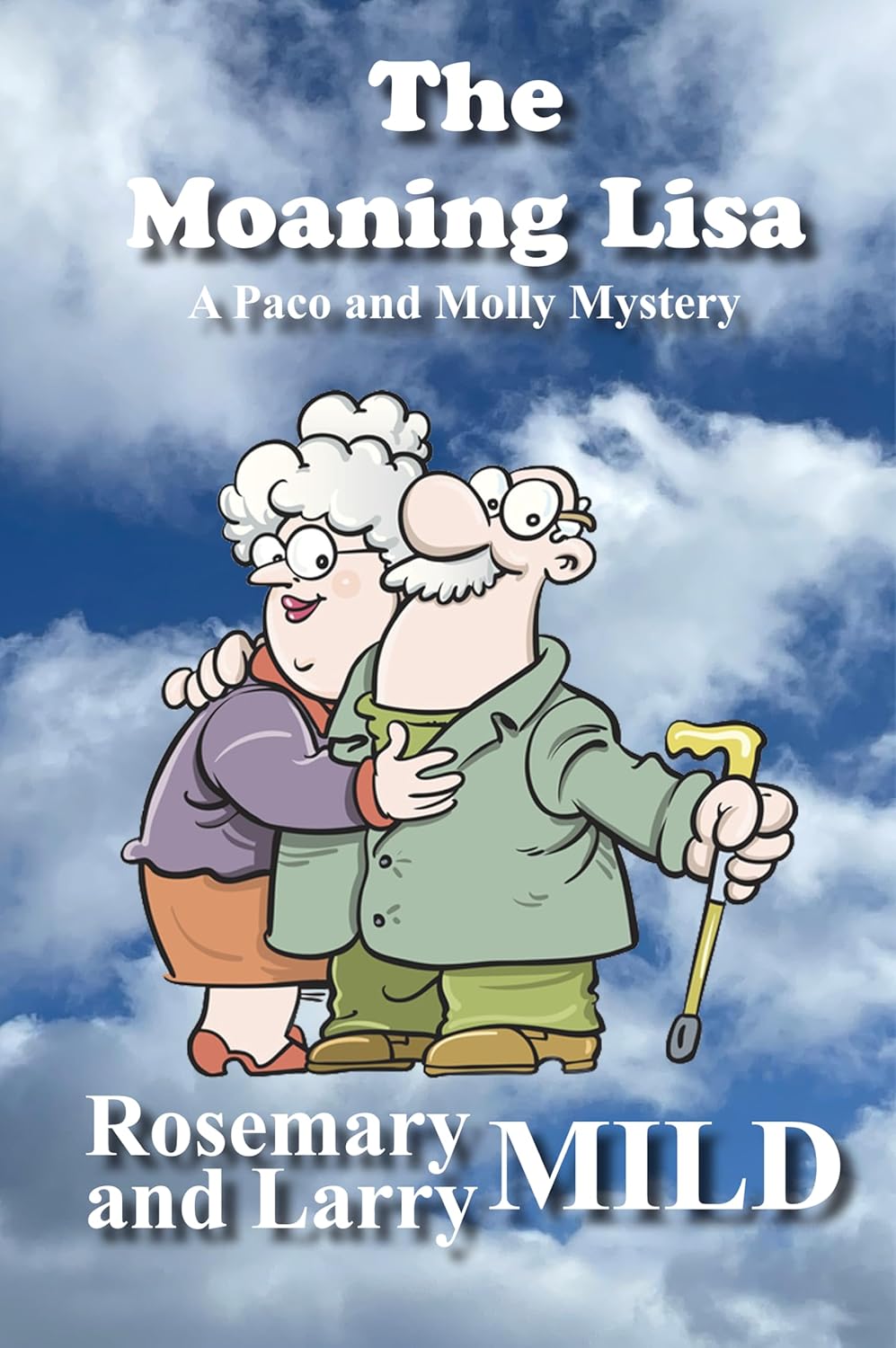

The Moaning Lisa follows Paco and Molly LeSoto, an older married pair of sleuths who land in the middle of a disturbing mystery inside the Gilded Gates assisted living community. A missing resident. Strange moans in the night. A stone turret that hides something far worse than dust and spiders. The story builds piece by piece as Paco and Molly tug at each loose thread until the whole place starts to unravel around them. It is a classic cozy mystery with a darker edge, tied together by the couple’s warmth, humor, and stubborn grit.
I felt surprisingly swept up in the tone of the book. The writing moves with an easy rhythm that let me sink into the world without thinking too hard about it. Sometimes the dialogue cracked me up with its little quirks, especially Molly’s playful mangling of words. Other times, the tension tightened just enough to make me pause. The setting also hit me in a way I did not expect. There is something both comforting and spooky about an assisted living home that tries very hard to look polished while hiding secrets in back stairwells. I found myself rooting for Paco and Molly, not just because they are skilled, but because they feel so relatable, creaky knees and all.
There were moments when the plot leaned into familiar mystery beats, and I caught myself predicting turns before they landed. Still, I did not mind much. The charm of the story is not in shocking twists. It is in how the characters bounce off one another and how their age actually shapes the plot, rather than sitting in the background. I liked that. It made the danger feel different. Slower. Closer. The book also has a gentle emotional core. It touches on loneliness, trust, and the strange little worlds older adults create around themselves. That part stuck with me more than I expected.
I would recommend The Moaning Lisa to readers who enjoy light mysteries with heart. It is especially good for fans of amateur sleuth stories, cozy mysteries with an eerie twist, or tales featuring older protagonists who still have fire in them. If you want something that feels warm but still gives you a few chills, this book will hit the spot.
Pages: 234 | ASIN : B0FJ4WVHYQ
For Cause
In Kansas City, truth used to be simple… facts, evidence, justice. But attorney Josephina Jillian Jones… 3J… is about to learn that in a world of deepfakes, even reality can be weaponized. When Paxton Energy files for Chapter 11, 3J expects a brutal legal brawl with a powerful bank group. What she doesn’t expect… is betrayal captured on video. A damning confession from CEO Remmy Paxton… clear, crisp, and devastating. There’s only one problem. He swears… it isn’t real. As the banks tighten their grip and a crooked Wichita banker pulls strings from the shadows, the judge gives 3J twenty days to prove the impossible: that the truth is a lie. Her only hope lies with a digital forensics prodigy, who now works for Robbie McFadden, the Irish mobster who rules Kansas City’s underworld with charm, menace, and a new business model: manipulating reality itself. From urban courtrooms to the windswept oil fields of northwest Oklahoma, 3J, her mentor Bill Pascale, and investigator Ronnie Steele race to unravel a conspiracy where corruption runs deep… and the wrong move could cost far more than a case. This time, justice has competition. Coming in early 2026.
Obesseus Feasts Of Legends (The Slam-Fu Edition 1)
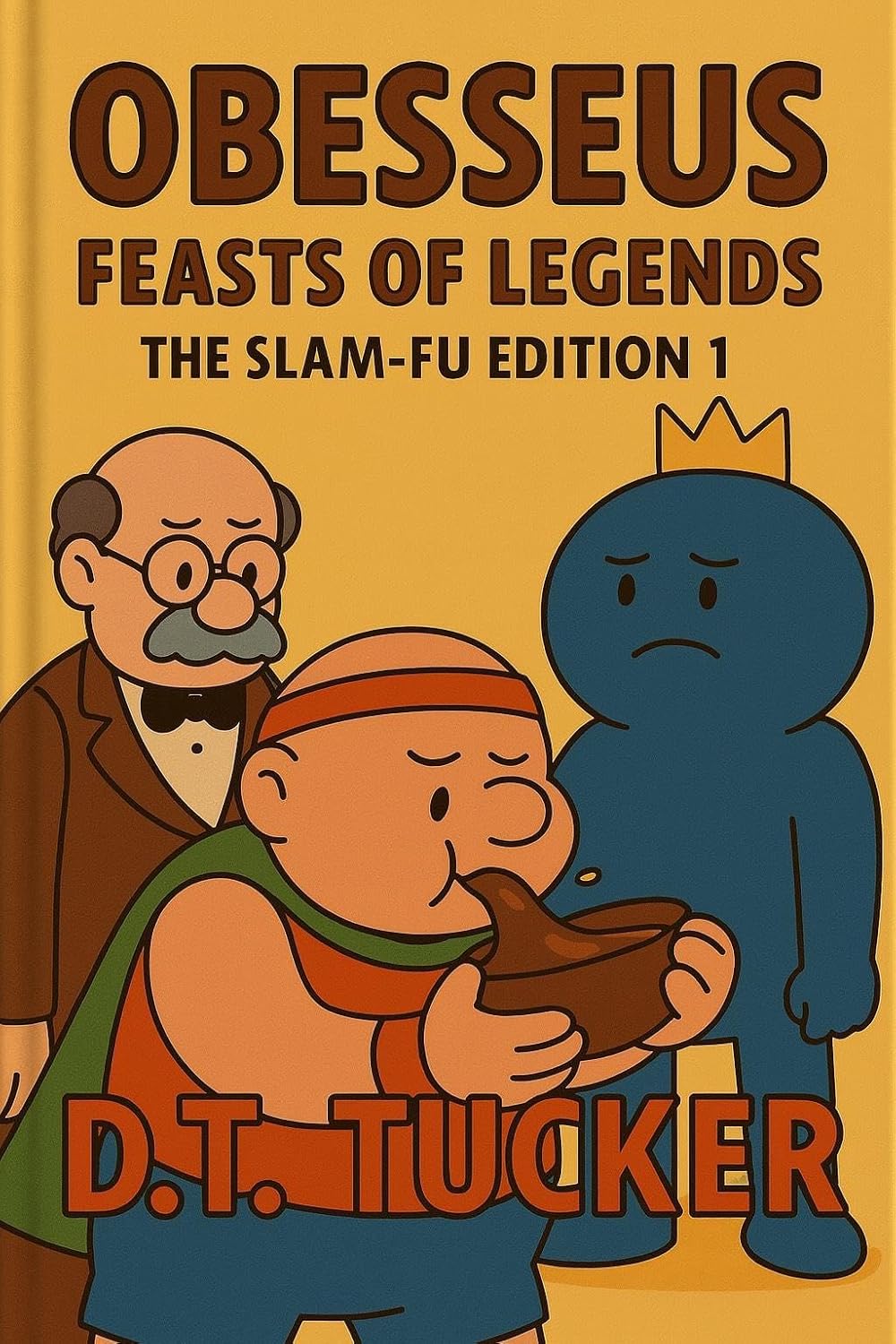
I just finished Obesseus Feast of Legends, and what a wild ride. This book tells the story of Obesseus. He is a hero. His belly is big. His heart is bigger. He just wants to eat dumplings. A former friend, Monica Mango, starts a war. She leads the “Juice Regime.” She hates solid food. Obesseus must fight. He learns a power called Slam-Fu. The book follows his journey. He defends the world of Buffetland. It is a huge, sprawling, absolutely massive food fight.
The writing is a total trip. Sentences are short. Sometimes just one word. Then a long, rambling thought. Things are yelled in capital letters. It felt less like reading a novel and more like reading a script. A script for the most frantic cartoon ever. The sheer number of ideas is surprising. The author just throws everything at the wall. And honestly? I loved watching it stick. It was a blast.
I really connected with the ideas here. The book is not just about food puns. It’s about big feelings. Obesseus himself is pure joy. He represents indulgence. He fights against control. The villains are great. They are juice-cleanse tyrants and asparagus-god dictators. I felt a lot for the side characters. Conflicted Tomato was my favorite. He just wants to know where he belongs. What a mood. I will say the plot gets messy. Part 1 was simple. Part 3 was just bananas. New characters kept appearing. Muffin Ninjas. Sinister Shrimp. A gaslighting grapefruit named Grant. It was a lot.
I am genuinely happy I read this. It is a messy, chaotic, and wonderful book. Do not read this if you want a quiet, serious story. This is not that. This book is loud. This book is strange. This book is wacky. I would recommend this to anyone with a wild imagination. It’s for people who grew up on hyperactive cartoons. It’s for anyone who just wants to see a hero win. A hero who wins with a full belly and a good burp.
Pages: 262 | ASIN : B0FZD69XD4
An Important Lesson

The Case Against Jasper is an allegorical mystery where a farm’s rush to judgment after a tragic accident exposes how communities distort truth when fear takes hold. What inspired you to explore human justice and mob mentality through the lens of animal characters?
The book was born out of a rush to judgement on my daughter’s part, who is age seven and arguing with her five-year-old brother and gossiping about him with her friends in the neighborhood. In order to teach both of them an important lesson, I created this theme about Jasper the squirrel and his endeavors. The story is a way to connect with them and give them an example that rushing to judgement and gossiping can have detrimental effects. Then enter Ink and Fiona, who represent intellect. Before rushing to judgment, look at the situation, study it and come to a conclusion. Ink and Fiona represented the internal intellect to look at things from all sides, test theories, and make decisions on the results. I liked the story so much that I decided to write the book.
Did you model any of the farm’s characters, like Ink or Fiona, after real people or archetypes?
Regarding real people, not really. The name Fiona is my mother’s name, so I used it in that way. Archetypes, absolutely. Jasper represents the scapegoat and those that are misunderstood. Jenny is the catalyst for the story. Others, like the group of squirrels, rabbits, etc., represent the mob. The hens, they are the hypocrites.
How did you balance the fable-like simplicity of the narrative with the weight of its moral themes?
By writing Jasper with a leaning towards gentle naivety, I allow the reader to experience injustice through the innocent eyes of Jasper. Although Jasper never fully comprehends the malice directed at him, he definitely feels it. It is this emotional honesty that preserves the purity of the fable while allowing readers to impose their own interpretations of guilt, grief, and alienation.
I think the ending leans toward restoration rather than punishment. What message did you hope readers would take from that choice?
Take any classic fable, and they typically end with punishment: the liar is caught, the greedy are undone, and the cruel are devoured by their own cruelty. Yet, The Case Against Jasper is written to break that cycle because the true tragedy of the story is born from misunderstanding, not malice. Jasper, as it turns out, never commits a crime. The crime is the community’s judgment itself. To punish would affirm the same broken logic that condemned him and would fall in line with classic fables. The stories’ true resolution must come from recognition and reparation, not vengeance.
Author Links: GoodReads
As rumors tangle like briars, a chorus of barnyard witnesses steps forward—some earnest, some opportunistic, all convinced they know what happened. Unreliable testimonies pile high: a jealous hen with a glint for shiny narratives, a rabbit fond of order and outrage, and a skittish mouse who “saw something.” With the farm on edge and a tribunal brewing, Jasper must prove his innocence before the story hardens into a sentence.
Enter Ink, the investigative ferret with a nose for hidden threads, and Fiona, the whisper cat whose quiet intuition hears what pride and fear try to bury. Together, they sift through half-truths and harvest-time politics to uncover what grief looks like when it’s weaponized—and what justice requires when the crowd wants a culprit.



 LITERARY TITAN