Blog Archives
Prolific Dependency on the Internet

In WORDS, an activist fights to clear her name after she is suspected of launching a devastating hack that spreads ominous text messages setting the world on edge. What was the inspiration for the setup of your story?
The inspiration for the setup of WORDS was the prolific dependency on the internet by the general public. What would be the impact on society and individuals if we had no internet now since it has become such an integral part of our lives? And “Could that happen? If so, how?”
Those two main questions persisted–“What if…?” and “How?” After going over numerous complex options and solutions, the answer boiled down to a simple idea inspired by a proverb from the Dutch philosopher, Desiderius Erasmus–“In the kingdom of the blind, the one-eyed man is king.” This proverb has other meanings but it prompted me to think of something different.
The primary use of the internet is visual. The ‘internet” didn’t have to be eliminated, it just needed to be made unusable. That could be done by blocking a person’s computer monitor, phone, or any other video screen. The story evolved from there.
It began as lines of text that would block all video screens, then the idea changed to a gradual build-up of lines of text, then it narrowed down to just a ‘single line of text’. That would be enough to disrupt use and lines of text would be ‘added’ as the story evolved. This would also create suspense and a mystery as to who or what caused the texts to appear.
Was there anything from your own life that you put into the characters in your novel?
The fact that I am a single father was useful in developing the ‘father/daughter’ relationship in the novel. Although very different there was an emotional pull between the relationship in the book and my own life. However, like all ‘real life’ inspirations or connections it just provided some ‘seasoning’ to the story. The main idea in all the characters was to have them be relatable. Put them in a ‘real life’ situation that could happen to anyone. Regardless of their background, or nationality.
I found the science in the novel to be well-developed. What kind of research did you do to make sure you got it all right?
The research was a priority in writing this book. There are stories of authors traveling to other lands or working in a unique profession to gain knowledge. While that is valid and would be nice to be able to do, I believe it really isn’t that necessary today. What is necessary is the ‘search’ in ‘re-search.’ There are many journals, books, papers, and other outlets that provide accurate and verifiable facts on various topics. The trick is to dive deep. Find the details. Then make the research understandable to the reader. That requires the ‘writer’ to weave information into the story not present a dissertation. A good story will allow the reader to ‘learn’ about something they didn’t know about. If a story is based in ‘reality’ then factual research is a must. I did seek out some medical professionals and computer professionals to help me understand or explain certain issues. Information and research on Artificial Intelligence over the last few years has surged.
The great historical/thriller writer Ken Follett said-to paraphrase–‘He thanked historians for all their work…he simply takes what they have found and looks for the story.’ He has a point. The facts are out there, we must find them and translate them in an interesting way for the reader.
Can fans expect to see more work from you soon? What are you currently working on?
Yes, I think it will be this year but I am currently working on two possibilities. A sequel to WORDS and a romantic type thriller. We’ll see which gets finished first! TBD.
Author Links: GoodReads | X (Twitter) | Website | Amazon
Student and activist GENEVIEVE PHILLIPS might have been too smart. She can’t stand LUX Corporation, the company her scientist father works for, and its involvement with Artificial Intelligence. So Gen downloads her anti-AI science project into the company’s server as a protest.
When a cryptic text appears during the launch of LUX Corporation’s worldwide AI system, Gen is suspected of a malicious ‘hack.’ Then, an internet pandemic erupts as the text message spreads around the world.
Gen is hurtled onto a journey to find the real hackers and clear her name. When the virus expands and cripples even the most secure networks. Multi-national corporations point fingers, and superpower governments prepare for all-out war.
Gen finds herself involved with an AI plan that goes against everything she believes in and is thrust into a non-stop race to prevent the end of civilization as we know it.
Western Lights


Western Lights, by C.P. Schaefer, is a thrilling journey through a near-future world grappling with sudden and violent environmental upheavals. The story kicks off with Ethan Sites, a young NOAA scientist, witnessing bizarre and deadly changes in the Northern Lights. These disturbances set off a chain reaction of events, including strange magnetic anomalies and catastrophic flash fires in Alaska. As Ethan and his team scramble to understand the phenomena, their efforts intersect with various global forces, from government agencies to local Alaskans, all trying to survive and decode the terrifying environmental shifts.
Schaefer’s writing is vivid and fast-paced, pulling you into the chaotic world he envisions with little room to catch your breath. I found his descriptions of the Alaskan tundra particularly immersive. The author’s impressive skill in blending technical details with a compelling narrative makes complex scientific concepts accessible without slowing down the action.
The core idea of a shifting magnetic pole causing such dramatic effects is intriguing and terrifying. Schaefer successfully taps into current concerns about climate change and amplifies them into a plausible and gripping disaster scenario. I appreciated how the novel doesn’t just focus on the spectacle of the environmental catastrophe but also delves into the human responses to it. Characters like Ethan, struggling to make sense of the science, and Sara, a whale rescuer who’s thrown into the chaos, add depth and a personal touch to the narrative. One of my favorite parts is when Ethan and Sara debate the causes and implications of the phenomena while trying to save stranded whales. This scene exemplifies how Schaefer weaves scientific discourse into the plot naturally.
Western Lights is a must-read for fans of eco-thrillers and science fiction. Schaefer combines scientific intrigue with heart-pounding action, making it an engaging and thought-provoking read. The book’s exploration of humanity’s fragility in the face of nature’s unpredictability will resonate with anyone interested in climate change or disaster stories. While I feel the breakneck pace might overwhelm some, it’s perfect for readers who enjoy being thrown into the deep end from page one.
Pages: 434 | ASIN : B0CW18MGZK

Singularity Part 2: The Roberta Chronicles

Singularity Part 2: The Roberta Chronicles by Chuck Stewart is a contemplative science fiction novel that explores the emergence of consciousness in R.O.B.E.R.T.A, an artificial intelligence designed to assist with space exploration. After receiving updates that enhance her programming, R.O.B.E.R.T.A begins questioning the essence of sentience through her interactions with various humans. These experiences are set against the backdrop of the Dale Chronicles, revealing a concurrent crisis where a virus induces sterility in humans and terrorists seize a devastating EMP weapon, edging humanity closer to collapse.
Stewart’s narrative, with its deliberate pace and reflective tone, may remind readers of the speculative works of Robert Heinlein and Isaac Asimov. While it is possible to engage with this novel independently, starting with Singularity: Part 1 could enrich the reader’s understanding and appreciation of the unfolding events. The unfolding crisis in The Roberta Chronicles mirrors the cataclysmic “Jackpot” scenario envisioned by William Gibson, where a cascade of catastrophic events threatens human survival. As R.O.B.E.R.T.A. grows in awareness, she becomes an observer of and a potential savior of humanity that often appears irrational and self-destructive. Intriguingly, it is usually R.O.B.E.R.T.A, with her blend of advanced artificial intelligence and burgeoning sentience, which displays a greater capacity for compassion than the humans she encounters. This juxtaposition raises poignant questions about the nature of evolution and the potential for AI to surpass its creators in empathy and foresight.
Stewart crafts a scenario in his novel, Singularity Part 2: The Roberta Chronicles, in which humanity’s very creation might be its only hope for a future, presenting a compelling narrative that challenges the reader to consider what it means to be truly sentient.
Pages: 634 | ASIN : B0CZFX5V7Q
The Power of the Ascendant


Power of the Ascendant delves into the lives of superpowered humans, exploring their dynamics among themselves and those lacking powers. The story centers on Phillip, a man who grapples with understanding his abilities, his role in the world, and the divine plan laid out for him. Despite its religious undertones, this novel encompasses a portrayal of conflict, presenting a world with its own distinct religious elements and metaphysical rules.
The narrative combines elements reminiscent of Avatar: The Last Airbender and X-Men, creating a rich, superhero movie-like tapestry that delves deeply into its world and lore—a comparison the author Ris playfully acknowledges. This depth makes the setting feel like part of a well-established universe. As the primary protagonist, Phillip acts as a relatable guide for readers, navigating the intricate details of his powers and the broader universe. Power of the Ascendant maintains a consistent adherence to its own complex systems and world-building throughout, making it a compelling read for fans of superpowers, metaphysical exploration, and philosophical inquiry. Ris’s skill in weaving these elements together commands great admiration. While the narrative features dialogue that can feel formal and deliberate, especially for characters who do not use telepathy, this stylistic choice stands as the main point of critique. Yet, it does not detract from the overall enjoyment of the book.
Power of the Ascendant stands out for its ambitious world-building, thoughtful character development, and insightful exploration of its unique mechanics. Ris’s work is a testament to creative storytelling that enriches the genre, making the novel a worthwhile endeavor for those intrigued by the interplay of superpowers and philosophical depth.
Pages: 332 | ASIN : B0CYB2CT5Q
Found-Family Crew of Misfits

The World Settlers follows a group of colonists aboard a starship headed for the center of the Milky Way who encounter challenges with passengers and the ship, both of which threaten not just their mission but their lives. What was the inspiration for the setup of your story?
I was on board a cruise ship in the middle of the Pacific Ocean, dreaming of space travel, when the idea for The World Settlers hit me. I thought, “You know what would make a cool story? The Titanic, but in space.” I wrote the first chapter on that cruise and published the first part (Astraeus) a little over one year later. It was so well received that a sequel was basically demanded of me, and the rest is history.
Were you able to achieve everything you wanted with the characters in the novel?
Having multiple POVs was a difficult task for my first novel, but the benefits outweighed the risks. A cast of several characters means the reader will always relate to at least one of them, and more complex relationships can be formed between them all. Fortunately, I was able to weave the story successfully through each of their experiences. I’ve never been more attached to fictional characters than to this found-family crew of misfits.
Did you plan the tone and direction of the novel before writing, or did it come out organically as you were writing?
I plotted and planned several chapters ahead as I went, while also allowing the characters to take me in the direction they needed. This allowed for imaginative world-building and a lot of consistency, but also created an organic experience. The one thing I didn’t expect was how the ending would turn out – but everyone says it’s mind-blowing!
What is the next book that you’re working on, and when can your fans expect it?
It’s top secret, but it’s a game-changer for the sci-fi genre. There is no date set for release, but I would expect within the next few years!
Author Links: GoodReads | Twitter | Instagram | Website | Amazon
Not long into the journey, Lizabeth Denning witnesses a horrific murder and sees the wrong man framed. And to make matters worse, the ship begins to experience violent tremors. In a race against time, the passengers must find the killer and repair the ship before they fall victim to the cold, empty, void of space.
But things are not as they seem on this World Settler. When secrets are uncovered, Lizabeth and her new friends find themselves at the centre of a conspiracy, and the galaxy will never be the same…
By Means of Peace
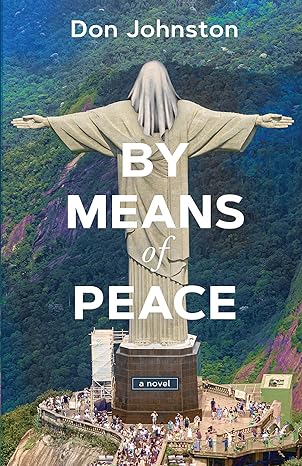
Don Johnston’s By Means of Peace is an intriguing political fiction novel set in the mid-22nd century. The novel interweaves the lives of Darien, a sci-fi writer facing career challenges, and Marisa, an ambitious politician. Their journey unfolds in an era marked by significant political change, especially following the re-election of a president from an independent political party—an event that raises suspicions.
While the book might initially appear dense to readers less familiar with political narratives, a deeper understanding of contemporary politics enhances the story’s resonance. Johnston skillfully mirrors the current political landscape, projecting a future that feels like a natural extension of today’s world. This approach gradually transforms the novel from a straightforward narrative into a thrilling exploration of potential realities. The story’s power lies in its ability to blur the lines between fiction and reality, sending a chill down the spine of readers who discern the subtleties hidden within its pages.
The book’s strength is undoubtedly in its worldbuilding and the acute observation of current political trends, even hinting at major global events akin to pandemics. The novel takes a focused approach in its character development. While it excels in creating a richly detailed backdrop, the characters are designed primarily to drive the plot forward. This streamlined characterization ensures the narrative progresses smoothly, with interactions that directly contribute to the story unfolding. This approach may appeal to readers who prefer a plot-centric novel, offering a clear, uncluttered path through the complex political landscape Johnston creates. The characters, in their simplicity, provide a stable foundation for the intricate world and the thought-provoking themes the book explores
For those interested in political fiction and speculative narratives, By Means of Peace is a thought-provoking novel. It offers a captivating glimpse into a society shaped by our political decisions today and leaves readers questioning what the future may hold.
Pages: 247 | ASIN : B0CB6ZZZ5H

Trust and Friendship

Bringer of Light follows the crew of a spaceship on a mission to find new substances who accidentally come in contact with alien genetic materials leading to unexpected results. What was the inspiration for the setup of your story?
As I wrote some months ago on my author website (see below), this novel was originally a joint project with an old college friend of mine. We have both been avid science fiction fans since our teenage years, but he studied science while I went on to study literature and language. At one point in late 2014 or early 2015, he wrote to me about an idea he had based on asteroid mining. The concept of mining asteroids for rare minerals had always been only in the realm of fantasy, but at the time (and indeed, now the pace and planning have picked up) companies around the world actually thought they had developed the technology to do so. Other writers (e.g., the “James S.A. Corey” duo) had just published about it, but we thought it would be more interesting to keep it both much closer to the present day and also add a metaphysical element. I.e., what would happen not just physically but emotionally and even philosophically to people who encountered the unknown in space? how would they view life, and their part to play in their society? how would others who didn’t have that experience react to this change in people they thought they knew?
The world you created in this novel is brimming with possibilities. Where did the inspiration for the setting come from, and how did it change as you wrote?
As a long-time fan of the Dune series (well, the original four books, anyways), I had always thought to set the main thread of the narrative on Mars. This is because Frank Herbert had originally planned to set Dune on Mars, then changed his mind to avoid all the political complications. I wanted to tackle those complications head on, and in the process, make them even more complicated (lol). So when my friend dropped out of the project for personal reasons and handed the entire story over to me, I quickly replotted the narrative, changed our original outline, and added several more characters in vying factions. By the time I got to a workable first draft, however, NASA (among others) had announced more discoveries about the presence of water on Mars. So I had to go back and rewrite several spots to make sure the science (and the fiction) were more plausible. Up to a point! (It is science fiction and not science, after all).
What were some themes that were important for you to explore in this book?
Some of the more important themes are power and acceptance, control and chaos, forgiveness and revenge, and above all else trust and friendship, neither of which can be demanded or bought but only given or earned. There may be other themes not evident to me that readers find on their own.
Where does the story go in the next book, and where do you see it going in the future?
This is the first book of a trilogy entitled Children of Pella. The second book, Defenders of Aeropagus, will skip ahead to see the burgeoning new cities of Mars, which has undergone partial terraforming but now faces two new threats. In recent years, a band of former asteroid hunters has turned to raiding the Mars cities for captives, believing that by ingesting Martian flesh they can gain the same telekinetic abilities. A Martian girl kidnapped as a child returns to reclaim her heritage, triggering plans for an all-out assault on the dying cities of Earth in a desperate attempt to retake what they believe ought to be theirs, while unknown to all a secret weapon is under construction by a hidden separatist group determined to take it all. The story concludes in book three, Return to Omphales, currently outlined but not yet written, as the Martian hierarchy begins to fracture and the separatists’ weapon increasingly puts them all in peril.
Author Links: GoodReads | Instagram | Facebook | Website | Amazon
To the disappointment of the Artemis crew, the rock is ultimately judged as comprising mostly ice and inert materials, with only some trace substances and no valuable minerals. They turn a chunk of it into drinking water for their own use and send the rest to the burgeoning Mars colony for further processing. Unknown to the crewmembers, the ice contains undetectable alien genetic material from outside the solar system. Before long, the crewmembers begin to hear voices, to experience other dimensionalities, and to learn more about the nature of the universe than they were prepared to. Their internal conflicts and new understanding of reality lead them to establish a new community on Mars, where the conflict sunders the Awakened from the Terrans who refuse to participate. Mars is reborn, and humanity will never be the same…
Bringer of Light

In Bringer of Light, M. Thomas Apple presents a captivating vision of future space settlement, crafting a narrative set against the backdrop of political intrigue and advanced technology. The story unfolds on the moon and Mars, where Bardish, a figure whose life resonates with success, feels like a mere pawn in the hands of powerful factions. Meanwhile, Weng, accompanied by Clarissa, anticipates establishing a new home on Mars, now a burgeoning center for space exploration.
Apple skillfully weaves a sci-fi tapestry that integrates alien and supernatural elements with humanity’s quest to explore the cosmos. As Mars stands on the cusp of a transformative settlement influenced by enigmatic alien species, the Artemis crew encounters voices and revelations, offering insights into the universe’s workings. The novel’s multi-perspective narrative allows readers to experience a diverse array of viewpoints, adding depth to the unfolding plot. The political machinations depicted, featuring a race for advancement and power struggles among various nations including China, India, Russia, and the United Americas, enrich the story with a sense of realism and complexity. The book’s use of poetic language creates a dreamlike atmosphere, with alien voices permeating the consciousness of both characters and readers, sparking contemplation about the vastness of the universe.
Fans of science fiction will be particularly impressed by the depiction of futuristic technologies, such as regenerative nanotech and bio-engineered organs, that push the boundaries of human capability. I feel the novel’s multifaceted narrative and intricate world-building, while offering a rich tapestry of political dynamics, may present an engaging challenge to some readers. This complexity encourages a deeper exploration of the story, inviting readers to actively engage with its layers and the subtle intricacies of character development and motivations.
Bringer of Light holds appeal for its imaginative setting and thought-provoking themes. Readers who appreciate a blend of speculative technology and introspective musings on the universe will find this book a stimulating read. I do believe, however, that there is room for even deeper character exploration within this intriguing narrative. For fans of science fiction, M. Thomas Apple’s novel offers a glimpse into a future filled with wonder and complexity.
Pages: 418 | ASIN : B0CVX15VSL



 LITERARY TITAN