Blog Archives
Mushroom Cloud
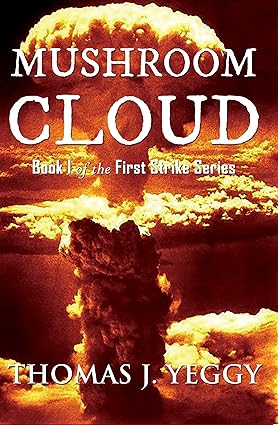

Mushroom Cloud: Book 1 of the First Strike series by Thomas J. Yeggy is a gripping historical thriller that delves into the complex world of nuclear warfare and its devastating consequences. The novel follows the life of Dr. Caleb Young, a highly intelligent and thoughtful American who goes from working for the CIA to advocating for bomb shelter construction in the aftermath of President John F. Kennedy’s assassination. In the wake of Kennedy’s death, Marshall and Deputy Attorney General Nicholas Katzenbach visit Dr. Young to learn what he knows about the CIA’s potential role in the tragedy. Identified as the likely source of a National Security Council leak regarding the heightened danger of nuclear war, Dr. Young finds himself embroiled in a web of conspiracy and deceit.
Throughout the book, historical figures such as Harry S. Truman, Albert Einstein, and Adolf Hitler come to life, adding a rich layer of authenticity to the narrative. The protagonist, Dr. Young, is a complex and multifaceted character whose life story reveals the profound consequences of the development of nuclear weapons and the power struggles between nations in the mid-1900s. As a history buff, I found the book to be a compelling and engaging read. However, I must note that some of the technical information regarding military equipment and procedures and the plans and instructions are intricately detailed. Additionally, the protagonist has a particular disposition that will have readers experiencing a love him / hate feeling. This character development serves to make Dr. Young a more complex and nuanced character, adding depth to his personality and motivations.
Mushroom Cloud is a thought-provoking and timely read that raises serious concerns about power, ambition, and the devastating impact of nuclear warfare. It is a gripping and entertaining read that will stay with readers long after they turn the final page.
Pages : 357 | ASIN : B0C78V9MX7

The Collapse of the Bronze Age

The Age of Heroes follows iconic Bronze Age civilizations that face extraterrestrial threats, mysterious deities, and formidable organisms, blurring the lines between history and science fiction. What was the inspiration for the setup of your story?
For a long time, I’ve been fascinated by the catastrophe that befell the brilliant Mediterranean Bronze Age civilization at the beginning of the 12th Century BCE. The rich, interconnected, multi-faceted world had ceased to exist in a few decades. The cities had been razed and burned, the crops destroyed, and the people dispersed.
The cause of the Catastrophe is still subject to a fierce debate among scientists. We might never know the truth.
This provides a perfect setting for studying the Bronze Age civilizations while adding fictional and fantastic elements. I took the liberty to imagine a certain “what if” scenario, an alien expedition amid the struggle for supremacy between the human kingdoms.
I hope this story will motivate the readers to learn more about this fascinating time and discover historical facts about the Bronze Age collapse.
The Soarers, portrayed as deities observing humanity, present a unique take on ancient gods. How did you conceive this alien race and their intricate relationship with human emotions?
Having aliens posing as deities is not a novel concept. I tried to imagine what it might be like when technologically advanced humans, exploring space, encounter an alien civilization not unlike the Bronze Age Mediterranean culture. Would we try to elevate them to our level, or would we succumb to the most primitive instincts of our nature? The contradiction of a technologically advanced species, with a superior intellect and driven by logical argument, yet subject to the basest desires and emotions, is a riddle I’m very curious about. Will we ever be able to transcend our animal nature? Do we really need to strive to do it, or does it give us, humans, a unique advantage?
What were some themes that were important for you to explore in this book?
First of all, this is a book about humanity, the aforementioned contradiction between reason and emotions, the neverending pursuit of ephemeral goals, imposed by poorly understood desires, and the drive for domination and conflict. Are we doomed to continue this mad race? Or is there a different path, the path of reason and advancement?
Second, I wanted to immerse the readers into the atmosphere of the Bronze Age Mediterranean and introduce this rich, sophisticated, and still poorly understood world to them. The history of these ancient civilizations is full of enigmas and quests that far surpass any fantasy stories we can come up with. My intention was to lift the veil and hope it would raise the readers’ interest in this epoch long gone.
Third, in one of the subplots, I wanted to explore how artificial intelligence, born into the world of biological species and adopted by them as one of their own, would adjust, interact, and grow. How would this new entity behave and what decisions would it make? Would we then call it human if it becomes an integral, inseparable part of human society?
What is the next book that you are working on and when will it be available?
I am currently working on the sequel to my first book, a hard science fiction mystery, “Out of Time.” The working title of the new book is “The Illusion of Time,” and it explores the nature of the human consciousness and its link with the Universe within a setting of the dying world of the early 22nd Century. As in all of my stories, there are lots of complex characters, sub-plots, twists, and epic battles. I am planning to release it in mid-2024. I hope you will read and enjoy it!
Author Links: GoodReads | Website | Amazon | BookBub
The great human empires of the Bronze Age are locked in everlasting confrontation, with control of the Mediterranean as the coveted prize. Echelaos, prince of Pylos, prepares to wage war against treacherous Trojans to restore his honor and return his bride-to-be, Helen of Hatti. Ninurta-apal-Ekur, king of Assyria, follows the gods to conquer the neighboring tribes, while in Egypt, Khay, a grave robber, awakens the ancient evil.
Meanwhile, the commander of an alien expedition that has arrived to study Earth faces a difficult decision about whether or not to interfere in these terrestrial matters. The expedition members reveal polar opinions, threatening to shape the future of humanity according to their own vision.
Suddenly, all beings must proceed with extreme caution. Because alliances are fragile, betrayals are common, the great collapse has begun, and the new age is nigh.
An unforgettable story of war, love, glory, and duty, “The Age of Heroes” is a historical sci-fi epic filled with action, adventure, and intrigue where gods, heroes, and aliens collide in a showdown for the ages.
No One Is All Good or Evil

INFINITY: There be Pirates follows a knight tasked with hunting down a pirate who ends up falling in love with the woman he is supposed to apprehend. What was the inspiration for the setup of your story?
My goal was to create a pirate romance that wasn’t the typical misogynistic nonsense that authors write in this genre. If you’ve never read a pirate romance… you’re not missing much. They’re all the same. I’ll give you a brief breakdown. A naïve, adolescent, virgin girl is kidnapped against her will by a philandering brute who attacked her ship and murdered her friends and family. She warms up to this lunatic for the sake of her survival. The leading man is a violent, unrepentant, criminal with no depth and no motivation other than to get rich and get laid. Then I, the reader, am expected to applaud at the end of this Stockholm Syndrome story when this dumb girl falls in love with her oppressor. My inspiration for writing my pirate romance was how terrible they normally are. I know what you guys are thinking. “Didn’t Sarah abduct Matthew? Isn’t that the same situation?” No, and this is why. Matthew wasn’t some defenseless teenage girl. He was a deadly military operative who was hunting Sarah and her crew. The only way she could survive was to trap him first. Also, Matthew and Sarah have a complicated past. They are not strangers. He didn’t fall in love with his abductor. He remained in love with a woman he was already in love with long before she was a pirate.
This story blends fantasy and historical fiction in an alluring and creative way. What books do you think most influenced your work and the creation of this series?
I love classic books and I get inspiration from them:
Treasure Island
Peter Pan
20,000 Leagues Under the Sea
Sinbad the Voyager
King Arthur and the Knights of Camelot
Robinhood
Pirate stories are filled with action and adventure on the high seas making for an entertaining and engaging novel. What was your favorite scene in this story to write?
My favorite scene in this adventure book was not adventurous at all. It was the scene where Matthew is taken back to the pirate stronghold on the Isle of Maroons and he enters this whole new world. Pirates are outlaws. As a British knight and a navy captain, it’s his duty to apprehend and execute them. Yet he empathizes with them to some extent. Matthew knows there are circumstances that would cause him to commit the same crimes. I enjoyed this scene because it’s the part of the story where he humanizes his rivals. He realizes that no one is all good, and no one is all evil. People are a complicated mixture of both.
What future plans do you have for Matthew and Sarah, and when can your fans expect the next book?
The next book will be INFINITY: Love & Treasure which is the swashbuckling conclusion to the buccaneer trilogy. Pirate books require a lot of time and research so it probably won’t be released until the fall of 2024. I know that’s a long time from now but I want to make sure I am writing a book that is worthy of my readers. I’m also in the process of making video editions of my books on YouTube. I appreciate all the Infinity fans. Thanks so much for your support. https://youtu.be/6XafzpfUonY
Author Links: Website | YouTube
Includes 30 illustrations.
A Story of Survival

Stone Mother follows a young girl in post-WWII Germany who initially is unaware of the horrors her family and country have committed, and when she discovers the truth must find a way to heal. What was the inspiration for your story?
First, a quick clarification: Marie, my protagonist, is indeed unaware of the horrors her countrymen committed. However, the “horrors” within the family are not linked to the Nazis. They reflect private digressions, though the argument could be made that abuse in the family is a crime against a fellow human being and thus a Nazi-like behavior; the Nazis’ mechanization of killing and the vast scope of their brutality, however, remains unique.
What was the inspiration? My own complicated life experience and that of my friends and classmates. My generation was kept in the dark about Germany’s recent past. We sensed “the uncanny” but could not grasp it. And, once enlightened, we had to struggle with a terrible history we had not participated in yet had to carry as a burden from that point forward.
What was your writing process to ensure you captured the essence of the characters?
That is a challenging question. The process of “creating” and/or “re-creating” characters is very complex and not always under the control of the author. Simply put, I wanted my characters to be fully alive and assigned them certain “roles” within the overall arc of the story. And yet, some characters took on a life of their own and “wrote their own story” rather than conforming to a preconceived script. That happened with the character of Monsieur de Remarque, for example. I took the memory of my sister’s classmate’s crush on a young French teacher (with whom I had never spoken) as an inspiration and gave him the vital role of a rescuer. I guess what I am saying is characters may reflect or be inspired by real-life people but are totally transformed during the creative process—especially when the author is what I call “in the zone.”
What do you think were some of the defining moments in Marie’s development?
There are many defining moments. First and foremost, the move from—i.e., separation from—her beloved castle and the sudden “absence of her beloved father.” Both events coincide. That is a terrible blow for 7-year-old Marie. She is assured that her father should get better in the sanatorium before too long, but in reality, his ‘recovery’ will take two long years.
The next defining moment is Marie’s experience of the “children’s home,” which pushes her into the lowest and most despised stratum of society—perhaps comparable to the experience of a black child during Jim Crow, or possibly a child wearing the yellow star of David under the Nazis, though Marie’s “enslavement” lasts only from Easter to Christmas. Mama does finally rescue Marie and her sister from that societal abuse, but not with enthusiasm. The children’s home experience also becomes the seed for Marie’s distrust of “institutions” in general, such as the church.
On the more positive side. Sophie’s entry into Marie’s life after her father’s return is another defining moment, this time a heartwarming experience that provides Marie with friendship and support under the care of Sophie’s mother who becomes the family’s housekeeper following Mama’s emigration to Canada.
Another defining moment is Marie’s visit to Canada where she experiences cultural shock and is forced to endure harsh conditions on the Alaska Highway. I won’t elaborate any further; readers will discover that passage of Marie’s life on their own.
The most decisive experience for Marie and her peers happens during a seminar organized by her prep school, when they learn the full extent of Nazi brutality and killings. Marie and her friends intuitively understand that it will take a lifetime of trying to come to terms with that reality.
That horrific clash with reality is also the first chapter I wrote decades ago. If you will, it is the driving force behind the entire novel though not the only one. Marie and her friends must from that point forward struggle with their faith: how could God allow this to happen? And they must struggle with the knowledge that “their own people” committed such an outrage. Young people of other nations who learn of the holocaust (that word did not exist when Marie grew up) can point to “others,” to “the Nazis,” and to “the Germans” who perpetrated such evil. Marie’s generation cannot. How would that feel to a young American?
What is the next book that you’re working on and when can your fans expect it out?
The next book is on the drawing board and slowly coming to life in individual scenes and chapters but will need much loving care before it can see the light of readers’ eyes. It is, in many ways, a sequel to Stone Mother. This time, Marie arrives in the United States as a twenty-year-old, a student on an Ivy league campus who settles into and tries to decipher this country with the eyes and mind of a newcomer. Wait until you read Marie’s observation on her first football game! She might as well have come from Mars.
Author Links: GoodReads | Facebook
Marie is a dreamy child of a doctor whose family is offered refuge within the walls of Falkenburg Castle after the war. Within the safety of this thousand-year-old “stone mother,” Marie begins her coming-of-age journey dominated by her troubled, often violent mother and comforted by her beloved father.
Soon, Marie is forced to leave the castle and is bounced from a Dickensian Children’s institution, to an inspiring private prep school for girls in Heidelberg, to the wild Alaska Highway, and back to Germany, where, at age fifteen, she discovers the full extent of Nazi atrocities and contemplates suicide.
With the help of her mother’s former teacher and the spirit prince of Falkenburg Castle, Marie begins to understand her mother’s pain. She finds a way to accept—though never condone—what she cannot change. Ultimately, when she faces the transgressions of both her mother and her motherland, she is inspired to engage more fully with her new Germany.
Hieronymus

In Nic Ularu’s Hieronymus, we are gracefully led into the world of Jeroen, a painter of unusual flair. Facing estrangement from his family, Jeroen’s art becomes his refuge. Yet, it’s his tumultuous bond with his brother Goossen that adds depth and tension to his narrative. Simultaneously, we encounter the affluent widower Goyarts, whose aspirations for his daughter Aleid’s marriage set the stage for unexpected twists. The surprising union of Jeroen and Aleid enriches the tale, as Jeroen’s newfound resources permit an exploration of avant-garde, albeit scandalous, artistry. While his provocative work stirs societal discontent, the shield of his influential kin spares him from backlash.
Can Jeroen salvage his relationships? And will Goyarts discern the follies of his wealth-centric perspective?
Ularu’s novel transports us to a period where patriarchy was dominant and the church’s influence was palpable. We see Jeroen, ambitious and imperfect, navigate this world. His fervor for art and inherent defiance make him a compelling figure to accompany. The narrative seamlessly touches on grave societal issues of the time, like the ominous witch-hunt trials with their dire consequences.
Ularu crafts a luminous portrayal of 15th-century life. The narrative weaves themes of perseverance, sexuality, faith, love, and kinship with finesse.
The novel offers a detailed historical exposition. Its erotic content, which is part of the storyline, is prominent in certain sections. The complex plot features numerous simultaneous events, necessitating careful reading, and the abundance of characters can be a lot to keep track of.
Yet, for aficionados of historical fiction — especially those fascinated by the dance of romance, art, and theology — Hieronymus stands as a commendable pick. It’s a tapestry of past epochs, passion, and human nuances waiting to be unraveled by the discerning reader.
Pages: 300| ASIN : B0C6R4XPNH
My Grandmother’s Life

Augusta follows a thirteen-year-old farm girl forced into marriage and motherhood who, after being abandoned in the city, must find a way to survive for herself and her children. Where did the idea for this novel come from?
This novel is based on my grandmother’s life. The image of her on the cover was from a 2.5×3.5 inch daguerreotype. When my aunt Ivon gave it to me, she said it was taken on her wedding day, and she was wearing her eighth-grade graduation dress. EEEK.
You went into great detail to get the setting right, especially in regard to money, life in the city, and even the emergence of home appliances. Did you do a lot of research to maintain the accuracy of the subject?
I researched life in Arkansas at the turn of the twentieth century. Finding out what it was like for the very poor in 1920s Detroit was a surprise. My mother told me that my grandmother came to Detroit wearing a feed sack as a dress.
What were some themes that were important for you to explore in this book?
My father was Buddy. He told me that his mother made him share, with other children, the goodies he received when he was in the hospital. I made a point of discovering what candies were popular at the time and what toys children may have received.
What is the next book you are working on, and when can your fans expect it to be out?
My next book will be out in April 2023. Big Guy is a middle-grade children’s book. Like Black Beauty, this story is told by the horse. I trained horses and gave riding lessons for many years. The personalities that I convey are my imagining of the personalities of horses that I knew and loved.
Author Links: GoodReads | Twitter | Facebook | Website | Amazon
The historical novel begins in 1906 on a rural farm in Arkansas, where Augusta was raised on a hard-knock farm and married off to the widowed father of one of her classmates at the age of thirteen. They flee the failed cotton crops for factory work in Detroit, and Augusta must navigate city life alone as a new mother. Abandoned by her second husband, Augusta works as a waitress, but with four children to provide for, she is forced into a decision that will haunt her forever.
The Age of Heroes: A Historical Sci-Fi Epic
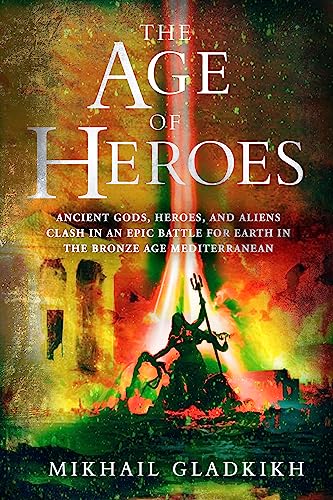
Mikhail Gladkikh’s “The Age of Heroes” masterfully interweaves elements of science fiction with historical fiction, plunging readers deep into the heart of the Bronze Age Mediterranean. At the center of this expansive tale are epic battles, iconic heroes, intricate power dynamics, and profound human sacrifices.
Gladkikh offers a novel perspective on the destinies of the societies that once thrived in the Mediterranean and the Near East. He delves into a reimagined version of the spectacular downfall of these ancient civilizations, providing an immersive reading experience.
The narrative unveils a world where the grand empires of the Egyptians, Minoans, Mycenaeans, and Hittites are on the brink of catastrophe due to unforeseen extraterrestrial threats. The Soarers, an advanced alien race, portray themselves as deities and covertly observe humanity. As these entities grapple with human emotions, a massive conflict erupts, dragging unsuspecting humans into their intergalactic disputes.
Beyond the alien dynamics, Gladkikh introduces other enigmatic entities: Aten, a formidable mushroom organism that enthralls entire populations, and eerie primordial beings capable of reducing a person to mere residue.
With a narrative spanning kingdoms and weaving intricate plotlines, Gladkikh’s writing remains incisive throughout. He meticulously resurrects ancient civilizations with vivid descriptions, giving readers a visceral experience of the era. Although fictional, the novel remains loyal to the Bronze Age’s historical intricacies, ensuring an authentic voyage through time.
What truly sets “The Age of Heroes” apart is its innovative fusion of science fiction and history, a pace that never relents, and a plethora of multifaceted characters. Gladkikh delves deep into themes of humanity, oscillating between our potential for profound violence and our innate ability to love, remain loyal, and forge enduring bonds.
I think the novel’s ambitious scope and plethora of characters occasionally make certain segments challenging to navigate. Yet, this slight setback pales in comparison to the book’s overarching allure.
“The Age of Heroes” is a captivating reimagination of the factors that might have precipitated the Bronze Age civilization’s demise. With its fresh perspective and riveting storyline, it’s an enthralling read I wholeheartedly recommend.
Pages: 346 | ASIN: B0CCK9CGWV
Shadow Runner


Set in the captivating world of Victorian England, K.J. Fieler’s debut novel, Shadow Runner, introduces readers to the steampunk realm inhabited by Ada, a young girl born into wealth yet yearns for adventure. With a fear of ending up confined to a marriage like her mother, Ada’s thirst for excitement is both challenged and fulfilled when she is abducted by the Shadows, a mysterious group that tears her from her comfortable existence.
Thrown into a dark criminal realm, Ada must face incredible challenges and hurdles. It’s a world entirely alien to her, yet she navigates it with a courage that keeps readers engrossed. Fieler has woven a rich narrative, blending elements of fantasy and a coming-of-age story that consistently engages the reader.
Fieler’s prose is well-crafted, and the intrigue begins from the very first page. Ada’s strength as a protagonist sets the tone of the novel, and as readers delve into her years within the Shadows, her unyielding adherence to her morals – even when put to the test – is both impressive and refreshing. The character development is executed to perfection; Ada’s internal conflicts and confusions are artfully revealed to the reader, even as they remain concealed from the protagonist herself. This narrative device adds layers of complexity, making the unfolding dark tale even more compelling.
The writing is simple yet gripping, turning even the most intricate parts of the plot into seamless elements of the story. I feel some of the events toward the conclusion appeared somewhat rushed, but this is clearly the stage-setting for what promises to be an exciting series. Even those unfamiliar with the steampunk genre will find Shadow Runner an absolute page-turner.
What truly sets Shadow Runner apart is K.J. Fieler’s skillful manipulation of language and ability to weave emotionally resonant scenes throughout the plot. This is a thrilling exploration of courage at its lowest and highest points and a story that hints at more down the road. Shadow Runner is a commendable entry into the genre, a tale rich in detail and character that promises to linger long in the reader’s imagination.
Pages: 277 | ASIN : B0BXQ7337M



 LITERARY TITAN