Blog Archives
Bronx Attitude


Bronx Attitude is Rossana Rosado’s memoir of becoming herself: a Bronx-born Puerto Rican girl raised among stairwells, bodegas, bilingual family music, formidable women, stern patriarchs, and the warm chaos of Wheeler Avenue, who grows into a journalist, publisher, public servant, and keeper of communal memory. The book moves from childhood scenes, like her grandmother teaching her to read El Diario in Spanish, to the electric public history of Sonia Sotomayor’s Supreme Court nomination, to Rosado’s years at El Diario, where journalism becomes both vocation and inheritance. It’s really a story about “we”: family, Latinos, women, neighborhoods, ancestors, and the complicated blessing of belonging.
The early chapters have a gorgeous lived-in texture: the garbage cans clanging on the curb, WADO playing through a neighbor’s window, Papá bringing coffee to Mamá, the child sneaking upstairs for toast and discovering that the newspaper isn’t broken, it’s in Spanish. Those moments feel tender. I also loved how she writes women into the center of the world, not as saints exactly, but as forces. Mamá with her private money, Lucía dancing with children in the rain, Rosa calling everything “divine” despite the quiet cruelties around her. Rosado’s sentences can be plainspoken, almost conversational, and then suddenly they gleam. The memoir has that Bronx rhythm: affectionate, blunt, funny, wounded, proud.
The book insists that personal history and public history are braided together. Rosado doesn’t treat Sonia Sotomayor’s nomination as a distant news event. She makes it feel like a family room, a newsroom, a collective exhale, with champagne glasses, red nail polish, and the startling realization that one woman’s ascent could lift a whole community’s posture. The chapters on El Diario carry a different ache. When she writes about Manuel de Dios’s murder, or about inheriting leadership after Carlos Ramirez’s death, the memoir becomes more than remembrance. It becomes an argument for ethnic media, for courage, for telling the stories mainstream institutions overlook. I didn’t always feel the book was equally tight from chapter to chapter, but even that looseness has a kind of honesty. It reads like someone making room at the table for everyone who shaped her.
I felt like Bronx Attitude had earned its title: not attitude as swagger alone, but as stance, memory, defiance, and love. Rosado’s final reflections on leaving El Diario and looking back at her younger self gave the book a soft, satisfying ache, especially because the memoir never pretends success is clean or solitary. It’s carried by the dead, the elders, the cousins, the mentors, the city, the language, the food, the paper, the block. I’d recommend this to readers who like reflective memoirs about identity, journalism, Latina leadership, New York City, and the emotional architecture of family. It’s a good book for anyone who knows that where you come from doesn’t just explain you, it keeps speaking through you.
Pages: 264 | ASIN : B0GS98TMGQ

Literary Titan Gold Book Award: Nonfiction

The Literary Titan Book Award recognizes outstanding nonfiction books that demonstrate exceptional quality in writing, research, and presentation. This award is dedicated to authors who excel in creating informative, enlightening, and engaging works that offer valuable insights. Recipients of this award are commended for their ability to transform complex topics into accessible and compelling narratives that captivate readers and enhance our understanding.
Award Recipients









Three Little Words by Lucy Clifford
Visit the Literary Titan Book Awards page to see award information.
Entrepreneur Secrets: Real Stories of Purpose, Profit, and Power

Entrepreneur Secrets: Real Stories of Purpose, Profit, and Power is a many-voiced collection about entrepreneurship as lived experience, not glossy myth. Across its chapters, author Peter Remington gathers business leaders who treat success as something more textured than revenue: Bill Baldwin grounds real estate in trust, neighborhood knowledge, and showing up; Dr. Jacquie Baly frames leadership through education, policy, immigrant resilience, and legacy; Matt Brice turns the sudden shock of opening a restaurant just before pandemic shutdowns into a lesson in improvisation; Gretchen Gilliam builds The Hive around the humble, communal metaphor of bees; Beth Harp’s Kids’ Meals story reminds the reader that scale can still be tender, human, and mission-led. The book’s central argument is simple but deeply felt: entrepreneurship is not just building a business, it’s building a life with purpose braided through the hard parts.
What I appreciated most was the book’s emotional generosity. Its strongest chapters don’t pretend that entrepreneurship is sleek or painless. They linger in the uncomfortable rooms: the empty restaurant dining room after COVID closures, the early office where the phone doesn’t ring, the private ache of reinvention later in life, the quiet pressure of leading people who are looking to you for courage. I found those moments moving because they made the advice feel earned. Baldwin’s insistence on one phone number and one email for decades could have sounded like a small business tip, but in context it becomes almost moral, a commitment to steadiness. Baly’s reflections on education and representation carry the warmth of someone who knows that access isn’t abstract. Saba Syed’s spa story, with its emphasis on faith, women’s care, and starting again, adds a softer and more intimate register.
Some chapters read like polished keynote speeches, some like memoir, some like mentoring notes written from across a kitchen table. The book leans into motivational language, and a few passages repeat familiar success principles about mindset, gratitude, resilience, and finding your “why.” Still, I found myself forgiving the repetition because the voices keep shifting the light. Charles Clark’s food-centered origin story has a satisfying sensory pull, while Kimberly Sherer Cutchall’s “You. Only Better.” chapter brings a sharper leadership lens, asking not only what leaders achieve but how they make people feel. The best writing here has a plainspoken sincerity that lands because it refuses cynicism.
I came away from Entrepreneur Secrets with respect for its sincerity and its insistence that profit, power, and purpose don’t have to live in separate rooms. The book works best when read slowly, one story at a time, rather than as a conventional business manual. Its conclusion, for me, is that entrepreneurship is less about certainty than devotion: to people, to craft, to community, to the stubborn little flame that keeps asking to be protected. I’d recommend it to aspiring entrepreneurs, small business owners, nonprofit leaders, career changers, and anyone who wants business wisdom with a distinctly human pulse.
Pages: 277 | ASIN : B0GMTLB6KR

Between Flights: Reflections on the Unspoken Truths of Leadership and Life
Between Flights is a reflective leadership memoir in fragments, written out of airports, late-night flights, and the exhausted spaces in between a demanding career and a fully lived personal life. Author Wendy Walker builds the book less as a manual than as a series of honest landings, circling around ambition, empathy, confidence, burnout, identity, grief, patience, and the quiet recalibrations that keep a person from drifting too far from herself. What stayed with me most was the governing image of the book itself: that leadership is often shaped not in the loud moments of performance, but in the pauses, the delays, the window-seat silences where the truth finally catches up.
What I admired most is that Walker writes from inside the strain, not from some polished summit beyond it. When she describes opening her Notes app after a text from her son and typing, “This pace isn’t sustainable,” the book declares its emotional contract immediately: it’s going to tell the truth, even when the truth is tender or inconvenient. I found that candor appealing. The best sections have a lived grain to them, especially when she moves from abstraction into scene, like the quarterly review where empathy with a frightened sales leader changes the whole conversation, or the chapter on ambition where she refuses the noisy, conventional version of success in favor of something steadier and more interior. I also liked the book’s generosity. It doesn’t sneer at vulnerability or worship hardness. It keeps returning, with real conviction, to the idea that presence matters more than perfection, and that landed with me.
Walker trusts her images and lets them do the work, and I found that to be a strength. The aviation motif gives the reflections shape and lift. “The window seat perspective,” “holding pattern,” “landing gear,” “cabin pressure,” these metaphors create a quiet coherence across the book, and they suit its meditative temperament. I was especially moved by the chapters that widen leadership beyond performance into emotional weather: the heartbreak of a promotion that vanishes, the need to land a season well before taking off again, the insistence that emotion is not the enemy of judgment but one of its instruments.
Between Flights is less interested in teaching leadership than in humanizing it, and I think that’s exactly why it works. It’s warm without being soft, thoughtful without becoming abstract, and personal without collapsing into self-display. I’d recommend it to readers who are carrying a lot, especially leaders, working parents, women in senior roles, and anyone in a season of reassessment who wants a book that feels like calm company rather than instruction from a podium. It’s a graceful, intelligent reminder that sometimes the most important course correction begins in stillness.
Pages: 238 | ISBN : 978-1998528745
Adventures in Leadership
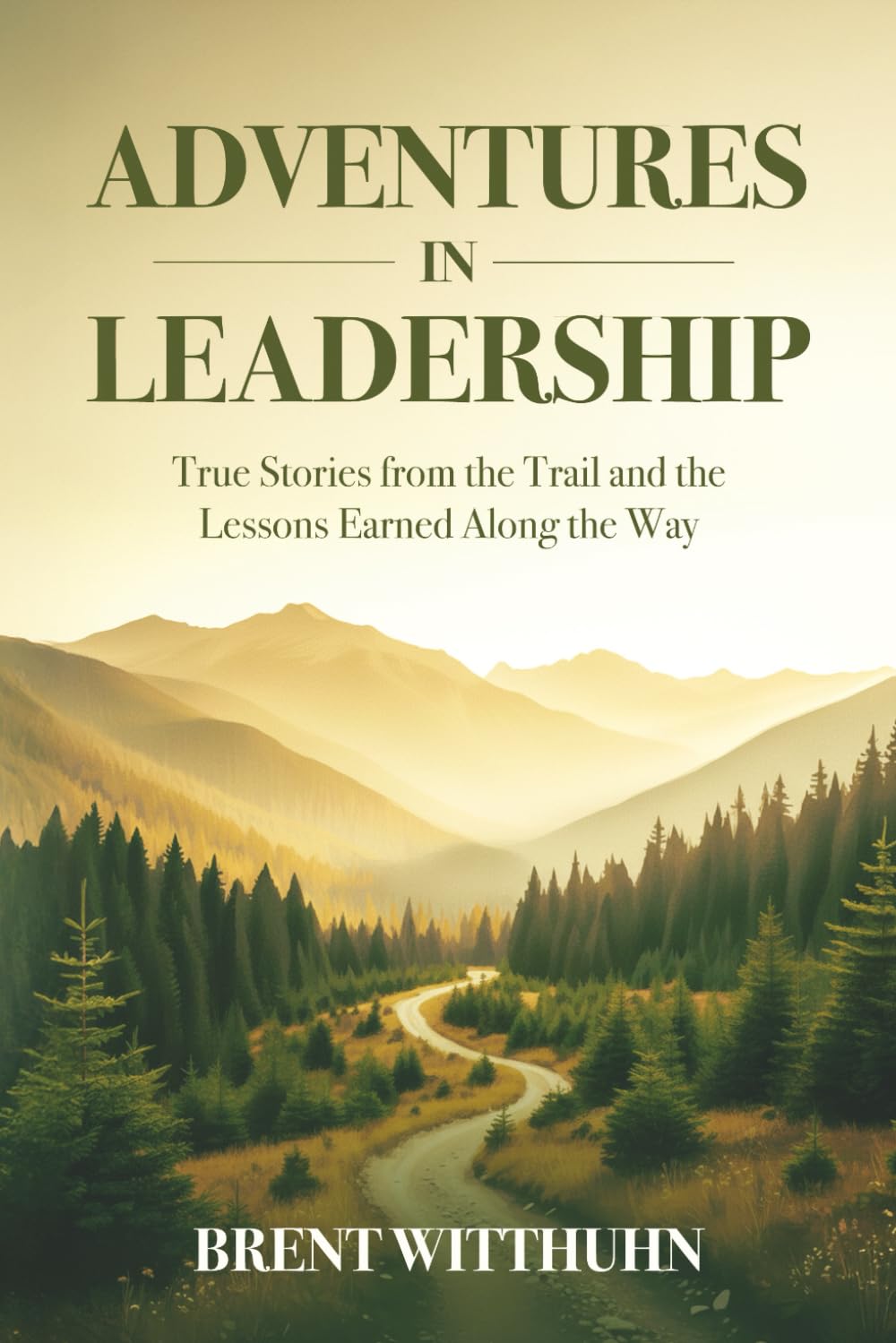
Adventures in Leadership is a short, clear-eyed book of leadership reflections built from outdoor misadventures, near misses, and hard-won moments of perspective. Brent Witthuhn structures it as a series of trail stories that turn into leadership lessons, so a wrong turn on the Buffalo River Trail becomes a meditation on admitting you’re off course, a freezing night in the Ozarks becomes an argument for preparing beyond best-case scenarios, and a tense river rescue becomes a case for calm, immediate action when someone is in real trouble. The governing idea is simple and sincere: leadership is less about authority than responsibility, less about appearing strong than staying present, steady, and useful when conditions turn.
What I liked most is that the book’s moral vision is earnest without feeling cynical or slick. Witthuhn returns again and again to humility, care, and attentiveness, and while those aren’t radical ideas, he gives them enough lived texture that they land. I found myself responding especially to the chapters where he resists the fantasy of the infallible leader. The scene where he realizes he’s wandered onto the Old River Trail, the Half Dome descent where a dehydrated hiker has to be helped down, and the story of trying to help novice backpackers without taking over all work because they expose the small vanities that leadership can hide inside. He’s at his strongest when he lets embarrassment, fatigue, and uncertainty stay on the page. Those moments give the book its credibility, and they also make it warmer than a standard business parable.
The writing has an easy, quotable cadence, and many chapters end with clean takeaways. The book has a predictable rhythm: vivid outdoor setup, distilled lesson, and practical challenge. That rhythm makes the book accessible. Some insights are genuinely sharp, especially the warning against reacting to imagined threats instead of facts, or the chapter on sunk cost disguised as commitment when the river was clearly signaling danger. I admired the plainspoken conviction of the book. It’s not trying to impress me with theory. It’s trying to tell the truth as the author has learned it, and that honesty carries real weight.
Adventures in Leadership is less a grand argument than a companionable field guide to character. It doesn’t pretend leadership can be mastered once and for all. Instead, it makes a modest, sturdy case that people remember who stayed calm, who shared the load, who told the truth when the map no longer matched the trail. I’d recommend it to new managers, team leads, mentors, coaches, and really anyone who prefers leadership writing with dirt under its nails and a little weather in its voice. It left me with the sense that the author means what he says, and that, in a book like this, matters a great deal.
Pages:75 | ASIN : B0GDJF3Q6V
It Is Not a One-Size-Fits-All

Becoming a Certified Six Sigma Master Black Belt is a comprehensive guide for aspiring Master Black Belts that reframes Six Sigma as a leadership discipline and equips readers to align strategy, build culture, and drive enterprise-wide improvement. Is Six Sigma ultimately a technical system—or a human one?
As the saying goes in improvement, “it depends.” The most effective practitioners understand that Six Sigma requires a balance: the emotional intelligence to lead people through change, and the technical capability to guide complex problem-solving. You can have the most elegant analysis in the world, but if people don’t trust it, understand it, or feel part of it, it won’t stick.
In our experience, Six Sigma is not a one-size-fits-all methodology—it’s a leadership discipline. It requires reading the situation, understanding the people, and adapting your approach accordingly. The tools matter, but it’s how you engage people in using those tools that ultimately determines success.
When most people think of Six Sigma, they often gravitate toward the technical aspects—the tools, the data, and the statistical rigor. But in practice, Six Sigma will surely fail if it doesn’t feel human.
You emphasize that improvement must connect to enterprise strategy rather than operate in isolation. Why do organizations struggle with that alignment?
In our experience, organizations don’t struggle with alignment because they lack strategy—they struggle because strategy doesn’t translate easily across the various levels of the organization.
Senior leaders may have a clear vision, but that clarity often breaks down as you move deeper into the organization – from senior leaders, to managers and directors, and eventually to team leads and operators (at the sharp point of the organization, closest to the customer). The major breakdown is that the strategy isn’t translated into meaningful lead measures or actionable tactics at the departmental and frontline level.
As a result, people are asked to “be strategic,” but aren’t given line of sight into how their daily work connects to the organization’s larger aspirations. Without that connection, improvement efforts become fragmented—teams work hard, but not always on what matters most.
That’s where Six Sigma can either add tremendous value—or unintentionally contribute to the problem. Black Belts have the capability to improve processes effectively, but they also have the responsibility to ensure they are improving the right things. When projects are clearly tied to strategic priorities, improvement becomes a driver of enterprise performance—not just isolated success.
The training sections emphasize application over passive learning. What are the most common failures in Six Sigma training programs?
The most common failure in Six Sigma training programs is that they prioritize knowledge transfer over behavior change.
Too often, training is designed as a one-time event—heavy on tools, concepts, and statistical theory—but light on application. Participants leave with binders full of content, but without the structure or support to consistently apply what they’ve learned in their day-to-day work.
In our experience, the goal of training isn’t just to teach people Six Sigma—it’s to change how work gets done. That only happens when learning is embedded into the work itself and supported by effective coaching and mentorship. Without those elements, Six Sigma training becomes an academic exercise. With them, it becomes a capability-building system.
With AI, automation, and data science evolving rapidly, how do you see the role of the Master Black Belt changing?
As AI accelerates access to analytics, modeling, and even advanced problem-solving capabilities, the technical barrier to generating insights continues to drop. What used to require deep statistical expertise is becoming increasingly automated and widely accessible.
Because of that shift, the differentiator for Master Black Belts is no longer “who can run the numbers.” That capability will be broadly available. Instead, the value is moving toward “who can help architect the system that uses the analytics to guide behavioral change and create competitive advantage.”
In this environment, the Master Black Belt evolves from technical expert to system designer. Their role becomes less about producing analysis and more about ensuring that insights are embedded into how work actually gets done—through leadership behaviors, standard work, and decision-making systems that turn data into sustained performance improvement.
In companies implementing Six Sigma, the role of Master Black Belt is to train, guide, and coach Black and Green belts to execute their improvement projects efficiently. In addition to this, Master Black Belts are often responsible for overseeing the organization’s entire improvement program with the ultimate responsibility for creating a robust culture of continuous improvement. Thus, the competence of MBBs is critically important for the success and long-term sustainability of Six Sigma in organizations.
This book is ideal for all those who wish to get trained and certified as Master Black Belts and train others to achieve breakthrough results using Six Sigma to shape and execute improvement projects. The book has the right balance between topics such as strategic planning, project selection, stakeholder management, and training design, to advanced statistical techniques such as propagation of errors, destructive measurement systems, general linear models and components of variation, and complex blocking structures in Design of Experiments. This book was written by three expert Master Black Belts certified by the American Society for Quality (ASQ). Moreover, they are from different parts of the world and industry, which brings great diversity to the contents of the book.
Becoming a Certified Six Sigma Master Black Belt
Becoming a Certified Six Sigma Master Black Belt is a large, serious study guide that tries to do more than help someone pass an exam. It maps the Master Black Belt role as both strategist and technician, moving from enterprise-wide planning, governance, project selection, and organizational culture into training, coaching, advanced analytics, DOE, DFSS, case essays, and a simulated exam. The book keeps insisting that Six Sigma at this level is not just about statistical fluency. It’s about building systems, teaching people, and translating strategy into disciplined action across an organization.
What I admired most is the book’s refusal to let Six Sigma become a sterile toolbox. Again and again, it pulls the reader back toward leadership, alignment, and the stubborn human realities of change. The Hoshin Kanri section captures this especially well. The idea that “red is okay” if targets are truly ambitious is one of those deceptively simple insights that lingers after the page is turned. That case study, with its weekly Hoshin meetings, X-Matrix discipline, and eventual sale of the company at 175% of the anticipated price, gives the book a welcome pulse. It reminds me that process excellence is never only about neat dashboards. It’s also about nerve, candor, and the willingness to look directly at uncomfortable signals without flinching. I also found the training chapters unexpectedly strong. Their emphasis on application over passive instruction, and on coaching as the bridge between classroom learning and real work, gives the book a humane center.
The book is dense, often deliberately so, and sometimes reads more like a well-stocked reference shelf than a continuously shaped argument. That breadth is valuable. There are moments when the writing feels utilitarian, especially in the more technical sections on measurement systems, nonnormal capability, nested ANOVA, simulation, reliability modeling, and DOE. Still, even there, I found myself respecting the ambition. The authors are trying to honor the full sprawl of the body of knowledge, and the result is a book with real heft. I also liked that the later DFSS material does not simply repackage DMAIC for everything under the sun. By distinguishing improvement from design, then moving into QFD, TRIZ, axiomatic design, and the pressure cooker example, the book quietly argues that quality thinking should begin before defects ever appear. That’s an idea with more philosophical force than the book sometimes lets on.
This isn’t a breezy business book. It’s rigorous, exhaustive, and often genuinely useful, especially when it connects methodology to judgment, culture, and coaching. I’d recommend it most strongly to serious Six Sigma practitioners preparing for Master Black Belt certification, to Black Belts ready to widen their view beyond project mechanics, and to operational leaders who want to understand how improvement work is supposed to connect to strategy rather than float beside it. For the right reader, it will feel less like a manual and more like a hard-earned apprenticeship in how improvement actually lives inside an organization.
Pages: 372 | ASIN : B0DWKX7S41
Literary Titan Gold Book Award: Nonfiction
The Literary Titan Book Award recognizes outstanding nonfiction books that demonstrate exceptional quality in writing, research, and presentation. This award is dedicated to authors who excel in creating informative, enlightening, and engaging works that offer valuable insights. Recipients of this award are commended for their ability to transform complex topics into accessible and compelling narratives that captivate readers and enhance our understanding.
Award Recipients














Visit the Literary Titan Book Awards page to see award information.


