Blog Archives
Ancilla: Master, Teach Me
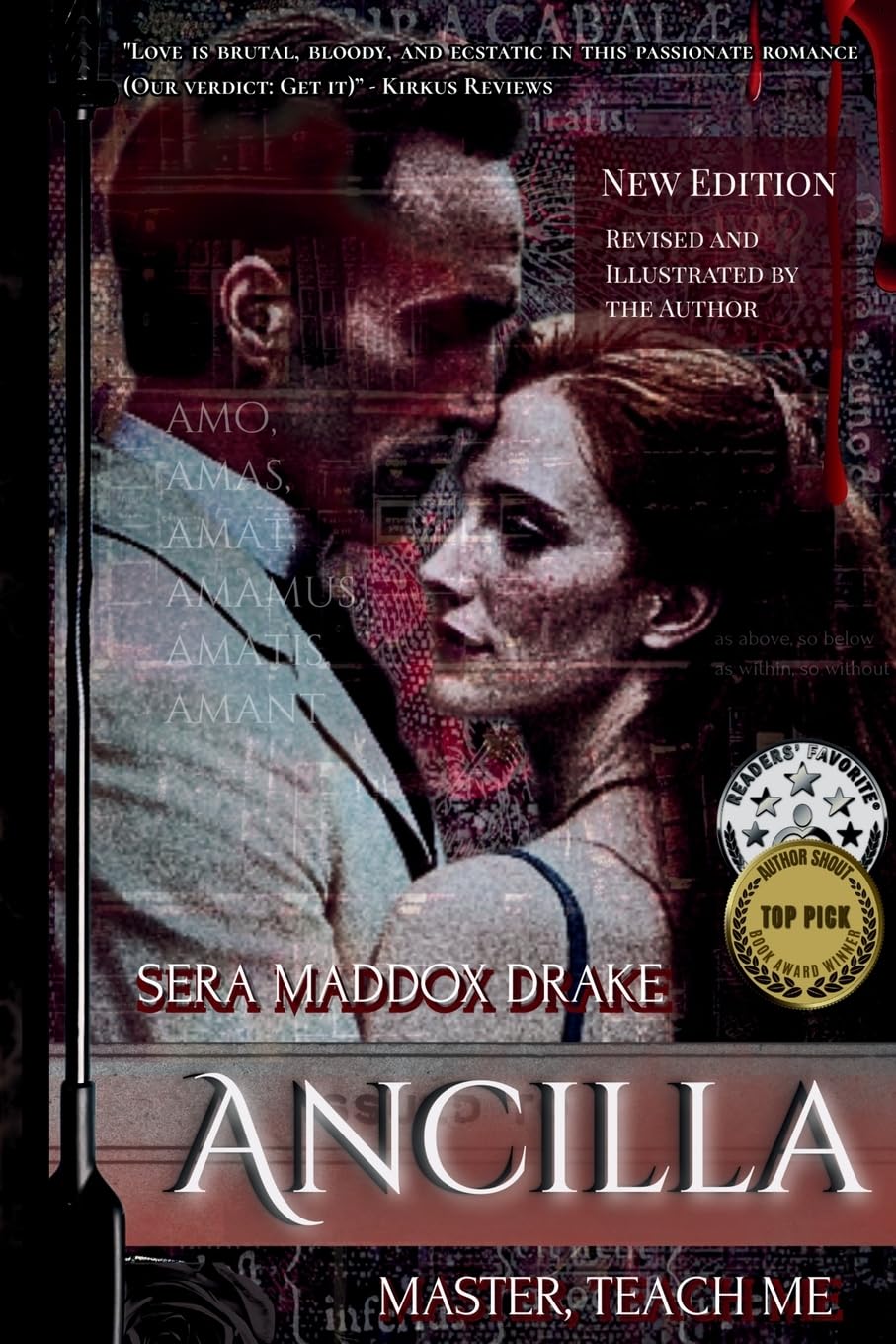

Sera Maddox Drake’s Ancilla: Master, Teach Me is an occult, sexually explicit BDSM romance that tracks a bisexual woman in late-80s to mid-90s Rust Belt Ohio as she unravels a strict sedevacantist Catholic upbringing and stumbles into a relationship with a charismatic magus who becomes her mentor, dom, and soulmate. The story is built around Western esotericism (Thelema and Golden Dawn style Kabbalah), and the chapters are explicitly organized around the Tree of Life sephiroth, with each section acting like a rung on a ladder of transformation rather than “just” a new plot beat. Along the way, the book leans into edge play and on-page sex, plus harder emotional material like food insecurity, chronic pain, vampiric starvation that mirrors depression, and moments where the protagonist gets close to the cliff of suicidal thinking.
What landed for me first was the author’s directness about what the book is and what it is not. The content warnings are frank in a way that feels almost like Drake is taking you aside before you enter the room, making eye contact, and saying, “This gets intense.” That honesty gave me trust, especially because the erotic material isn’t treated as a naughty bonus but as part of the protagonist’s learning curve. Sex here is not a fade-to-black reward. It’s language. It’s ritual. It’s also messy, risky, and sometimes emotionally heavy, which fits the “mentor/dom/soulmate” setup the author spells out early in the narrative.
I also kept thinking about the author’s choice to foreground the moral complications of the spiritual framework itself. Drake doesn’t pretend Western esotericism is clean or culturally neutral, and she names the colonial “cafeteria” dynamic head-on, including the way the characters “loot and pillage” ideas from oppressed cultures. That doesn’t magically resolve the tension, but it does change the feel. Instead of the book asking me to admire the system, it asks me to watch people reach for meaning through a flawed system, sometimes sincerely, sometimes blindly. The Tree-of-Life chapter structure reinforces that. It’s as if the author is saying: growth can be real even when the tools are imperfect.
By the end, I felt like Ancilla is best approached as dark, reflective erotic romance with occult and paranormal undertones, not as a tidy love story or a neutral “intro to magic.” If you like intimacy that’s explicit and psychologically charged, and you’re also curious about spirituality, power exchange, and the way belief can reshape a person for better and worse, you’ll more than appreciate this story.
Pages: 440 | ASIN : B0GLLRBK55

The Duel


The Duel follows Johab, an enslaved rice grower and root doctor in 1770s Carolina, whose gift for medicine and spirit-work keeps pulling him into other people’s peril. When rebels torch the Loyalist plantations, Johab is torn between saving chained strangers and protecting his own wife Oriza and their son Adam, a choice that sends the family scattering across the Lowcountry and into the orbit of the Toombs brothers, August and Oliver, whose feud culminates in the rainy, haunted duel that gives the novel its title. From the burning rice fields to a desperate crossing through storm-flooded marsh, and finally a hard-won journey with Adam toward refuge in the Muscogee valley, the book braids escape, grief, and quiet acts of resistance with moments of the supernatural, including a luminous epilogue where love briefly bridges the worlds of the living and the dead.
I felt most gripped by how embodied this book is, rice chaff in the air, sweat and river mud on skin, the weight of shackles and the ache of a splinted leg. Even the magic has texture: Johab’s confrontations with a boo hag and other spirits aren’t airy fantasy; they’re smoky, bone-deep episodes that leave bruises and blood behind. The duel itself, with Johab holding out the pistols like a midwife presenting a newborn while August quietly turns spiritual power into a last, sly weapon, manages to be both suspenseful and strangely intimate. I came away feeling that the “duel” is less a single event and more a lifelong contest between mercy and survival, faith and fury, in every choice Johab makes.
I also appreciated that the story refuses to flatten its characters into symbols. Johab is a healer who sometimes chooses the wrong patient; Oriza is both fierce protector and a woman carrying unspeakable violation; Adam grows from frightened child into someone who can shoulder grief without becoming brittle. Even among the white characters, evil isn’t one-note: Oliver is monstrous, but August is compromised rather than simply redeemed, and Elizabeth’s calculations about land, love, and safety feel chillingly pragmatic. The spiritual closing vision with Oriza and the twins could have tipped into sentimentality, yet it landed for me as something quieter, a benediction that doesn’t erase what came before but lets the living keep walking.
I’d hand The Duel to readers who seek historical fiction, Southern Gothic, and a touch of magical realism that grows organically from African and Gullah Geechee traditions rather than being pasted on. Fans of Colson Whitehead’s The Underground Railroad or the haunted interiority of Toni Morrison’s work will recognize a similar mix of brutality, tenderness, and the uncanny. This is a book for anyone who wants a slavery narrative that honors terror and beauty in the same breath. The Duel is a storm-lit story of bondage and belonging, where every act of love is its own quiet revolt.
Pages: 249 | ASIN: B0FNT2HCPV
Fiction Became My Canvas

Song of Hummingbird Highway follows a wounded woman who journeys from Michigan to Belize, where myth, music, and motherhood force her to discover her own strength and truth. what was the inspiration for the setup of your story.
The inspiration connects to the universal arc of pain to empowerment—an evolution I’ve lived and continue learning. I carried physical and emotional wounds for years, clinging to resentment like pennies in a purse, their weight familiar, even comforting. Then I understood what Nelson Mandela meant: “Resentment is like taking poison and hoping your enemy will fall.” It serves no purpose except to weaken resolve.
For an instant, I considered writing a memoir, but fiction became my canvas—a space where my characters could teach me what I needed to understand about releasing what no longer serves us. Terri’s journey from pain to empowerment unfolds through learning to trust her own strength and believe in authentic connections that tell a story. Redemption isn’t dramatic; it’s simply making better choices about viewing the challenges we face.
I’d traveled to Belize years earlier and felt something shift when I heard Garifuna drums for the first time—not a soundbank from a midi drum machine, but the real thing, played by people for whom rhythm is prayer. Those drums stayed with me for decades, insisting I tell this particular story about a woman who needed what I’d discovered: that transformation requires stepping into unfamiliar territory where we can finally hear ourselves clearly.
What drives the story’s heart: myth, music, and motherhood aren’t manufactured calculations—they’re driven by the human pulse. I wanted to create something structurally innovative—a novel where 100+ carefully curated songs aren’t just soundtrack but architecture, where each of 30 chapters opens with original black-and-white photography that functions as visual meditation. Musical notes paint pictures in our hearts, creating immersive experiences that bridge the gap between what we feel inside and what we can express.
Like the authentic connections I nurture with people I meet, Terri’s journey mirrors that search for genuine resonance. The drums of Belize don’t just provide a soundtrack; they become a language for emotions she’s kept locked away, each note a key turning in a rusted lock. The setup pairs internal wounds with external displacement—Michigan represents everything familiar but confining, while Belize offers spiritual traditions and sacred spaces that don’t require her to be anyone she’s been before.
Terri longs to be truly seen, yet struggles to trust herself. What drew you to that emotional tension?
That tension between visibility and trust fascinates me because it’s fundamentally incongruous—we can’t be truly seen until we trust ourselves enough to show what’s real, but we can’t build that trust without being witnessed. It’s a cyclic sequence most of us repeat unless we reframe our perspective.
I rarely think about my childhood—instead, I feel like I was plopped into adult life at seventeen. Like Terri pointing at the Caribbean on a map, I picked Long Beach, California with five hundred dollars in my pocket and the dreams of writing a book someday. That early leap taught me about the courage it takes to follow your heart before you fully trust it.
For a long time, I allowed others to judge me, steer me, always trying to change myself to please them. It took me years to gain the confidence to listen to my own heart, to love myself, to function from a place of strength rather than constant accommodation. I wanted to write a character who couldn’t articulate her own desires because she’d spent so long performing. Terri knows something is missing, but she doesn’t have language for the absence.
That’s where music becomes essential to the narrative structure. The 100+ songs curated throughout the novel speak what Terri cannot yet say aloud. Strength is ours to keep or give away—we choose whether to take responsibility for our own choices or hand that authority to someone else. We all own our power, like choosing which song to play after a hard day.
The technical challenge was showing Terri’s evolution without spelling it out, trusting readers to recognize the shifts. Early chapters include songs about escape and longing. Later, the music transforms, becomes grounded, rooted, rhythmic rather than melodic. The music evolves with Terri becoming the language she finally trusts.
Writing this book in the early mornings and weekends over three years, some mornings Terri refused to cooperate. She’d make choices I hadn’t planned, reveal vulnerabilities I found uncomfortable. That’s when I knew I was writing someone real—someone wrestling with the same question I was: What is my truth? Terri’s quest taught me that we get to decide which melody defines our lives.
Ancestral voices, Mayan cosmology, and ritual appear through the book. How did you research and approach these traditions with care?
Throughout my life, I’ve been drawn to spiritual texts like a compass needle finding north—the Bible, The Four Agreements, The Power of Attraction, Apprenticeship with a Maya Healer. As a young adult, I fell in love with Caribbean folklore, particularly the stories of Anansi the spider. He’s not so different from Brer Rabbit and that’s when I understood: I’d rather focus on what we share than what divides us.
I deeply love and respect the Belizean people who welcomed me into their homes and lives, who shared the beautiful, intricate aspects of their culture. I traveled to Belize grieving and felt something shift when an elder from Hopkins shared his wisdom of the earth, the plants, the ancestors. I heard Garifuna drum rhythms that stayed with me, insisting I tell this story.
When I approached the magical realism sections, I researched meticulously, anchoring fictional possibilities in documented truth and fact. The story required three years of cultural research with Mesha Steele, a Belizean-born cultural consultant, songwriter and music educator, because I strove to capture a glimpse of the depth of Belizean spiritual traditions, as anchors and beauty, not as decorative elements.
At the book’s end, there’s a bibliography and references section that I insisted on, even though my publisher said fiction doesn’t require one. I wanted readers to know I respected these cultures enough to attempt to truly understand the complexities of this diaspora, I categorized 245 references by cultural elements, images, poems, lullabies, books, hymns, songs and television shows.
Cheryl L. Figueroa-Noralez, president and founder of Garifuna-American Heritage Foundation United, read my book cover to cover and caught inaccuracies that needed to be revised. Those corrections mattered more than any other editorial feedback because they protected the integrity of communities that trusted me with their stories.
I walked everywhere with a pen and notepad, talking to people, really hearing their stories—not just waiting for my turn to speak, but listening to the rhythm beneath their words. The characters developed and grew the same way I did while writing: by paying attention to voices that have been singing long before we arrived.
What do you hope lingers with readers after the final page?
Hummingbirds represent optimism and hope, their wings beating seventy times per second, creating a hum that sounds like possibility itself. But Song of Hummingbird Highway doesn’t offer neat resolutions because transformation rarely works that way. Instead, I hope readers will sit with discomfort: What would it cost to walk away from everything familiar? Can we trust our own hearts when they lead us somewhere terrifying?
While writing, I spent time with all of my characters—loving them, painting their strengths as well as their flaws. Nothing is black or white in this story. I saw each character as both champion and victim in their own ways, making choices that felt right in the moment even when those choices caused harm. I love that complexity that makes us human.
What I hope lingers is the music and the art. The songs embedded in chapters create an accompaniment that extends beyond the page. A soundtrack not driven by algorithm, but by heart. Music that transcends eras, encouraging readers to replay scenes in their minds with their own emotional rhythm attached. Drums and funky beats speak what words alone cannot, building bridges between us—much like the 30 photographs that open each chapter, visual meditations in black and white rag paper, revealing conviction about our innate wisdom, and the imagery of nature revealing who we are and who we’re becoming.
I dream that in a hundred years, someone could pick up Song of Hummingbird Highway and walk alongside Terri as she discovers something essential about herself in the most unexpected places. That they’ll understand the courage to step into unfamiliar territory and listen to what they find there.
The words that capture this story are journey, connection, truth. Not destinations, but the path we take. Not easy answers, but genuine curiosity, questions we’re brave enough to ask ourselves.
Always ending with my signature question: Are you creating?
Author Website
When her son vanishes, Terri, a woman with more bravado than self-esteem, must navigate betrayal, sacrifice, and deadly secrets-or lose her child to forces she doesn’t understand.
To find him, she must track her son through folklore and mysterious cenotes, guided by music that connects past wounds to future healing. In a journey where maternal love becomes the most dangerous magic, she discovers a powerful truth: Pain can become her greatest teacher.
From Los Angeles to Belize’s sacred caves, Song of Hummingbird Highway explores how love, loss, and a mother’s fierce resolve converge into a story as intricate and luminous as the music that inspired it.
Lab Rat (Chronicles of Avilésor: War of the Realms Book IV)

In Lab Rat, author Sara A. Noë drops readers into Cato’s head the way the story drops Cato into captivity: abruptly, violently, with the taste of metal already in my mouth. He wakes bound inside a closed truck bed, is delivered to the underground Agency of Ghost Control, and gets reclassified as “Subject A7,” a “half-breed” anomaly whose powers can be forced on like switches. The book’s early movement is a gauntlet, chemical “Detox,” electrical testing, and surgically implanted ports, before Cato lands in Project Alpha’s cages beside other young prisoners (Ash, Jay, RC, Finn, Reese) and the feral, feared A6, while a larger prophecy thread hums in the background: seven and eight, roles and fates, pieces being placed whether anyone consents or not.
My first reaction was physical. Not “oh wow” physical, more like clenching-my-teeth, shoulders-up-by-my-ears physical. The prose leans into sensation with a kind of unblinking stamina: the “Detox” sequence reads like a ritual of dehumanization dressed up as procedure, and I kept noticing how often Cato’s dignity is treated as an inconvenience to be managed. When the story escalates to the port implantation, drills, the cold ring, the doctor who refuses the comfort-lie of “you won’t feel a thing,” I found myself admiring the author’s nerve even as I wanted to look away. It’s body-horror with a bureaucratic clipboard hovering nearby, which somehow makes it worse.
Alpha isn’t just a scary room; it’s a system that tries to “unname” people, sanding them down to numbers and compliance. That idea, identity as contraband, is what gave the brutality a point beyond shock. And then there’s Ash: her quiet endurance, the way the others speak around her pain because naming it out loud would re-open the wound, and the night-raid scene that is written to disgust rather than to titillate. The book’s tenderness arrives in odd places, like a stolen conversation with the holographic system ECANI, or Cato insisting on names instead of serials, and those small mercies felt hard-won.
Lab Rat is for readers of dark fantasy, paranormal fantasy, dystopian science-fantasy, and YA-adjacent captivity/escape thrillers, especially anyone who wants a morally ugly villain structure and a stubborn ember of found-family refusing to go out. The premise gave me flashes of The Institute by Stephen King, kids turned into “subjects,” cruelty rationalized as research, but Noë twists it through ghost physiology, Divinities, and prophecy math until it feels like its own bruised mythology. Lab Rat explores the cost of being remade by force and how a name, spoken, claimed, and defended, can be a kind of escape.
Pages: 460 | ASIN : B0G4SXMQ6C

Shinbone Lane

Shinbone Lane is a work of magical realism set in 1970s San Francisco, following sixteen-year-old runaway Maddy as she stumbles into a pocket of the city that feels almost hidden from time. Taken in by warm-hearted Clara and her neighbor Ted at 346 Shinbone Lane, Maddy finds herself surrounded by artists, misfits, and dreamers, watched over by Captain, a vividly colored, opinionated pigeon with a spring for a foot. As she settles into this found family, the lane’s history starts to surface: a bitter neighbor whose daughter vanished, a house that seems to reconfigure itself, a ripple tree that hums and shimmers, and secrets that tie the past and present together until they converge at the annual Shinbone Fair, where healing and reckoning arrive side by side.
Reading it, I kept feeling like the lane itself was the main character. The magical realism sits lightly on the story, but it is everywhere, from the impossible backyard at 346 to the soft chiming of the ripple tree’s heart-shaped leaves and the way Captain quietly nudges people toward wiser choices. Laura McHale Holland writes San Francisco with such affection that I could almost smell the mix of diesel, ocean air, and bakery sweets, especially when the scent of those famous Star Bakery scones with their butterscotch maple glaze drifts up the hill. The choice to juggle many points of view, not just Maddy’s but also people like Clara, Lark, Eloise, and others, gives the book that classic ensemble feel you often get in community-centered magical realism.
What stuck with me most were the emotional currents under the whimsy. This is magical realism, but the magic never erases how hard it is to be human. You feel Maddy’s hunger for safety after months on the road, Lark’s bruised self-image as she compares herself to every woman who passes beneath her window, and Eloise’s grief curdling into control and cruelty as she clings to the idea that her missing daughter must be close by. The book does not shy away from darker turns, including violence and betrayal, or from the way people can exploit each other while insisting they are acting out of love. At the same time, there is a steady thread of resilience that feels very much in line with women’s fiction: characters keep getting knocked down, then choosing, sometimes shakily, to reach for connection again. I appreciated that the magic, whether it is a talking pigeon or a mysterious flute sending shimmering mist across the hillside, mostly amplifies what is already in the characters instead of fixing their problems for them.
By the end, I felt like I had been invited to a long, slightly chaotic block party where people sing show tunes off key, argue about renaming the street, fall in and out of love, and still manage to show up for one another when it really counts. The book sits comfortably in the genre of magical realism with a strong blend of historical and women’s fiction, and I think it will land best with readers who enjoy character-driven stories, found family, and a city setting that feels almost like a living spell. If you are up for wandering a strange little lane in 1974 San Francisco, listening to a wisecracking pigeon and a singing old house while a group of wounded people figure out how to be kinder to themselves and each other, Shinbone Lane is a very satisfying place to spend some time.
Pages: 324 | ASIN : B0F5N6Y2X4
A Beautiful Direction

Hug Whispers Between Worlds follows a stalled 28-year-old man who drifts between self-doubt, family pressure, and a difficult love relationship until he meets a gnome who helps him face hard truths. What was the inspiration for the setup of your story?
Current events. I was in the business world, and I empathise with what the twentythirty-year-olds are going through. College for four years and all of a sudden they’re back to the starting gate because of AI–a difficult situation for sure, but not insurmountable.
Did you imagine this novel as magical realism from the beginning, or did the magic emerge naturally as Tim’s story took shape?
It really just happened. I remember writing the outdoor bonfire scene and thinking, “Now what?” And thoughts of Tim going near the water by the dock and finding a waist-high Gnome named Hug just seemed to make sense. It just took on a beautiful direction.
The family scenes feel uncomfortably real for many readers. How important was it to capture that quiet emotional tension?
I lived it too, so I can understand. It was one of the keys because that’s why Tim was so hyper-focused on changing his situation. This is the first of, at least, three books, so you will see how all of this plays out. Very exciting!
What do you hope readers feel when they close the final page?
Feel good. There is enough bad stuff going on now, I don’t want to contribute to it. I always want to leave the reader uplifted and hopefully provide a change in perspective about their current situation. Tim had the motivation all along; all he needed was someone, or a Gnome, help him look at his situation a little differently. That’s when the magic happens!
The Love For Truth

PHOENIXA: THE NEST is a story blending history and fantasy and follows a spirited girl growing up in turbulent time in China’s history. Where did the idea behind this novel come from?
I AM PHOENIXA. PHOENIXA: THE NEST is my personal, lived history, and a passionate initiation of dialogue between myself, my grandfather, and my ancestors—whose connection to me was, in essence, cut off by politics and by time. PHOENIXA: THE NEST can be viewed as a bioepic, in which a real-life story is elevated to mythic, historic and moral significance. I was born and raised in Beijing in Mao’s China, and with only a small dose of private education from my family- one that had been essentially torn apart – I was able to somehow survive the very sweet, sugar-coated terror of collectivism and brainwashing. I am eternally grateful to the motherland that has nurtured me. Yet there is something greater than the love for your motherland, that is the love for truth – truth that lies beyond familiar borders and comfort zones.
The idea behind this novel came from my midlife cry for roots. After leaving my job as a CCTV anchor/journalist in the late 1980s, and living an adventurous, self-exiled life in the United States for two decades, I grew increasingly restless, uncertain of who I was, or what—or where—home truly meant. After a willful search for Cheng family history – I stumbled upon my grandfather’s name – one that my father had hidden all his life, one that struck me like lightning: Cheng Zhenjun 程振鈞, a western-educated Chinese pioneer and leader who died on duty in 1932, advancing China’s modernization. In that moment, I trembled, shocked by the magnitude of family drama as well as the voice of history itself—muffled, suppressed, and long silenced. I felt betrayed, lied to by omission. Someone—or something larger—had cut off my roots, my very source of becoming.
I picked up my pen and my camera. What followed was more than a decade of research into the life of my grandfather and the forces that shaped him into a hero and a martyr, I have traversing not only the physical terrain of China, but also the inner fabric of Chinese civilization including Chinese mythology. Here you are, PHOENIXA: THE NEST, the first in PHOENIXA trilogy.
Looking back, I’ve come to realize that I paid a dear price to preserve my naïveté, my idealism, my conscience and, ultimately, my freedom as an individual human being. I am so thrilled today that I am now able to share “the pearl of life “with you – formed over the course of my entire life, but cultivated into shape in the solitude of the three-year COVID lockdown. I feel I have been metamorphosed through creating PHOENIXA and reinventing myself as an author and mythic thinker— and I hope my readers will be too, through reading and listening to this novel ( yes, as an audiobook, too), through pursuing something truly meaningful, something that allows each of us to make a contribution to this troubled yet beautiful world.
What is it that draws you to this period in history?
The dominant narrative throughline centers around PHOENIXA’s life inside CHENG COURTYARD during the onset of the Cultural Revolution in 1966 — echoes of which a careful reader will recognize not only in today’s China but also other parts of the world. It is the violent nature and its insidious chain of indoctrination that I defy, and from which we must break free; PEACE – world peace – must begin with inner peace. But how does one attain inner peace as an individual? Let the ancient wisdom of Chinese sages guide you. The novel detours into, and occasionally references, several sub‑timelines, each designed to illuminate the depth of Chinese culture, history, and philosophy, which runs at the core of Cheng values and education. Some explore the dynasties and the Enlightenment of the early twentieth‑century Republic of China; others drift into the timeless, fantastical realms of the Chinese Phoenix and other magical beings. My hope is to lift the spirits of readers, guiding them to navigate this troubled world. Glide with me, and soar on the wings of a child’s imagination!
What was your writing process to ensure you captured the essence of the characters?
As the Cheng family historian, I have devoted years to meticulous research on my grandfather’s life—his struggles, his achievements—and the tumultuous era he lived in: China at a crossroads in the late 19th and early 20th centuries, transforming from a wounded, fragile imperial dynasty into a young, hopeful, and vigorous Republic. I am fortunate to read both simplified and traditional Chinese, as well as classical Chinese. I have delved deep into the layers of centuries, savoring the flavor and absorbing the nutrients of Chinese antiquity. My research will continue across China, the United States, and soon, Europe, in preparation for the PHOENIXA Trilogy.
Writing, to me, is confessional and a deep act of soul-searching—therefore, an act of courage. You cannot lie; you must lay yourself bare in order to connect with, and perhaps even be rescued by, a higher power—be it your ancestors, a guardian angel, or God.
Can fans of PHOENIXA: THE NEST look forward to a follow-up soon? Where will it take readers?
Yes, I have created my life’s work and brand: PHOENIXA or P.H.O.E.N.I.X.A. Each acronym has its distinct meaning. please discover yours and share with me.
Here is the PHOENIXA Trilogy: THE NEST, THE FLIGHT, and THE RETURN.
From the enchanted childhood and coming-of-age in tumultuous China in PHOENIXA: THE NEST, to the evocative youth odyssey in America in PHOENIXA: THE FLIGHT, and onward to her middle-age return confronting the dark fate of Cheng Courtyard and enacting a Cheng ancestral resurrection, Cheng continues her bioepic fantasy storytelling deeply rooted in her intimate personal adventure and the unflinching history of China.
Author Website
A Mystical Quest for The Cheng Legacy
A novel
by J.J. Cheng
Phoenixa, rising from the ashes of her ancestors, the six-and-half-year-old kite-flying, Phoenix-riding, Chinese girl embarks on a mystical journey into China’s tumultuous past searching for her Renaissance Grandpa who read her Shan Hai Jing, The Lore of Mountains and Seas, seeking cures for human greed.
From the interior of a traditional Beijing courtyard to the tip top of a giant Wu Tong Tree, Phoenixa found her nest being moved from safety to danger. Fortunately, the enduring incandescent Feng Huang, the Phoenix, has kept her amused and protected as a secret guardian from a relentless hidden Red force ready to strip her home bare.
Written in the genre-defining style now called“mystical realism”, Cheng tapped into the subconsciousness and beyond in search of human goodness. Cheng’s debut novel is stunningly visual, fantastical, dreamlike yet achingly real, demystifying China, as it offers a luminous insider’s view on why and how the dragon roared.
Phoenixa: The Nest, A Mystical Quest for the Cheng Legacy, is a story of courage, of hope, of madness, of redemption, of humanity at the brink of self-destruction.
From Misfit to Mastery

Shamaness: The Silent Seer follows a young girl born mute but also psychic, who, despite a childhood filled with cruelty, grows into a powerful shamaness. What was the first image or moment that sparked this story for you?
I literally dreamed the story of Kreya, the psychic but mute girl whose destiny takes her on a journey from misfit to mastery. Start to finish, including the main characters and events! It’s the only time that’s happened to me, and it took years after that dream to craft the story.
The shamanic teachings unfold slowly, almost as if the reader is being trained alongside Kreya. Was that intentional?
Yes. In high school when my classmates were exploring psychedelics, I was hunkered down on the floor of the dusty stacks at the local library, reading about ancient cultures and healing traditions. I wanted to share those traditions and beliefs in a way that makes sense for today’s readers. As a corollary, I also teach yoga:).
Kreya’s grandmother’s “rainbow voice” is a striking image. How do symbols like that function in your storytelling?
As a clinician working with individuals of all ages and brain-based conditions, I came to appreciate the role of multisensory experience and understanding. I perceive people in five senses! For me, sounds can inspire colors, just as sights can inspire physiological responses smells inspire memories. Amma’s presence seemed to me like a rainbow, so her speech carries that aspect.
You frame the novel between Kreya’s childhood and her sixtieth summer. Why was it important to tell the story from both ends of her life?
I rewrote the story three times, experimenting with different beginnings/endings and timelines. My wonderful critique partner read the second one and told me to “shred this and start over.” It was the best advice! I realized that the reader needed to know from the beginning that Kreya would not be defeated, that her future was solid.
Author Links: Facebook | Website


