Blog Archives
A Necessary Journey

Why: Earth 2278 follows a general and his inner circle as they engage in a global conflict, and they question the motives of the people in charge of their controlled society. What was the inspiration for the setup of your story?
In the history of Earth, humans have always had a tragic past. The abuse of power has resulted in many millions of innocent lives lost, from the time of the caveman until now. It is called war, and the heartfelt pain resulting in conflicts around the globe. I hope the readers do not dwell on the painstaking decisions of Butch Sweeney but find his pain worthy of hope and a necessary journey.
My family and I spent hundreds of hours traveling to my daughter’s sporting events, and my daughter and I spent time on some trips talking about Earth 300 years into the future. In retirement, I decided to write a futuristic novel that was centered on a military backdrop. Using my degree in marine engineering, it was gratifying to create a futuristic civilization in the thought-provoking world of Sci-Fi.
What is the most challenging aspect of writing science fiction? The most rewarding?
Being an engineer, the most challenging part was proper grammar and sentence structure. I loved creating characters and blending them into a futuristic society. The Sci-Fi part was fun to create and rewarding. I was surprised to find how passionate I became in writing Sci-Fi. This week, when I finished my final approval with the production team for the interior and cover of Why: Earth 2278, it was a testament of a three-year project becoming a reality. I have to say that was my biggest reward.
As any author will tell you, the reward is for the reader to find joy in their work. This is why I write.
Do you have a favorite scene in this novel? One that was especially satisfying to create?
When Butch squares off with his friend Grouch, it is a scene of consequential significance to have to fight your comrade. This moment in Why brings an unfathomable conscience to live with. The tough burden on a man trying to resolve Earth’s future for its people.
The satisfaction in this scene was to embed deep-rooted feelings of a man shouldering the entire planet, Earth. A man in power must have a conscience to achieve greatness.
What is the next book you are working on, and when will it be available?
I have started Where: Earth 2280. It should be completed in a few months. Hope to launch my second novel in 2027.
The Dog Pack Series will be, for now, a trilogy. The backbone of any good novel is the intertwining of solid characters. The Dog Pack is this backbone.
Author Links: GoodReads | Facebook | Instagram | TikTok | Website | Amazon
Why: Earth 2278


Why: Earth 2278 is a military science fiction thriller about a future Earth run by the Union, where order is kept with ruthless clarity, and where the people in charge are starting to look a lot like the monsters they claim to prevent. It follows Butch Sweeney, the Union’s top general, as he watches the system strain under rebellion, resource theft, and creeping corruption. The opening drops you straight into that reality with a public execution and the chilling logic behind it: “You kill, you die.” From there, the story widens into a global conflict where Sweeney and his tight inner circle, the Dog Pack, start asking the most dangerous question in a controlled society: what if the “stability” is the problem?
I enjoyed the book’s commitment to momentum. It’s written in a direct, boots-on-the-ground voice that feels like someone briefing you after a long night, still keyed up, still running on duty and adrenaline. The tech details (smart suits, ships, surveillance, AI systems) are delivered with a kind of matter-of-fact pride, like the hardware is part of the characters’ identity. And then you get these tonal pivots where the Dog Pack starts cracking jokes, swapping nicknames, and needling each other. It humanizes them fast. Sometimes it’s crude, sometimes it’s funny, sometimes it’s both, but it does what it needs to do: it makes their bond feel lived-in, not just declared.
Under the action, the idea engine is pretty clear and kind of unsettling: a system built to stop humanity from repeating its worst habits can quietly become the thing that traps people in them. The book lays out how the Union was designed as a streamlined alternative to old political chaos, and then shows how Thomas Kraft twists it into something close to a dictatorship, even extending term limits to keep control. That thread felt more interesting to me than the pew-pew parts, because it’s not abstract. It’s procedural. It’s the small levers. And when Sweeney starts running out of “clean” options, the story doesn’t pretend there’s a painless fix. It basically admits, through him, that every path forward leaves bruises. Even the romance with Eva lands in that same messy place, tender in moments, but always under the shadow of the bigger war machine.
By the end, the author commits to the “thriller” promise: escalation, damage, and a clear setup for what comes next, with an epilogue that puts a target on Sweeney’s back and makes the conflict personal at the highest level. I’d recommend this most to readers who like military sci-fi that mixes chain-of-command politics with big combat stakes, plus a squad dynamic that leans on loyalty and gallows humor. If you’ve enjoyed the tradition of Starship Troopers or the forward-driving, high-stakes feel of Red Rising, this will probably hit a similar part of your brain, even though Hill’s voice is more blunt and conversational than stylized.
Pages: 254 | ASIN : B0GB3ZSSHS

Man Against the Universe

The Call of Abaddon follows a gifted young scavenger on a crumbling, post-apocalyptic Earth who is attacked by an ancient alien obelisk, triggering a surge in his dormant psychic abilities. What was the inspiration for the setup of your story?
Thanks for the interview and for the thoughtful questions. The genesis of The Call of Abaddon goes back many years, through countless drafts and title changes.
The initial spark was Jason himself. I had a dream when I was younger about a guy (someone like me) using the power of his mind to fight something dark and terrifying. Obvious inspirations would be Luke Skywalker, Neo, Beowulf, and others. That darkness took many forms as the story evolved—from extradimensional demons (like in Doom or Warhammer) to biological zombie plagues—but eventually coalesced into the Abaddon Beacon obelisk. I did get my “zombie plague” in the form of the Nanophage, but it’s far more complex than a simple virus and will continue to (literally) evolve in future books, as Abaddon seeks revenge for Jason’s unexpected, hail-Mary-level victory at the end of Book 1.
The rest of the cast and world grew over years of development, both visually and on the page. In other interviews, I’ve mentioned some external inspirations—like a friend who started writing and a student teacher who gave me a massive sci-fi reading list in eighth grade—but the true origin of the story was always Jason. He began life as a bit of a power fantasy for me, but over time, Jason matured into something far more complex and mythic. Honestly, I think all my characters grew up as I did, which is why I’m glad I waited this long to publish. Great works take time to cook, and this one was no exception.
I find the world you created in this novel brimming with possibilities. Where did the inspiration for the setting come from, and how did it change as you were writing?
The setting changed a lot over time. Colossus Station, the orbital habitat referenced in Book 1 a few times, was originally supposed to be the primary setting. But as the lore and backstory deepened, I ended up pushing the journey to Colossus to future books. It’s kind of like going to Arrakis, stepping outside the Shire, or Odysseus leaving Troy—it marks the real beginning of the larger saga. That said, Book 1 is not a prologue or filler. New Toronto ended up becoming a much richer part of the story than I had expected, so the journey to Colossus had to wait.
Even New Toronto wasn’t originally envisioned as a sealed arcology. That came later, as the lore of the Confederacy and the Great War took shape. The idea of a dying Earth, ravaged by ecological collapse, ended up setting the perfect tone for readers—something like, “This world is old, broken, and a lot has happened here already… but you have no idea what horrors are coming next.”
Like any great SFF setting, the world grew, snowballed, got chopped down, and rebuilt several times. But once all the threads were tied together, it felt real. I think that’s what early readers and reviewers are responding to, regarding the setting in particular.
A lot of fictional worlds in SFF feel designed purely to serve the stories within them. A horror world, for instance, where things conveniently go wrong a little too easily. But I think that world of Abaddon strikes a stronger balance—it feels like it would still exist even if these characters weren’t in it. The events are wild, sure, but the world around them remains grounded. That’s something I worked hard to achieve.
What were some themes that were important for you to explore in this book?
In other interviews, I’ve talked about the themes of memory, identity, and mental health—all of which are central to the book. Tyranny, environmentalism, freedom—those are in there too. But the core theme, the one that threads through everything, is the power of the creative human soul—and how that power transcends anything external.
The Abaddon Beacon hijacks human society, addicting us to its nanotech like a drug. But none of that comes from our own ingenuity—it replaces it. The real question becomes: what happens when someone has all that taken away? No nanotech, no psychic powers. Just a man against the universe and its horrors. What does he do?
In Jason’s case, he channels something deeper—something that lets him subvert Abaddon’s godlike influence and strike a blow that no one else has. But the question remains: is the power he wields a twisted form of what the obelisk gave him, or is it something else entirely? Only future books will reveal the truth.
Where does the story go in the next book, and where do you see it heading in the future?
Great segue from the last question! As mentioned, future books will feature Colossus Station much more heavily. I won’t say how or why just yet—but the reason will probably shock readers.
The series is fully planned. Not down to line-by-line detail, but all the major arcs, twists, and character beats are mapped out—including the ending. Some things might shift along the way, but the key points are locked in. Readers are in for a saga with all the expected twists of epic sci-fi—but also some deeply personal character twists that I don’t think anyone will see coming.
Now that the world, characters, and conflict are in motion, readers get to grow with them, just like I did. I may be the creator, but I’m also part of the audience now, cheering them on… and hoping they all survive the hell I’m about to unleash.
Author Links: Goodreads | X (Twitter) | Facebook | Website | Amazon
New Toronto is a fractured city-arcology on a dying Earth, where hope is as scarce as clean air. For Jason, survival means scavenging the ruins beneath the city – where any day could be his last.
But everything changes when an ancient alien obelisk – the ABADDON BEACON – attacks Jason’s mind from afar, making his dormant psychic abilities spiral out of control. After barely surviving Abaddon’s psionic possession attempt, Jason and his companions are left with no choice but to find the obelisk before it consumes him.
Problem is, Abaddon has been sealed within a top-secret United Earth Federation research lab for over a century, silently worming its alien technologies into human society, presented as gifts with a far darker purpose. The Beacon doesn’t just speak; it infects, projecting its viral energies far beyond the walls of the lab.
And Jason isn’t the only one hearing Abaddon’s call. Across the Solar System, a ruthless Emperor will stop at nothing to seize the Beacon’s power for himself.
As the Imperial invasion of Earth looms, Jason’s quest to confront Abaddon will force him into a critical choice: master the strange power growing inside him … or succumb to the
Beacon’s godlike influence, ushering in mankind’s doom.
The Call of Abaddon is a gripping mythological tale of humanity’s struggle to overcome an unimaginable darkness, blending the political intrigue of Dune with the eldritch terror of Lovecraft, and the explosive world-building of The Expanse.
A Catastrophic Future

Renegade follows a space captain who discovers his father is the target of an assassination attempt, leading him to defy orders and go rogue to hunt down the assassin. What was the inspiration for the setup of your story?
First, I think it was only a matter of time before Nick’s father (Van Childs) and the leader of the Consortium would be the subject of an assassination. Second, I wanted to put Nick back on Earth after years of absence. And finally, I wanted a story that centered more around Nick and not the Argos team as a whole. Doing these things required a story backdrop that would carry Nick forward in a compelling tale with some complexity that people would want to follow.
What are some things that you find interesting about the human condition that you think make for great fiction?
As the book suggests, humans are becoming more and more reliant on automation of one kind or another, especially with the addition of AI. As a result, and as each generation passes, we lose the fundamental skills and sense of initiative that earlier generations had. In Renegade, I suggest what society might be like after the major threats to humans have been eliminated and governments can divert money from military preparations to social causes. The need and even willingness to work fades when everything is taken care of by the government. One of the most significant issues that exists even today is the lack of skilled labor. Who will take care of plumbing issues years from now? Who will fix your cars and other modes of transportation? All these skilled positions are fading as the older generation passes. Given the scenario in Renegade, that could be catastrophic. When writing about the future, I think it is important to project current events and capabilities and guess what impact society would have in the not-so-distant future.
When you first sat down to write this story, did you know where you were going, or did the twists come as you were writing?
Initially, I had an idea that I might normally have run with, but this time, I mapped out the outline of the book from beginning to end. That’s not to say that I didn’t make changes along the way; there were many. With as many characters as the book contains, filling their backstories was a significant challenge. I constantly had to refer back to things that I wrote early on. One of the hardest parts was choreographing the battle scenes in space. I had over thirty sheets of paper with each stage of the battles to ensure consistency in locations, attacks, damage, etc. Twists and turns presented themselves along the way.
What is the next book that you are working on, and when will it be available?
The next book will be called Defiance. In it, the Argos team will return to the planet Brintal at the request of the world government. Something strange is happening there, and they need the help of Captain Nick Hall and his crew to solve the mystery. As one might suspect, there are complications, including the existence of a new species that can threaten Brintal and all of the worlds of the Consortium: the home of the Argos. It should be a page-turner!
Author Website
Captain Nick Hall has always followed orders—until now.
When an assassination attempt targets his father, he defies Guardian Force and the Consortium, embarking on a rogue mission to hunt down the assassin. What he discovers is far worse than he imagined.
Earth, once a dominant force, has fallen into complacency after the Arkon war. Advanced technology has made life easy, and global defenses have crumbled. Two powerful factions see this weakness as their chance to seize control, using covert sabotage and open warfare to reshape the planet’s future.
With limited resources, minimal support, and enemies closing in from all sides, the Argos crew is facing their most dangerous fight yet.
Packed with high-stakes action, political intrigue, assassinations, and space warfare, Renegade is an explosive chapter in the Records of the Argos series.
If you love intense battles, deep strategy, and heroes willing to break the rules to win – Join the fight for Earth’s survival.
Renegade: Records of the Argos, Book 4

Renegade, the fourth installment in the Records of the Argos series, drops you straight into a tense, post-Arkon War universe, where Earth’s fragile new order is under threat. The story follows Captain Nick Hall as he returns home to find his father, the Commander of Guardian Force, nearly assassinated. With his crew scattered and orders to stand down, Nick goes rogue to track down the attacker and uncover a conspiracy that stretches from Geneva to São Paulo. It’s a space opera packed with political tension, cool tech, a snarky AI, and a relentless sense of urgency that had me flipping pages like a maniac.
As a diehard fan of The Expanse, I felt right at home with Farlow’s blend of grounded world-building and layered political drama. The Earth Federation, strained by internal divisions and past trauma, felt eerily familiar—like the uneasy alliances in The Expanse’s Earth-Mars-Belter triangle. One moment that really stuck with me was when Nick returns to Earth and sees how society has grown soft post-conflict. Wizzy, the ship’s AI, quips about Earth’s complacency, saying people had “no challenge” left. It’s the kind of subtle world commentary that sneaks in under the radar.
Then there’s the writing style. It’s clean and direct, like Farlow’s trying to get out of the way and just let the story flow through you. The sniper scene early on with Paul Aubert was chilling. Quiet tension. Perfect pacing. I was holding my breath as Paul assembled his Dragunov in Geneva. That kind of scene-building takes skill. Later, when Nick’s alone on the Argos, grappling with the betrayal and powerlessness, it doesn’t drag—it simmers. The emotional weight is there, but it never bogs down the momentum. And Wizzy steals the show. Picture a sarcastic cousin of Mass Effect‘s EDI with zero filter and perfect timing. Every conversation between him and Nick crackles.
What surprised me most was how personal the book felt. Sure, it’s got galaxy-spanning stakes, secret missions, and sleek shuttles, but the heart of Renegade is one guy trying to protect his family and figure out who he really is when the rules break down. Nick’s torn between doing what’s “right” and doing what’s necessary. When he breaks protocol and sneaks back to Earth as “Walter Scott,” it’s risky and maybe dumb, but it’s so human. That’s what makes these kinds of stories sing.
If you love sci-fi with teeth—gritty, smart, character-driven with a pulse—you’ll enjoy Renegade. Especially if you’re into series like The Expanse, Battlestar Galactica, or anything where politics, tech, and loyalty are tangled up in a mess of consequences. Farlow doesn’t reinvent the space opera wheel, but he sure as hell tunes it up and makes it roar.
Pages: 338 | ASIN : B0DY6VMFF5
Another World


Another World, by I.M. Stoicus, is the sequel to the dystopian fiction Humans’ Enhancements, which introduced us to the dark, futuristic tale of Solon, an enhanced soldier. In this follow-up, Stoicus delves deeper into a dystopian future where global elites wield advanced technologies to exert control over society. The Globalist Legislative Unified Enterprise, a new power rising from the ruins of cities devastated by the Great War, offers stability at the cost of freedom, using deceptive holograms to maintain their grip. Solon emerges as the central figure in the rebellion against this regime, battling both human oppressors and formidable android armies.
Another World explores themes of resistance, unchecked technology, and the unbreakable human spirit against tyranny and oppression. The story propels readers into a future where technology is both a tool of control and a beacon of hope. Solon is a relatable character whose struggle against the globalist regime echoes real-world issues, making his fight compelling and poignant. The book excels in world-building, immersing readers in a society where freedom is sacrificed for a false sense of stability, prompting reflections on the true meaning of freedom.
Another World stands out as an impressive continuation of what promises to be a thrilling series. The interaction between humans and androids adds a layer of intrigue, prompting ethical considerations about advanced technology. The plot’s twists and turns maintain a brisk pace, though I feel the narrative leans occasionally toward detailed descriptions. This, however, does not detract from the gripping storyline. The book’s portrayal of resistance and the fight for freedom is powerful and unflinching, highlighting the harsh realities and stakes of rebellion.
While some plot twists are predictable, the emotional depth and resonance of the story make it a worthy read. Familiar themes and conflicts are given fresh, thoughtful treatment, making Another World a compelling exploration of contemporary concerns about technology and governance.
This story of resilience and courage, and the thirst for freedom will captivate fans of thought-provoking dystopian fiction. Not only does Another World successfully continue the gripping tale from its predecessor, but it also stands alone as a phenomenal story with a powerful message about the indomitable human spirit and the fight for what is right.
Pages: 156 | ASIN : B0D348C7L6
PULSE
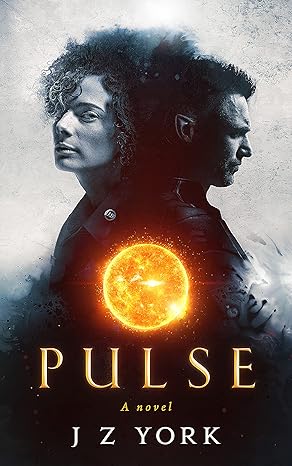
In Pulse, J.Z. York presents an imaginative fusion of military precision, scientific intrigue, and fantasy. This debut novel introduces Staff Sergeant Grace Woods, a cryptographer who immerses herself in work to cope with her family’s loss. Her existence takes an unexpected turn when a cataclysmic electromagnetic pulse propels her into a parallel universe dominated by Fae. This new world, echoing the fantastical stories once told by her grandmother, captivates and challenges her in equal measure.
York excels in world-building, crafting a parallel realm with precision and flair. The environments are vivid, drawing readers into a universe where magic mirrors the functionality of electricity in our world—a clever twist that enhances the believability of the fantastical elements. The transition between worlds is handled with finesse, providing a seamless narrative experience. The plot advances at a measured pace, deftly balancing action, suspense, and character development. Grace’s evolution from a grief-stricken soldier to a pivotal figure in an unfamiliar world is depicted with depth and sincerity. Her interactions, particularly with the skeptical Fae authorities who see her as a potential threat, are portrayed with a realism that underscores the narrative’s emotional stakes. York not only spins a tale of adventure but also weaves in profound themes of humanity, fate, and destiny. As Grace confronts the pattern of loss that haunts her, the story probes philosophical questions, elevating it beyond mere escapism. The novel also reflects on contemporary societal challenges, using its fantasy elements to explore issues such as resilience and adaptation.
Pulse is a standout novel that deftly combines elements of science fiction and fantasy. It offers a fresh perspective within the genres, bolstered by York’s adept blend of detailed military knowledge and rich imaginative storytelling. This book will appeal to enthusiasts of both genres and marks J.Z. York as a promising new voice worth following. I look forward to her future works with great anticipation.
Pages: 332 | ASIN : B0BWR7FV6B


