Blog Archives
Everybody Lies: The History, Science, and Practice of Deception Detection


Stephen John Komorek’s Everybody Lies is an ambitious and deeply researched journey into how human beings conceal the truth and how investigators learn to find it. Komorek moves from ancient trials and the first lie-detection machines to behavioral science, intelligence work, and digital deception. What makes this broad history compelling is the personal authority behind it. His experiences in military intelligence, federal training, and private investigations give the book a grounded voice, while his curiosity about why people lie keeps the subject human.
I especially enjoyed the book’s intellectual honesty. Komorek treats microexpressions as signs of concealed emotion, not automatic proof of lying, and he explains that a polygraph measures arousal. Again and again, he returns to the importance of baselines, behavioral clusters, context, culture, corroboration, and competing explanations. That restraint gives the science real weight. The reader isn’t handed a bag of clever tricks, but a disciplined way to observe behavior without letting confidence outrun evidence.
The centerpiece is the Komorek Method, a five-phase framework built around baseline observation, interference mapping, stress sequencing, behavioral compression, and precision elicitation. It’s detailed enough to show how each phase supports the next, yet clear about the training required to apply it responsibly. I found the method most persuasive when Komorek described it as a structure for locating pressure points in an account. His insistence on graded confidence, ethical limits, and post-interview assessment makes the framework feel practical, careful, and refreshingly accountable.
The case studies give the book its strongest narrative momentum. The betrayals of Aldrich Ames, Robert Hanssen, and Ana Montes reveal how institutional trust, narrow assumptions, and scattered evidence can shelter deception for years. The later investigations, “The Billion-Dollar Lie” and “Two Places at Once,” bring the method into close focus through financial records, timelines, witness credibility, self-contradiction, and claims that expand when questioned. These chapters show that the decisive evidence is often sitting in plain sight, waiting for someone patient enough to connect it.
At nearly six hundred pages, Everybody Lies feels less like a quick guide than a complete course in disciplined inquiry. Chapter objectives, professional notes, tables, and key takeaways make that depth manageable, while Komorek’s conversational voice keeps the material connected to real people and real consequences. I finished it more observant, but also more cautious about mistaking intuition for knowledge. Everybody Lies transforms the search for truth from a gut feeling into a disciplined, humane, and remarkably powerful way of seeing.
Pages: 597 | ASIN : B0HGRC6M6Y

That Very Human Fear

Viscera Varnish follows a Chicago artist who returns to a grisly private ritual after a humiliating gallery opening confirms his fears that the art world has lost faith in his work. What was the inspiration for the setup of your story?
The story actually began as a short story concept. Toward the end of last year, I saw a publisher looking for submissions in the vein of The Twilight Zone or Tales from the Crypt—stories where a character’s flaws ultimately lead to their downfall or where there’s a dark moral at the end. I outlined six different ideas with that theme in mind, intending to submit one to the anthology.
Ironically, Viscera Varnish was the one I almost threw away. Of the six concepts, it was probably my least favorite. Before scrapping it completely, I decided to revisit it one last time and realized the biggest problem was the main character. My original version of Daniel was far too cartoonish to be compelling.
Once I reimagined him as an artist desperately searching for inspiration, the story finally clicked. That idea came from a very real place. At the time, I was wrestling with my own creative process, trying to come up with ideas for future books and wondering where inspiration actually comes from. Daniel became an exaggerated reflection of that struggle. Thankfully, I don’t resort to the horrifying methods he does, but I took that very human fear of running out of ideas and pushed it to its darkest possible conclusion.
Daniel Virek is both repulsive and strangely compelling. How did you approach writing a protagonist whose inner logic remains believable despite his monstrous actions?
At his core, Daniel’s motivation is actually very relatable. He’s searching for inspiration, and I think anyone who works in a creative field—whether it’s writing, painting, filmmaking, or music—knows that feeling of desperately wanting to create something meaningful and wondering where the next great idea will come from. That part of him is rooted in my own experiences as a writer.
Where Daniel becomes frightening is in how far he’s willing to go. I enjoy exploring what happens when an ordinary human desire collides with someone who’s willing to cross a moral line that most people never would. That contrast is what makes him compelling to me. Readers may understand his frustration without ever condoning his choices.
My hope was that readers would find themselves following his logic for a while, even as they become increasingly uncomfortable with where it’s leading. Eventually there’s a point where you can no longer go along with him, but by then you’re invested enough to see how it all ends. I also wanted his ultimate fate to feel earned—a conclusion that reinforces the consequences of the choices he makes throughout the story.
The novella gradually shifts from psychological horror into something more supernatural and metaphysical. Did you always intend to widen the story in that direction?
Yes, absolutely. I always intended the story to expand in that direction. Most of my creative influences come from film, television, and books that embrace the paranormal, the supernatural, and the cosmic. I’ve often described my work as what might happen if David Lynch and H.P. Lovecraft were somehow merged together, and that’s still probably the simplest way to explain my approach.
What I enjoy most is starting with something ordinary and grounded. I like stories that feel believable, even mundane, before gradually allowing the impossible to seep into them. I think the supernatural is far more effective when it intrudes on everyday life rather than existing in a world that’s already fantastical.
To me, that contrast is what makes the strange feel believable. If the world around the characters feels authentic, then when reality begins to fracture, it invites readers to wonder if the impossible might be lurking just beneath the surface of their own lives. That’s the feeling I always hope to create—the sense that maybe there really are monsters under the bed after all.
What is the next book you are working on, and when will it be available?
I’m currently working on my next novel, The Day the Sky Died, a work of cosmic horror wrapped in an archaeological mystery. If I had to describe it in one sentence, I’d say it’s what you might get if H.P. Lovecraft wrote and directed an episode of The X-Files.
The story follows an archaeologist who uncovers evidence tied to a decades-old mystery, only to discover that some things buried beneath the earth were never meant to be unearthed. Like much of my work, it starts from a grounded premise before gradually descending into something far stranger and more unsettling.
I’m aiming to release it either late this summer or very early fall in time for Halloween season, though I haven’t announced a firm release date just yet. I’m working with the great Matthew Wildasin for the cover art. He did a great job on Viscera Varnish and I know what he comes up with for this one will be good too.
After that’s finalized, I’m all in on writing a sequel to my first book Reflections in the Dark.
Author Links: GoodReads | X | Facebook | Website
Now he’s fading—creatively, spiritually… and dangerously.
As critics turn cold and inspiration dries up, Daniel becomes obsessed with reclaiming the raw, visceral power that once made his work undeniable. His search leads him away from galleries and into the city’s forgotten spaces—where desperation, suffering, and whispered promises begin to take shape.
What starts as a desperate pursuit of artistic truth becomes something far more unsettling.
Something that doesn’t just demand creation…
but transformation.
Viscera Varnish is a psychological horror novella about art, identity, and the cost of creation—where genius rots, obsession festers, and the line between artist and medium begins to dissolve.
The Magic Circle


The Magic Circle follows the life of Mary Armstrong, the daughter of a powerful senator whose secret history of incest, trauma, and metaphysical obsession comes to light through her diary. The narrator, Mary’s childhood friend, takes that diary and retells the story as a blend of memory, confession, myth, linguistics, erotic mysticism, and psychological unraveling. The book moves through Mary’s childhood abuse, her attempts to understand it through religion and philosophy, her fixation on the Magi, and her belief that orgasm and God are the same force. As the narrative unfolds, it spirals into ideas about guilt, family collapse, incest as cosmic metaphor, cultural history, race, violence, and the long shadow of forbidden desire.
Reading this book felt wild, stirring, and at times emotionally overwhelming. The writing swings between sharp humor, painful honesty, and surreal insight. Sometimes I felt pulled along by the narrator’s voice, which is chatty and almost confessional. Other times, I felt pinned down by the weight of Mary’s thoughts as she tries to decode her past through religion, linguistics, anthropology, and mythology. I caught myself reacting with both shock and strange admiration. The author does not flinch. She leans into discomfort, and the effect is gripping. There are scenes that left me uneasy, others that made me strangely moved. The mix of intellectual curiosity and emotional rawness kept me on edge in a way that felt honest. The book refuses to tidy anything, and I actually liked that. It mirrors the chaos Mary lived in.
What struck me most was how the story keeps circling back to the idea that forbidden intimacy shapes a life, long after the act itself. The narrator shows us how Mary interprets that childhood violation as something magical, terrifying, and foundational. Her thinking is messy and bold. It is full of leaps that made me raise my eyebrows and then reread the lines just to sit with them. I kept feeling that the book wanted me to see how trauma bends a person’s sense of God, morality, memory, and even language itself. The voice is emotional, angry, tender, and sometimes darkly funny. I felt pulled between sympathy and disbelief. It is rare to read something that so openly stirs up confusion and still feels intentional.
The Magic Circle left me feeling unsettled in a way I appreciated. It is not a light read. It is intense, clever, sometimes messy, and often surprising. I would recommend this book to readers who like psychological depth, taboo subjects, and stories that blend intellect with raw emotion.
Pages: 288 | ASIN : B0G45N7LFH

Navigating Life’s Challenges: Mindful Resilience for Zodiacs
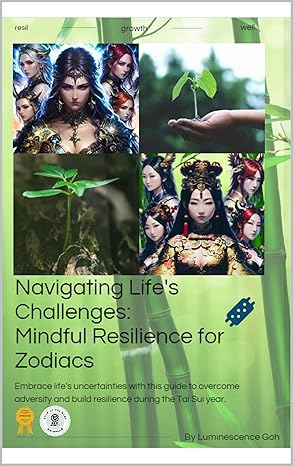
Navigating Life’s Challenges, by Luminescence Goh, delves into the concept of Tai Sui, a symbol of challenges that arise when one’s zodiac sign clashes with the Grand Duke Jupiter. Combining historical depth with modern interpretations, it seamlessly blends Eastern astrology and contemporary psychological strategies to foster personal growth. The book provides readers with tools to cultivate emotional intelligence, mindfulness, and critical thinking. By connecting astrological influences to life’s trajectories, the author transforms abstract concepts into accessible, practical insights. Readers are guided step-by-step, starting with inner mindfulness and progressing toward actionable strategies for managing relationships, navigating career transitions, and achieving financial stability. Goh thoughtfully builds a framework that equips readers with resilience and the capacity for growth.
Goh’s writing is clear, structured, and deeply engaging. Her tone strikes a balance between scholarly depth and accessibility, making intricate astrological and psychological ideas understandable for all. Beginners will appreciate the simplicity, while seasoned readers will find value in the depth of analysis. The writing flows effortlessly, moving from research-based theories to practical advice without ever feeling oversimplified. Goh’s authoritative yet supportive voice encourages introspection while keeping readers grounded in actionable steps. Each section transitions smoothly, ensuring that complex topics are unpacked with clarity and purpose.
Goh expertly weaves together ancient astrological wisdom, modern management theories, emotional intelligence frameworks, and wellness practices. Each chapter builds logically upon the last, progressing from foundational concepts like self-awareness and mindfulness to advanced techniques for decision-making and long-term planning. The depth of research is evident, with citations from astrological authorities, psychological scholars, and management experts that bolster the book’s credibility. By incorporating both Eastern and Western astrological traditions, Goh creates a culturally rich reading experience that appeals to a broad audience. The neutrality in perspective allows readers to form their own conclusions while showcasing the benefits of drawing from diverse disciplines. This multidisciplinary approach enhances the book’s value and depth.
Navigating Life’s Challenges emerges as a distinctive and essential guide for overcoming personal and professional hurdles. Its unique blend of ancient wisdom and modern science offers readers both enlightenment and practicality. Whether you’re drawn to astrology, personal development, or psychological resilience, this book serves as a comprehensive roadmap to transformation and growth. Goh’s focus on resilience-building strategies ensures the book’s lasting relevance as a timeless resource for navigating life’s unpredictability. By bridging mystical traditions with actionable psychological insights, Goh empowers readers to embark on a journey of self-discovery and enduring growth. This fusion of wisdom and practical guidance solidifies the book as an invaluable companion for those seeking to thrive in all areas of life.
Pages: 90 | ASIN : B0DKCFSKRJ
Catatonia

Catatonia, by C.S. Crane, is a captivating exploration of the human quest for meaning, artfully presented through a diverse cast of characters. These characters, including a Catholic priest, a troubled young man, a conniving uncle, a young woman, her devout elderly mother, and her teenage brother, offer a rich tapestry of perspectives and beliefs that ultimately converge in a tragic yet thought-provoking narrative.
The author skillfully delves into the intricate lives of these characters, providing readers with an intimate look at the world through their unique eyes. In doing so, Crane masterfully illustrates how conflicting beliefs can both clash and merge, weaving a complex web of reality for each character to navigate. At the heart of it all lies the manifesto of the mentally ill young man, a belief system that disrupts the lives of everyone it touches, even though he initially appears catatonic. While the story takes unexpected twists, it’s precisely this unpredictability that keeps readers engaged. The author’s ability to create a web of interwoven plotlines adds depth to the narrative, leading the characters down an unsettling yet riveting path. The resulting tragic events, though deeply disturbing, serve a purpose in highlighting the immense impact of the young man’s manifesto.
In the end, Crane’s storytelling prowess shines through, achieving his intended effect of leaving readers both puzzled and disturbed. It’s a testament to his ability to challenge conventional narratives and evoke a wide range of emotions. While the story may not be without its unsettling moments, Catatonia ultimately offers a unique and thought-provoking reading experience that makes it a standout within its genre.
Pages: 288 | ASIN : B0C1J6Q1ZF
The Monsters We Create
Pythia in the Basement is a biting satire about our fears, existence, morality, philosophy, and lacking common sense. What was the inspiration for the setup of your story?
Life, as cliché as it may sound. Just the nuanced complexities we face as we encounter obstacles on our journey. And how we deal with said obstacles. As well as the monsters we create to justify our lack of growth, movement, fears, etc. For most of us, it is easier to create an excuse than face our truth. Not all of us are brave and that is not easy to accept. I tried to sprinkle some of those complexities into the characters.
Roger and Colin are intriguing and well-developed characters. What were some driving ideals behind your character’s development?
Thank you for that. I think it was the search for meaning and truth. Self-validation. I know that is broad in scope, but ultimately that is the driving ideal. Colin, like all of us, is full of contradictions; he is trying to be a better version of who he was in the past, but he still succumbs to his proclivities and societal expectations. Almost like a musician struggling to accept his duality: he doesn’t want to sell out, but at the same time he longs for stardom. And you could say that in a way, Colin has not accepted his fate. Roger, on the other hand, seems to be comfortable in his skin, and you get the sense that if he was to perish he would have no regrets. He is at peace and I believe he in turn becomes the moral compass of the story.
What were some themes that were important for you to explore in this book?
Self-deception, the lack of common sense, and the demise of religion and the resulting repercussions on society as a whole. Again, I am falling into redundancies, but I think that was a major theme of the book. I am not a ‘religious’ person myself but I do see the importance that religion once played in our societies and how we have created new religions to fill that void. This story does border on the absurd, but I think listlessness and lack of meaning make a fool of us all. The search for validation is a powerful force that I find quite intriguing. I think ultimately, we are all looking for self-validation in one form or another, and more often than not that search leads us to extremes, regret, and frustration.
What is the next book that you are working on and when will it be available?
I have a few ideas but none that I would call good at the moment. Maybe I will delve deeper into satire and social commentary.
Author Links: Amazon | GoodReads
It’s A Shared Experience

Behind Blue Eyes follows Joe as he struggles against the odds to turn his life around after falling into addiction. What was the inspiration for the setup to your story?
The inspiration came after a working involvement within the field of addiction and treatment, seeing and being a part of delivering different models of therapeutic community, which in Australia is quite varied across the sectors. I had a six month period living in the midlands of Ireland so I took the idea and the story just seemed to develop. There is often trauma behind addiction and a host of others issues so I in part wanted to try and show that in a spiritual sense it’s an individual journey that crosses boundaries of class and personality. It’s a shared experience.
Joe Marley is an interesting and well developed character. What were some driving ideals behind your character’s development?
Well I have also worked in schools and had my own formative experiences of institutions and education in a time when abuses seemed to run freely so for Joe the links are there. He’s a smart fellow but some events in life ultimately are beyond us to think our way through. Again it came back to Joe’s relationships and the power to draw from a different mythology, if you like.
What were some themes that were important for you to explore in this book?
The themes I most wanted to explore were of course the whole recovery from tragic loss, betrayal and the power of emotions to set Joe on a destructive but ultimately redemptive course. Community and connection were another with I guess, the power of love and kindness to ultimately restore the balance with some kind of renewed vision for life. I also was quite struck by a comment from James Hilman, the rather famous psychologist who would often say that the ‘gods of Greece and Rome are alive and well and living on 42nd street BUT, the Mythologies of old are now the psychopathologies of today’.
What is the next book that you are working on and when will it be available?
I’m currently working on a novels – a part of this series, titled Mary’s Boys – The Immaculate Misconception. It’s a story about Joe’s childhood experiences as an Irish catholic immigrant growing up in Australia in the 1970’s. I expect it to be available for publishing in August 2022.
Author Links: GoodReads | Facebook | Website


