Blog Archives
Stenetta Anthony Author Interview

Ella Learns to Dance follows a young elephant girl who dreams of being a ballet dancer even when others discourage her. What was the inspiration for your story?
After hearing a story about a professional ballet dancer and her challenges. She was told she did not have the proper body image to be a ballerina.
What educational aspects were important for you to include in this children’s book?
Some of the ideas suggested in the book are: (always be proud of yourself, teach them to deal with frustrations when learning a new skill and how some children can relate to Ella’s story when friends do not always support their dream).
Are there any emotions or memories from your own life that you put into your characters life?
One memory comes from learning modern dance in high school. Since I never considered myself as a graceful dancer. It was often difficult to learn the dance moves, sometimes not wanting to attend the class.
What is the next book that you are working on and when will it be available?
Ella Learns to Dance is the first book in her series, so I am currently working on the 2nd and 3rd books respectively.
Author Links: GoodReads | Twitter | Facebook | Website
Freeman Explains!
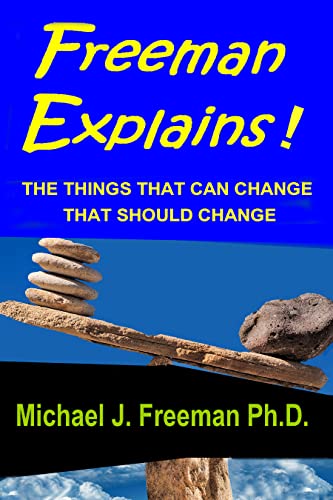

The title of this fascinating book instantly grabs readers, Freeman Explains: The Things That Can Change, That Should Change. This is because the content in the book is literally what the title states. The author Dr. Michael J. Freeman is direct and gives readers exactly what the title promises. This book summarizes what happens in society and what is wrong with people’s approach regarding pertinent issues. Freeman is intentional and weighs on issues before offering a solution. The author examines the problem, digs down to the root, and analyzes every aspect of the issue before giving his final take.
There are multiple issues discussed in the book, but there is one particular topic that I am grateful for the most; Kids and pornography. This is a sensitive subject to some and is even outlawed in certain cultures. In Freeman’s book, however, the reader is given a clear perspective on the harm pornography causes to young minds. Freeman writes about the harm of pornography and how the internet, despite making life easier, is causing tremendous damage as anyone can access whichever content they please. The author hopes that internet pornography can be regulated. He even offers strategic solutions to this problem, giving rational answers to anyone with questions.
Other than pornography, Freeman also tackles more than a dozen other topics. Like the title suggests, Freeman explains things you need to know as a human being and a citizen of the world. Contemporary issues need modern solutions, and the author is here to do just that, offer sensible and logical solutions. I also enjoyed reading about drug problems, healthcare, politics and policymaking, medicine, religion, marriage, sex, education, voting rights, and civic education. Readers will get a discussion on almost all topics law-makers debate about.
What I like most about the author is his passion for children and young people. One can see the genuine concern he has through his text. He will share with you why children need to be protected and how every responsible adult can do it. Two of my favorite texts in the book are ‘Without perspective, you know nothing’ and ‘you don’t know what you don’t know.’ Both phases are in reference to children or young minds. On issues like pornography, children may not be able to know what is good for them and what is not because they are yet to see or experience what adults already have. Simply put, they lack perspective and thus don’t know anything.
Dr. Michael J. Freeman and his work are the true definition of ‘with age comes wisdom.’ The author, having experienced an eventful life, understands what ails society and knows what should be encouraged. Reading his thoughts was refreshing, as one can tell that the author is not influenced by modern trends. Freeman openly shared his takes and explained in detail his views. This thought-provoking book is perfect for those interested in how the modern world is shaping children and their futures.
Pages: 213 | ASIN : B0BLXW5PMH

Thought is Not the Boss of Me!

Our minds are very powerful things. It allows us to do many things, such as dancing, sports, and learning new skills. They can, even without us knowing, control our entire bodies to stay alive. Our minds can also get lost in thought, and thought can sometimes cause mischief.
In, Thought is Not the Boss of Me! by Sheila Booth-Alberstadt and Sarah Lamb, we are introduced to Lincoln. A young child who tends to get into some trouble without realizing he is being coerced into doing so by none other than ‘Thought.’ ‘Thought’ bosses Lincoln around and makes him do not nice things, and ends up being punished.
This relatable story is beaming with delight, from the vibrantly adorable illustrations by Elizabeth George to the comical and inviting writing. This picture book was such a clever way of showing young kids how thoughts and the mind work and how to overcome the negative thoughts that come along with them. I love how Lincoln is presented as innocent during the entire ordeal but makes a conscious decision to stop listening to ‘Thought.’ Once Lincoln realizes ‘Thought’ only gets him into trouble, he starts thinking as well as acting on his own account. What an extremely difficult thing it is to do, to master one’s thoughts, as a growing child.
Thought is Not the Boss of Me! is an extraordinary children’s book about recognizing and dealing with big emotions. This well-written story helps children realize that big feelings are normal and that they can learn how to manage them. I Would absolutely recommend it to any family or young reader, as the message is valuable to people of all ages. It would make a great addition to a school library or classroom.
Pages: 32 | ASIN : B09LFLLS9N
Once There Was a Child
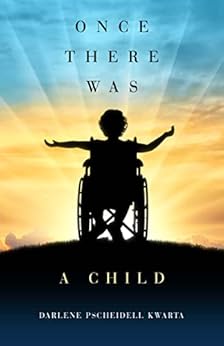

Once There Was a Child is a fun, yet deeply touching account of Darlene Pscheidell Kwarta’s time as a special education teacher. She describes the daily trials and triumphs of working with America’s ‘forgotten’ children: those living with disabilities, experiencing abuse or being passed around within the foster system. Darlene gives a unique perspective into the minds of her small group of students as they navigate school life and the outside world. She leaves the reader pondering how the system could be improved for these children, as many of the problems she encounters are still ongoing today.
Although the book is short, it takes you on a rollercoaster of emotions. One minute I was laughing and the next my heart was sinking. I only wish that the book had been longer, so I could have gotten to know the children’s backstories and personalities in more detail. I learned a lot from Darlene, particularly about the psychological aspects of such a job, and I would love to learn more.
I would definitely like to read more from this author, whose attitude towards her students should be an inspiration, not only for anyone working within this field, but for anyone who ever encounters a child with special needs. Darlene doesn’t preach about how you should treat these children, rather relays the information through short anecdotes. She manages to convey the thoughts and feelings of those who cannot speak, and delivers this to the reader in a comprehensible and personable manner. The combination of informal language and short, manageable chapters make this book an easy and enjoyable read, despite the emotional topic.
I would recommend Once There Was a Child to anyone who is interested in learning more about, or improving their attitude towards, children with special needs.
Pages: 69 | ASIN: B0BFBVJZSW
How We Fill Those Vast Empty Spaces

Late in the Day follows three people who find solace and companionship in one another’s company and together forge a path ahead. What was the inspiration for the setup to your story?
The inspiration was a slow-growth idea that incubated during my longstanding habit of dining out alone in hushed, dimly lit restaurants. I enjoy observing couples at other tables, especially couples who have clearly been together for a long time. I can feel their history at work in their gestures and in the snippets of conversation that I overhear, and it gives me enormous pleasure. At the same time, I wonder how deep the grief and sense of upheaval would be when such couples are separated—by betrayal, by death, or by a slow, gray dissolve. How does one learn to be alone? Is it possible to create another rich history with someone new? Is there enough time and energy? These considerations pressed on me as I grew older, and I wanted to write a story about how such circumstances could play out, how solitude and loneliness take on a different hue as we grow older. And then there is the flip side of loneliness: attachment. How we lose or give up (voluntarily or involuntarily) the people and the objects that gave us a sense of home for so many years, and how we fill those vast and empty spaces.
Your characters are compelling and well developed. What were some driving ideals behind your character’s development?
First of all, let me say how pleased I am that you found my characters to be compelling and well developed, especially since they couldn’t be more different from one another. My driving ideal was a difficult one: to let my characters have some say over who they are. We fiction writers like to think that we have total control over our novels, and in trying to exert that control we often do our characters a great disservice. We can easily flatten them—even suffocate them—with our own desires and needs, rather than letting them show us how they need to evolve. Like any relationship, the relationship between an author and a character is a give-and-take enterprise. As a writer, I need to give space for each character to chart a course. When my characters surprise me with an action or reaction that I hadn’t planned for in the novel, I know I’m on the right path. Another driving ideal for me is to focus on the small things: Will this character say “Yes” or “Yeah”? Will she brush a wisp of hair away from her face or let it hang there? Will he stroke his beard or let his hand rest quietly on the table? Will they walk hand in hand or simply let their arms brush up against each other from time to time? For me, the accrual of such details creates the real and lived-in character.
What were some themes that were important for you to explore in this book?
I was most interested in exploring the possibility of connection, companionship and renewal at a stage in life when we realize that we don’t have all the time in the world to make our life work out the way we assumed it would. As I was putting the final touches on the book, I happened to read an article by Jennifer Senior in The Atlantic. One paragraph struck me in particular. She wrote, “Of course, all deep friendships generate something outside of themselves, some special and totally other third thing. Whether that thing can be sustained over time becomes the question. The more hours you’ve put into this chaotic business of living, the more you crave a quieter, more nurturing third thing, I think. This needn’t mean dull…There’s loads of open country between enervation and intoxicating. It’s just a matter of identifying where to pitch the tent. Finding that just-right patch of ground, you might even say, is half the trick to growing old.” After I read that paragraph, I felt as if she had been looking over my shoulder the entire time that I’d been working on the novel to see if my three characters—strangers to each other and with little in common except their advanced years and their measured solitude—could find that place to pitch their tent, quietly and together.
What is the next book that you are working on and when will it be available?
I am finishing up a solid first draft of another novel. This one is shorter—about 200 pages—and is quite different from my other two novels. The main differences are that it is written in the first person, and the time span of the novel covers about 60 years. My other novels were much longer, were written in the third person, and covered very short time periods. I’m not ready to disclose what the novel is about, but I will say that I believe it’s my best work to date. And my cohort of trustworthy beta readers feel the same way. I’m very excited about it and hope to have it finished and ready for publication in about a year. But who knows? Maybe one of the characters will surprise me with an unexpected path and it will take longer!
Author Links: Amazon | GoodReads
In their advanced years, Honey, Hank and Seth didn’t expect to find themselves unattached through divorce, separation and death. They have little else in common except their morning ritual of taking a solitary walk along the same stretch of Florida coastline to behold the sun breaking through the horizon line with equilibrium and serenity, day after day. Each morning draws them closer until they relinquish their solitude and seek one another out. At first, silence is broken by polite conversation, stillness by small gestures. The bond between them slowly sets roots that are deep enough to guide them toward a bold decision that both embraces and defies their solitary condition and their advanced years.
Late in the Day is a lucid and sober meditation on the possibility of connection, companionship and renewal in three lives that have narrowed with time. With a keen eye for detail, Shapiro chips away at the crust of aging. Something more complex and delicate emerges with a realism that is simultaneously stark, poetic and deeply felt as Honey, Hank and Seth chart a future that is neither straightforward in their hope nor liberated from their pain.
What a Muck
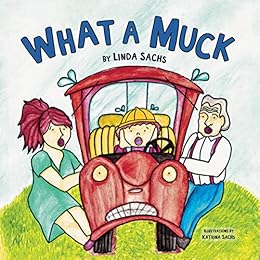
Have you ever found yourself trying to help someone with a task but then finding yourself making an even bigger mess? In What A Muck by Linda Sachs, Drew finds out the answer to that question is an absolute yes!
While Mom and Drew are packing up the car with gardening tools to go help Papa Lou in his garden, Drew accidentally locks the keys inside their car, they must walk to Papa Lou’s house in the hot sun, leaving them unable to garden and clean up the muck.
Now Drew has another idea. Drew wants to help Papa Lou, so Drew hops in the truck and proceeds to pull the stick shift down. The truck begins to roll away. Thankfully before the truck could crash into a pole, Drew was able to clean up the muck and knows now that it is important to ask how to be helpful.
In this charming rhyming children’s story, we follow young Drew, who only wants to be helpful but causes some chaos instead. Drew’s heart is always in the right place, but it is hard to figure out the correct way to help. I felt the situations Drew got into could realistically happen to other children; this makes the story both comical and frightening. This amusing story reminded me of reading about Curious George with all the unintentional mishaps that Drew ends up in.
The author has a great vision with the message in the story, such as that it is important to want to be helpful but even more important to ask HOW to help. In addition, I enjoyed that the book also shows children playing an active role in activities with family, which is extremely important for children’s self-esteem.
What a Muck by Linda Sachs and illustrated by Katrina Sachs is an entertaining picture book that shows children the importance of not just helping but making sure they are helping in a manner that is actually helpful. This would be a great aid in teaching children the importance of communication, teamwork, and trust.
Pages: 31 | ASIN : B09XWHT8SL

Valuable Lessons

Billy Be Kind helps young readers find the courage they need to tell the truth. What was the inspiration for the idea behind this children’s book?
This book, like all my books, is inspired by authentic situations and real conversations that I’ve had with my three children. Like most parents, the importance of honesty is something that I emphasize regularly to my children. In particular, this book was inspired by a discussion I had with my son who admitted to telling a lie to avoid getting into trouble. I realized that all kids lie, but it’s up to us as parents to create an environment that encourages honesty.
The art in this picture book is vivid and cute. What was the art collaboration process like with illustrator Ayesha W?
Since I have collaborated with my illustrator Ayesha Warusavitharana on other projects, she has a clear understanding of my vision. I begin by sending her my storyboard and stick figure drawings. She then sends me her interpretation of my ideas. We often go back and forth until we are both satisfied that the artwork matches my vision. Her humility, patience, attention to detail, and her desire to excel in her field make it easy to work with her.
What is one piece of advice you would give to parents that are trying to teach their kids about honesty?
The best way to teach honesty is to be honest. We are our children’s first teachers. Have the “honesty conversation” early and look for ways to acknowledge and appreciate their choice to tell the truth, especially when it may have been easier to tell a lie.
What can readers expect in the second book in the Billy Be Kind series?
In the second book, Billy Be Kind: Making A New Friend, the readers are introduced to a new character, Lucy-Lou. She is a shy little girl who has a hard time making new friends. Billy Be Kind, the kind little mouse, encourages her to be brave and take the first step in meeting someone new. The readers can expect rhyming stories, colorful illustrations, and themes that teach valuable lessons simplified for young children.
Author Links: Goodreads | Facebook | Website
This wonderful, rhyming story is part of the Billy Be Kind Children’s Series.
The Billy Be Kind Children Series is a collection of short stories with important lessons simplified for young readers. The series offer eye-catching illustrations, diverse characters and relatable themes that help children thrive to reach their full potential. Ages 2-5
I Love My Kids, But I Don’t Always Like Them
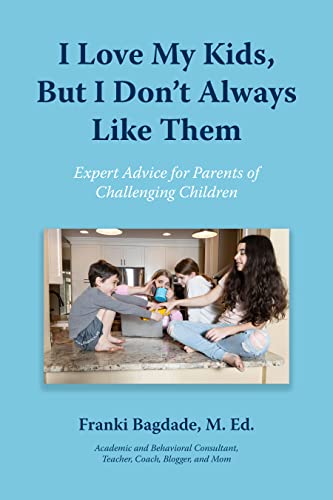
I Love My Kids But I Don’t Always Like Them by Franki Bagdade provides readers with guidance that will help struggling parents understand their children. This book is written in easy to understand language and career-specific terms are explained with many practical examples.
In each chapter the author addresses the different areas that parents may find challenging. From infant age to toddlerhood up to adolescence, Bagdade left no stone unturned in taking readers through the peculiar roadblocks associated with child developmental milestones. Bagdade, a mother of three children herself, demonstrates mastery of the behavioral pattern of children and provides actionable advice on how to handle situations where your children behave in ways you don’t approve of. While admitting her failure to handle some situations in the best way, Bagdade provides advice on how to deal with the guilt that comes with those situations.
In exploring perhaps the most difficult aspect that comes with parenting, the author explains how to understand children with special needs. That moment when you don’t know if your child’s tantrum is some behavioral flaw that requires expert opinion and support or just another moody day. This book offers a solution on how to get those in contact with your child, from teachers to family relatives, to make adequate provisions for your child.
In the chapter, “Right Size Your Expectations”, the author shares with readers how to prioritize intent over the outcome of actions. This helps to handle times when parents feel disappointed in their child’s behavior especially when the children are not doing anything necessarily bad.
This is a critical resource for parents that will help parents re-evaluate their parenting style and promote conversations on parenting and how there is no one-formula-fits-all in raising different children even within the same family. With quirky humor and a free-spirited tone, Bagdade has written an engaging parenting book that is colored by her experience as a mother and consultant educator. She details easy-to-follow approaches to parenting that will help parents enjoy their children, even during their worst times.
Pages: 157 | ASIN: B09KLZBZFF


 LITERARY TITAN