Blog Archives
Alchemy of Adversity – How Emotional Intelligence Transforms Trauma Into Leadership Strength


Sarah Staley’s Alchemy of Adversity is a hybrid of memoir, trauma-informed leadership study, and practical guide to emotional intelligence. Drawing on the accident that killed her husband, Sean, and left her with severe injuries, Staley examines how traumatic experience can influence judgment, relationships, workplace behavior, and leadership. The book’s argument is carefully qualified: “Adversity does not automatically create strength”. Growth, she contends, emerges through the deliberate integration of experience. Its five-part structure reflects that process, progressing from personal devastation through neuroscience and emotional development to organizational practice and renewed purpose.
The memoir sections give the book its emotional authority. Staley describes the accident, hospitalization, grief, physical recovery, and responsibility of raising her young son, Eli, with directness and considerable sensory detail. Her image of the “gray world,” a period when color remained visible but had lost emotional meaning, conveys the numbing effects of trauma with unusual precision. These chapters also trace the uneven nature of recovery through therapy, gratitude, family support, work, and the gradual restoration of agency. The epilogue, which follows her relationship with Cody and the family life they build, provides a fitting conclusion to this personal narrative by showing a life broad enough to contain grief, gratitude, memory, and new love at once.
The book’s analytical center connects Staley’s experience to research on the amygdala, prefrontal cortex, memory, nervous-system regulation, post-traumatic growth, and the window of tolerance. Staley then converts those concepts into the ALCHEMY framework and the four emotional-intelligence domains of self-awareness, self-regulation, social awareness, and relationship management. Case studies involving a grieving leader named Chris, organizational crises, and Satya Nadella’s leadership at Microsoft widen the book’s scope beyond individual recovery. Reflection questions, regulation exercises, narrative-reframing practices, and the four organizational pillars of safety, trustworthiness, choice, and empowerment make the later chapters particularly useful for managers and teams. The material’s recurring formulations give it the cadence of a leadership seminar, reinforcing its main principles while occasionally slowing the narrative momentum.
Staley’s strongest contribution is her treatment of emotional intelligence as an embodied discipline shaped by both pain and practice. “Self-awareness didn’t make me perfect. It made me present,” she writes, a statement that captures the book’s practical ethic. Leadership here means remaining regulated under pressure, recognizing distress beneath performance, preserving accountability without humiliation, and creating conditions in which people retain agency. Alchemy of Adversity offers leaders, trauma survivors, coaches, and organizational-development professionals an accessible framework for understanding how personal healing can affect entire systems. Its blend of intimate testimony, research, and workplace application presents leadership as a human responsibility grounded in awareness, ethical power, and sustained relational care.
Pages: 311 | ASIN : B0GQQ32QXL

THE SILENT BULLY. A Journey from Abusive Brain Chatter to Self-Love: A Personal Transformation Self-Help Book

The Silent Bully is a memoir-infused self-help book about recognizing and changing the cruel inner dialogue that Jacquie Elliott calls “Abusive Brain Chatter.” Elliott draws from her experiences with depression, compulsive eating, unhealthy relationships, childhood expectations, sexuality, parenting, work, body image, and aging. Her central framework is easy to remember: become Aware of the abusive voice, Believe in a kinder inner source, and Challenge the core beliefs feeding the criticism. That structure gives the book a clear direction even as it moves through many areas of personal life.
The book’s most engaging quality is Elliott’s willingness to be open about her own history. She describes moments of shame, addiction, fear, family conflict, sexual trauma, and self-sabotage without presenting herself as someone who has reached a flawless state of healing. Her account of lying in bed, eating compulsively, and listening to an inner voice tell her she’d never change gives the concept immediate emotional weight. Later stories about training for a triathlon, building healthier relationships, setting boundaries, and creating a satisfying life show how her transformation happened gradually. The tone often feels like a candid coaching conversation with someone who’s been through the struggle herself.
This is also very much a working book rather than something meant to be read passively. The “Self-Love Work” sections ask readers to rate the severity of their self-talk, identify triggers, journal about fear and shame, examine inherited beliefs, clarify values, practice meditation, create affirmations, set manageable goals, and work through resentment and forgiveness. Elliott uses memorable terms such as “Tornado Head” for escalating thought spirals, along with practical tools like grounding exercises, breathing methods, visualization, SMART goals, gratitude practices, and progress tracking. Spirituality is woven deeply into the method, but she defines a Higher Power or Loving Source broadly, allowing readers to interpret it through religion, nature, inner wisdom, community, or another compassionate presence.
I’d recommend The Silent Bully most strongly to readers who recognize that their self-talk has become harsh, repetitive, and limiting, especially those who enjoy a blend of personal testimony, spiritual reflection, journaling, and hands-on exercises. It may also resonate with people recovering from emotional abuse, codependency, addiction, difficult family patterns, or long-held feelings of inadequacy. Readers who take their time with the prompts will probably get more from it than those who rush straight through. At its heart, the book is a warm, earnest invitation to stop treating self-criticism as truth and begin building an inner relationship based on patience, responsibility, and genuine care.
Pages: 318 | ASIN : B0FXHM1XP8
Healing Powers of Poetry

How I Understand It is a blend of poetry, memoir, therapy-informed reflection, and guided self-inquiry. Did you write these poems with a specific audience in mind, or was it a more personal endeavor?
Writing poetry–especially what I call Bad Poetry is always a personal endeavor, near and dear to my heart and my experiences. Because of this, taking my poems public has been a very vulnerable exercise. It is perhaps because this book has been the most vulnerable project I have engaged in that it has also produced the most delight and been one of the most rewarding experiences.
When I first started writing, I was writing specifically for an audience of one: my young daughter. I felt compelled to transmit information, my hard-earned wisdom, my therapeutic insights, to her in a way that would be accessible, engaging, and informative. I wanted to make a reference tool that she could return to throughout her life, one that would be a source of comfort and guidance if I could not be there in person. (I wanted to make not just something that she could refer to, but something that she would want to refer to.) I wanted her to know me, what I wish for her, and what I have learned about resilience that would be useful to her in different phases of her life. To my surprise, once I started writing, I found that poetry was the best vehicle for this project. The poems that became the core content of the collection poured out of me, one after the other. In writing for my daughter, I found myself all over again, and eventually realized that I was writing as much for me as I was for her. Once I finished writing the collection of poetry, the experience was so profoundly moving that I knew I wanted to extend the project further and bring it to a wider audience.
I started writing the book as a mother doing a very private project. But, as a therapist, I knew that the content of the collection would appeal to a wider audience. I’ve worked with enough clients to know that the topics covered in the book are topics everyone ponders. Bad Poetry is something everyone can do and benefit from. Bad Poetry helps us connect to ourselves and others in meaningful ways. Bad poetry helps us discover the strength within our vulnerabilities. Moving forward with publication was, in a sense, an embodiment of the Bad Poetry ethos.
In my profession, I have taught and experienced creative writing and particularly the healing powers of poetry. There is something magical that happens when we take important information, condense it, and infuse it with layers of emotion, with pieces of ourselves. Our ability to gain insight into ourselves grows. Our ability to engage in perspective-taking increases. Our resilience improves. And- who wouldn’t want that? This poetry collection is for everyone.
The book draws from your experiences as a therapist, mother, former spouse, and individual navigating life’s challenges. How did you balance personal vulnerability with professional insight?
I’ve always been a practical person. And, to me, poetry became appealing when I started to understand its practical applications and specifically how I could use it as a tool for self-improvement, insight, and growth. It is much easier for me to be vulnerable if I understand why I’m doing it and that my vulnerability is serving a purpose worth pursuing. The private matters I discuss in the book, I do so with intentionality and purpose.
Additionally, my book is all about how I understand my experiences and life. I don’t know that I can separate my understanding of my experiences from my professional insights because my profession has informed me and shaped me profoundly. Becoming a therapist has given me the language to talk about my experiences in a way that I find deeply satisfying.
What misconceptions about healing do you encounter most often?
So many that it is hard to list!
I will say this: More often than not, healing requires us to confront pain, hold it, and metabolize it.
Many people believe that they cannot handle pain. That to confront the emotional pain would be too life-threatening. It is, in fact, more life-threatening to avoid your own emotions and pain. It leads to so much disconnection, suffering, and stagnation- much more so than if you took the initiative to confront, hold and metabolize it.
If you are anything like I once was, and thought that poetry was a frivolous, self-indulgent luxury, I have news. Bad Poetry is a way to take the initiative and gently metabolize pain, at your own pace. And it works!
What do you hope readers take away from the sections dealing with relationships and codependency?
Hope!
Everyone wants love, to have it, to give it… Humans are wired for connection. We just can’t help ourselves. Relationships are wonderful. Connections and especially romantic connections are ways that we learn more about ourselves, and they are how we learn how to give and receive love. Difficulties in relationships, such as codependency issues, are invitations to examine our relationship with ourselves and erroneous conceptions that we might have about what constitutes love. It is worth the effort to fully be present for your relationships, to listen to your emotions… It makes space for real love to grow.
Author Links: GoodReads | Instagram | Facebook | Website | Amazon
How I Understand It is a candid, unconventional collection of poems, reflections, and clinical insights from a therapist who isn’t afraid to call out codependency, detail the emotional complexities of grief, or tell imposter syndrome to go f*ck itself. Each chapter explores a universal theme-love, divorce, dating, trauma, forgiveness, grief, motivation-blending raw poetry with therapeutic commentary and journaling prompts that invite readers into their own journey of insight and growth. The book culminates with a guide on how to build your own collection of poetry for resilience, making it a practical therapy tool for anybody looking to upgrade their self-expression repertoire.
Whether you’re a therapy client, a clinician, or a human navigating the tender terrain of adulthood, this book is here to remind you: your emotions make sense, your perspective is valid, and your story is still being written.
This is not your average poetry book.
This is not your average self-help book.
This is How I Understand It.
How I Understand It


How I Understand It: A Bad Poet’s Guide to Mental Health & Resilience is a deeply personal blend of poetry, memoir, therapy-informed reflection, and guided self-inquiry. Author Margaret Bryden writes from the overlapping places of therapist, mother, former spouse, wounded person, and stubbornly hopeful human being, moving through love, belonging, divorce, pregnancy, aging, trauma, grief, parenting, imperfection, and creative resilience. The book’s central idea is simple but surprisingly fertile: “bad poetry” can be a brave, playful way to tell the truth, make sense of pain, and build a more compassionate relationship with yourself.
I appreciated the book’s refusal to act polished in the ways books about healing often do. Bryden’s voice can be funny, blunt, tender, profane, and oddly ceremonial, sometimes all within the same page. I found that tonal looseness disarming. A poem like “Making Love Alone,” with its cookie, its solitude, and its sweet redefinition of intimacy, captures the book at its best: warm, strange, embodied, and quietly radical. I also liked the way Bryden keeps returning to personal responsibility without turning it into punishment. In poems about boundaries, codependency, and divorce, she doesn’t soften the bruises, but she also doesn’t linger in helplessness. The writing is not traditionally elegant all the time, and it doesn’t seem to want to be. Its charm is more ragged than refined, more alive than sculpted.
The ideas in the book stayed with me because they’re grounded in emotional reality rather than neat self-help slogans. Bryden’s treatment of grief, especially the long case-study sequence on grief avoidance, is messy and uncomfortable in a way that feels honest. Her reflections on pregnancy and motherhood are just as affecting, particularly when the body becomes both a site of wonder and bewilderment. I was moved by how often the book turns toward paradox: selfishness as a path to deeper love, boundaries as a way of drawing the right people closer, success as boring and humble, and death as a reason to live more fully. There’s a real pulse here, a sense that the author has earned her insights by walking through the smoke herself.
By the end, I felt that How I Understand It is less concerned with being a perfect poetry collection than with becoming a companion for people trying to hear themselves clearly. Its ending, especially the defiant tenderness of “Imposter Syndrome Can Go Fuck Itself” and the practical invitation to make one’s own poems of resilience, gives the book a satisfying sense of arrival. This is a heartfelt and emotionally generous book. I’d recommend it to readers who like therapy-adjacent writing, reflective poetry, journaling, and books that speak plainly about love, grief, trauma, and the difficult art of becoming kinder to yourself.
Pages: 234 | ASIN : B0H2FPMTS9
Ego Degradation: Pulling Back the Veil of Illusion to See Your Mind’s Programming

Ego Degradation: Pulling Back the Veil of Illusion to See Your Mind’s Programming by Alexx Shaw is a spiritual self-help book that blends psychology, neuroscience, philosophy, trauma language, and metaphysical ideas to explain what Shaw calls “ego degradation,” a painful but potentially clarifying breakdown of the mind’s old programming. The book argues that the ego creates our perceived reality through duality, judgment, expectation, and control, and that awakening begins when we learn to see those patterns instead of blindly living through them.
The writing has a direct, almost coaching-like energy, and at times it feels less like reading a quiet guide and more like sitting across from someone who is trying to shake you awake. I appreciated that intensity, especially when the book talks about trauma, attachment, and the way people mistake old coping habits for identity. Some claims stretch into spiritual territory. The book wants to give language to experiences that can feel frightening, private, and impossible to explain.
Shaw moves between Freud, Eastern religion, brain regions, karmic lessons, mindfulness, and non-attachment, which makes the book feel wide-reaching and ambitious. Sometimes that range is energizing. The central idea kept pulling me back: what if the stories I tell myself are not facts, but programs I keep running because they once helped me survive? That is the strongest part of the book for me. Under the spiritual vocabulary, there is a very human question: how much of my suffering comes from reality, and how much comes from my grip on reality?
I would recommend this book to readers who already enjoy spiritual self-help, consciousness writing, shadow work, trauma reflection, or books that mix personal growth with metaphysical thinking. For readers who are open to inner excavation and a genre that treats healing as both emotional and spiritual work, Ego Degradation offers a challenging, candid, and sometimes bracing invitation to look more closely at the mind behind the curtain.
Pages: 264 | ISBN : 1917704607
Shame, Survival, and Silence

Beyond These Walls shares your journey through separation, incarceration, and healing, blending memoir and guidance to show how reclaiming your personal story can transform shame into resilience and open the door to a renewed life. At what point did you realize your story could help others?
What made me realize was how eager I was to help souls who were stuck, depressed, and just in a rut. It then hit me while I was still sitting in the mess alone, grieving, separated from my kids. I remember thinking, If I ever get out of this, I’m going to help someone else through it. At first, it was just journaling to survive the busy, running from self. But as I started to heal, I began to see that my pain had purpose. I didn’t need to be perfect—I needed to be honest. And I realized that being willing to tell the truth about where I’d could give someone else the courage to come back from where they are.
You place strong emphasis on reclaiming and reframing one’s personal story. Why is narrative so central to healing?
Because your story is your identity, and if you don’t own it, it’ll own you. For a long time, I carried a story shaped by shame, survival, and silence. But healing began when I started telling the truth with new language. Not just “I went through this,” but “Here’s what it taught me. Here’s how I grew.” Reclaiming your narrative means you stop being the victim of it and start becoming the author. That’s where freedom is.
You include reflections and exercises throughout the book. How do you hope readers will use them?
This book isn’t meant to be passively read; it’s meant to be worked through. I share reflections and exercises as tools to help readers pause, go inward, and apply what they’re reading. I want them to engage with their own story, not just mine. Whether they journal, cry, pray, or plan, it’s about breaking the cycle of just surviving and beginning to live again with intention.
What does living authentically mean to you now, compared to earlier chapters of your life?
Back then, I thought authenticity was just being tough, showing up strong, and pushing through. I silenced my words to allow others to feel comfortable. Not owning my flaws and allowing myself to trust myself as a neurodivergent, I kept myself safe, like with dyslexia, comprehension, and a busy brain. Now I know authenticity is about showing up real. Your people will find you Just Be. It’s being rooted in truth, even the ugly parts, and not performing for approval. I don’t need to hide the past or sugarcoat the journey. Living authentically today means I lead with integrity, I honor my story, and I no longer shrink to make others comfortable.
Author Links: GoodReads | LinkedIn | Facebook | Website | Amazon
True personal growth takes time. It requires confronting the root causes of our pain, learning to communicate effectively, and, most importantly, healing. Life isn’t designed to be perfect; it’s messy and unpredictable. But within that mess, there’s a chance for renewal and transformation. Please pay attention to your emotions; they often signal areas that still need healing.
I understand how difficult it can be. But know this: you are not defined by your past. You have the power to break free from shame, self-doubt, and negative beliefs and embrace the chance to live authentically. Life’s setbacks don’t happen to us, they happen for us. By changing your perspective on these challenges, you can create a healthier, happier, and more fulfilling life.
Remember, prison isn’t always a physical place—it’s a mindset. And freedom begins when you decide to forgive, heal, and reclaim your story.
As a Wellness Coach, I’ve journeyed down a path similar to yours, and I’m here to assure you that life improves beyond the self-imposed barriers. We’re all on a unique journey; sometimes, detaining ourselves is essential to rediscovering ourselves. Even if it seems daunting, each step is part of our growth. Whether it’s overcoming incarceration, divorce, addiction, or total loss, there are strategies, support networks, and mentors ready to guide us through these obstacles.
“I will share some practical tools for your well-being to guide you through any circumstances. It’s never too late to start again, this time armed with tools to live a fulfilling life. Dare to dream again, unleash your creativity, and free your soul beyond what your eyes can see. You deserve it all. I want you to reinstate yourself at the center of your life, forgive yourself, and rewrite your story. For those who have felt imprisoned by pain and shame, I want to remind you that you are capable of restarting life. I hope you feel motivated, encouraged, and ready to surpass your expectations, limitations, and shame after you read the book. I wish you to thrive; you have not met the part of you waiting to be free. Everyone has an opportunity to live a positive, successful, and peaceful life.
Mind, Body & Spirit

Who Trains, Wins is a personal guide to growth through martial arts, written with a mix of tough love, lived experiences, and clear admiration for the warrior path. You describe martial arts as a blueprint for living. When did that shift happen for you?
When I was young, I was living by trial and error. I could be told what to do, but many times I needed to learn the hard way. I found that when I was training regularly and spending the majority of my time with those who were focused on self-improvement, I was consistently getting better all around results in my life. When I wasn’t putting in work on my spiritual/physical side, I would move backwards, and my general life results became poor quickly. I am a slow learner, but around age 26, it eventually became ridiculously obvious. I found the rhythm for my success required continuous work in mind, body & spirit – all three equally. If I slacked, I paid in kind.
Was there any story you hesitated to include but ultimately felt needed to be there?
Such an insightful question. In writing this book, I wanted to focus on the reader and where they want their life to go. Originally, I included many, many personal stories that seemed to be relevant as examples in each section. Ultimately, I cut 98% of them as they were just that, personal, and weren’t broadly relevant to a wider audience. I didn’t want to drown out, drone on, and hijack a success formula self-help book, to instead make it an autobiography. The martial arts is a very personal journey and each person should start “tabula rasa” – as a blank slate, and let the martial arts principles and their discipline bring them where they need to go. I didn’t want to inject any bias or limit the scope of what’s possible for those in completely different circumstances to my origin. So the stories I told I felt were just enough to make a connection with the reader, and I tried to leave lots of room to write in their own story and personal comparisons.
How can someone with no martial arts background start applying these principles immediately?
A self-assessment is the place to begin. Identify your ideal experience in this human form that you think is achievable for yourself. We don’t need to be talking lofty goals. Just a few simple improvements. Are you on the path to getting there? If not, why not? I believe many people don’t realize life can be navigated with more success if you first draw up a map for where you want to go. That map needs to include a regime to shore up 3 areas: 1. Spiritual, 2. Physical, 3. Mental. These three separate systems must run at peak potential simultaneously for quick results. If they are optimized, backed by a plan, a road-map of who you want to be and where you are going, the world will make way for you, and you will get much further than you can imagine.
How do you help readers stay motivated when progress feels slow or invisible?
This is the secret sauce and one of the hardest questions we all must face. Love is the key. Love for your pet, your grandmother, love for yourself. The motivation, love, and joy bring are boundless. I cannot instill work ethic or push you, you need to want to be there. Love feels scary to give unconditionally, but if you love yourself, then you will want what is truly best for yourself. We live in a society that makes food and cars and sex about self love. Those can quickly become traps and negatives. True self love means staying healthy, focusing on positive things, helping those in need. Giving of yourself and your time is empowering and uplifting. So find and hug your grandmother today, time is limited for those. Go outside and smile at a stranger, the rest of their day they will remember that. Look in the mirror and say I love you three times out loud, and see if you don’t all of a sudden look just a little more attractive. I’m smiling just thinking of you doing that. That’s the key to staying motivated – love.
Imagine taking on your biggest challenges with the mental fortitude and unshakable confidence of a seasoned fighter. This isn’t reserved just for black belts or elite athletes. Anyone can apply these principles to daily life and see real results.
The truth is, you already have the tools inside you. You just need to sharpen them through deliberate practice. Like a fighter perfecting their stance or a martial artist drilling their forms, success in life requires consistent training in the fundamentals. Use the same proven martial artists techniques for any challenge you face.
This book will guide you to the core essentials that separate those who achieve from those who simply dream. Through the same discipline, mental toughness, and strategic thinking that masters have used for centuries, you’ll develop the warrior mindset that makes unlimited success inevitable.
Who Trains Wins reveals how martial arts discipline translates into wealth, success, and fulfillment—not through shortcuts, but through becoming the complete person capable of achieving any goal.
This isn’t theory. It’s a battle-tested roadmap.
YOU’LL LEARN:
• How to choose the right martial art, school, and master (and what red flags to avoid)
• Training regimes broken into achievable daily steps
• How to master emotions, conquer fear, and build unshakeable self-respect
• Ancient philosophies adapted for modern success
• Nutrition and physical optimization for peak performance
• Spiritual practices including meditation and energy work
• The warrior’s path from student to teacher to master
Train your mind. Hone your body. Transform your life.
The path is clear. The methods work. I’ve walked it, and so can you.
Join me in training to WIN.
About the Author;
(Drawing on decades of training across multiple disciplines—from Tae Kwon Do to BJJ, from close protection operations to high-risk contracting—author Matthew Black distills the martial wisdom that transformed his life into practical tools anyone can use.)
Who Trains, Wins: How anyone can train for SUCCESS & WEALTH with THE MARTIAL ARTS Train and Grow Rich
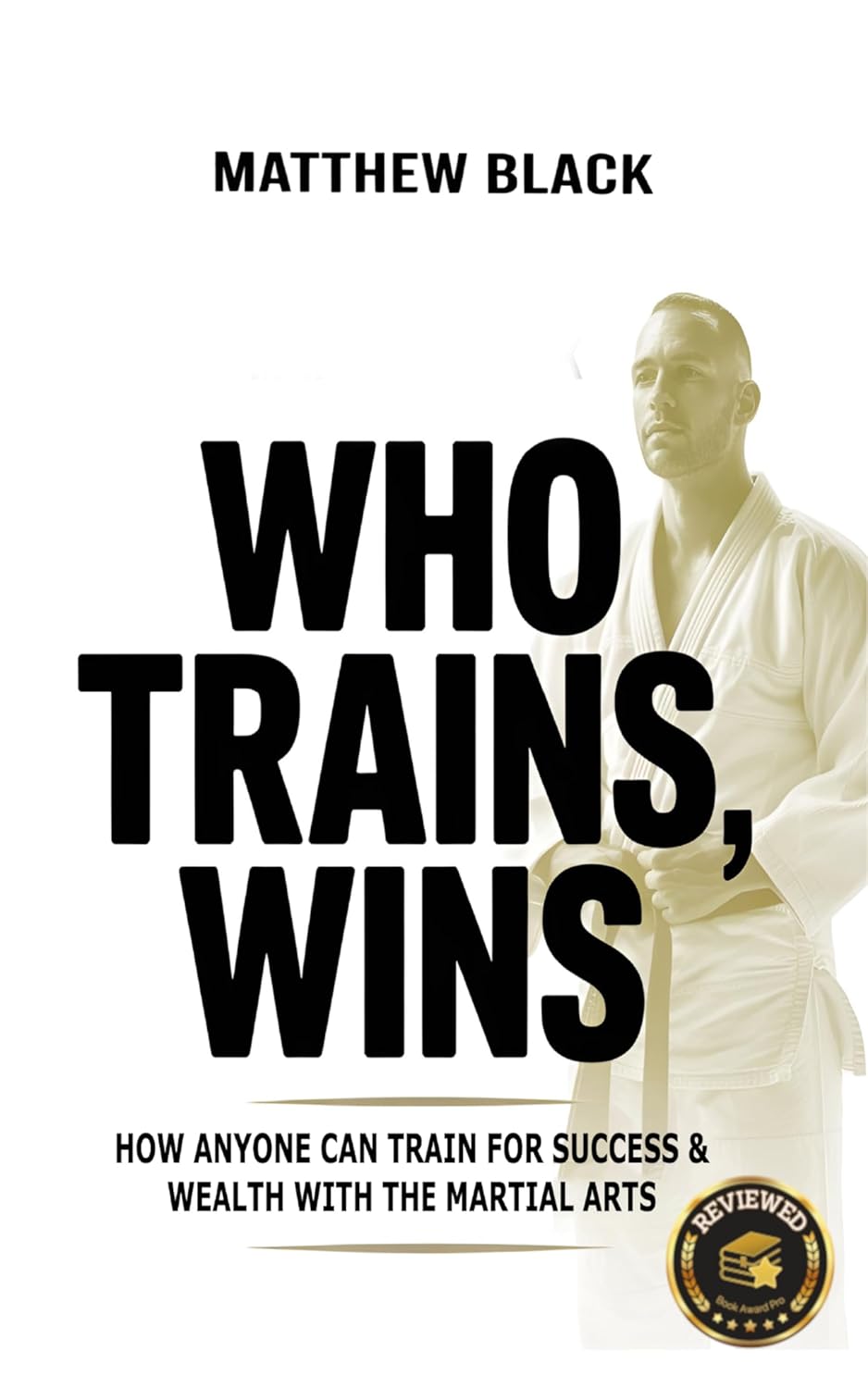
Who Trains, Wins is a personal guide to growth through martial arts, written with a mix of tough love, lived experiences, and clear admiration for the warrior path. The book blends personal stories, practical training advice, and reflections on discipline, emotion, and mindset. It walks through the author’s own training across many countries and styles, and it ties each lesson back to everyday life. The message comes through loud and clear. Training shapes the body, the mind, and the choices we make.
Some parts felt almost like a coach shouting from the sidelines, and other parts felt like a quiet conversation late at night when you admit things you rarely say out loud. I liked that contrast. It kept me awake. Author Matthew Black writes with a kind of sharp honesty that sometimes pokes at you. I felt it most in the sections about discipline and frustration. They reminded me how often we get in our own way. The storytelling adds heart. His memories from childhood scraps or tough nights on the job land with real weight. They give the book grit and color, and I appreciated that he never tries to make himself look perfect. It made the lessons easier to trust.
His talk about training against yourself really resonated with me. It is easy to chase external markers of progress. It is harder to sit with your own limits and push past them. I liked how he tied emotional control to fighting, and how those thoughts spill into everyday challenges. He writes in a way that makes you feel both seen and pushed. At times, the tone got intense, yet it also carried warmth. It made me feel motivated and a bit humbled at the same time.
By the end, I felt the book had given me more than advice. It had given me a mood. A sense of wanting to do better for myself. I would recommend Who Trains, Wins to anyone who wants a mindset shift and not just a workout plan. It is perfect for people who crave discipline, or who feel stuck and want a spark to move forward, and for anyone curious about the deeper side of martial arts.
Pages: 290 | ASIN : B0G4NFFWX8


