Blog Archives
Christ vs Satan – Final Battle for Earth has Begun


The Final Battle for Earth has Begun, Christ vs Satan, by Trinity Royal, is one of the most extraordinary books that I have read this year. The concept of an ongoing war between good and evil, light and dark, that is hidden from the human eye is intriguing and the way that this provocative yin and yang is explained and explored in the book is fascinating.
The author describes the world we live in as a matrix, and in most religions, there is a pull for our souls either toward light or darkness. This book references Christianity, insisting that Satan is on the battlefield to wipe out our souls for judgment day. It perfectly describes the fall of Lucifer, the battle for our souls, why we are in this matrix, and most importantly, how to break off from the matrix that is seemingly designed for us to be controlled. It draws similarities from the Matrix movies, describing how we can take either the blue pill to remain oblivious to what is happening, or the red pill to be shown how deep the rabbit hole goes.
The author says that one can be in the Matrix, but not of the Matrix when describing ways in which it can be broken. A quote that sums up the purpose of this book is, “You can train yourself, through conscious mental effort, to go beyond the false illusions the spiritual Matrix inflicts on you and raise your mind to an awareness of the spiritual realities it keeps from you”. This is an interesting parallel to Neo’s journey in The Matrix. The book continues to point out ways in which one can be manipulated by darker forces, and how to avoid them.
While I thought the book presents some interesting ideas, the book shapes scripture to convey its poignant philosophy. The concept of free will as well, which I think most religions are based on, takes on a new meaning and understanding through the interference of these forces in our lives. This is an interesting book that I would recommend for Bible study, or to anyone interested in Christian philosophy, Christology, or spiritual leaders.
Pages: 141 | ASIN: B0BFC9BB6Y

The America I Grew Up In
The Rise and Fall of the American Republic give readers a look at how the US government was originally structured vs. how it is structured today. Why was this an important book for you to write?
I love my country but I felt it dying in my lifetime. I wanted to know why. I felt the need to share what I found to bring awareness to those who never knew the America I grew up in. .Without knowing what the disease is, you can’t treat it in order to survive. The people are the vital organs of the country- without sufficient recovery the country can’t survive. I hoped the book would enlighten enough people to encourage, not force, a turnaround, a movement towards a healthy lifestyle that will return each American to a thriving, strong and prosperous existence.
How much research did you undertake for this book and how much time did it take to put it all together?
It took over 6 months to research and write this book, I started with religion in the United States. Why has the message changed since I was a teenager? Originally, eternal life was the result of the lack of sin. Today saying you accept Christ as your Lord and Savior is sufficient to be saved from eternal death without the need to desire to imitate Christ. As a result, continuing to live a sinful life doesn’t matter. The change from “Revealed Religion” to a “Social Religion” led me to additional research on how the absence of the religious principles our country was founded on, allowed the progression of other ideologies into every aspect of our lives like the spread of a disease.
What were some ideas that were important for you to share in this book?
Self-reliance is critical to living a good life. When you stumble, you get up. Practice make perfect. It gives you self-respect, pride in your character, and it gives others someone to look up to, respect for you, and trust in you as a role model. It encourages others to be like yourself-reliant. You will cultivate appreciation, true friends and companions. Someday, when you can no longer care for yourself, others, who followed your lead, will be there for you. You reap what you sow. Should that spread across the nation, there will be no need for dependence on government, no ability for government to control every aspect of your life, because you have, with good reason, self-respect.
What do you hope is one thing readers take away from your book?
The book was written to bring awareness, without being judgmental, that you have a choice: Live the way Americans lived before the 1950’s, or after the alliance of the Democratic Party with the Communist Party in 1953. It is since 1953 that the agenda towards government control began to infiltrate and degrade the education system, and never ending social programs proliferated to replace self-reliance, and guarantee votes from the poorly educated and the unmotivated. I believe without a return to Godly principles and the 2-parent family, a 3 R’s education system and a standard of self-reliance, the next best option will be, for those who do, to prepare to move to a country (like Costa Rica) whose monetary system is not dependent or linked to the U.S. Dollar. Because it seems inevitable that our policies will result in a total collapse of our government and it’s currency, bringing us all down into poverty and under the thumb of a new government that will control all industry, telling you where to live, to work, and paying you what they can afford (a form of Universal Income). We will be equally poor.
Author Links: GoodReads | Facebook
By promoting discontent where there was none, they have divided our nation by socioeconomics, race, ethnicity, religion, and politics. There are exaggerated issues of racism, the rich and the poor, business vs. the working class, climate change, entitlements vs. hard work, Socialism vs. Capitalism, and Conservatism vs. Liberalism. All these deceitful distractions are productive tools of our enemy that divert our attention from the master plan to fully install a new form of government that gives full control of our lives to the government.
Most Americans, as well as most politicians, are too distracted by the minutiae mentioned above to see the big picture that this book details. There are no longer enough people who understand or are willing to defend the Constitution that enabled US to become the greatest nation in history while it was strictly interpreted. I fear it is too late to reverse the process now.
URGENT UPDATE- email christiansoldiersofamerica@gmail.com for a free Bonus Chapter.
The Eighteen Years That Didn’t Change Anything
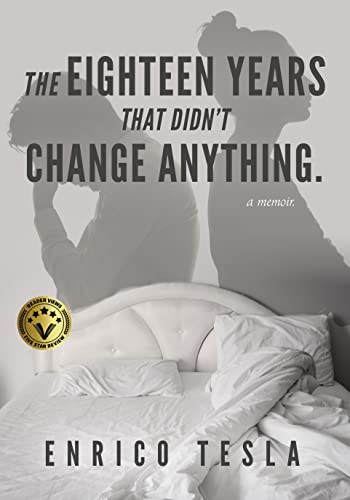

Enrico Tesla’s The Eighteen Years That Didn’t Change Anything is a memoir depicting the life of an average man as he lives through his prime to middle-aged years. The author takes an alternative approach to contemplate the human condition and existence.
Tesla excels in portraying himself as an average man within his words, “above average prospects.” The arc of the text shows him as a young man just beginning his career and concludes with a man who has loved, lost, and been a bit weathered by life. This portrayal renders his character accessible and relatable; he is neither above nor below the reader and, therefore, human. Still, he maintains a curious ego that leads him to ponder his existence in the context of some transformative life events.
The peculiar way he regards both his existence and the human condition also attracts the reader’s empathy. He ponders his existence in a neurotic, scientific-theory-based manner that encourages the reader to ponder the intersections of humanity, an arguably subjective matter, and science, a discipline founded in concrete fact.
His careful pairing of certain scientific facts, such as natural selection and Einstein’s iconic mass-energy formula, alongside his analysis of human perseverance at the end of the novel, is his thesis on life. It is through these efforts to prove his mastery of understanding life at its core that he comes to a poignant yet sobering conclusion. He frames even the most intimate experiences, such as love, in a clinical manner and even expresses to the reader areas in which he feels inadequate. Yet he possesses a stern conviction that due to the foundational understanding he has of life and the due process of nature, life is still worth living.
Pages: 114 | ASIN : B0BBCS8FCT
This Is A Lesson To Us All
Icarus Never Flew ‘Round Here follows a lonely rancher on a contemplative journey that explores our idea of God and how we can become servile to that idea. What was the inspiration for the setup to your story?
The initial spark of this story came from driving through the same Oregon High Desert that’s depicted in the novel. It’s a lonely stretch of highway. The kind where significant chunks of time can pass without seeing another car. This produces an immense loneliness. But oddly it’s sort of a euphoric loneliness, especially if you’re the kind that can appreciate the beauty that a high desert has to offer, because it makes you feel like you’re the only one alive. And, if you’re inclined to believe in god, it makes you feel closer to him/her/it. It makes you feel special.
So, the idea of putting a character out there on the edge of the horizon sat around in my mind for quite some time. Then, as I began to read and teach authors like Kafka, Sartre, Camus, and Dostoyevsky, I became fascinated by absurdism, existentialism, and the like. The specific idea that became the driving force behind Icarus Never Flew ‘Round Here is the clarification Jean-Paul Sartre provided for existentialism in a famous speech turned essay titled Existentialism Is a Humanism. It was there that he outlined that people traditionally believed that our essence precedes our existence, meaning that the idea and purpose of human beings was conceived in a creator’s mind before we were born. Existentialism posits that the order is reversed, that we exist and then it is us who determines our essence.
I wanted to critique the traditional religious view of that debate by showing the dangers of thinking god has ordained all that you do. Historically, there has been a lot of pain caused by this idea, especially because it’s so difficult to rid yourself of once the idea takes root. I believe it to still be one of the biggest cancers in modern American culture.
Dale Samuel is an interesting character. What were some driving ideals behind his character’s development?
Toughness and self-sufficiency are probably Dale’s two defining characteristics. And although Dale is rather rough around the edges from the beginning, those characteristics give him a nobility that I think readers can respect. He is in some ways an ode to the kinds of hardworking, rural people that can be found in the wide-open spaces of Idaho and Oregon and, of course, the rest of “Middle America”.
Eventually, Dale’s toughness and self-sufficiency work against him, as it does with many of us stereotypically stubborn Americans, because he thinks he can figure everything out by himself. Or, when rather humble and undecided, he tends to go with his gut instinct to break the tie. It’s through this type of thinking that I critique all of us who find the meaning in life’s events that we desire to exist. We create our own meaning but think that we’ve discovered god’s, which creates a sense of elation that few recover from.
What were some themes that were important for you to explore in this book?
Demonstrating the flaws of thinking our essence precedes our existence is the central theme, which is why the novel is told non-linearly and why there is no real inciting incident. I attempted to marry content and form by having the reader witness events in Dale’s life without knowing why they were happening. The why, or the essence, comes after the event as you piece things together. So, that theme dictated not only what the novel is about but also how I constructed it and sequenced the final product.
Another more subtle theme, that’s also prevalent in my first novel Ways and Truths and Lives, is the idea that everyone possesses little bits of relevant truths. If we pay attention to all of Dale’s encounters, all the people he comes into contact with dispense tiny fragments of wisdom. Wisdom that could have saved Dale a lot of trouble if he wasn’t so headstrong. This is a lesson to us all, and through it I try to celebrate the idea of democracy merged with the more Eastern idea of multisided truth.
What is the next book that you are working on and when will it be available?
I have a third novel idea that is now mostly in note form, although a few practice chapters have been drafted. It will center on a priest who has lost his faith and a whole host of characters that come to him for guidance. The book, as I see it now, will center on how the church (at large, not specifically Catholicism) represses our sexuality in unhealthy ways. That project is, however, probably several years away.
What you’ll most likely see from me first is a book of poetry, which I hope to have fairly ready after I finish my master’s in creative writing (2024). The bulk of my poetry centers on the idea that absent and/or delinquent fathers are a perfect metaphor for a god, assuming one exists, that has abandoned us (i.e., the Christian god).
Author Links: GoodReads | Twitter | Website
Years of living and ranching in the lonely and desolate Oregon High Desert has given Dale plenty of time to think. He specifically ruminates and wrestles with the idea of whether he and his wife Janice are cursed like all of humankind, or if somehow they are different—special even. Armed with only a thimble full of theological understanding, Dale must figure out whether he indeed has a preordained essence or if he simply exists, and what the consequences of either would be.
Dale’s inevitable descent into frustration and erratic behavior illustrates the irony that so many of us are guilty of: when we try to emulate the idea of god that we’ve developed in our mind based mostly on intuition, we end up becoming servile to an idea, the results of which often ripple and reverberate in disastrous ways.
The only question is, does the horizon say anything back?
Believe In Positive Change

Building High Trust CommUNITY examines the contributing factors that have led to mistrust in America’s leaders and the growing divide between the people of the nation and proposes what must be done to resolve the situation. Why was this an important book for you to write?
We have observed the widespread mistrust and divides, which are all around us and so frequently described in the media. We talk about those divides in the book. It was important for us to write about specific approaches to making progress, to rebuilding trust, to bridging divides whether at an individual level or working on larger problems. We have evidence trust can be built with intentional efforts and we want to broadly share this good news.
What were some ideas that were important for you to share in this book?
The first important idea is that it is a myth that there is nothing we can do to build trust. In fact, everything we do contributes to trust or distrust. We can intentionally move from a distrusting to a trusting environment. It takes work but it brings out the best in all of us.
Did you find anything in your research of this book that surprised you?
We were surprised and pleased by the number of people who want to change and contribute to building a more trusting environment—more trusting socially, more trusting politically. Individuals we interviewed for the book, regardless of their backgrounds or political preferences, expressed genuine interest in bridging the divides that have led to negative polarization and the lack of problem-solving so characteristic of our present times.
What do you hope is one thing readers take away from your book?
We hope readers will believe in possibilities; we hope they will believe they can make personal differences in their lives and the lives of the individuals around them. We hope they will believe in positive change and that trust is the bedrock of that change.
Author Links: GoodReads | Website
A Literary Study of the Book of Genesis

A Literary Study of the Book of Genesis by Wilma Brown-Foreman is an educational course that will help teachers and students gain and test their knowledge of the Hebrew Bible. The author opens the text with a pre-assessment so that the reader can measure their understanding of the Hebrew Bible. The author also provides the website links for the reader to go online and take the assessment. After the pre-assessment author Brown-Foreman dives right into the lesson about teaching the Bible in public schools. With around 35 lessons the author covers several topics in the Book of Genesis.
This is an enlightening and informative book that will help readers learn in a way that is comfortable for them. The information in this illuminating book is delivered in a straight-forward manner, as if in a classroom with a wise professor. The author successfully provides readers with the tools needed to learn and test their knowledge of the Hebrew Bible.
The teachings in the book may be controversial to some, but I think this book would be beneficial for those who are curious about how teaching the Bible in school can be beneficial. I appreciated that the author provides factual evidence rather than her personal opinion and she does not try to persuade the reader to convert or change their beliefs. I can see this book being used in Bible school as the author provides the reader with the information they need to learn, grow, and better understand their strengths and the subjects they need to focus more on. This can also be an interactive learning experience for readers that are serious about the subject because the author provides her contact information to reach out to her for clarification or more information.
I would recommend this book to students who want to learn more about the Hebrew Bible and to teachers who want to provide their students with an easy to use study guide.
Pages: 266 | ISBN: 1915165172
The Rise and Fall of the American Republic

Books offering opposing viewpoints and unique takes on current events always catch my eye. I believe that learning what makes others tick can be helpful in the long run. As a public school educator of over 25 years, I was intrigued and felt compelled to read D. Jonathan Scott’s most recent work, and I was not disappointed.
The Rise and Fall of the American Republic offers readers a complete breakdown of the current status of the government of the United States, its history, and what today’s structure looks like compared to its beginnings. Scott goes into great depth as he explains the results of his research into Communism’s appearance in the United States. Scott’s research is thorough, and his examination of Socialism and Communism gives readers a unique perspective on which to contemplate.
Christianity and anything that stands as a threat to it are important in Scott’s examination of current political events in the United States. Readers who are concerned with maintaining a Christian-based society will appreciate Scott’s research, especially when it comes to schools, the media, and laws. Scott has gone to great lengths to help explain how far our country has strayed from its original plans and how that has impacted each and every aspect of our lives today.
As a teacher, I found Scott’s research on education particularly interesting. It’s always enlightening to hear another perspective on public schools and how our children are being taught. Scott not only shares the results of meticulous research, but he gives a list of suggestions for getting our country back on track.
The Rise and Fall of the American Republic is thorough and enlightening and I highly recommend it, although at times it does feel like a textbook. I recommend Scott’s work to anyone looking for a carefully researched explanation of today’s political climate as well as a hard, no-holds-barred breakdown of all that is wrong with our country. Scott minces no words, and his work will resonate with many a reader.
Pages: 112 | ASIN: B08NFP8L1B
China Watcher
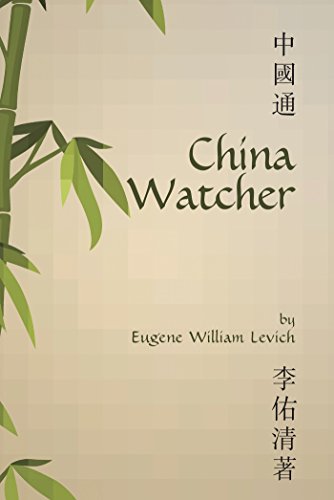
Author Eugene William Levich’s China Watcher gives a rare, personalized account of China’s culture and history while also touching on the political unrest characteristic of its relationship with Taiwan. Levich has an advanced understanding of East Asian studies, having received two master’s degrees and a doctorate in the field. China Watcher recounts his time living abroad in Taiwan in the 1970s, where he was able to experience the local lifestyle firsthand. Charming anecdotes are intermingled with brief historical explanations in an attempt to provide a comprehensive view of Taiwan, which is an essential part of mainland China and its own independent entity.
What I found most remarkable about this work was the thoughtful, clever, and compassionate way in which it was written. What could have been yet another dry historical text is brought to life by the very personal nature of the writing. Often chapters open with lines of poetry or ancient Chinese wisdom, which adds a quality of loveliness to the text and seems an accurate reflection of the culture.
Though the author does discuss the politics and recent history of the region, what stands out most are his stories—his own personal experience with the Taiwanese. For example, he tells one story of Ah Hua, a little girl who lived on his block, who once organized a heist to obtain his fresh pineapple plate. Because the story is told with such obvious affection, you cannot help but fall in love with Ah Hua yourself and with Taiwanese culture as a whole.
While a delightful read, China Watcher did tend at times to read like a college lecture—albeit funny and thoughtful. If that was the intention, then it succeeds. Perhaps, though, with a heavier lean towards memoir and away from history textbooks, the text could be appreciated by a wider audience.
China Watcher is an entertaining and educational look into the philosophy and culture of the Taiwanese. Through true story accounts and well-researched historical facts, readers will develop a comprehensive understanding of what life is like on the island of Taiwan.
Pages: 277 | ASIN : B079654SJG


 LITERARY TITAN