Blog Archives
Who Trains, Wins: How anyone can train for SUCCESS & WEALTH with THE MARTIAL ARTS Train and Grow Rich
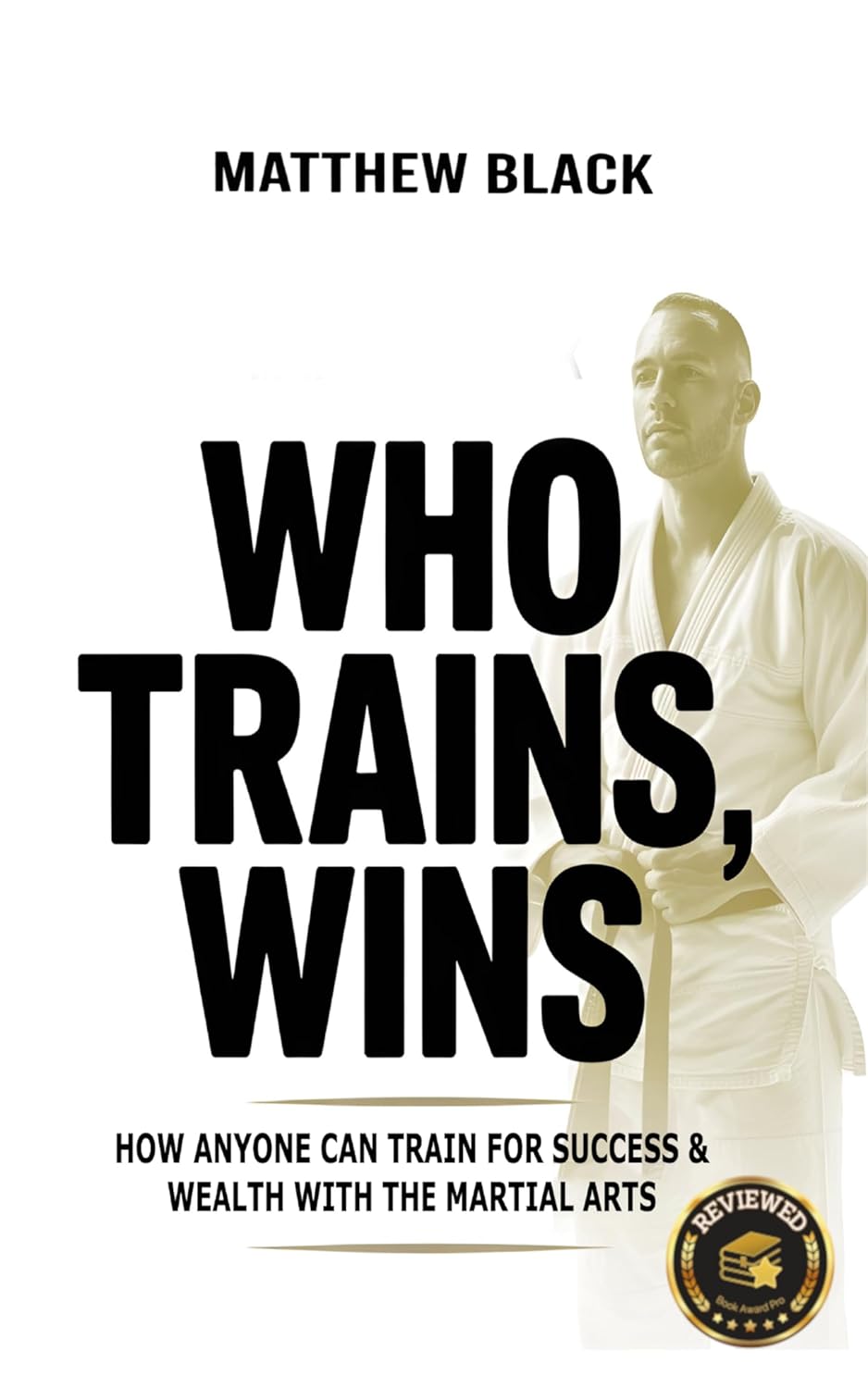

Who Trains, Wins is a personal guide to growth through martial arts, written with a mix of tough love, lived experiences, and clear admiration for the warrior path. The book blends personal stories, practical training advice, and reflections on discipline, emotion, and mindset. It walks through the author’s own training across many countries and styles, and it ties each lesson back to everyday life. The message comes through loud and clear. Training shapes the body, the mind, and the choices we make.
Some parts felt almost like a coach shouting from the sidelines, and other parts felt like a quiet conversation late at night when you admit things you rarely say out loud. I liked that contrast. It kept me awake. Author Matthew Black writes with a kind of sharp honesty that sometimes pokes at you. I felt it most in the sections about discipline and frustration. They reminded me how often we get in our own way. The storytelling adds heart. His memories from childhood scraps or tough nights on the job land with real weight. They give the book grit and color, and I appreciated that he never tries to make himself look perfect. It made the lessons easier to trust.
His talk about training against yourself really resonated with me. It is easy to chase external markers of progress. It is harder to sit with your own limits and push past them. I liked how he tied emotional control to fighting, and how those thoughts spill into everyday challenges. He writes in a way that makes you feel both seen and pushed. At times, the tone got intense, yet it also carried warmth. It made me feel motivated and a bit humbled at the same time.
By the end, I felt the book had given me more than advice. It had given me a mood. A sense of wanting to do better for myself. I would recommend Who Trains, Wins to anyone who wants a mindset shift and not just a workout plan. It is perfect for people who crave discipline, or who feel stuck and want a spark to move forward, and for anyone curious about the deeper side of martial arts.
Pages: 290 | ASIN : B0G4NFFWX8

Vulnerability Is Strength

The Work In Between is a memoir sharing your experiences of losing over 100 pounds, surviving cancer multiple times, and going through a period of self-reinvention. Why was this an important book for you to write?
I kept getting asked where my book was. People assumed I had written one given my experiences. After a lot of self-reflection, therapy, and conversations, I felt I was ready to tackle a book. To be honest, I wasn’t convinced I had that interesting of a story. I wasn’t sure anyone would care. However, some conversations made it clear that it might be helpful to others, if only to show you can go through some pretty tough stuff and still be a compassionate, successful, and joyful person. So, I wrote it. The response has been overwhelmingly positive.
I appreciated the candid nature with which you told your story. What was the hardest thing for you to write about?
It’s the only way I know how to be. I’m not very good at sugar coating things or only telling one side of the story (i.e., where I only look good). The hardest part was writing about when my brother Eric died. I cried when I was writing about losing all of my family, but Eric’s death was particularly difficult. Still is. I laughed a lot, too, though. I ended up remembering things I had forgotten. Good memories. Happy memories.
How has writing your memoir impacted or changed your life?
I’m happy that it’s resonated with so many people. Writing the book has made me realize I have a lot more work to do. I wrote a chapter in The Backyard Peace Project anthology and got a fantastic response to my chapter about loving ourselves harder when we stumble and fall. I think it’s a really important message to get out there, especially with all of the negativity and skewed reality from social media.
I’ve learned through my book that vulnerability is strength. Most people are tired of branded packages of unrealistic life. I think they are hungry for real, honest conversations about hard things. That’s how we grow. I was once told that I talk about things people usually keep in the shadows. That’s true. I do that because if I try to carry it all alone, it makes me sick: physically, emotionally, spiritually, and mentally unhealthy. We aren’t supposed to walk around with shame and guilt. Talking about it is healing, and it helps others process their experiences. Everyone has experienced hard things; sharing them helps us heal and grow.
What do you hope is one thing readers take away from your story?
That they are worthy just as they are and worthy of love and a good life. It doesn’t matter what the scale says, what other people tell you, or where you started in life. If you want to improve your physical, mental, emotional, or spiritual health, great. Do that. However, you are worthy of love and an amazing life no matter what.
Author Links: GoodReads | Website | Amazon
Witty, frank, and richly thoughtful, The Work In Between is peppered with wisdom from the author’s expertise in the field of Health Communication. Holmes brings an astute eye to the relationship between outward appearances and medical experiences as she draws from her doctoral education and years of service as a hospital executive. And yet, the complex web of stories that characterize The Work In Between extend far beyond Holmes’s own experiences. As this memoir makes clear, we carry family trauma in our bones. Until we do the inside work of facing our demons and declaring our worthiness, we cannot live the full, happy lives we were meant to live.
The Adventures of Belle Bear

The Adventures of Belle Bear tells the story of a cheerful polar bear cub who lives in snowy Mount Bearia with her loving grandmother, Baba Bear. Life is warm and cozy even in the cold. Then everything changes when they must move far away to sunny Calibearia. Belle Bear struggles with loneliness, new faces, and a school where she feels totally out of place. With Baba Bear’s steady encouragement and a magical new orange cape, she slowly finds her courage, makes friends, and discovers that who she is has always been enough.
This picture book captures that weird mix of excitement and fear that comes with starting over. The writing is simple in the best way. It feels comforting. I loved how Baba Bear’s words repeat like a song. It made me smile every time because it reminded me of the kind of thing a real grandma might say. The gentle rhythm of the book pulled me in. I didn’t expect to feel so moved by a polar bear pep talk, but here we are.
Moving, making friends, trying to fit in. It all felt honest. That moment when Belle Bear loses her cape on the journey felt symbolic in a way that surprised me. When the new cape appears as she speaks those affirmations in the mirror, it feels empowering. The story doesn’t pretend that being brave is easy, and I appreciated that. The artwork in the book is bright, friendly, and the characters are full of personality. Every character looks lively and expressive. The colors are soft but cheerful, which gives the whole book a cozy vibe. Each animal has its own charm. The style overall feels playful and comforting, perfect for a children’s book about friendship and courage.
By the end, I felt genuinely happy for Belle Bear. The book wraps everything up with this sweet feeling of hope, and it left me wishing every kid could hear Baba Bear’s nightly reminder. I’d recommend this book for kids who might be moving, starting a new school, or feeling unsure of themselves. Honestly, it’s also lovely for any child who just needs a confidence boost or a comforting story at bedtime. It’s warm. It’s kind. It’s the sort of book that stays with you.
Pages: 32 | ISBN : 1966786506
Confidence Transformation

Girl Game: Balls Out is a blend of memoir, psychology, and empowerment, and is a call for women to reclaim their power, stop people-pleasing, and rise unapologetically into their full selves. Why was this an important book for you to write?
In love, I was always had an anxious attachment style, and I genuinely felt like something was medically wrong with me. My insecurities always got the best of me, and I grew up without any confidence or self-esteem. Rejection was my middle name. I was unlucky in love. I had to get to the bottom of this, so I spent 5 years intensively studying attachment theory and childhood emotional neglect, and boy, did my findings revolutionize my life as I know it. That research and my own confidence transformation were the catalyst and backbone of this work.
In Chapter Six, “The Fight of Your Life,” you write about internal battles. How do you personally recognize when you’re in one?
By how I am feeling. All internal states are attached to a feeling, and all feelings are trying to tell us something vital about ourselves.
What do you hope women take away from your message when they’re standing at their own
breaking point?
That they heal “balls out” style. Many people sit in a therapist’s office for years and take medication for decades hoping to numb the pain, but they never really heal HEAD ON. I encourage radical healing through awareness and consciousness, and that requires a full-blown, balls-out exploration of the shadow, or what I call an emotional exorcism, in this book.
You mix faith, psychology, and empowerment in a unique way. How do those three forces coexist in your own healing process?
I am a spiritual person. I do blend faith, spirituality, psychology, and empowerment because of my background in all 3. I refuse to take pills. I don’t go to therapy (but I am a huge fan of it) – I champion healing by facing problems head-on and feeling them fully until healed.
Author Links: GoodReads | X (Twitter) | Facebook | Website | Amazon
With over 100 years of research behind it in human psychology, emotion, healing, attachment and relationships, self-worth and identity, this book provides profound insights concerning the realities that shape our existence when we struggle with low self-esteem. Since our subconscious accepts all suggestions as facts, we are met with demons we didn’t create who plague us as mirrors impacting our closest relationships while making rejection become the norm. This happens because of generational trauma passed down from ancestors and the general negativity felt and experienced in the external world. By embracing self-worth from within, the book emphasizes the transformative power it holds in reshaping personal connections and attracting genuine affection. The text prompts introspection on questions of rejection, societal constraints, and the impact of insecurity on personal growth and fulfillment. Encouraging a shift from seeking external validation to embracing inner worth, GIRL GAME: BALLS OUT advocates for empowerment and taking control of one’s narrative. By fostering self-belief and authenticity, individuals can transcend self-doubt, radiate confidence, and magnetize positive interactions.
You can either overcome or come undone… the POWER is yours.
Are you hiding behind that pretty face…
True Empowerment
Girl Grit: Savage Not Average is a blazing manifesto that exposes the wounds society inflicts on women and rebuilds them into fierce, unshakable self-worth. What moment or experience first sparked the fire that became Girl Grit?
In August of 2022, I was on vacation in Florida, swimming in a pool by myself, when the idea very suddenly hit me all at once. I came home, put pen to paper, and finished my first book GIRL GRIT: SAVAGE NOT AVERAGE in 5 months.
You write with such raw honesty. Were there parts of your story that were hardest to include or share publicly?
Yes and no. I am a mask-off author. True to my nature, I believe in authenticity and the realness of life. The good, the bad, and the ugly. It’s time we are hit with the truth as a society instead of sweeping real problems under the rug while wearing the façade of our ancestors. We will grow and evolve as a society when we face our problems head-on. As an author, I was never going to transform someone’s life overnight by writing about candy canes and gumdrops; I was going to do it through raw honesty, authenticity, and vulnerability were necessary.
The book moves from pain to power. How did you decide where to draw the line between vulnerability and empowerment?
Vulnerability and empowerment go hand in hand. You cannot access one without the other. Willing to be vulnerable is where true empowerment lies. We diminish our empowerment when we hide behind facades, suppress emotions, and refuse to solve problems head-on. People also usually go the route of drinking, drugs, or other addictions. I wasn’t about to go down those dark paths; I was going to take pain and truly turn it into power in an authentic and meaningful way.
If readers take only one message from Girl Grit, what do you hope it is?
Don’t be afraid of what anyone else thinks of you. Live your life authentically and heal others by refusing to put on the show of being perfect and infallible.
Author Links: GoodReads | X (Twitter) | Facebook | Website | Amazon
In Girl Grit, Dr. Elinsky passionately challenges and dismantles restrictive gender roles, asserting that they limit our potential as women and undermine our purpose as equal human beings. As an expert in gender relationship dynamics, Dr. Elinsky draws on extensive research to critically examine the very fabric of our social conditioning. She urges, “It is time to wise up, rise up, and ascend to your highest potential.” Celebrating the worthiness and grandeur of women’s capacities, Girl Grit will elevate you to unimaginable heights.
Finally, Dr. Elinsky advises, “Do not read this book unless you are ready to revolutionize your life as you know it.” Learn what it means to become a fire woman and unleash your regal authority into the world. Girl Grit will set your self-esteem on fire.
Humor is Like Social WD-40

The Awkward Optimist’s Guide to Human Connection is a hilarious, insightful, and refreshingly honest look at the challenges of social interaction. Why was this an important book for you to write?
The Awkward Optimist’s Guide to Human Connection grew from my own spectacular failures at small talk and my uncanny ability to say “you too” when waiters tell me to enjoy my meal. After decades of collecting enough awkward moments to fill a museum (or is that a mausoleum?), I realized I wasn’t alone in this special kind of social purgatory—and that maybe my pain could be everyone else’s comedy gold.
Writing this book was important to me because I believe humor is like social WD-40—it makes the squeaky, uncomfortable parts of life glide a little smoother. Plus, it felt therapeutic and cathartic to transform my most cringe-worthy moments (like the time I waved back at someone who was actually hailing a taxi) into stories that might make others feel better about their own social blunders.
Beyond the comedy, I wanted to create an antidote to those insufferable Instagram influencers who make authentic connection look as effortless as their “candid” sunset yoga poses. Real human connection isn’t filtered or perfectly lit—it’s messy, sometimes awkward, and occasionally involves spinach in your teeth during important conversations. Take a look at my podcasts and YouTube casts. They are not NPR Perfect-are you kidding? They are perfectly awkward and authentic.
Ultimately, this book is the guide I wish I’d had during my own journey—a reminder that we’re all just awkward optimists hoping someone will laugh at our jokes and forgive us for accidentally calling our boss “mom” that time in a staff meeting. Everyone else was laughing, so I joined in. That was awkward.
What were some ideas that were important for you to share in this book?
The core ideas I absolutely had to share in “The Awkward Optimist’s Guide” emerged from years of underfunded research (read: embarrassing myself in public and taking mental notes). Some of the most important concepts include:
First, the “Three-Second Rule of Overthinking” – not the one about eating food off the floor, but rather my discovery that giving yourself more than three seconds to analyze a social situation is like falling down a rabbit hole lined with your most embarrassing memories. Action before anxiety became my mantra.
I also needed to debunk the “Perfection Myth” – this bizarre cultural notion that everyone else is navigating social waters like graceful dolphins while you’re flopping around like a caffeinated seal. The truth is we’re all seals. Some just hide their flippers better.
The concept of “Authenticity as a Superpower” was crucial to include. I found that when I finally stopped performing what I thought was a convincing impression of a socially adept human and just showed up as my awkward self, people actually connected with me more. Turns out, vulnerability is like social catnip.
And finally, the idea that “Connection Happens in the Cracks” – those unplanned, unfiltered moments when someone sees you spill coffee all over yourself and instead of pretending to be perfect, you both laugh until your sides hurt. Real relationships aren’t built during flawless dinner parties; they’re forged in shared catastrophes and mutual weirdness.
I wrote this book to give permission to the awkward optimist in all of us to stop waiting until we’ve figured it all out, because spoiler alert: none of us ever do.
What is one piece of advice you wish someone had given you when you were younger?
One piece of advice I wish someone had given me when I was younger? “Your awkwardness isn’t terminal—it’s your personality’s immune system fighting off inauthenticity.”
Throughout my teens and twenties and thirties and forties, I treated my social awkwardness like a contagious disease that needed to be quarantined. I spent approximately 60% of my mental energy trying to appear “normal” in social situations (worrying about what others were thinking), 30% replaying my conversational fumbles in excruciating detail, and the remaining 10% avoiding eye contact with anyone who witnessed said fumbles.
No one told me that those cringe-worthy moments—like the time I confidently waved at my crush across the cafeteria only to realize I had ketchup smeared across my face like war paint—were actually building my resilience muscles. Or that the person who called out “enjoy your haircut” after I left the barbershop (to which I brilliantly responded “you too” to someone clearly sporting a shaved head) would become one of my closest friends because we bonded over mutual awkwardness.
If I could go back, I’d tell young me to save the energy I spent trying to be a smooth operator and redirect it toward something more achievable—like solving cold fusion or teaching cats to respect personal boundaries. Because eventually I learned that people don’t connect with your highlight reel; they connect with the blooper reel you’re brave enough to share.
So, my advice? Embrace the awkward early. It’s not the obstacle to connection—it’s the express lane.
What is one thing that you hope readers take away from The Awkward Optimist’s Guide to Human Connection?
If readers take just one thing from The Awkward Optimist’s Guide to Human Connection, I hope it’s the liberating realization that everyone else is also mentally rehearsing conversations before they happen and then performing extensive post-mortems afterward. We’re all members of the same neurotic book club—some of us just have better covers.
I still remember the day this truth hit me: I was standing frozen in the grocery store, contemplating whether saying “I like your shirt” to the really pretty cashier would come across as friendly or deeply unsettling and creepy. Then I noticed the person behind me muttering what appeared to be their own same conversation script under their breath. That’s when it clicked—we’re all out here simultaneously terrified of each other and desperately wanting to connect. It really hit me after the COVID 19 Pandemic. We needed understand personal connection again.
My fondest dream is that somewhere, someone will read this book in public, laugh out loud at a particularly embarrassing anecdote (probably the chapter about my disastrous attempt to network using only movie quotes), and the stranger next to them will ask what they’re reading. They’ll strike up a conversation, both fumbling through the social niceties, until one of them bravely acknowledges the awkwardness—and in that moment of shared humanity, a real connection will form.
Because ultimately, that’s the paradoxical magic I hope readers discover: our collective awkwardness isn’t the barrier to connection—it’s the bridge. So next time you accidentally text “Love you!” to your plumber or walk into a room and immediately forget why you’re there (I do this a lot!), remember you’re not failing at being human. You’re actually doing it exactly right. As awkward as it is, your call to action is to go buy my book. I can guarantee it will be a mistake worth making.
Author Links: GoodReads | Facebook 1 | Facebook 2 | Website | Reedsy | Kobo | IngramSparks
The guide navigates both digital and physical social landscapes, acknowledging that forming meaningful relationships in either realm can feel like trying to perform surgery while wearing oven mitts. Through chapters like “The Science of the Awkward” and “The Zoo, The Bar, and The Museum: Pickup Lines in the Wild,” readers explore how their most embarrassing moments might actually be their most endearing.
Unlike traditional dating and social skills manuals that promise to transform readers into charismatic smooth-talkers, this book embraces authenticity in all its messy glory. It suggests that waiting three hours to craft the perfect “casual” text message or accidentally walking the wrong way after saying goodbye are universal experiences that make us human rather than social failures to be corrected.
The author positions social mishaps as future anecdotes waiting to happen, teaching readers how to transform their most cringe-worthy encounters into entertaining stories. The book also offers unexpected perspectives on modern social phenomena, suggesting that being ghosted might be a hidden blessing and that failed attempts at wit might create more memorable connections than polished pickup lines.
Written for anyone who’s ever felt like a caffeinated rhinoceros in a world of graceful gazelles, the guide serves as both a practical manual and a permission slip to embrace one’s authentic self. It promises not transformation into a social butterfly, but rather the confidence to flutter awkwardly and own it. The result is a humorous yet insightful exploration of human connection that turns social anxiety into social advantage, one uncomfortable encounter at a time.
The Awkward Optimist’s Guide to Human Connection- A Field Manual For The Socially Ambitious
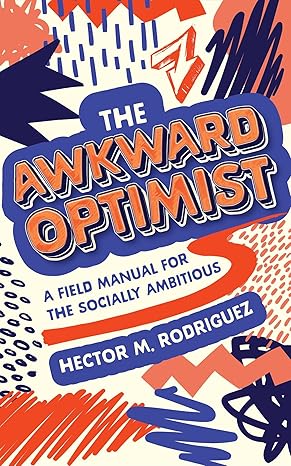
Hector M. Rodriguez’s The Awkward Optimist’s Guide to Human Connection is a hilarious, insightful, and refreshingly honest look at the challenges of social interaction. It’s part self-help, part comedy, and 100% relatable for anyone who has ever fumbled their way through small talk or tried (and failed) to master the art of a good pickup line. Structured as a “field manual” for the socially ambitious, the book breaks down everything from deciphering body language to navigating the terrifying world of dating apps. It reassures readers that awkwardness isn’t just inevitable—it’s a rite of passage on the road to building real human connections.
Rodriguez’s writing style is the best part of the book. He doesn’t drone on with clinical psychology or rigid rules; instead, he infuses every chapter with sharp wit, self-deprecating humor, and painfully relatable anecdotes. Take, for example, his breakdown of pickup lines in The Anatomy of a Pickup Line: A Postmortem. He dissects pickup lines with surgical precision, complete with real-world examples of just how cringe-worthy they can be. The book feels less like a lecture and more like a conversation with a friend who has been through it all and is here to make sure you don’t make the same mistakes.
One of the book’s standout strengths is its deep dive into nonverbal communication. The chapter Reading the Room and the Person’s Nonverbal Cues is packed with practical advice on how to interpret body language, but it’s never dry or clinical. Rodriguez presents it as a detective game—one where your mission is to decode subtle gestures, posture shifts, and even the dreaded forced smile. His discussion of the “Duchenne smile” (the real vs. fake grin) is both fascinating and useful, but what makes it memorable is the way he wraps it in humor. Instead of feeling like homework, it feels like an adventure in social sleuthing.
The book also shines in its breakdown of different social environments. Rodriguez goes beyond the obvious and explores places like libraries, museums, and even farmers’ markets as unexpected but prime locations to meet new people. The Safari of the Soul: Meeting People in Unexpected Places chapter made me laugh, especially the section about striking up conversations at the zoo. He encourages readers to embrace the weirdness of life and find opportunities for connection in the most unexpected places, reinforcing the book’s overarching message: human interaction is messy, awkward, and often ridiculous, but that’s what makes it fun.
The Awkward Optimist’s Guide to Human Connection is a must-read for anyone who struggles with social interaction, dating or just wants to laugh at the absurdity of human connection. If you want a book that embraces the chaos, teaches you useful skills while making you chuckle, and reassures you that awkwardness is just part of the process, then this is for you.
Pages: 153 | ASIN : B0DW4KTH76
Mental Health Crisis

The Stress is Gone Method helps readers navigate stress, anxiety, and trauma via emotional awareness and exercises centered around self-reflection. Why was this an important book for you to write?
I feel this material is so important right now because effective mental health care is so hard to find. The mental health crisis is compounded by stigmas, waiting until the last minute to ask for help, long wait times before appointments are available, etc. Personally, I have seen thousands of clients quickly improve their mental health by learning how to address problems from the inside, as opposed to searching for solutions on the outside.
How much research did you undertake for this book, and how much time did it take to put it all together?
This book is a culmination of the past 25 years of professional experience in the field. The techniques are time tested; first by myself, and second by my clients and students. I now train a broad range of mental health professionals, school guidance counselors, and suicide prevention specialists in my methods. The reach of these techniques continues to grow.
Why was it important for you to include a workbook for your readers?
Often I’m asked, “Why did you write a workbook?” It’s because the human race has a lot of work to do. Another book to read and not interact with, not engage with, that doesn’t help you explore yourself, would be just another book on the shelf. But something that causes a person to look deep inside themselves, and then guides them through practical steps to reduce their stress and anxiety, I felt would be my best service to humanity.
What is one thing you hope readers take away from the advice you offer in The Stress is Gone Method?
I hope readers take away a few things; (1) they can take control back from stress if they focus on what’s happening inside their body, (2) they can release anxiety and emotional pain, and heal traumatic memories, and (3) they can find all the answers they seek inside themselves in deep meditation.
Author Links: GoodReads | Instagram | Facebook | Website | Amazon
• Traumatic Events
• Caring for Elderly Parents
• Work, Finances, or School
• Caring for a Child with Special Needs
• Out-of-Control Family Situations
• Abusive or Narcissistic Relationships
• Personal or Family Health Crises
• Generational or Ancestral Trauma
• Loss of a Loved One
• Legal System or Medical Trauma
• Exhaustion from Placing Everyone Else’s Needs Before Yours
• Being Raised by Abusive, Addicted, or Neglectful Parents
This book allows stress to enlighten us as triggers become teachers and self-love fills the hole that trauma left in our soul.



 LITERARY TITAN