Blog Archives
Colin the Crab Finds a Treasure
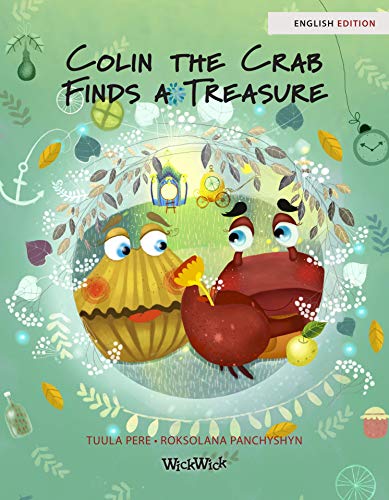

Colin, the crab, feels like he is an ordinary crab living alone. He has many friends who have many things going on in their lives, such as a family, success, and impressive antique collections. One day something unexpected happens to Colin. A tidal wave tosses Priscilla the pearl oyster into his backyard. Colin takes Priscilla in and helps her recover from the tidal wave, and before long, they become good friends. After Priscilla loses something valuable to her, Colin helps her find it and shows Priscilla that, more than anything, their friendship is the most valuable to him.
Colin the Crab Finds a Treasure by Tuula Pere follows Colin the crab as he lives his life content to be alone while his friends have many things going for them. When Colin starts to wonder if he is content being alone, Priscilla the pearl oyster appears in his backyard. Colin soon learns that friendship means more to him than fancy gadgets. Pere teaches kids to give everyone a chance no matter their status.
Children will be captivated by the colorful images done by illustrator Roksolana Panchyshyn as the pages are filled with detailed underwater scenes. This book is written for readers who are a bit older, kindergarten through fourth grade, as the chapters are longer and the lesson is more complex. Learning what is important in life and what to value is a challenging life lesson. Pere manages to convey this lesson in a manner that children can comprehend and relate to. In addition, this fantastic children’s book shows readers it is ok to express your feelings and be open and kind to others. I can see this book in libraries and classrooms.
Colin the Crab Finds a Treasure is a charming and entertaining book that will teach children the value of friendship and seeing the important things in life.
Pages: 24 | ASIN : B07HY341W6

Do You See Me at Home
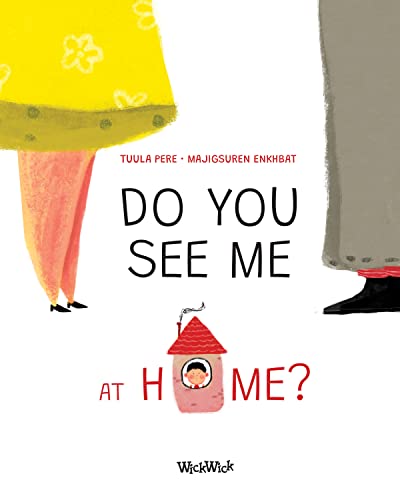
Do You See Me at Home written by Tuula Pere is a picture book that feels like you are looking into the mind of a child. This story is written from the perspective of a child’s thoughts and their parent’s responses to their feelings. All the interactions are everyday occurrences that parents and children can identify happening in their own lives at one point or another. Things like excitement and wanting to share their day, being scared by something they see on the TV or computer, things too loud, or having to stop playing in the middle of an adventure are experiences children have all the time.
My first thought when reading this realistic children’s book was, I have been here with my own children. I could identify with almost every situation the child and parents were experiencing. This would have been a wonderful book to have had to read to my own children when they were in preschool and young elementary kids. I can see how this expressive picture book would allow children to see their feelings are valid and normal.
The illustrations done by Majigsuren Enkhbat are vivid and bold. There are strong colors that work well together, helping to portray the child’s mood from page to page. When the child is scared by something on TV there is a mostly black page with an angry red fire. When the parents are comforting the child it is bright white with a sky blue and yellow that is soothing.
Do You See Me at Home is a beautifully written picture book that teaches children that their feelings and emotions are normal and ok to have. It is ok for big situations to be difficult for small children and parents and family are there to help them through. This is an ideal children’s book for preschoolers and kindergarten-age kids.
Pages: 32 | ASIN : B09JMDTFRC
Axel Washes the Rug
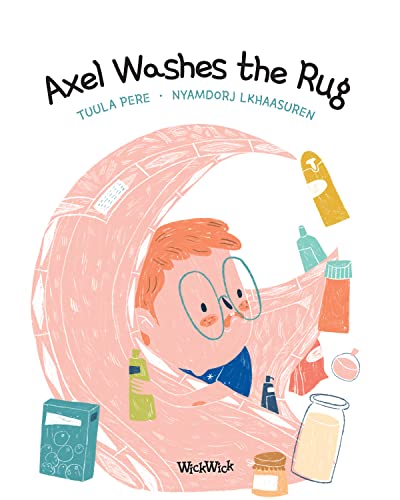
Axel is a little boy visiting Granny for the afternoon. She decides today’s snack will be blueberries. Axel loves blueberries and can’t wait to eat them. Unfortunately, someone comes to the door, and Granny has to go talk to them. Axel, unable to wait, grabs the bowl of blueberries and spills them on the floor. He tries cleaning up the mess, but they have left blue splashes of color all over Granny’s light-colored rug. Feeling bad, he flips the rug over to hide the mess. During nap time, Axel sneaks to the kitchen and drags the rug into the bathroom to wash. He has the right idea but accidentally puts bleach into the tub with the rug. Now Axel has to tell Granny what happened.
Axel Washes the Rug, written by Tuula Pere and illustrated by Nyamdorj Lkhaasuren, is a heartwarming picture book about asking for help, taking responsibility for your actions, and forgiveness. Axel tries to do things on his own but, in the end, needs to ask for help. He tried to hide things when he stained the rug and while trying to fix it accidentally made things worse, so he admitted he had done something wrong to his Granny and feared the worst. However, Granny is more worried about Axel getting hurt with the bleach than her rug.
Children will see when reading this story that it is important to let adults know when there is an accident and let them help fix things. It also shows that just because they make mistakes does not mean they will not be loved. Granny showed compassion and love to Axel even though her rug was ruined. The message that people are more valuable than things comes through with the text and the illustrations.
The illustrations are fun and colorful. The style of the drawings is appealing to children, and the emotions are evident in the pictures. You can follow the story through just the illustrations as the details and expressions match what the author has written.
Axel Washes the Rug is an entertaining and meaningful picture book with important messages presented in a way that preschoolers and kindergarteners will be able to understand. Teachers and parents will love sharing this feel-good story with kids.
Pages: 36 | ASIN : B09K49ZVVG
The Fox’s City

Francis is a real piece of work and has been since he was a young fox. Known for his greedy ways and the bullying he inflicted on others, he grew into an even more selfish adult. When he finagles his way into becoming the acting mayor, his plans to run the city are no less conniving and self-serving. Erasmus, the mayor’s good friend and trusted assistant smells a rat and sets out to put a stop to Francis’s scheme. The days of Francis getting what he wants may just be coming to an abrupt end.
The Fox’s City, written by Tuula Pere and illustrated by Andrea Alemanno, is the delightful tale of one fox’s plan to outwit a city and have his way. Francis is your typical literary fox–sly, selfish, and always scheming. He is a fantastic main character and has every possible flaw needed to make him memorable and make his story worthy of rereading time and time again. Erasmus, who seems so unassuming, is the ideal sidekick to the mayor and gives readers someone to root for against the calculating fox.
Pere’s tale is well-written and engaging, and I was enchanted by Alemanno’s beautiful illustrations. Between the little element of mystery in Francis’s tale and the softly-lit illustrations, this story is a true delight to read.
The Fox’s City would make a wonderful addition to elementary teacher’s collection. I can see Francis’s story as part of a classroom unit on trickster tales. Cover to cover, Pere and Alemanno deliver a wonderful story with an important lesson in cooperation and teamwork. Suitable for both read alouds and independent reading in mid to upper elementary grades, I highly recommend Pere and Alemanno’s work to teachers and parents alike.
Pages: 22 | ASIN: B07HYYX99R
Scared to Swim (Little Fears)
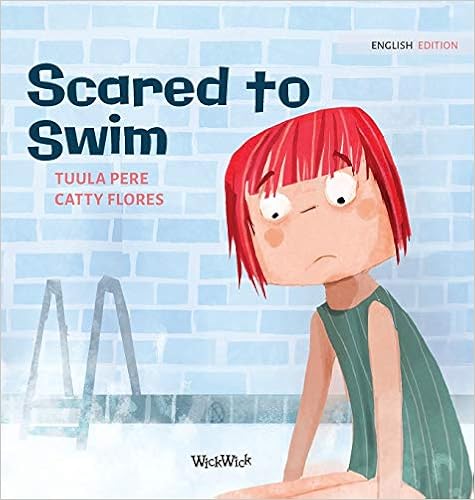
Lillian is taking a bath one day and decides that it would be fun to learn how to swim. Her father agrees and quickly signs her up for swimming lessons. But that night Lillian feels that she may have been too hasty in her decision and starts to worry. Sure enough, when she is in class she is frightened by the noise and wild activity in the class. How will Lillian ever learn to swim?
Scared to Swim is an educational children’s book that shows young readers how to conquer their fear, specifically their fear of swimming. Many parents, myself included, think that sending their child off to swim lessons solves their swimming problem. But for some kids all the activity of a swim class can make them nervous. Author Tuula Pere illustrates this point perfectly in her children’s book.
I loved the art in the book as it made Lillian’s emotions throughout the story very plain. The dramatic enhancement of emotion on the characters make for some funny scenes, like when Lillian says she wants to learn how to swim. I literally laughed out loud when I saw her waving her arms around as if she was swimming.
This bright kids book sends a powerful message to young readers that if they trust in their parents, and give it a good try, together they can accomplish anything. I thought this book was going to show the parent encouraging their child to take the class. I was delighted to see that the parent is the one that helps their child learn a new skill and gain confidence in themselves. This shows young readers that relying on family can be powerful.
Scared to Swim is about so much more than swimming, and all of these ideas are shared in an easy to understand and beautifully illustrated picture book. This is a fantastic book to read multiple times as I’m sure that every time a child reads it they will pick up a new subtle but important lesson.
Pages: 34 | ISBN: 9523254510
Heart, Brain, and Love

The Wild Waves follows a young boy that is terrified of boats because of the noise and speed and how a patient Grandpa helps him overcome those fears. What was the inspiration for your story?
I lived my important childhood years in the lake district of Eastern Finland. I have spent a lot of time in the waters – swimming, fishing with my father, adventuring on a rowing boat along the nearby lakes – so this subject is familiar to me.
As for swimming, I was one of the bravest and loved diving, too! But I must admit, I was afraid of fast motorboats. Our family only had a small rowing boat that I could use whenever I wanted. But I hated situations when someone took us for a ride in a motorboat. I would have preferred to have escaped the whole situation, but I tried to be polite! The feelings of such experiences now flow into my stories for children and their families.
The Wild Waves story is part of my book series, The Little Fears. I have built the series on the importance of a child’s experience. All the stories draw attention to the role of the adult as a listener and supporter for the child.
The adults easily underestimate the importance of the child’s concern. My experience is that the little fear quickly grows too big if you don’t get help with it in time.
When I present my Little Fears Series at book fairs in different countries, I often hear very personal confessions and childhood memories from adults. The message is the same: If only someone had taken my worries seriously, I would have coped easier with my fears even as an adult!
What books did you grow up reading?
As a child, I enjoyed living next to a small village library for a decade. There was enough to read for the curious child. I gradually went through most of the library department by department and subject by subject. Of course, I liked fairy tales at first, but soon I started reading longer novels and nonfiction.
In fact, nonfiction was my passion. Whenever I wanted to find answers to questions that preoccupied my mind, I browsed various encyclopedias and books about nature, geography, or history. My passion for information was great, and we didn’t have such literature at home. So, I spent a lot of time in the library and borrowed loads of books to read at home.
In elementary school, I quickly did all the other tasks, so the teacher let me read any books freely for the rest of the lesson. There, I became acquainted with Finnish folk tales and the stories of the Thousand and One Nights – both of which are still my favorites.
If you had to describe yourself in just three words, what would those be and why?
This is a difficult question. Sometimes it feels like one person can hold so many things that an entire dictionary would be necessary to describe them. I would rather divide the question into two parts: the words that describe my most important roles in different areas of life and those that define me as a person.
But let me try to stick to the assignment and choose the words heart, brain, and love.
The three words I have chosen are significant to me. I try to combine them all into a harmonious entity because I think they reinforce each other’s influence.
The things I find most meaningful in my life always follow me in my heart. It represents the human factor in everything I do. I am a very family-oriented person, but I try to extend the same warmth of my heart beyond the close circle and influence the well-being of others, too. I’ve noticed that incorporating the warmth of the heart into everything you do opens surprising doors and creates unexpectedly rewarding connections with others. Writing books for the world’s children is very well suited for this purpose, too!
Good goals are easier to achieve if they involve not only the heart but also the brain. I greatly appreciate people’s ability to learn, acquire knowledge, and use their own brains to weigh things up. The brain, used wisely, also effectively promotes soft values. The use of the brain is also related to a person’s self-confidence. With the help of education, it is possible to develop both the knowledge base and the ability to use it for the common good. For this reason, I want to combine my work as a children’s author and publisher also to support children’s education.
When my father died, and I had to choose the text on his tombstone, the choice was easy. Now it reads freely translated: The greatest of all is love. I feel that love has incredible power everywhere, not just in the family. If I can sense that a person truly loves and respects other people – even strangers and distant ones – it is easier to find common ground to start cooperation. Love cannot be pretended. When it includes genuine respect and interest in life, it has irresistible power. We can transmit that power in many ways. It goes along with everything we say or write, sometimes in words and on lines, sometimes between them. Even silence can contain love.
I hope that all these words – heart, brain, and love – say something about me. At least, I value and need them in everything I do.
What would you say is your interesting writing quirk?
I hope I understood the question correctly. One of my special traits and skills in writing is remembering in detail very old experiences, feelings, and scenes from my childhood. I also bear in mind events told by others and their emotional states. I combine all of these with my books, which are thus authentic and vivid.
After more than sixty years of living, I have a vast collection of stories in my mind. Just give me a keyword, and I’ll tell you a story about it. Let me work with the illustrator, and we will have a children’s book ready. I don’t mean to brag; there’s no reason for that. The world is full of more advanced authors. But I’m honestly doing what I truly believe in. That’s the best guarantee for my writing, and it doesn’t need any tricks!
Author Links: Facebook | Website
“The Wild Waves” is a story about the fear of high speeds and waves.
Otto dreads his family’s boat trips. He’s afraid of speeding over the water in the motorboat. But Grandpa is a patient teacher, and in the end, Otto dares to go aboard Grandpa’s old boat as assistant captain.
The waves are splashing, and the wind is howling. Otto is sitting stiffly in the cabin while the rest of the family is enjoying the boat trip. “What if the motor dies during the storm, and we never get back to shore?” Otto worries.
With Grandpa, Otto tries to get used to fast speeds on a new carousel. Thumb signals are a great help! In the end, Otto boards Grandpa’s old boat as assistant captain.
The Life Of An Author Is Never Dull!
The Caring Crab follows a handyman crab that is always out to help others that forgets to take care of themselves. What was the inspiration for this story?
Many adults who have read my book The Caring Crab tell me it’s a story of their life! About how they would like to help everyone all the time and cannot say “no.” Their own needs are left behind, and they become simply too tired. This sounds sad, but I can assure you that there is a lot of genuine friendship and sharing life together in my book.
Colin is the main character in Colin the Crab Book Series, which already has four books for older children and two so-called Mini Crab Books. This gentle and old-fashioned character has become a favorite of readers. It is typical for him to help everyone in need. And they are many!
Sometimes, others are even taking advantage of Colin’s patience and pushing him in various directions. But luckily, he is mostly stubborn enough to realize that he has the last word when it comes to his own life.
Colin represents all the gentle and kind people who tend to think first about the needs of others. They often leave their individual plans and wishes behind. Of course, it’s great to be helpful to others and be sensitive to what other people around you might need. But there is a danger that a person’s own needs will not be met, and exhaustion will take over eventually. In adult life, we often talk about burnout.
The story is strongly connected to the interplay between different individuals in real life, and we can interpret it in many ways. It’s about friendships between different people, sharing things, and helping each other. But it also reminds us to be selfish in a healthy way and take care of our needs. – And this includes the time for building the dream pavilion, too!
What books do you enjoy reading?
I have always been interested in history. Reading about the development of cultures and societies gives us a lot to think about even today. I believe everything in the world is connected. Life is a combination of countless chains that mix and form an extensive network. It links everything that has been to the present. Chains extend into the future. That’s why I think it’s important to read as much as possible and get information. It is an essential resource for all of humanity and, of course, for individuals.
I love to find the “stories” about people who lived before my time. And I don’t just mean rulers, leaders, financial figures, or other influential people. I love to read – and write – about more ordinary people, too, as I want to pay attention to the value of their life. I often think that each person would need a book of their own, telling their life story to the present world instead of being forgotten.
When I want to relax by reading, I choose something light to read. Detective stories are a lot of fun. Browsing through art books and architectural works is also refreshing when you’ve been working with words for hours and hours. My most recent holiday reading consisted mainly of local history as well as everyday cultural history – also the history of dollhouses.
Who has been the biggest supporter of your writing?
This is easy to answer. My main supporter has definitely been my husband. He made me start publishing my children’s books more than a decade ago and developed an international approach to our business. I would never have been able to establish such a project alone. He has spent both time and money on Wickwick Publishing. I can write good stories and communicate with illustrators and translators, but there is much more to it that depends entirely on my spouse’s skills.
Besides, it’s fun to travel together to the international book fairs, where my husband is also my “bodyguard” and takes care of all the logistics. A strong home front is vital to the author. Where else would I otherwise be able to read new texts straight away to an interested listener? It’s nice to immediately see the reactions on the face you’re used to interpreting. At least my spouse claims that evening coffees are always fun when he listens to what I’ve written during the day.
I also have a few trusted and loyal friends who always manage to encourage me to keep writing. Their support is especially important at times when I feel impatient and don’t see the impact of my work on the environment clearly enough.
What do you like to do when you’re not writing?
Although I am sociable and enjoy meeting people and traveling, I also need to spend a lot of time at home in complete peace. That’s when I listen to music on the radio or listen to documentaries. I often have some knitting in making because I love different colored wool yarns. From the people in my circle, the socks never run out! It’s also lovely to bake buns and tiger cakes at home, especially if I get the closest people to visit and enjoy them together.
I also spend a lot of time alone outdoors. There I can listen to the sounds of nature and think about my most sensitive thoughts. Many of my books have their origins in those walks. I know a lot of plants and birds, and I like to take photos of them. I also take a lot of pictures on my trips abroad. Often, they are strange pictures of some of the details that have caught my attention.
All in all, I am interested in both the big and small things around me. The world is full of stories if you keep your eyes open and are patient enough to listen to what others are saying or what is left unsaid. The life of an author is never dull!
Author Links: Facebook | Website
The exhausted Colin buries himself under a blanket and refuses to open his curtains. Puzzled, Colin’s friends call an emergency meeting—it’s time for them to take action
I Have To Trust My Instinct
The Healer Cat follows a house cat that has the power to heal through her touch and purrs as she goes out in a winter storm to help save a baby bunny. What was the inspiration for your story?
The initial inspiration for the book The Healer Cat contains mysterious features. The Healer Cat herself came to me as I lay half-asleep on the couch with the migraine just started. That kind of headache is rare for me, and I don’t like to take medication. When this mysterious fairytale cat arrived and put her paw on my head, I got the whole story in a flash – and my headache disappeared!
Amazed, I got up and began to memorize the story of the cat’s miraculous journey in a snowstorm and her encountering a wolf in a dark forest. When it was on paper, I felt surprisingly irritated. Something important was missing, and I couldn’t remember what it was! But the cat came back and reminded me about this scary wolf, one of the main characters besides the cat and the hare. I added the missing chapters, and the story was ready!
Also noteworthy is that I’m not really any cat person, but this healer cat Celesse became my friend. I even illustrated the first version of the book myself – which I hardly admit to anybody. But this current version is illustrated by a professional artist, and I love her skillful artwork.
What are common traps for new authors?
I think a new author may suffer from two opposing delusions; unreasonable disbelief or excessive expectations of one’s own possibilities.
The newcomer may be unsure whether anyone is interested in the book or whether it is good enough. I think the authors must at least be passionate about their stories and believe in their power.
On the other hand, some new authors may assume that publishers’ reactions are faster and more enthusiastic than they will be in harsh reality. Unfortunately, most books never find a publisher – and those who find one have to search through a dozen companies first!
My advice to the new author would be to keep realistic about one’s particular strength and not give up if the writer genuinely has something to say to the others!
What is your favorite book series?
All my series are dear to me, each in a different way. Several of them talk about the lives of children and their families from various angles. I try to pass on what I have experienced and learned as a parent for three decades.
I find it necessary to write about the unfortunate attempts (Axel and Ava Series) or difficulties of young children (The Little Fears Series and Do You See Me? Series). But the independent activities and sometimes slightly disobedient acts of older children deserve their own books (I Did It! Series).
But if I must choose something exceptionally dear to me, it would be Colin the Crab Series.
Colin is an exceptionally sympathetic crab with a mixed group of friends around him. I have created their extraordinary river bay world with many human joys and sorrows. When all friends are different as individuals, it is possible for me to address topics from many perspectives. All characters are unique, and everyone has something to give to each other.
The idyll at Colin the Crab’s home river is not perfect, as there are often disagreements about the issues, and opinions must be reconciled. These features of diversity and inclusion – individuality and coexistence – are precisely those that I like in human communities as well. Taking others into account makes living together more rewarding for everyone.
Colin has gained his fan base even abroad. Readers often comment on other characters in the books as well. They try to figure out which one of the characters they or their friends resemble. Opinions can even collide!
What has been the most surprising reader reaction you’ve received so far?
I have experienced a lot of powerful reader reactions. Often, the story brings to the surface the emotions the reader has tried to hide.
We have cried and laughed together with many young and old readers when we have been talking about my books and the stories behind the stories. I think a good book offers a basis for deep discussions. Suddenly new doors open, and people meet each other on another level.
In particular, the most demanding stories of survival, war, and shortcomings touch readers deeply and perhaps raise their concerns. For someone, the wolf in the forest in The Healer Cat has been the suicide of his friend. For the other, it has been the severe illness threatening the life of her dear mother. Raspberry Red has built understanding between generations in the families about the war experiences that have been too difficult to discuss so far.
This kind of feedback has encouraged me to write further, even about the most demanding subjects. I have to trust my instinct and use all my skills to handle these issues. The challenge for me is to have a sensitive mind and a delicate hand in interpreting these extraordinary situations in life.
In one particular case, I received the most amazing reader feedback indirectly through a professional who helps children with difficulties. This professional told me – without details – about a child who refused to talk during their sessions together. It took many meetings, and the child was under the table without saying anything. The therapist read The Caring Crab book aloud every time they met. The story went on, and suddenly one day, the child started talking about it – still sitting under the table. The little patient was angry at how unfairly the others treated Colin when this friendly crab needed their attention for once!
When I heard about this feedback, I felt happy. I had managed to help a struggling, closed child at least a little. A connection had been established through which this person could express his or her feelings, and the healing of the mind could begin.
Author Links: Facebook | Website
One snowy night a mother hare rushes in, desperate for help. Reluctantly, the healer cat travels with her through a nighttime snowstorm and biting cold winds. In a dark forest, Celesse comes face-to-face with a scary surprise and is forced to gather her powers for the first time in a while.



 LITERARY TITAN