Blog Archives
We Are Not Monsters

In Out Of Step, you share your experiences in the military during the Vietnam War, from the rigors of Basic Training to family pressures, shame, and the social physics of the Army. Why was it important for you to share your story?
The first question about that war for those of us who were there is “What the Hell happened? And how did we end up on the wrong side of history, vilified as monsters and baby-killers? It is a little-known fact that ninety percent of us were not in the Hollywood version of Combat. We were the clerks and jerks, the cooks, truck drivers, supply and logistics specialists who played defense. I sat through about ninety mortar attacks but, aside from one time at the range, never fired my weapon. I cleaned it everyday. I arrived a month after the Tet Offensive and did my job…or rather jobs. I had five of those simultanously. I was part of the most effective intelligence collection system of the war but had to add contributions from John Wadje and John A, Reid to create a full picture of what happened at my unit and brief paragraphs from other ASA soldiers. That’s the other thing, I wasn’t really in the Army but a uniformed part of the NSA with compartmented access to protect “sources and methods”. I had to wait fifty years for NSA to declassify most of it so I can provide a wider context. I think it is important to correct the popular culture image and provide a narrative without the guts and glory meme. That’s just for the other ninety percent who were not so-called “front line” soldiers. I’m a novelist so this written as one without the fiction.
I appreciated the candid nature you use in writing about your darkest days. What was the most difficult thing for you to write about?
The humiliations I suffered in training. I think this is where most of my PTSD comes from. Vietnam was easier. I was never really afraid and I never thought I would die there. I was seriously thinking about making the Army a career. The reasons I didn’t are in Part Two. The main reason was an invitation to attend the Iowa Writers Workshop. Even the re-enlistment NCO thought I’d be a fool to turn that down.
Looking back on your writing process, is there anything else you now wish you had included in your memoir?
No. It was already too long. That’s why I split it into two parts. In Part Two I go from the hot war to the Cold War as a General Staff NCO at the European headquarters of ASA. It was a unique path. The most surprising thing about it was the anti-Vietnam veteran prejudice even within the Army. The resentment was palpable. But I ended up in the Public Information Division. That was my first paid job as a writer.
What is one thing you hope readers take away from your story?
That Veterans of all the wars after World War Two, the so-called “Greatest Generation” also deserve respect. And I do not mean that “thank you for your service” BS that most utter and do not mean. That’s just patronizing and demeaning.
Out Of Step – Part One, A Memoir of the Vietnam War
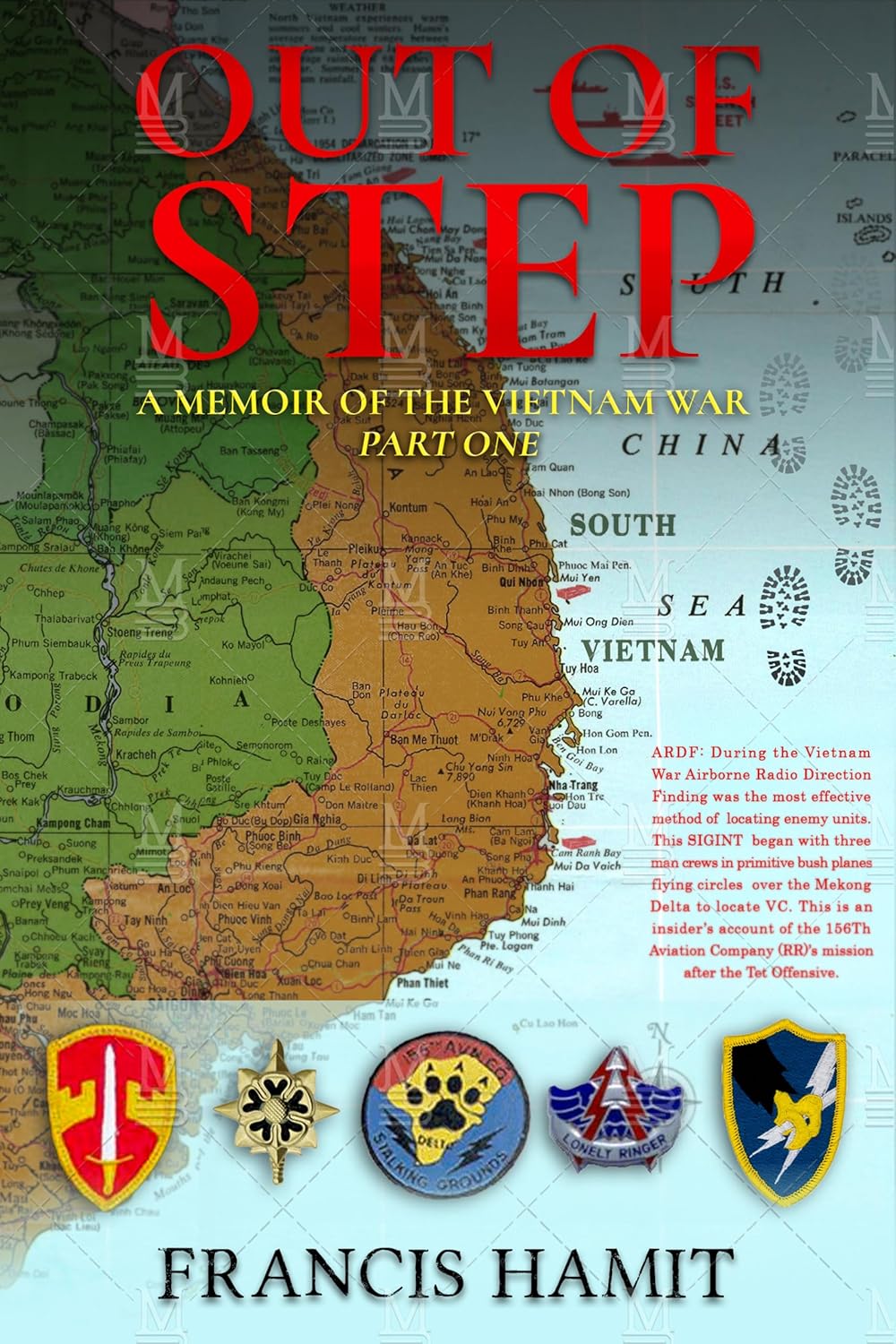

In Out Of Step, author Francis Hamit walks readers through the Vietnam-era hinge where a messy young life gets snapped into military shape, first in Basic Training and stateside intelligence schooling, then into the quieter, stranger corridors of the Army Security Agency (ASA) and its SIGINT world. He frames the war as an intelligence contest as much as a jungle contest, admiring (with a bit of grudging awe) how North Vietnam built a formidable cryptographic service and set the terms of visibility, see clearly or be seen clearly, long before Americans turned it into a slogan.
What struck me first was the book’s refusal to behave like a tidy “war story.” Hamit’s voice is candid, prickly, and alert to the social physics of the Army: who gets hazed, who gets protected, who is quietly sacrificed to bureaucracy. He’s funny in a sharp-edged way, humor as a scalpel, not a comfort blanket, and he’s willing to show himself unflatteringly, including the bad motives that shove him into enlistment and the petty humiliations that sandpaper a person down. The prose keeps swiveling between the personal (family pressure, wounds, lust, shame) and the institutional (orders, cover stories, the odd not-quite-Army status of ASA), which made me feel the claustrophobia of being processed by a machine that doesn’t pause for individual anatomy.
My second reaction was an admiration for the way Hamit describes “realistic training” metastasizing into something darker, particularly the Tactical Training Course at Fort Devens, where simulated capture and interrogation drifts into sanctioned cruelty. Reading about the “menu” of coercion, electric shocks, the “Apache pole,” waterboarding, lands with a delayed thud, because it’s delivered not as a sensational reveal but as another entry in a long ledger of what people will justify when they think the future demands it. And yes: he warns early that sex is plentiful and the story is also a coming-of-age account, which changes the temperature of the memoir. This isn’t antiseptic recollection, it’s lived-in memory with sweat still in it.
This will hit best for readers who like memoir, Vietnam War, military history, espionage, SIGINT, and coming-of-age narratives, especially anyone curious about the war’s less cinematic strata: cover names (“Radio Research”), invisible bounties, and the daily discipline of not drawing attention to yourself while doing work the broader Army barely understands. If Tim O’Brien gives you the war as moral weather in The Things They Carried, Hamit gives you the war as a lived system, bureaucratic, occasionally absurd, and always humming with consequences. In the end, this is a memoir that doesn’t salute the myth of Vietnam; it interrogates it, and keeps its balance while doing so.
Pages: 196 | ASIN : B0G5483Y6L

Life-Long Impact

The Legacy of the Twins Platoon follows a group of young Minnesotans who enlist as Marines in 1967 and find themselves facing some of the most horrific battles of the Vietnam War. Where did the inspiration for this novel come from?
It was my calling. But due to the perceived difficulty of writing a book about 150 Marines and their experiences, it took 6 years before I set out to do what seemed to me to be an overwhelming task.
What draws you to this period in US history?
I am drawn to this period in history because it is unforgettable and is forever etched into memory. To have experienced and witnessed how the Vietnam War forever changed the lives of those who served in the military, and the life-long impact it had on their families and loved ones, is something I felt compelled to write about.
Can we look forward to more work from you soon? What are you currently working on?
My focus now is to bring awareness to the book, so that the life experiences of those I have written about can benefit other people. At a time when new books are like a “blizzard in a snowstorm,” my challenge now is to weather the storm.
Author Links: GoodReads | Facebook | YouTube | Website | The Legacy of the Twins Platoon | Amazon
They were sworn in on television at a pregame ceremony and were guests of the Twins at the game. By the end of the fourth inning, the recruits were hustled to buses whisking them to the Wold-Chamberlain Field Airport, and they flew to San Diego. Before dawn the next day, the Twins Platoon met their drill sergeants at the receiving barracks of the Marine Corps Recruit Depot. By the end of the year, the Marines were in Vietnam sprinkled across the length and breadth of the Marine Corps operating areas of I Corps, the northernmost part of South Vietnam where they experienced some of the toughest combat of the war. Khe Sanh and Hue City were just a few of the hot spots they encountered as the 1968 TET Offensive rolled across the country. Not all members of the Twins Platoon came home in one piece. Some did not come home at all. In The Legacy of the Twins Platoon, author Christy Sauro Jr. tells their complete stories from baseball to combat and their lifelong readjustment to civilian life.
Eagle Scout to Killer: A Novel Based on True Events
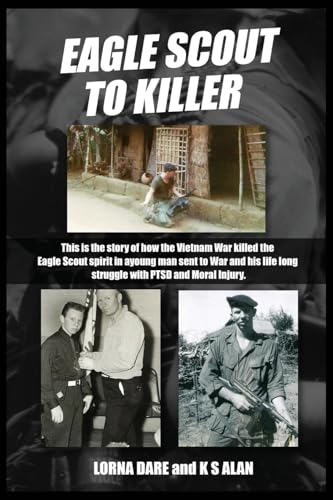
Eagle Scout to Killer by K.S. Alan and Lorna Dare is a harrowing and unflinching account of one man’s transformation from idealistic youth to haunted veteran. Told through the voice of Kurt S. Alan, a soldier whose service in Vietnam blurs the line between heroism and survival, the book chronicles the moral and psychological toll of war. From its opening pages, where Alan recounts his covert involvement in the events surrounding the Gulf of Tonkin, the narrative establishes itself as both historical confession and personal reckoning. This is not a traditional war story; it is an exploration of how combat reshapes identity, erodes morality, and leaves wounds that no medal can redeem.
The authors write with a restrained intensity that makes the book deeply affecting. Alan’s first-person account of meeting CIA operative Coleman and orchestrating a staged naval attack feels chilling in its calm precision. When he admits, “I grew up being taught to never lie, but here I was perpetrating a lie on the U.S. Congress,” the line reverberates beyond his personal guilt; it becomes an indictment of the political machinery that demanded such deception. The prose is unsentimental yet charged with quiet anguish, capturing the conflict between duty and conscience with unsettling clarity.
What gives the book its emotional weight is not only its exposure of covert operations but its portrait of trauma. In the preface and the reflections from Alan’s VA therapist, the story is framed as part of a long process of healing. The therapist describes it as “Kurt’s effort to reclaim his soul,” and the book indeed feels like an act of reclamation. When Alan later visits the Vietnam Memorial and leaves his Special Operations coin at the wall, the gesture becomes a moment of fragile grace amid decades of inner torment. That scene encapsulates the cost of survival and the longing for absolution that haunts so many who return from war.
The combat scenes themselves are vivid, brutal, and often difficult to read. Chapters such as “The Punji Pit” and “Operation Cherry” depict the chaos of Vietnam with visceral precision. Yet the violence never feels gratuitous; it underscores the moral corrosion that the preface warns against. The narrative’s strength lies in its refusal to glorify combat or simplify the psychology of those who endured it. Alan’s voice remains grounded, disciplined, and painfully self-aware. The result is a story that feels at once deeply personal and universally human, a meditation on guilt, loyalty, and the enduring search for meaning after unimaginable loss.
Eagle Scout to Killer is not an easy book to read, but it is an essential one. It speaks to veterans who have carried their battles home with them, and to civilians who have never confronted what war truly demands of those who fight it. For readers interested in military history, moral philosophy, or psychological resilience, this book offers a rare and unsettling clarity. It is both a confession and a cautionary tale, a powerful reminder that while war may end, its echoes never do.
Pages: 264 | ISBN : 9781965390139

The Tilted Palace: Weeds of Misfortune

The Tilted Palace: Weeds of Misfortune is a haunting and human story about broken souls trying to stitch themselves back together. It opens with Jimmy Ray Crandall, a retired Green Beret haunted by Vietnam and marooned in the quiet of small-town Massachusetts. His loneliness seeps through every line until a wounded stray dog, and later a disheveled pastor named Trinity Hathaway, stumble into his life. What follows is a gritty, sometimes funny, often painful dance between despair and redemption. Through late-night bourbon, raw honesty, and shared pain, two strangers become mirrors of each other’s brokenness. It’s not a simple war story or a tale of faith. It’s about survival when everything that gave life meaning has already burned to ash.
The writing pulls no punches. It’s blunt, messy, and real. The author writes like someone who’s seen too much and refuses to pretty it up. The dialogue, sharp and layered, swings between biting sarcasm and quiet revelation. There’s a strange rhythm to it, like life itself, uneven but true. Some scenes hit me hard, especially when the pastor and the soldier lay their wounds bare. Both want to die, yet somehow keep each other alive. The dog, Jezz, might be the most human of them all. She’s the glue, the silent witness to two lost people trying not to drown.
This is an emotional book. It made me angry at how war chews up men like Jimmy Ray and spits them out forgotten. It made me ache for people like Trinity, trying to preach hope while secretly running on fumes. There’s no sermon here, just raw humanity. The story doesn’t tie things up neatly, which I liked. Life rarely does. The prose has its rough edges, sure, but they fit the characters. They live in those jagged lines. At times, the story drifts into monologues that feel like confessionals, and that works because I feel like the whole book is one long confession.
I’d recommend The Invisibles to readers who crave something honest and bruised. I think it’s for those who understand that redemption doesn’t always look holy and that healing can start with a bottle, a stranger, or a dog scratching at the door. For me, this book wasn’t just a story; it was an experience.
Pages: 253 | ASIN : B0FF4B3CF5
Confront The Truth

The Saigon Guns shares facts about the final year of US combat operations in South Vietnam from the perspective of someone who was actually there. Why was this an important book for you to write?
This is a history that has not been told. Most people think the US Army involvement in South Vietnam ended in mid-June of 1972. Actually, some of the most intense combat that year for the US Army forces was after June. The US Army Greenbook, which is the official history of the US Army even perpetuates this myth today. A consequence of the lies about 1972 US Army operations was that the military records for those of us there at that time went missing. This plagued me for the rest of my career, as it did for many others, and almost denied me VA benefits. Only recently has the National Archives allowed access to some of these records.
When I attended the US Army War College in 1994, I heard seminar instructors explain that no US Army forces conducted combat operations, only local unit defense, after June of 1972. I pointed out that this was not true. I was asked on what basis I could say that. I explained I was there and that the US Army units still in-country were seriously taking the fight to the North Vietnamese and the Soviets well into December of 1972. The seminar leader was incredulous. He suggested I write a paper, which I did. Never saw that paper again, and it was not to be published.
President Nixon stated that he had pulled out all combat troops of Vietnam in June of 1972 as a re-election ploy, despite the fact that he did not. But no one wanted to confront the truth. After we were actually out of Vietnam as the result of the peace treaty, President Nixon and Congress had no appetite to re-engage even in the face of the massive North Vietnamese violation of that very treaty in 1975.
The Vietnam War is one of those moments in history that is glossed over in textbooks or outright ignored. Your book sheds light on the facts and uncovers the uncomfortable truth of the situation. I appreciated the candid nature with which you told your story and those who were stationed in Vietnam. What was the hardest thing for you to write about?
I suspect that most combat veterans have the hardest time dealing with “survivor guilt.” As a consequence, it was most difficult for me to write about the loss of friends in combat. For the rest of your life, you wonder, “Why them and not me?” But I also found that writing about specific combat actions or engagements sometimes became a bit too intense for me, and I would simply stop and take a break. Then I found that on many occasions it was hard to pick the narrative back up and continue. It might take hours, a week, or even a month to do that sometimes. Of course, then there was research I needed to try and make the narrative as accurate as I could. This took time. My wife and I even traveled to the National Archives in Maryland to research records. Though what we found was scant few records of use for this period of the war. I also reached out to fellow unit members that I served with in Vietnam to pick at their memories and personnel records to fill out details. That is why it took me several years to write this book.
What is a common misconception you feel people have about the Vietnam War and the military forces that were sent there?
The main misconception, now fostered in many high-school textbooks, is that the Vietnam War was an illegal war. This is, of course, the same line that anti-war groups, often assisted by the Soviet-operated World Peace Counsel, publicized to support their anti-war efforts. The truth is that the war was started by the North Vietnamese for two purposes. One was certainly to unify the country under Communist control. The other, less clear reason, was that the Soviets wanted a “warm water’ port on the South China Sea. The Soviets wanted this port because it provided them an all-weather power projection base against the American Pacific Fleet and against the Chinese, with whom they were in direct conflict in the 1960s and 1970s. The US turned down a request by Ho Chi Minh to assist them in unifying the country by force in the early 1960’s. The US refused to assist him with a takeover by force of arms. Additionally, the US had an air base in South Vietnam in Da Hang that was strategic to our defenses against the rising power of the Soviets. So, when the effort to overthrow the government in South Vietnam was begun by the North Vietnamese, supported by the Russians, we sided with the South Vietnamese on the basis that it was illegal for one country to take over another peaceful country by force of arms. It is also interesting to note that most Americans, again as the result of Soviet propaganda and, to a certain degree, the interests of opposing political parties in the United States, were told that we were only fighting poor Vietnamese peasants and the North Vietnamese were simply assisting them. The truth was that the North Vietnamese were who we were primarily fighting and who made up the bulk of what we refer to as the VC or Viet Cong irregular forces. By 1972, with the major North Vietnamese invasion of South Vietnam with conventional armored forces, entire Soviet military units were committed to the way and were engaged against US forces. Today there is a Russian Vietnam Veterans organization!
What is one thing you hope readers take away from your story?
The truth about the war and what those of us who served there tried to do for America and for the poor South Vietnamese is what I hope readers take away from my book. Remember that millions of people died in Southeast Asia upon our pullout of forces and our refusal, after the Spring of 1973, to provide support to the South Vietnamese.
There is an old joke among my contemporaries about that war. We were winning when we left. This was quite true. In the space of 8 months in 1972, four US Army Cavalry troops, the US Air Force, and the US Navy, with an assortment of American military advisors with various South Vietnamese Army and Marine units, wiped out five divisions of North Vietnamese and Soviet armor. This was not old, obsolete Russian Armor from World War II but then state-of-the-art Soviet military hardware. Yet the North Vietnamese offensive combat power was destroyed to the point that the North lacked the capability to continue the war when the Peace Treaty in Paris was signed.
It took the North Vietnamese, and their Soviet supporters two and a half years to rebuild the North Vietnamese offensive combat power and then conquer South Vietnam. With our complete pullout and refusal to provide help to the region, panic set in across all the nearby countries, and dictators and thugs, backed by the Soviets and the North Vietnamese, seized power in Cambodia and Laos. Estimates for the loss of life over the four years following our complete withdrawal and the fall of South Vietnam in these three countries alone run as high as 10 million people! And, to this day, the propaganda of the Soviets and of the anti-war movement here still denies these facts and the reality of that war. We see the same approach to war in Ukraine today, along with the same use of propaganda and ruthless war on a civilian population. The “just war” concept has no place in the Russian way of war. It was so in Vietnam, and it is so in Ukraine. So yes, there are lessons, and they start with recognizing and accepting the truth of what is actually happening.
Author Links: GoodReads | Facebook | Website | Amazon
The remaining US aviation forces, along with the US Air Force and US Navy and Marine aviation assets, would not be easily removed from the battle. For the US forces still in-country, this is an untold story of heroism, dedication, and refusal to yield the battlefield despite being largely considered by US political leaders as “expendable.”
The Saigon Guns
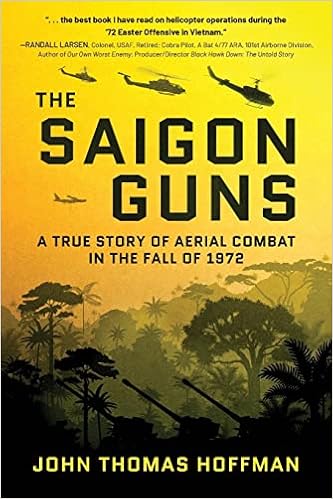
In The Saigon Guns, John Thomas Hoffman offers a riveting narrative of his time serving in the Republic of Vietnam. While many Americans who valiantly fought alongside him in the early 1970s found themselves marginalized and disregarded upon their return, Hoffman courageously shines a light on their lived experiences, juxtaposed against the backdrop of the growing influence of Russian advisors aiding the North Vietnamese.
Beyond merely chronicling war tales, this book seamlessly weaves in elements of a personal memoir. Before enlisting, John led an ordinary life, working as a part-time fireman and ardently pursuing his studies at Georgetown University. These rich anecdotes provide a layered understanding of the man before his immersion in the tumultuous world of warfare.
Hoffman’s detailed descriptions, such as the intricacies of the TH-55 helicopter or the nuanced differences between the M-14 and M-16 guns, showcase the depth of his research and commitment to authenticity. Throughout, he punctuates his account with profound reflections, signaling his lived experience and the wisdom gleaned from it.
The book explores significant socio-political events of the era, such as the racial tensions of the late 1960s and the mounting resistance against the Vietnam War – with figures like Jane Fonda playing pivotal roles.
The Saigon Guns stands as a testament to Hoffman’s courage. To share a narrative that has largely been erased from official histories and to do so with such raw honesty is genuinely commendable. It’s a sweeping journey: from the heart-wrenching sorrows of war, exhilarating adventures in the skies, and intense training sessions to introspective reflections on pivotal life moments. I wholeheartedly recommend this illuminating read to military veterans, history enthusiasts, and anyone keen on uncovering the intricate facets of the Vietnam War.
Pages: 465 | ASIN : B0BTZXZ54X
Darkness and Light Intertwined: Book 3 of the Agent Orange Trilogy

In 1954, against the haunting backdrop of war-torn Vietnam, Chi Anh Ong faces the heart-wrenching separation from her baby daughter Linh, who is, unbeknownst to her, taken to an orphanage by her father. Abandoned by Linh’s father, a foreign soldier, Chi is cornered by circumstance and grief. Yet, in a fervent pursuit of revenge, she joins the Viet Cong, targeting American soldiers.
As the years pass, Linh begins to lose herself. Her struggle for survival pushes her into the shadows of prostitution. A chance encounter with an American soldier offers her a shimmering ray of hope and the possibility of a new life in the US. But can one ever fully escape the past?
Darkness and Light Intertwined, by Kaylon Bruner Tran, is a poignant historical fiction novel, featuring a cast of characters caught in the brutal jaws of war yet yearning for redemption. The desperation Chi feels in her search for Linh is palpable, while Linh’s own journey illustrates the depths one might go to for survival.
Kaylon Bruner Tran strikes deep emotional chords, rendering a tale of individuals seeking healing from the scars of war. Each character’s internal struggle prompts readers to grapple with the intricate moral implications of their own choices.
Darkness and Light Intertwined underscores the moral conundrums faced by those in conflict zones. Amidst the chaos of the Vietnam War, each character yearns for a glimmer of light–a semblance of normalcy. Darkness and Light Intertwined is more than just a book; it’s an introspective journey, prompting reflections on the gripping emotional trials born out of real-life adversities. Highly recommended for those seeking a deep, thoughtful read.
Pages: 364 | ASIN : B0BGJSVWW5


