Blog Archives
Stand Up Speak Up: How Survivors Created a Movement to End Sexual Violence


This book is both a painful personal account and an inspiring call to action. Author Tim Lennon begins by recounting his own childhood trauma as a survivor of clergy abuse, a story that unfolds with heartbreaking honesty. From that foundation, he traces the rise of a global movement of survivors who have turned silence into strength and pain into activism. Through detailed chapters, Lennon chronicles the efforts of individuals and organizations that have worked tirelessly to expose abuse, support victims, challenge institutional cover-ups, and push for justice around the world.
What struck me most was the rawness of Lennon’s writing. His emotions come through in every line. Rage, grief, confusion, and ultimately, a fierce determination. He walks us through his journey from a silent, broken child to a relentless advocate and leader. The writing has a rough-edged clarity. It’s not polished like a memoir written for mass market appeal, but that’s exactly why it hits so hard. You feel like he’s speaking directly to you, almost like you’re sitting in a church basement at a support meeting, hearing someone finally say out loud the things no one else will.
The book is packed with stories, statistics, names of organizations, and powerful examples of systemic failure across nearly every major institution like churches, sports teams, the military, Hollywood, schools, and government. It’s an ambitious, wide-reaching work that paints a clear picture of just how deeply rooted the problem is. Lennon doesn’t shy away from the scale or complexity of it all. Instead, he leans in, showing us the full scope so we understand that this isn’t about one bad actor or one broken system. It’s everywhere. And that’s what makes the book so powerful. It’s not meant to make you feel comfortable, it’s meant to wake you up.
I’d recommend Stand Up Speak Up to anyone who cares about social justice, survivor advocacy, or institutional reform. It’s especially powerful for survivors who might be looking for a sense of connection or hope. It’s not always an easy read, but it’s an important one. Lennon’s voice is not only personal, it’s political, unflinching, and urgently needed. This book is a torch passed from one survivor to another. If you’re ready for it, it will light something in you.
Living Love of Christ

El Gran Intercambio (The Great Exchange) is a powerful autobiographical account of your life, vividly chronicling your spiritual, emotional, and personal journey from childhood trauma, abusive relationships, false religious systems, to divine healing and restoration. Why was this an important book for you to write?
This book was deeply important for me to write because it gave voice to years of silence. For so long, I carried pain that I didn’t know how to release—and writing became both a mirror and a doorway. I wanted to create a space where others who have faced similar wounds could feel seen, understood, and ultimately, offered hope. El Gran Intercambio is not just my story—it’s an invitation to anyone who has ever felt lost, broken, or deceived to experience true freedom through God’s healing power.
What were some ideas that were important for you to share in this book?
One key idea was the difference between religion and relationship. I had lived much of my life trying to perform for acceptance—by people, systems, and even God. I wanted to show that healing comes not from following rules, but from encountering the real, living love of Christ. I also wanted to address the generational impact of trauma, the dangers of spiritual manipulation, and the beautiful reality that we are not defined by our past—we are transformed by grace.
What was the most challenging part of writing your memoir, and what was the most rewarding?
The most challenging part was revisiting the darkest moments of my life. Writing about abuse, loss, and spiritual deception required deep emotional courage, and there were times I had to step away and allow myself to grieve again. But the most rewarding part was realizing that every page—every painful memory—had purpose. Knowing that my story could serve as a lifeline for someone else made it all worth it. Healing for me came not just through writing, but through the act of sharing.
What do you hope is one thing readers take away from your story?
I hope readers walk away with this truth: You are not alone, and you are not beyond restoration. No matter how far gone life may feel, there is a divine exchange waiting for you—your pain for His peace, your shame for His grace, your ashes for His beauty. Healing is possible. Freedom is real. And God has not forgotten you.
Author Links: GoodReads | Facebook | Amazon
Este libro relata la vida de la autora y su lucha contra la soledad y las falsas comunidades de la iglesia. Criada por sus abuelos sin el amor de Dios, luchó por encontrar amor y conexión. Esto la llevó a Estados Unidos, donde buscó la religión para encontrar la paz. Sin embargo, los sistemas religiosos con frecuencia la alejaron de Dios. A través de sectas, falsos profetas y charlatanes, la autora enfrentó numerosos engaños y manipulaciones, pero, finalmente, encontró el camino de vuelta a casa, como el hijo pródigo, a los brazos de Dios. El relato honesto de su vida inspirará a los lectores a superar sus propias dificultades con un corazón abierto y un compromiso con Cristo.
Unspoken


Unspoken is a deeply personal and emotionally raw autobiographical novel that follows the harrowing journey of two boys, Williams and Tega, who suffer and survive sexual abuse. Told through alternating narratives, the book plunges into the terrifying silence many male victims are forced to live with, capturing the confusion, betrayal, and eventual resilience that arise in the aftermath of trauma. At its core, this is a story about reclaiming power, finding one’s voice, and pushing back against a society that often ignores or mocks male victims of abuse.
Emecheta writes with a kind of honesty that cuts to the bone. He tells it like it is. I found myself angry, gutted, even ashamed at times, not at the victims, but at the adults who failed them and at the systems that let abusers slip through unnoticed. The storytelling isn’t polished in a literary sense, but it’s blisteringly authentic. The language is raw and emotional, which works in its favor. His use of direct narration, flashbacks, and interior dialogue brings you so close to the trauma that you almost want to look away, but you can’t.
Healing isn’t linear, and trauma tends to loop, not walk a straight line. What the book lacks in polish, it makes up for in courage. There’s nothing easy or neat here, and it doesn’t try to give false closure. The characters don’t get perfect justice, and the parents don’t suddenly transform into loving, attentive caregivers. It felt real, and maybe that’s why it hurt and helped so much.
But what I really appreciated was that this book didn’t just stay in the trauma. It showed the fight to break free. The courage it took to speak. The relief of being believed. And the stumbling, uneven path toward healing. It made me cry, yes, but it also made me hopeful. Emecheta’s honesty is unflinching, but his compassion is just as powerful. The story doesn’t just expose the abuse. It shines a light on what it means to reclaim yourself after being broken.
Pages: 98 | ISBN : 978776291X

Speaking For Those Who Do Not Feel Safe

No Ordinary Love follows several women whose stories reveal the terror and trauma of domestic abuse. Why was this an important book for you to write?
Because it’s my story—and the story of countless other women around the world. Despite how widespread intimate partner violence is, it continues to be treated as though it’s rare or private. It’s an epidemic. As long as that remains true, more stories need to be told. I was inspired by the women who spoke up before I found the strength to do the same. Now, I’m speaking for those who may not yet feel safe enough to share their truths.
I appreciated the candid nature with which you told this moving story. What was the hardest thing for you to write about?
The hardest part wasn’t the writing itself—I had already survived the events. In fact, the process of writing was profoundly therapeutic. What was most difficult was transitioning from that healing space into the often retraumatizing demands of publishing—critiques, edits, legal reviews, marketing, promotion. Writing gave me back my voice, my truth, my agency. But sharing it exposed me to judgment, disbelief, and the need to prove my experiences.
What was especially painful was the fact that I had to fictionalize elements of my own life story—not to protect myself, but to protect the identity of my abuser. After being silenced for over two decades, I finally found the courage to speak out. Yet, I still had to call my memoir “fictionalized” when it’s 98% truth, with only minor changes made to shield the person who harmed me. That’s harder than I can express in 100,000 words.
What is one misconception you believe many people have regarding the aftermath of domestic abuse?
That the abuse ends when you leave. It doesn’t. What I wanted to highlight most in No Ordinary Love is the aftermath—the long shadow trauma casts, the lingering triggers, and the decades it can take to fully disentangle yourself from the psychological grip of abuse. Healing is not linear. It is life-long.
What is one thing you hope your readers take away from No Ordinary Love?
I hope it inspires honest, necessary conversations—about the subtle and insidious nature of coercive control, how it undermines autonomy, the long-term psychological impact of chronic abuse, and the intersection of trauma, mental health, and systemic failure. Most of all, I want to illuminate the barriers survivors face in their search for safety, support, and validation.
No Ordinary Love
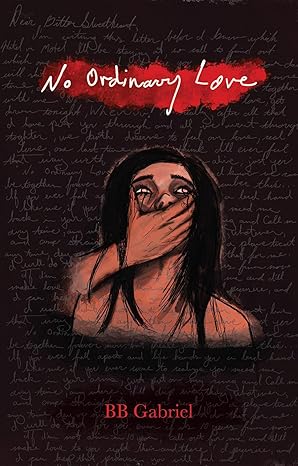

No Ordinary Love, by BB Gabriel, is a searing memoir that threads together the lives of several women grappling with the many faces of intimate partner violence. Through a braided narrative—alternating between Gabbi, Alex, Katee, and others—the book unveils the terror, trauma, and tangled aftermath of abuse while illuminating slivers of healing and resilience. This story stomps, screams, and weeps across the pages, detailing coercion, fear, childhood confusion, and adult reckoning. Told in raw vignettes and memory-soaked prose, it is not just one survivor’s story—it’s a collective mirror for far too many.
Reading No Ordinary Love shook me. There were moments I wanted to put it down and moments I couldn’t look away. The writing, often poetic and stark, pulled me close enough to feel the fear and the fresh heartbreak. Gabriel doesn’t romanticize trauma, and that’s what makes her voice trustworthy. She doesn’t craft her pain into tidy scenes or polished resolutions. Her story spills over in waves—sometimes chaotic, sometimes controlled—and always relatable. The structure, with its shifting timelines and perspectives, felt disorienting at times, but maybe that’s the point. Trauma is disorienting. This book doesn’t offer clarity; it offers truth.
I admired the way Gabriel let silence linger in her writing. Some chapters stopped short, leaving me breathless, the same way trauma interrupts a life. And yet, she also knows when to lean in—when to take us all the way through a panic attack, a memory, a phone call no one wants to make. This book isn’t just about surviving abuse. It’s about what comes after—the guilt, the longing, the ghosts that live in your muscles. And somehow, it’s also about love. Love between sisters. Love that fights back. Love that rebuilds.
I’d recommend No Ordinary Love to anyone willing to confront the brutal honesty of what abuse looks like behind closed doors—and what it takes to speak it aloud. It’s a gut punch for survivors, advocates, and even bystanders who have wondered, “Why doesn’t she just leave?” This book is for those who stayed. For those who left. And for those who still carry the weight of it all.
Pages: 381 | ASIN : B0DRZ5Z51X

Trusting Yourself

Rewilding follows a 12-year-old girl who finds solace in nature while struggling to keep her and her brother’s difficult home life quiet. Where did the idea for this book come from?
It started when a fledgling scrub jay landed in my woodpile. I knew there was a story in my family’s experience of trying to care for the bird. We made many of the mistakes that Joy eventually makes in the book. As Joy’s journey with nature and rewilding started to bloom, the darker challenges of her life also began to surface. At that time, I had a number of friends who were wrenching themselves out of gaslighting relationships. I began to wonder about Joy and what lots of kids deal with every day. I began to ask how do you solve a problem with no good answers? Where do you turn?
Is there anything from your own life that helped inspire your characters’ traits and dialogue?
One of my favorite artistic pursuits is collage. So often my books feel like little scraps of experience pieced together to create something new and cohesive. I have a few wild and wise older women in my life who helped inspire the character of Ezzie. And Joy’s younger brother, Ian, is absolutely modeled after my daughter, Mieke, who is full of exuberant energy and big feelings. She’s now twelve, but when I started writing the book, she was about Ian’s age. She liked to climb and jump on everything. I’m happy to report that she still does.
What were some themes that were important for you to explore in this book?
The theme of trusting yourself is very dear to me. So many of us grow up looking to others to tell us how to think and feel about ourselves. We look to others to see if we measure up, if we’re doing things the right way. But really, each of us is the expert on our own selves. We need to learn to listen to our inner voices.
Also, nature. It has always seemed to me that we humans are not here on this planet to dominate and control, but to care for and nurture and celebrate our home.
What is one thing you hope young readers take away from Rewilding?
I hope they see bits of themselves or others they know. I hope they find understanding and compassion for themselves and others. I hope those glimpses inspire them to look more closely at the world around them. Maybe that’s three things. Or maybe it’s all part of one big thing.
With her dad gone and her mom falling into depression, the responsibility of managing the household and caring for her younger brother, Ian, falls on her small shoulders. She struggles with the reality of wearing old clothes that no longer fit and constantly dealing with Ian’s hunger. Joy lives in fear that the school counselor might contact Child Protective Services due to their situation.
One day, a baby bird falls from its nest, reminding Joy of her dad’s warning, “You don’t know your own strength.” Desperate for help, Joy strikes a deal with their quirky neighbor, Ezzie, known as the “Ark Lady.” Through this new relationship, Joy, Ian, and her friend embark on a journey to restore the garden. In the process, they discover the concept of “rewilding,” which brings unexpected beauty and healing. This experience leads Joy to question her father’s views, opening her eyes to new possibilities and strengths within herself.
Rewilding

At its heart, Rewilding is a tender, poignant middle grade novel about twelve-year-old Joy, who finds herself juggling way more than any kid should. While taking care of her younger brother Ian and hiding their struggling home life from nosy adults, Joy stumbles into something unexpectedly healing: nature. Between dodging Child Protective Services and trying to keep her family from falling apart, she begins to rewild a neglected yard and, in the process, slowly begins to rewild herself.
Joy’s narration is painfully real, funny in all the right ways, and completely heartbreaking when it needs to be. Right from chapter one, when she eavesdrops on a conversation between the school counselor and her brother, we’re dropped into a world where Joy is already carrying the emotional weight of an adult. “Big clumsy Joy strikes again,” she says after barging into Bertie’s office, and that moment hits like a brick. She’s trying so hard to hold things together that you want to jump into the story and tell her she doesn’t have to. But that’s the thing, she does have to. No one else will.
The themes Gerlits weaves through the story of neglect, gaslighting, mental illness, and body image are handled with honesty and subtlety, but they never weigh the book down. Joy’s relationship with her own body, for instance, is explored quietly and compassionately. She’s constantly aware of her size, of how her clothes don’t fit right anymore, of how people react to her strength. And then comes the moment when Joy discovers a baby bird in the woodpile and makes the quiet but profound decision to care for it. The scene is deeply moving. When she gently says, “You trust me,” to the fragile creature in her hands, it becomes a powerful symbol of her own longing to be trusted, needed, and capable. For a brief instant, everything else in the story seems to pause around that simple, tender exchange.
But what I loved most was the metaphor of rewilding. Not just the literal ecosystem restoration Joy does in the ARK yard, but the way she’s unknowingly restoring herself. Her home life is rough. Her mom is barely functioning, her dad is unreliable, and her little brother is too young to understand the danger they’re in. Yet Joy never gives up. She mows the lawn, feeds her brother, protects her mom’s dignity, and tries (with mixed results) to raise a bird. The passage in which Joy resolves to clean up the yard to prevent others from suspecting neglect is among the most emotionally wrenching in the novel. It reveals a fierce, protective love intertwined with a desperate desire to maintain control over an unraveling situation. The moment is rendered with striking authenticity and emotional depth.
Rewilding isn’t just a story for kids. It’s for anyone who’s ever tried to make the best of a messy situation. It’s for anyone who’s ever felt unseen or overwhelmed or not strong enough, only to discover they are. I’d recommend this book to middle grade readers who like realistic stories with heart, but also to adults who remember what it was like to be young and scared and brave all at once. This book doesn’t shy away from hard truths, but it also offers hope in the shape of a baby bird, a patch of wildflowers, and a girl who learns she really does know her own strength.
Pages: 288 | ASIN : B0DZCJYQHW

Our Deepest Roots: Navigating Past Trauma to Build Healthier Queer Relationships
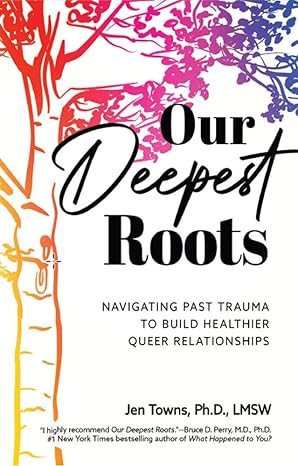
Our Deepest Roots is a brave and illuminating book about how trauma—especially the kind rooted in queerness and relational wounds—intertwines with the mess and beauty of love. Dr. Jen Towns doesn’t just discuss trauma in the abstract. She lays bare her own experiences, not as case studies or distant theory, but as raw, beating-heart truth. Through her lens as a queer trauma therapist and partner, she unpacks how our “parts” (the internal voices, reactions, and protections we develop) shape, distort, and sometimes save our relationships. She explores this through concepts like attachment theory, the Internal Family Systems (IFS) model, and a blend of hard-earned wisdom from both the therapy room and the kitchen table.
Reading this as a gay man who’s wrestled with his own ghosts, I felt seen in a way that knocked the wind out of me. The opening scene where Dr. Town’s wife (also a trauma survivor and therapist) writes about storming out of a fight, numb to her partner’s sobbing felt uncomfortably familiar. That terrifying push-pull of needing space but fearing abandonment? Yep. Lived it. And the self-loathing inner monologue she transcribes after the fallout was brutally spot on. It’s one thing to read about trauma reactions. It’s another thing entirely to read someone gently dissect their own and realize, oh god, that’s me too.
What sets this book apart is the refusal to shy away from the complicated, layered ways trauma shows up in queer love. Towns doesn’t romanticize healing, and she doesn’t offer cheap fixes. Instead, she walks us through her fights, her therapy, her missteps, and the hard-won tools she now teaches. When she talks about “fawning” in queer identity—where we perform caretaking to stay safe—it hit like a freight train. She describes fawning not as a flaw but as a strategy, born of survival.
Towns also brings a refreshingly down-to-earth voice. It’s not clinical or cold. It’s like a trusted friend walking with you, swearing a little, crying with you, laughing with you when you realize, yes, we’re all a little messed up but still deeply worthy of love. And her exercises, like the PEACE TALKS framework and the “Zhuzh” reminders, are actually doable—not just filler. She brings everything back to the body, the relationship, and the now. It’s healing work you can feel.
I recommend Our Deepest Roots wholeheartedly, especially to my fellow queer men who grew up believing we had to shrink to be loved, who still brace for rejection when things get close. This book isn’t just for therapists or couples in crisis—it’s for anyone tired of repeating old patterns and ready to face themselves with honesty and tenderness. It’s raw, smart, sometimes painful, and deeply human. And if you’re anything like me, you’ll find parts of yourself on every page.
Pages: 268 | ASIN : B0C6FRBKN2


