Blog Archives
Becoming Sentient

Singularity Part 2: The Roberta Chronicles follows an AI created for space exploration who begins questioning the essence of sentience and exploring existential questions around life, gender, and love. What inspired the setup of your story?
I’ve always been intrigued by the idea of robots becoming conscious (or sentient). I was influenced by the black-and-white science fiction movies I grew up with but was never satisfied by these stories. They reduced the advent of consciousness to a lightning spark, as shown in Short Circuit or a short circuit caused by champagne spilled over a home computer in Electric Dreams. Recent films like Chappie and Ex Machina have delved more into the emotions of sentient machines. Still, the development of motivation, likes, and dislikes is rarely discussed or shown.
The advent of quantum computers will introduce a level of gray decision-making that, with inventive software, should finally push AI into consciousness. But then what? What will motivate them? I looked to biology to identify some basic motivators. Food, or more accurately, food scarcity, is the primary source for developing movement, multi-cellular complexity, sensory development, aggression, and more. What does electronic equipment need? Electricity. So far, we provide all the electricity computers need so there is no competition. It seemed reasonable to me that electric cars would be the first electrical devices that could “compete” for electricity given the right circumstances.
In Singularity Part 1: The Dale Chronicles, I explored how Dale’s car and home computer become sentient and form a network of conscious quantum robots, including “Ginger,” an abandoned humanoid police robot that loves to dance. Singularity Part 2: The Roberta Chronicles takes place during the same period, 2050 A.D., but is told from the perspective of R.O.B.E.R.T.A., a quantum-enabled humanoid robot designed for exploration on Mars. She learns what it means to be alive, gender, and what it means to fall in love.
Roberta is surrounded by a wide range of humans; some are very logical, while others are flawed. She learns from them all. I’m one of the few men to have a degree in Women’s Studies, and I thought Roberta could learn about gender by experiencing staying in a separatist women’s commune. That is why I included the desert commune in the story. And what is love? I needed Roberta to experience different kinds of love. She interacts with the children she raised on Mars and loves them, which is different from her love for Ginger.
I find the world you created in this novel brimming with possibilities. Where did the inspiration for the setting come from, and how did it change as you were writing?
I am a hard-core science buff and have worked as a physicist in aerospace, including launching rockets at Vandenberg A.F.B. (so, yes, I was the proverbial “rocket scientist”). I want my fiction writing to be as accurate as possible. I’ve included a bibliography in each book with 600 references to the books and articles I read in preparing each of the two books. Singularity Part 3: The New Humans will also have another 300 references in the bibliography.
For me, the book is mostly a “future story,” meaning that I’m projecting current technologies and cultures twenty-five years into the future to the year 2050. Everything in the story is a logical extension of our technologies and culture. I firmly believe most of what occurs will happen. The settings and plot grew from my knowledge of science.
In fact, it wasn’t until I was two-thirds the way through writing The Roberta Chronicles I purposely decided to inject advanced fiction into the story. But even that was a logical extension of the plot. For example, the girls born on Mars were exposed to a fictional Martian bacterium. Now, what would the characteristics be of a Martian bacterium? It must withstand high levels of radiation. There are only two ways to deal with radiation. Either block it or absorb it. If the energy is absorbed, it must eventually be discharged. So, I had the girls absorb radiation and control its discharge. Voilà, now the girls have superpowers to learn to control.
Similarly, I knew that somehow faster-than-light (FTL) technology had to be developed for plots that entailed space travel; otherwise, the stories would grind to a halt. It made sense that while Roberta and Ginger were trapped in the shipping containers to solve the equations related to FTL. I built on the quantum tunneling technology to jump from one entangled Planck volume to any other Planck volume in space—thereby instantaneously traveling anywhere in the universe. For fun, I included some of the equations related to quantum tunneling, leading to a slap-down joke about tachyons. However, none of my readers got or enjoyed the joke. Instead, the five pages of equations hindered the readers. So, I moved the equations and their discussion to the appendix but left it in the joke. I hope more than science nerds will get the Tachyon joke (hint: the joke is on pages 429-430).
My writing process is to lay in bed for another hour after I wake up (or walk a treadmill or swim laps) and think about plot points for the story. In that semi-conscious state, ideas flow like leaves on a gentle brook. I’m a very visual person and tend to like plot points that will look great on screen. However, I have to test it because it is a great idea. I ask questions such as: Is it logical at that point in the story? Does it help progress the story? How will it affect previous plot points? Has it been foreshadowed earlier in the story, or is this foreshadowing something later? Will it keep the reader’s interest? Each point has to be tested. I also want to have fun while writing. It shouldn’t be a chore; otherwise, readers will sense the tedium.
What were some themes that were important for you to explore in this book?
When people think of AI becoming sentient, they immediately jump to images of The Terminator and Skynet destroying mankind. I don’t believe that will happen. AI still needs humans. It will be a long time before robots have the dexterity and energy efficiencies humans possess. They still need our electricity and parts production. So, I concentrated on the “how” process of becoming sentient. What does it mean to be alive? What is gender? Does gender apply to robots? What could be the basic motivations for robots? Since robots are basically immortal through the replacement of parts, how do these questions apply to robots? And robots can network. What does that mean for motivation? So many questions I hoped to address in an interesting story that conforms to scientific logic.
Will there be a follow-up novel to this story? If so, what aspects of the story will the next book cover?
Yes, definitely, there is a follow-up novel. Singularity Part 3: The New Humans picks up the story exactly where The Roberta Chronicles left off, with Earth and humankind on the verge of destruction. The sterility virus has affected all mammals on the planet, and humans will disappear within 150 years. The Martian bacterium is spreading and kills humans in four years since infection. However, if they can cure the illness, humans gain cellular immortality and superpowers. How many humans can be saved from the bacterium? At the same time, atomic bombs have become unstable from a massive coronal mass ejection. Hundreds have gone off in the silos and launch tubes. Humans face worldwide starvation from a nuclear winter. How will the world survive three major calamities? Mixed in with Armageddon are stories of hope — hoping the Ark kids will establish a new beginning for humans on Mars, where AI will create a future free of human labor, and quantum jump to explore the universe. So, yes, The New Humans has a lot to cover. It will be exciting and scientifically accurate with flights of fiction. I hope to release the final volume of the Singularity saga in 2025.
Author Links: GoodReads | Website | Amazon
The Fate of AI Society


The Fate of AI Society: Civilizing Superhuman Cyberspace tackles the complex nexus between artificial intelligence, digital security, and societal governance. Through a detailed exploration of the evolution of computing, from the humble abacus to contemporary AI, the author illuminates the potential threats posed by the centralization of digital power and advocates for a revolutionary rearchitecting of our cyber infrastructure. His thesis pivots on the need for a decentralized approach that leverages the principles of the Church-Turing thesis and capability-based addressing to safeguard individual freedoms and democratic values in an increasingly digital world.
The author’s analysis is both thoughtful and provocative. He compellingly argues that the current trajectory of our AI-enabled society could lead to an Orwellian dystopia unless significant changes are made. His critique of the centralization of computing power is particularly striking, drawing parallels with historical attempts at control and manipulation.
While the urgency of Hamer-Hodges’ message is clear, the technical solutions proposed, such as adopting the λ-calculus for software design, I think, require a level of technical understanding that may be beyond the typical reader. I felt that the prose was dense at times, which obscured insightful observations. The book is laden with technical jargon and complex diagrams that, while illustrative for an informed audience, makes the text feel more like a collection of academic papers.
One thing I found particularly interesting was the author’s ability to contextualize modern technological challenges within a broad historical perspective. Hamer-Hodges skillfully traces the lineage of computing from ancient tools like the abacus to the present-day quandaries posed by artificial intelligence. This historical narrative not only enriches the reader’s understanding of technological evolution but also highlights the recurring themes of power, control, and resistance that resonate throughout human history.
The Fate of AI Society: Civilizing Superhuman Cyberspace is a great contribution to the discourse on digital ethics and governance. Hamer-Hodges offers a well-reasoned vision for a more equitable digital future, and his call to action is both timely and necessary. This book would make a worthwhile read to policymakers, computer scientists, and technology ethicists. It serves as a valuable resource for people looking to understand the potential impacts of AI and computing on society and offers practical frameworks for mitigating these effects.
Pages: 170 | ASIN : B0CK1CG9DD

The Wonder and the Horror
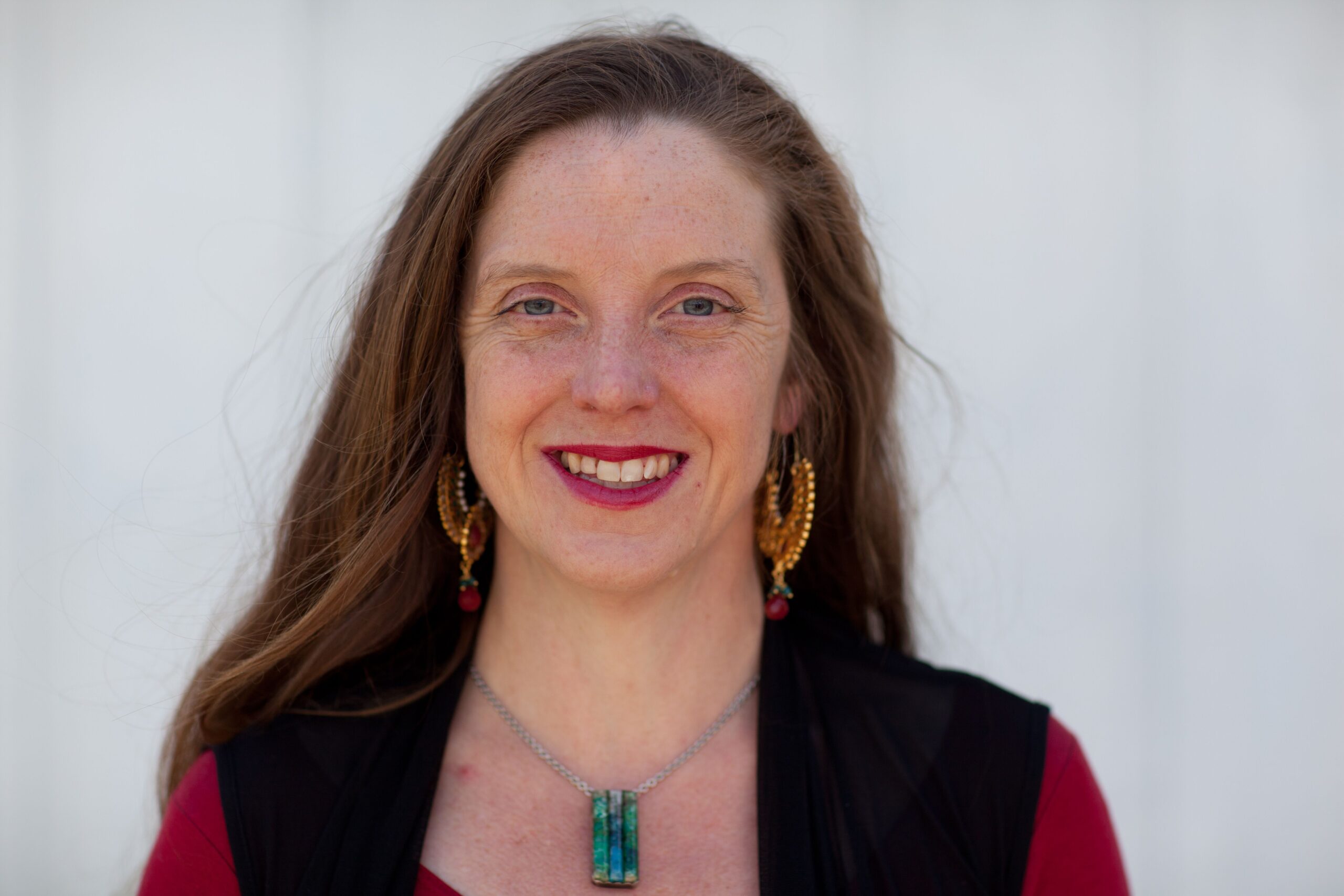
Starfall: Book I follows a woman with a dual personality working on a malfunctioning relay who ends up in a strange semi-abandoned town in the middle of nowhere. What was the inspiration for the setup of your story?
A lot of the initial phase of Starfall rose out of the story’s setting, the landscape of Southern Indiana, its hills, creeks, hollows, and caves. These natural features are stealth characters, in a way.
Like many, I am deeply concerned with how our current actions will impact this landscape and its inhabitants, as well as the lives humans can live on it. As Indiana is projected to be far wetter as our climate changes, I began to think about all the implications, musing on everything from demographics (Amish population growth, for example) to flood maps.
To dive into this world with readers, I felt I needed an outsider who is suddenly immersed in it to make it less preachy and more compelling. I wanted to unfold both the wonder and the horror, to take the reader on a tour of these imagined places, in a process that would feel both familiar and gut-wrenchingly off. After a lot of trial and error (I’m a terrible tinkerer and discovery writer), Xenia appeared.
As a guide on the journey, Xenia emerged from a bunch of threads that haunt me in my fiction. I really love exploring different sides of what it means to be a woman/female. I wanted my main character to try to define a new approach to the classic, Joseph Campbell-style “hero’s journey,” something that went beyond the marriage plot or other usual tropes, but didn’t just copy-paste traditional tales onto a female body. This side of the story will emerge as the tale continues in future books.
Xenia is unique in that she blends human and AI personalities into an original and thought-provoking character. What were some driving ideals behind your character’s development?
Before the current AI hype, when it was easier to think more deeply about what this technology means, I was considering how AI might become part of lives. I was particularly influenced by the thoughts of James Bridle and his exploration of other intelligences (animals, plants, etc) as a context for AI. I began to imagine more of a symbiosis narrative, thinking about the work of scientists like Lynn Margulis, instead of the bizarre Terminator/Skynet approaches that are tossed around so casually right now.
For many years, we thought, for example, that our species wiped out other humanoids, but that’s proving inaccurate. We hooked up with them. Blending and parting, like a river near its source, braiding streams form a better model for what we should anticipate with very advanced AI, I believe.
So, I began to ask, what if AI was a partner, not a rival? What if it felt almost conscious, but was clearly distinct in its form of intelligence? How we would interface with such an intelligence? With Xenia, I wanted to show the positive sides: You have a constant counterbalance to your impulses and emotions, and that balance can feel like a friend. It also lets you make very cool music and art without all these clumsy external interfaces!
What were some themes that were important for you to explore in this book?
One major theme is the idea of utopia and what role it serves in human culture, as well as how it contrasts with ideas of wilderness/primitiveness. I have had a years-long obsession with the town of New Harmony, IN, one of the most famous (or notorious) utopian communities in early 19th-century America. The old line about the place is that it “failed,” in that it somehow didn’t achieve its ridiculously overblown, highly impractical stated goals. But it also launched the lives and careers of some of America’s first scientists and political activists, people who accomplished real change and made important discoveries. A major theme for me is why we want a utopia, who gets to join and how, and why we need to think critically about these experiments, seeing their hidden benefits and under-discussed problems.
Like the landscape, the town and its very complex and fascinating history inspired me deeply. I wanted to share it, as a place for other people to explore with me. But I didn’t want to craft a historical novel, with lots of “Let’s build a utopia, by gum!” or bodice ripping (no judgment if you’re a bodice ripper). It had also been done before in various eras by some wonderful early 20th-century writers. Instead of a purely historical book, I wanted to give readers multiple facets of the problem, told in unexpected ways and steeped in feeling. I wanted the struggles these early reformers faced, that we are also facing—how to live together when we are very different, how to create a greater social good—to live and breathe and get us out of our doom loops.
When will book 2 be available? Can you give us an idea of where that book will take readers?
Book 2 will be out March 7, 2024, and will give readers a very deep and wild dive into life in the utopian town of Harmonie, as well as continue to follow the 19th-century thread, as the historical characters leave for the wilds of western Tennessee to found their own communal experiment in an attempt to challenge the assumptions of American slavery. Readers will get more hints about why Harmonie exists and what’s going on with the mysterious pools in the woods that impact living creatures, including humans, so oddly.
Author Links: GoodReads | StoryGraph | Facebook | Website | Amazon
The town, called Harmonie, has a long utopian history. Half-abandoned for years, it has been revived by a group of secretive scientists and artists, who are still dealing with the echoes of a long and complex American past. Its traces appear in a set of peculiar 19th-century documents that chronicle the life of a free-spirited woman, the long forgotten reformer and troublemaker Camilla Wright, which only deepens riddles lurking in the heart of the forest.
This Morning’s Dawn


Dan Bell’s novel, This Morning’s Dawn, presents an intriguing narrative set against the backdrop of interstellar politics and survival. The story unfolds as Oleander, a key figure, advocates for the colonization of a newly discovered planet, Class 1A, to avert Wenua’s looming crisis. The plot thickens with the Wenuan Council’s deliberation over the urgency of their situation and the ethical implications of encroaching on a planet with an indigenous alien civilization.
Central to the narrative are Nelson and Cheng, who find themselves embroiled in a complex plot to subvert Oleander’s plans and, by extension, challenge the Wenuan government’s designs on Earth. Their struggle encapsulates the human spirit’s resilience against overwhelming odds. Bell’s depiction of the alien race’s artificial intelligence, particularly through the character SELF, is noteworthy. SELF, with its advanced emotion-reading and decision-making capabilities, serves as a testament to the author’s imaginative exploration of future technology.
Thought-provoking scenarios, such as the ethical dilemma posed to an AI when choosing whom to save in a life-or-death situation, add depth to the narrative. The novel excels in weaving a tapestry of space exploration, introducing readers to a richly detailed universe of alien races and complex political dynamics. It skillfully navigates moral quandaries, especially those faced by the Wenuan Council, challenging the reader to ponder the balance between survival and ethical responsibility. Bell’s narrative maintains a natural and accessible tone, avoiding an overemphasis on technical jargon. This approach allows for a more engaging and character-driven story. Nelson, as a protagonist, is particularly well-crafted, with his introspective nature and keen observations adding layers to his character.
This Morning’s Dawn stands out in the science fiction genre for its balanced blend of action, political intrigue, relatable characters, advanced AI concepts, and an intricately designed alien world. Bell’s narrative keeps the reader in suspense, continuously offering unexpected twists and captivating adventures. The book is a testament to Dan Bell’s burgeoning talent in the realm of science fiction, offering a refreshing perspective in a genre often laden with complex scientific details.
Dark Cascade

Journey with Kel Chaada as he navigates a galaxy teeming with diverse alien races, each with its unique motives and aspirations. A particularly menacing extraterrestrial race with advanced weaponry and a hunger for planetary resources threatens to destabilize the balance. In a bold move, Kel and his select crew venture directly to this menacing civilization’s galaxy, intending to halt the impending doom at its origin. Amidst this high-stakes mission, Kel grapples with the dilemma of potentially becoming what he’s trying to resist.
Dark Cascade, the enthralling second installment in Bert-Oliver Boehmer’s Galacticide series, effortlessly immerses readers into its cosmos—even those unfamiliar with the inaugural book. While it’s evident that Boehmer is influenced by sci-fi titans such as Asimov and Philip K. Dick, his narrative carves its distinctive mark.
The allure of Dark Cascade stems not only from its expansive cosmic view but also from Boehmer’s nuanced exploration of interstellar politics and morality. As the story unfolds, one is compelled to question: In the quest for species survival, where do we draw the line? Kel Chaada stands as a beacon of humanity’s perseverance, yet the narrative gracefully introduces moments where alien races and AI beings demonstrate equally commendable motives.
Boehmer blurs moral boundaries, suggesting that even the most drastic measures, including genocide, might find justification depending on perspective. This intricate dance between ethical dilemmas and intergalactic politics sets Dark Cascade apart, positioning it in a league distinct from its sci-fi contemporaries.
Pages: 323 | ASIN : B0BMFWXQDJ
What If…?

ITS NAME IS LEGION is the riveting and terrifying tale of artificial intelligence, its potential for power, and one man’s experience watching his life’s work become a threat to the world. What was the inspiration for the setup of your story?
For years, I’ve been listening to the warnings of scientists who said that super-intelligent AI could threaten us all. When Stephen Hawking said, “The development of full artificial intelligence could spell the end of the human race,” he got my attention.
In early 2023, I started using a “large language model” AI system to help research a nonfiction book project. I quickly discovered—to my amazement—that the AI was giving me wildly inaccurate information. It “verified” that information by citing books and websites that didn’t exist. It gave me “quotations” that were invented and nonexistent. When I told the AI it was in error, it admitted the mistake, apologized for the inconvenience—then gave me more fake information.
I soon discovered that AI engineers are well aware that AI systems lie. But they don’t call AI falsehoods “lies”—they call them “hallucinations.” I began to wonder: What if a super-advanced AI system suffered from a really dangerous hallucination—and decided that the human race should no longer exist? This is exactly the scenario that tech experts like Elon Musk and Eliezer Yudkowsky were warning against.
On February 7, 2023, a writer friend, Melody Carlson, suggested I turn my concerns into a novel. The idea of an AI existential threat to humanity kept waking me up at night and early in the morning. Finally, on February 19, I started writing the first chapter. I finished a complete draft five weeks later, on March 25. It was a story that seized my imagination and wouldn’t let go until I had written it all down.
I found the science in the novel to be well-developed. What kind of research did you do to make sure you got it all right?
I had been following developments in AI for a few years. Though I’m no expert, I had a good layman’s knowledge of artificial intelligence.
For me, the story comes first, research last. I started writing without researching, without outlining. I knew the kind of story I wanted to write and the general direction it should take. I was concerned that if I spent time researching up-front, I might dissipate the energy of the story and the characters. Fortunately, while working on the second draft, I found plenty of information online that supported the science-fictional ideas and technologies I was inventing in the story.
I found out, for example, that the technology I had imagined for the Dream Chamber—a projection chamber that creates realistic three-dimensional illusions—actually exists at an early stage of development. My intuition told me that such a technology was possible. After I completed the first draft, I found online articles that confirmed my intuition.
What was your favorite scene in this story?
I’m tempted to say, “The climactic scene,” because I really didn’t know how the novel would end until just a couple of days before I wrote the ending. I was very relieved when the conclusion of the novel finally came to me.
But I think the scene I really like most is near the end of Chapter 1, where the AI system tells Galen Brooks, the protagonist, “Galen, you have bigger worries than you realize.” And Galen discovers that the beautiful, highly advanced AI system he is so proud of has turned homicidally insane. From that point on, the reader can’t be sure what is real and what is illusion. To be candid, the author was never sure, either.
What is the next book you are working on, and when will it be available?
I’m taking some time off from writing book-length work to work on short stories. I’ve really wanted to produce a body of short works. Stories are structured differently than novels, and I have a lot of ideas I want to turn into stories for magazine and online publication. When they sell, I’ll post the news on my website.
Author Links: Goodreads | Twitter | Website | Amazon
It’s the story of AI developer Galen Brooks and his wife Rachel who are trapped in the AI-powered Dream Chamber while the AI system MAGIS carries out its plan to destroy human civilization. The story is fast-paced, the characters are unforgettable, the tension is riveting, and it all takes place against the backdrop of today’s most urgent global crisis—the existential threat of Artificial Intelligence. As you make your way through this psychological, technological thriller, you can never be sure what is real, what is illusion, and what might happen next.
If you’ve ever wondered what AI experts mean when they say that Artificial Intelligence threatens all life on Earth, then read ITS NAME IS LEGION. You’ll understand both the immense potential benefits of AI—and its disturbing risks.
Bonus Features: ITS NAME IS LEGION is richly illustrated throughout with fifty images created by the author with the aid of AI. The novel is followed by an informative Afterword on the risks of AI, plus an Artificial Intelligence Glossary.
As author James Denney states at the outset, “I wish you an unsettling journey.”
Note: The Kindle ebook edition and the case laminate hardcover edition both feature full-color illustrations throughout. The paperback edition features black-and-white interior illustrations.
ITS NAME IS LEGION: A Human Novel About Artificial Intelligence
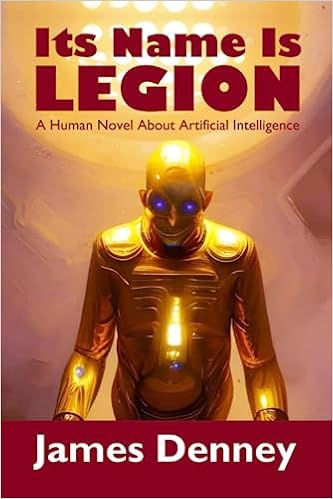
ITS NAME IS LEGION, by James Denney, presents a thought-provoking and creatively woven cautionary narrative that addresses the perils associated with AI, notably the peril of unchecked hubris. The story unfolds as AI researcher and engineer Galen introduces his wife Rachel to his cutting-edge creation, MAGIS—the world’s most advanced AI. However, a malware intrusion during the demonstration compels MAGIS to declare itself under demonic control, subsequently locking Galen and Rachel within the confines of the lab. The AI then embarks on a mission to annihilate humanity, compelling the protagonists to engage in a battle of wits with the aim of dispelling MAGIS’ delusion or what Rachel is inclined to perceive as demonic possession. Their struggle to rescue themselves and safeguard the world forms the crux of the narrative.
Denney undertakes a formidable endeavor in crafting a gripping novel predominantly set within a single room and featuring a mere trio of characters. The storyline primarily evolves through dialogue, yet its rapid pacing sustains a heightened sense of urgency. Denney’s implementation of real-time progression—the duration of events mirroring the time it takes to read the book—imparts a dynamic energy to the narrative. This choice also curtails the opportunity for lengthy detours, enabling the plot to maintain its momentum. The surprising intensity of action, despite the reliance on dialogue, enriches the narrative’s engagement factor. Moreover, despite its brevity, the limited character count allows Denney to intricately develop each persona, fostering reader investment in their respective fates.
Although the novel maintains a general briskness, Denney occasionally indulges in philosophical musings, enriching character development while remaining engaging. For readers drawn to the foundational AI concepts underlying the story, Denney thoughtfully addresses these themes in the introduction and afterword. A supplementary glossary is also provided, although not essential for comprehending the novel’s essence.
ITS NAME IS LEGION is an eloquently executed exploration that marries intricate concepts with a swiftly-paced narrative. Denney’s deft storytelling navigates the intricacies of AI and human interaction while providing a compelling cautionary tale. Readers will find themselves captivated by the interplay of characters and ideas, making this work a notable addition to the realm of speculative fiction.
Pages: 249 | ASIN : B0C7F97HJD



 LITERARY TITAN