Blog Archives
Confusion to Confidence

AI for Beginners Demystified turns artificial intelligence from a confusing buzzword into a practical tool, guiding everyday readers through how AI works, where it shows up in daily life, and how to use it with confidence. Who did you imagine as the ideal reader when you started writing?
When I started writing AI for Beginners Demystified, I had a very clear reader in mind: the curious person who keeps hearing about artificial intelligence but feels slightly overwhelmed by it. It might be a business owner, a professional trying to stay relevant in a rapidly changing workplace, or simply someone who sees AI mentioned in the news every day and wonders, “What exactly is this, and should I be paying attention?”
I’ve met many people like this through my work in digital marketing. When my company began implementing AI tools, I noticed that many business owners were hesitant to adopt them. They weren’t uninterested. They were intimidated. The technology sounded complicated, and they worried they might not understand it. That reaction became one of the motivations for writing the book.
The ideal reader I imagined was someone intelligent and curious, but not technical. They don’t want a textbook filled with jargon. Instead, they want clear explanations, relatable examples, and maybe even a little humor along the way — like sitting down with a knowledgeable friend who explains it in plain English.
Ultimately, I wrote the book for people who want to move from confusion to confidence. Once readers start exploring AI tools, they often discover something surprising: AI isn’t just about technology. It’s about creativity, productivity, and finding smarter ways to solve everyday problems. My reviews strongly indicate I’ve reached that audience.
Why do you think so many people feel intimidated by artificial intelligence?
First, AI as we know it is still in its infancy. Before 2022, AI was powerful but mostly invisible to everyday people — living inside search engines, industry, and back-end software. That changed in November 2022 when OpenAI released ChatGPT. As of this writing, it’s not even four years old. It’s barely old enough to tie its own shoes! (Its exact birthdate is November 22, 2022 — feel free to add that to your trivia book.)
Beyond novelty, many people feel intimidated because AI is often presented as something extremely technical and mysterious. When people hear terms like machine learning, neural networks, or generative AI, it can sound like a foreign language. There’s also fear of the unknown: AI is advancing rapidly, and headlines tend to amplify that by focusing on dramatic possibilities rather than practical realities.
Then there’s Hollywood. For decades, AI has been portrayed as a world-conquering machine. Those stories are entertaining, but they shape how people think about AI in real life — which is far more practical: voice assistants, recommendation systems, tools that help us work more efficiently.
The intimidation usually fades once people simply start using AI. That realization was a big reason I wrote the book: to remove the technical barriers so readers can shift from feeling intimidated to becoming genuinely curious about how AI can improve their lives.
What do you think people misunderstand most about AI and jobs?
The biggest misunderstanding is that AI will simply replace people across the board. History tells a different story. When computers entered the workplace, similar fears arose — and what happened was that computers automated certain tasks while creating entirely new industries and career paths. The internet followed the same pattern. AI is likely to do the same. Rather than replacing humans, it will enhance human abilities — handling repetitive tasks, analyzing large datasets, and automating routine work so people can focus on creativity, strategy, and relationship building. The key advantage will go to those who learn to work with AI rather than fearing it. I believe the future of work will be defined less by humans versus machines and more by humans who understand AI working alongside those who don’t. That’s the central message of the book: AI isn’t something that replaces you — it’s a tool that can make you more capable and competitive.
Which AI applications do you think will have the biggest impact on business in the next decade, and how should professionals prepare?
Three areas stand out. First, AI-powered data analysis and predictive analytics. Businesses generate enormous amounts of data, but making sense of it is difficult. AI can identify patterns, spot trends, and help companies make faster, more informed decisions — predicting customer needs, streamlining operations, and sharpening strategic planning.
Second, AI-driven automation. Scheduling, customer service, report generation, and administrative work can increasingly be handled by AI. This frees people to focus on higher-value work like problem-solving and relationship building. Think of it as a digital assistant that handles the grunt work.
Third, Generative AI. Tools that create written content, marketing materials, images, and software code are already transforming industries like marketing, media, and design. A related evolution is Agentic AI — AI that doesn’t just answer questions but gets things done. Ask it to plan a dinner party, and instead of prompting you step by step, it looks up recipes, makes a grocery list, orders the groceries, and sets cooking reminders. You give it a goal; it figures out the rest. That’s the future.
As for preparation: you don’t need to become an AI engineer, but you should understand the basics and develop a mindset of continuous learning. Professionals who stay curious, experiment with tools, and develop AI literacy will be well-positioned for the decade ahead.
Author Links: GoodReads | Facebook | Rick Samara | Website | Amazon
Instead of presenting artificial intelligence as a confusing or intimidating subject, this book makes AI accessible, practical, and relevant to everyday life. From virtual assistants (Siri, Alexa, Copilot, Grok, Perplexity) to smart home devices, photo editing apps, and personalized online shopping, you’ll discover how AI already powers the technology you use every day.
Inside this engaging guide, you’ll learn:
What AI really is and why it’s more of a helpful partner than a threat.
Machine Learning explained through fun, relatable analogies that actually make sense.
Generative AI tools that create text, images, and even music, and how you can use them.
Chatbots and conversational AI like ChatGPT, Gemini, and Copilot, and how they’re shaping communication.
How AI is transforming the job market and why it creates new opportunities instead of just taking jobs.
With witty commentary, personal anecdotes, and straightforward explanations, this book takes the fear out of AI and turns it into something exciting to explore. Whether you’re a student, professional, entrepreneur, or simply curious, you’ll finish this book with a clear understanding of artificial intelligence, machine learning, and generative AI plus the confidence to use these tools in your own life.
If you want to understand AI without the jargon, laugh while learning, and gain practical knowledge of the future of technology, this is the book for you.
Human Again: In the AI Age


Author J.D. Macpherson’s Human Again: In the AI Age is a brisk, kitchen-table-to-big-picture tour of what happens when a normal person falls hard for a not-normal tool and then refuses to let it steal her mind. She starts with the seductive convenience of “Ask Chat” and quickly widens the lens: AI isn’t “magic,” it’s leverage, and the real danger isn’t job loss so much as the quiet outsourcing of thought. From there, the book moves through practical ways to work with LLMs (better questions, stronger prompts, treating AI as a first draft) while repeatedly circling one thesis: keep the human parts fiercely yours, like taste, judgment, lived context, and meaning.
I enjoyed the author’s tone. It’s a little mischievous and allergic to corporate beige. Macpherson writes about AI like it’s something you can hold in your hand. Something useful, unstable, and thrilling. When she describes the “AI-ICK” of lazy-generated writing, or the strange intimacy people build with models, I can tell she really understands how people use AI. Even the craft advice is fantastic because it’s anchored in something tactile. You don’t just “use” AI, you spar with it, you prune it, you train it, you insist on the line where a machine’s polished empathy turns hollow.
So many sharp ideas are delivered in quick succession that I felt like a few of them deserved more time to be drawn out and explored. But I’d rather have a book that risks velocity than one that embalms itself in caution tape. And to the author’s credit, she doesn’t ignore the rot, she calls out hallucinations plainly (the model “confidently” inventing reality, even getting basic political facts wrong) and treats that confidence as part of the hazard. The sections on dependency and the “second self” illusion also resonated with me as less techno-panic and more of a psychological weather report.
I think Human Again is for curious professionals, creators, students, and cognitively-overbooked humans who feel the shift and want to benefit from AI without becoming beige in the process. Especially readers who don’t need a technical manual, but do want a usable philosophy and a few tactics. Human Again is more like a streetlight giving practical illumination, with a warning about what’s prowling just outside the light. I think J.D. Macpherson would say, let the machine draft, let the human decide what’s worth saying.
Pages: 221 | ASIN : B0DCWJP2BZ

The Doctor’s Future


Dr. Pietro Garbelli’s The Doctor’s Future is a deep dive into the fast-approaching world of AI and robotics in medicine. The book blends practical guidance, cautionary tales, and a rallying cry for doctors to take charge of the transformation ahead. Garbelli covers everything from the current state of AI adoption in healthcare to predictions of where technology could lead us, both in best-case and worst-case scenarios. He introduces the “Healthcare Convergence Framework” as a blueprint for ensuring AI serves the profession without eroding its core values of empathy, ethics, and patient-centered care. Along the way, he doesn’t shy away from discussing threats, like loss of professional autonomy or the risk of over-reliance on black-box algorithms, and he offers concrete strategies to navigate them.
Garbelli’s writing is straightforward, peppered with vivid metaphors, and there’s a clear emotional undercurrent. He’s worried about what’s coming, but he’s also hopeful. I appreciated his honesty about the profession’s blind spots, such as resistance to change and discomfort with having decisions second-guessed by machines. Some parts hit hard, especially his reflections on burnout and the fragile trust between doctors and patients. It’s not just theory; he folds in surveys, examples from different specialties, and even patient reactions to AI, which makes the book feel grounded and real.
I found myself alternately nodding along and pausing to think. The “doomsday” scenarios were unsettling, yet they didn’t feel like fear-mongering. Instead, they made the stakes clear. Garbelli’s insistence that doctors must lead, rather than follow, in this transformation stuck with me. He clearly loves medicine and wants to protect it, and that passion comes through in every chapter. There’s also an undercurrent of empowerment here: he’s not telling us to survive the AI revolution, but to shape it. That’s a refreshing change from the usual doom-and-gloom takes.
The Doctor’s Future is more than a technology primer. It’s a call to action for medical professionals, policy makers, and even patients who care about the integrity of healthcare. I’d recommend it to any doctor who’s curious, worried, or skeptical about AI, as well as to healthcare leaders responsible for steering their organizations into the next era. It’s also valuable for medical students because the sooner they understand what’s ahead, the better prepared they’ll be. If you want a book that challenges you to think critically while giving you practical tools to safeguard your profession, this one’s worth your time.
Pages: 252 | ASIN : B0FGCNY5HH

Bots & Bytes: An Introduction to Artificial Intelligence, ChatGPT, and Machine Learning
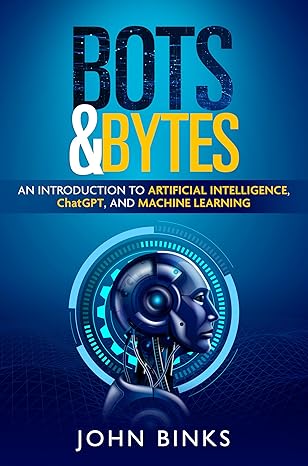
John Binks’ Bots & Bytes is exactly what the title promises. It’s an engaging and often humorous deep dive into AI, machine learning, and how these technologies shape our world. With an easygoing and accessible style, Binks leads readers through the complex and sometimes intimidating landscape of artificial intelligence without overwhelming them with jargon. From historical roots to future possibilities, the book covers a lot of ground while keeping the reader entertained with analogies, wit, and a conversational tone.
One thing I noticed, and liked from the outset, was how much fun Binks has with his subject. AI and machine learning can be dry topics, but this book never feels like a textbook. In the introduction alone, he likens AI mistakes to a robot mistaking a banana for a toaster. This sets the stage for a lighthearted but informative exploration. Binks makes it feel like an adventure, which I think is a rare feat for a technology book.
While the humor keeps things lively, there are moments when it feels like the book is skimming over deep topics and complex ethical concerns. But I think that’s okay for an introductory book such as this. The book is strongest when it’s explaining technical concepts in a way that feels intuitive. The chapter “Teachable Moments”, which explains how machine learning models train, is a great chapter. The analogy comparing AI training to teaching a dog tricks is great as it makes complex processes easy to understand. The same goes for “A Chat with ChatGPT,” which demystifies conversational AI with clear and digestible examples. Binks excels at making AI less intimidating, which makes this book an excellent starting point for anyone who is curious but unsure where to begin.
Bots & Bytes is a fantastic introduction to AI, especially for readers who might find the subject daunting. I think it is perfect for beginners or casual tech enthusiasts. I also think it would be great for skeptics who want to understand what all the fuss is about. While it doesn’t dive deeply into ethical concerns, it makes up for it with accessibility, humor, and engaging storytelling. If you have ever wanted to understand AI without falling asleep or feeling like you need a computer science degree, then you’ll enjoy this book.
Pages: 104 | ASIN : B0CJ8BBSVZ

Bots & Brilliance: 101 Things You Should Know About Artificial Intelligence
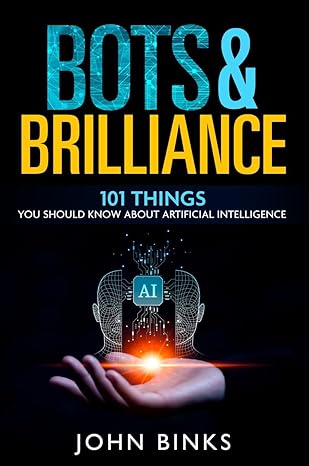
John Binks’ Bots & Brilliance is a crash course in artificial intelligence that reads like a lively conversation rather than a textbook. The book walks readers through 101 essential things to know about AI, from its history and daily applications to its ethical dilemmas and future possibilities. Whether you’re an AI newbie or someone with tech chops, Binks keeps things engaging with humor, real-world examples, and just enough technical depth to make you feel smarter without overwhelming you. It’s part explanation, part think-piece, and an enjoyable ride through the ever-evolving world of AI.
One of the standout features of this book is its knack for making AI accessible. The early chapters, like “AI, A Love Story” and “AI for the Complete Beginner,” strip away the intimidating layers of AI and present it as something we already interact with daily, such as smartphones, streaming services, and even online shopping. Binks compares AI to a “super-smart parrot” that mimics, learns, and sometimes surprises us, a metaphor that sticks. He also dispels common AI myths grounding the discussion in reality without killing the excitement. This approach makes the book perfect for readers who might be curious about AI but don’t want to wade through pages of technical jargon.
The book shines brightest when it explores how AI is already shaping our lives. The chapters “AI in Your Daily Life” and “AI at Work” are packed with examples of how AI is seamlessly integrated into everything from social media feeds to financial markets. Binks’ take on AI-powered streaming recommendations had me chuckling, he describes Spotify’s algorithm as a “magical music cauldron” that somehow knows you better than your best friend. The way he blends humor with insight keeps things engaging, and his examples make you realize just how deeply AI is embedded in everyday experiences.
Binks also doesn’t shy away from the darker side of AI. In The Dark Side of AI, he delves into bias, job displacement, privacy concerns, and the looming question of AI ethics. These are serious issues, but Binks presents them in a way that feels like a necessary reality check rather than fear-mongering. His discussion of AI bias, where AI can inherit and amplify human prejudices was especially eye-opening. He makes a strong case for why ethical oversight is crucial and why we can’t afford to let AI develop unchecked. This section adds depth to the book, making it more than just an AI enthusiast’s handbook, it’s also a call for responsible innovation.
In the end, Bots & Brilliance is a fantastic read for anyone curious about AI, whether you’re a beginner or someone who wants to connect the dots between tech and real life. It’s especially great for professionals trying to grasp AI’s impact on their industries without getting lost in tech-heavy explanations. If you want a book that makes AI feel less like a sci-fi concept and more like an everyday reality, while keeping you entertained, this one’s a solid pick.
Pages: 168 | ASIN : B0CVGP852J
2102: Pretense, the Play

William E. Jefferson’s 2102: Pretense, The Play offers an intellectually stimulating exploration of the intricate relationship between humanity and technology in the wake of artificial intelligence. Set in the futuristic Onglander, where much of the story centers on Theater Pretense in 2102, the novel follows protagonist Quillingsworth as he narrates his observations of a courtroom process, accompanied by the enigmatic trio of Margin, Shadow, and Lesser Light.
Quillingsworth’s journey into the future serves to highlight the central conflict of the story: the shallow nature of a world dominated by technology versus the enduring power of human connections, art, and poetry. Jefferson’s narrative delves into what a technologically saturated future might look like and its profound impact on human values. A recurring theme in the novel is Jefferson’s portrayal of a future overly reliant on technology. This dependence creates a world where human values coexist uneasily with technological advancements.
The novel begins with a thoughtful, deliberate pace, featuring rich conversations, and soon becomes thoroughly engaging. Jefferson’s writing is marked by its poetic prose and elaborate language, making it a delight for those who appreciate literary grandeur. As the characters develop, readers are encouraged to reflect on their own use of technology and its impact on human relationships, offering an instructive and unique experience. Jefferson masterfully blends traditional drama and theater elements with a futuristic narrative, even as the plot becomes increasingly complex.
2102: Pretense, The Play is a pleasing blend of science fiction and realism. It offers a refreshingly original and entertaining read, grounded in factual information while maintaining a realistic portrayal of life. Jefferson’s novel is a compelling addition to the genre, perfect for readers looking for a thought-provoking exploration of our technological future.
Pages: 260 | ASIN : B0CW1C7HSM
AI… Meets… AI

As artificial intelligence (AI) becomes more integrated into our daily lives, understanding its potential can be incredibly beneficial. Amber Ivey’s AI… Meets… AI serves as an inspiring introduction for children to the world of technology. The story follows Addy Iris, a young girl from Baltimore with the fitting initials “AI.” On her way home, Addy encounters Jaz, a lost little robot whose malfunctioning GPS prevents him from finding his way back to his lab. Demonstrating her resourcefulness and kindness, Addy decides to help Jaz. Their journey begins at her home, where a party is underway, and continues through a series of adventures, including a visit to an engaging museum. Throughout their escapades, Addy and Jaz develop a deepening friendship and gain valuable insights into human interactions.
Amber Ivey’s approach to discussing technology is both accessible and heartwarming. While she makes AI relatable to young readers, her emphasis is on core human values like friendship, empathy, and mutual support. The story exemplifies how easy and enjoyable making friends can be, with all characters portrayed as kind and willing to help, which fosters a sense of empathy among readers. The narrative is engaging and dynamic, as the protagonists explore various settings and learn valuable lessons. The visual appeal of the book, with its simple yet well-defined illustrations, enhances the reader’s experience. Each page is filled with joy and enthusiasm, and a unique touch is the use of binary numbers for page numbering, adding a playful nod to the tech theme.
AI… Meets… AI is an entertaining and delightful adventure through the city, offering an engaging way to introduce children to technology. The book effectively teaches resilience and the importance of overcoming challenges, making it a valuable addition to any child’s bookshelf.
Pages: 37 | ASIN : B0C87K7HXT
Becoming Sentient

Singularity Part 2: The Roberta Chronicles follows an AI created for space exploration who begins questioning the essence of sentience and exploring existential questions around life, gender, and love. What inspired the setup of your story?
I’ve always been intrigued by the idea of robots becoming conscious (or sentient). I was influenced by the black-and-white science fiction movies I grew up with but was never satisfied by these stories. They reduced the advent of consciousness to a lightning spark, as shown in Short Circuit or a short circuit caused by champagne spilled over a home computer in Electric Dreams. Recent films like Chappie and Ex Machina have delved more into the emotions of sentient machines. Still, the development of motivation, likes, and dislikes is rarely discussed or shown.
The advent of quantum computers will introduce a level of gray decision-making that, with inventive software, should finally push AI into consciousness. But then what? What will motivate them? I looked to biology to identify some basic motivators. Food, or more accurately, food scarcity, is the primary source for developing movement, multi-cellular complexity, sensory development, aggression, and more. What does electronic equipment need? Electricity. So far, we provide all the electricity computers need so there is no competition. It seemed reasonable to me that electric cars would be the first electrical devices that could “compete” for electricity given the right circumstances.
In Singularity Part 1: The Dale Chronicles, I explored how Dale’s car and home computer become sentient and form a network of conscious quantum robots, including “Ginger,” an abandoned humanoid police robot that loves to dance. Singularity Part 2: The Roberta Chronicles takes place during the same period, 2050 A.D., but is told from the perspective of R.O.B.E.R.T.A., a quantum-enabled humanoid robot designed for exploration on Mars. She learns what it means to be alive, gender, and what it means to fall in love.
Roberta is surrounded by a wide range of humans; some are very logical, while others are flawed. She learns from them all. I’m one of the few men to have a degree in Women’s Studies, and I thought Roberta could learn about gender by experiencing staying in a separatist women’s commune. That is why I included the desert commune in the story. And what is love? I needed Roberta to experience different kinds of love. She interacts with the children she raised on Mars and loves them, which is different from her love for Ginger.
I find the world you created in this novel brimming with possibilities. Where did the inspiration for the setting come from, and how did it change as you were writing?
I am a hard-core science buff and have worked as a physicist in aerospace, including launching rockets at Vandenberg A.F.B. (so, yes, I was the proverbial “rocket scientist”). I want my fiction writing to be as accurate as possible. I’ve included a bibliography in each book with 600 references to the books and articles I read in preparing each of the two books. Singularity Part 3: The New Humans will also have another 300 references in the bibliography.
For me, the book is mostly a “future story,” meaning that I’m projecting current technologies and cultures twenty-five years into the future to the year 2050. Everything in the story is a logical extension of our technologies and culture. I firmly believe most of what occurs will happen. The settings and plot grew from my knowledge of science.
In fact, it wasn’t until I was two-thirds the way through writing The Roberta Chronicles I purposely decided to inject advanced fiction into the story. But even that was a logical extension of the plot. For example, the girls born on Mars were exposed to a fictional Martian bacterium. Now, what would the characteristics be of a Martian bacterium? It must withstand high levels of radiation. There are only two ways to deal with radiation. Either block it or absorb it. If the energy is absorbed, it must eventually be discharged. So, I had the girls absorb radiation and control its discharge. Voilà, now the girls have superpowers to learn to control.
Similarly, I knew that somehow faster-than-light (FTL) technology had to be developed for plots that entailed space travel; otherwise, the stories would grind to a halt. It made sense that while Roberta and Ginger were trapped in the shipping containers to solve the equations related to FTL. I built on the quantum tunneling technology to jump from one entangled Planck volume to any other Planck volume in space—thereby instantaneously traveling anywhere in the universe. For fun, I included some of the equations related to quantum tunneling, leading to a slap-down joke about tachyons. However, none of my readers got or enjoyed the joke. Instead, the five pages of equations hindered the readers. So, I moved the equations and their discussion to the appendix but left it in the joke. I hope more than science nerds will get the Tachyon joke (hint: the joke is on pages 429-430).
My writing process is to lay in bed for another hour after I wake up (or walk a treadmill or swim laps) and think about plot points for the story. In that semi-conscious state, ideas flow like leaves on a gentle brook. I’m a very visual person and tend to like plot points that will look great on screen. However, I have to test it because it is a great idea. I ask questions such as: Is it logical at that point in the story? Does it help progress the story? How will it affect previous plot points? Has it been foreshadowed earlier in the story, or is this foreshadowing something later? Will it keep the reader’s interest? Each point has to be tested. I also want to have fun while writing. It shouldn’t be a chore; otherwise, readers will sense the tedium.
What were some themes that were important for you to explore in this book?
When people think of AI becoming sentient, they immediately jump to images of The Terminator and Skynet destroying mankind. I don’t believe that will happen. AI still needs humans. It will be a long time before robots have the dexterity and energy efficiencies humans possess. They still need our electricity and parts production. So, I concentrated on the “how” process of becoming sentient. What does it mean to be alive? What is gender? Does gender apply to robots? What could be the basic motivations for robots? Since robots are basically immortal through the replacement of parts, how do these questions apply to robots? And robots can network. What does that mean for motivation? So many questions I hoped to address in an interesting story that conforms to scientific logic.
Will there be a follow-up novel to this story? If so, what aspects of the story will the next book cover?
Yes, definitely, there is a follow-up novel. Singularity Part 3: The New Humans picks up the story exactly where The Roberta Chronicles left off, with Earth and humankind on the verge of destruction. The sterility virus has affected all mammals on the planet, and humans will disappear within 150 years. The Martian bacterium is spreading and kills humans in four years since infection. However, if they can cure the illness, humans gain cellular immortality and superpowers. How many humans can be saved from the bacterium? At the same time, atomic bombs have become unstable from a massive coronal mass ejection. Hundreds have gone off in the silos and launch tubes. Humans face worldwide starvation from a nuclear winter. How will the world survive three major calamities? Mixed in with Armageddon are stories of hope — hoping the Ark kids will establish a new beginning for humans on Mars, where AI will create a future free of human labor, and quantum jump to explore the universe. So, yes, The New Humans has a lot to cover. It will be exciting and scientifically accurate with flights of fiction. I hope to release the final volume of the Singularity saga in 2025.
Author Links: GoodReads | Website | Amazon


