Blog Archives
The Original Human Beings: Sometimes, in the Darkest Moments, We Can See the Brightest Lights!
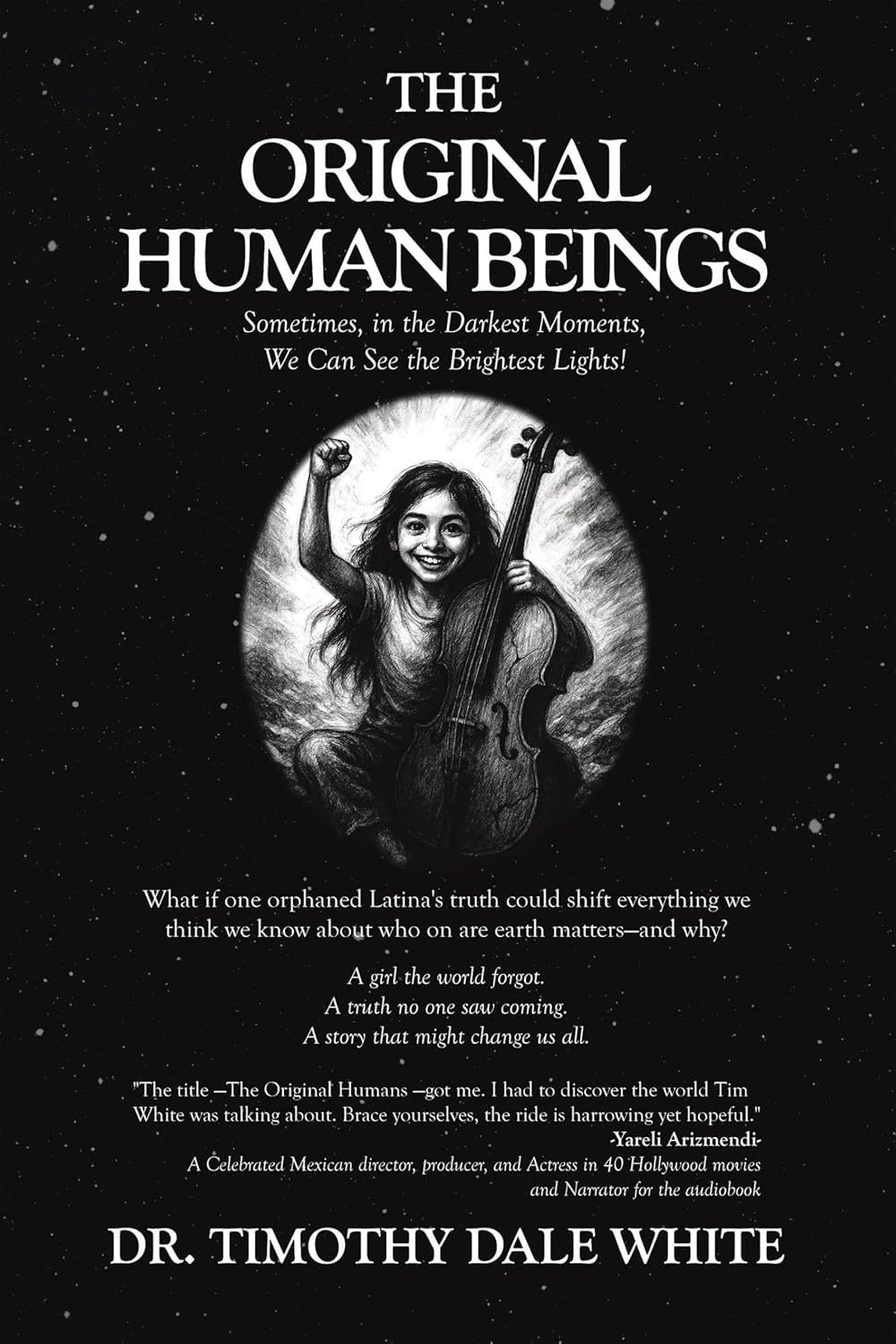

The Original Human Beings tells the life story of Never Morales, a Latina girl born in the Tegucigalpa garbage dump, who grows into a woman shaped by brutality, resilience, music, and a search for belonging. The novel follows her childhood in “Dante’s Inferno,” her encounters with dangerous men, her strange protector Loco Lucy, the death and revival prank of her mother, and the long journey that eventually leads her to the Nez Percé people and a deeper understanding of what it means to be human. Dr. Timothy Dale White blends raw memories with cultural history, weaving in philosophy and anthropology in a way that makes the story feel both personal and sweeping.
The writing swings between heartbreaking and strangely joyful, almost like the story breathes in pain and then exhales laughter. I kept feeling jolted by how quickly the author shifts from horror to humor. For example, the scene where Never’s mother fakes her own death to taunt her abuser left me shocked and then suddenly laughing through the tension. That moment hit me hard because it showed how joy can survive even when everything else is falling apart. The style feels bold, sometimes messy, sometimes poetic, but often intimate. I found myself pausing to absorb pieces of dialogue or reveling in small images.
I also felt a lot of admiration for how the book forces readers to sit with uncomfortable truths. The dump scenes are vivid and painful, and the children’s reality is harsh. Yet the story never sinks into hopelessness. Instead, it pushes toward questions about humanity, oppression, and identity. The inclusion of Indigenous philosophy and the Nez Percé worldview surprised me at first, yet it worked. It gave the story a bigger frame, like Never’s life was part of something older and wider. I appreciated that the book doesn’t pretend to have easy answers. It asks you to feel your way through the darkness instead and trust that something bright might show up.
I think this book would be perfect for readers who seek stories that blend emotional honesty with cultural depth. It suits people who want fiction that challenges them and surprises them, people who enjoy character-driven narratives, and anyone drawn to themes of survival, dignity, and identity. If you like stories that break your heart a little, this one is worth your time. Author Dr. Timothy Dale White has written a fierce and soulful novel that turns darkness into meaning.
Pages: 356 | ASIN : B0G42BPC2T

Terrifying and Darkly Funny

Unorganised Crime follows two down-on-their-luck publicans who make a deal with a loan shark to collect a man from the airport, but they run into trouble when he later goes missing, and they get the blame. What was the inspiration for the setup of your story?
Guy Ritchie’s early films were an enormous influence on me, especially Lock, Stock and Two Smoking Barrels and Snatch. I loved those hyperkinetic crime capers where small-time crooks blunder into big-time trouble, and everything spirals from one bad decision into the next until it all clicks into place at the end.
That style really shaped the setup of Unorganised Crime. On paper, it’s simple. Two debt-ridden publicans agree to pick up a Korean man from the airport for a local loan shark, in exchange for some debt relief. The fun is watching it unravel, because once your “everyman” characters are in over their heads, the chaos becomes the engine of the story.
Magdalena Black is unforgettable. Where did she come from, and how did you approach writing a character who’s both terrifying and darkly funny?
Thank you. Magdalena was one of my favourite characters to write. She took on a life of her own and became this intelligent, wolf-like apex predator who looms over the story like a dark, Armani-wearing cloud.
Truth be told, she started life as Leon Black, a sleazy, Hawaiian-shirt-wearing buffoon. But in a very male-centric cast, Leon never quite landed, and I realised I needed a bigger presence for the story’s main villain. It clicked after I saw Australian comedian Morgana Robinson on Taskmaster. Morgana has this perfect mix of beauty, elegance, intelligence, and, most of all, Aussie spunk that suited a character like Magdalena Black. I rewrote the character from scratch, gave her a posh voice and privileged upbringing, and Magdalena was born. The humour comes from how calm and practical she is. She treats intimidation like admin, which makes her both terrifying and darkly funny.
The book balances genuine danger with laugh-out-loud moments. How do you walk that line without undercutting the stakes?
Plotting and editing are my best tools for keeping that balance. With so many intersecting storylines, Unorganised Crime has to be tightly structured, otherwise the tension falls apart. The comedy works best when the stakes are real, and the humour comes from character, not from undercutting the danger.
A lot of it comes down to pacing. Sometimes it’s as simple as swapping the order of scenes, easing off the pressure with a lighter moment before ratcheting things up again. Editing is where I find the line. I have cut plenty of jokes that dragged or slowed the story down. Less is more, and if I can get a genuine laugh every few pages without losing momentum, I know I’m close.
Do you see more stories for Jack and Hung—or others in this world?
Absolutely, assuming my brand of quirky, darkly comedic crime capers finds its audience. I would love to keep exploring this world, and I’m especially drawn to an anthology approach, a bit like the Fargo television series. Different cities, different time periods, different crews of misfits making terrible decisions, with Easter eggs and recurring characters connecting it all together.
I would also love to revisit Jack and Hung down the track, a decade or two after the events of Unorganised Crime, and tie up a few loose ends.
Author Links: GoodReads | Facebook | Website | Amazon
On Australia’s glittering Gold Coast, two small-time publicans owe money to the wrong woman. Magdalena Black doesn’t offer lifelines … she deals in shackles.
To keep their pub afloat, Jack and Hung agree to do her one simple errand: collect a mysterious Korean man from the airport.
But when their passenger vanishes, the debt-ridden pair are suddenly prime suspects in a kidnapping they didn’t commit. Cue a violent chain reaction of Korean gangsters, bent detectives, and Melbourne hitmen … each more ruthless and ridiculous than the last.
Bodies fall. Tempers flare. Beer spills. And Jack and Hung are running out of luck on the Glitter Strip.
Darkly comic, fast-paced, and brimming with double-crosses, Unorganised Crime is Aussie noir in the vein of Guy Ritchie’s ‘Snatch’ and Elmore Leonard’s sharp-tongued crime capers. Perfect for readers who like their crime fast, funny, and unapologetically Australian!
Wordless Ways
Misconceptions of an Introvert follows a quiet sixth-grader who loves her own space, only to find herself misunderstood by classmates and even her teacher. What inspired you to write a story centered on an introverted child?
This story is based on one of my sixth-grade experiences. I have been an introvert since I was in elementary school and have often been misunderstood. I wrote this story to raise awareness of the personality trait of introversion.
Why was it important that Sherry advocate for herself rather than having an adult fix the problem?
Sherry needs to know how to advocate for herself because her parents will not always be there to support her.
What misconceptions about introverts did you most want to challenge?
The misconceptions I want to challenge are that introverts may not know what is happening in conversations or discussions because of our wordless ways. However, we are quietly observing and thinking. We process information more deeply before we verbalize our thoughts. Also, people may think that introverts are antisocial because of our love of solitude. Being alone helps us recharge and be better the next day.
Why did you feel this was an important story for classrooms today?
Introversion is a misunderstood personality type. Therefore, having classrooms aware of the personality type will help introverted students feel included and understood.
Author Links: GoodReads | Amazon
Honesty as a Skill
The Tail That Told the Truth follows a young fox who, if he tells a lie, has his tail change colors, causing him great embarrassment. What sparked the idea of a fox whose tail changes color when he lies?
The concept grew out of observing how children experience honesty long before they can fully explain it. In my own life, watching children navigate moments of truth, hesitation, and accountability–including my own–made it clear that these experiences are deeply emotional and often confusing. I wanted to translate that internal process into something concrete and visible. The fox, traditionally associated with cleverness, provided a familiar character, while the tail became a visual metaphor for how truth has a way of surfacing, even when we wish it wouldn’t.
The book frames honesty as something to practice, not something to fear. Why was that approach important to you?
Honesty is often taught through consequence rather than understanding. From both observation and experience, it’s clear that children don’t avoid honesty because they lack values, but because they fear disappointment or punishment. Framing honesty as a practice allows room for growth, reflection, and reassurance. It shifts the focus from being “caught” to learning how to do better, reinforcing honesty as a skill that strengthens with guidance and patience.
What conversations do you hope this story opens between children and adults?
I hope the story encourages adults to slow down and ask why instead of reacting immediately. Conversations about why a child felt compelled to lie-fear, uncertainty, or a desire to belong-are often far more meaningful than focusing solely on the behavior itself. The book is meant to create a safe entry point for discussions about accountability, trust, and empathy, helping adults model the kind of honesty they hope to see. The story was intentionally written to work both as a quiet read-aloud and as a starting point for gentle discussion, allowing children to engage with the idea of honesty at their own pace.
Will this book be the start of a series, or are you working on a different story?
Yes, this book is part of a broader emotional-growth series focused on helping children understand and navigate internal experiences such as honesty, self-trust, belonging, and emotional regulation. Each story stands on its own while contributing to a larger framework designed to support meaningful conversations at home and in educational settings. Additional titles in the series are currently in development.
Author Links: GoodReads | Amazon
This heartwarming book opens up powerful conversations about truth, trust, and the bravery it takes to admit when we’ve made a mistake. Perfect for bedtime reading, classroom discussions, or emotional learning at home.
For ages 4–8, this story will resonate with any child who’s ever felt the pressure to hide the truth—and the relief of letting it go.
Racial Freedom

Heat of Paris follows a 26-year-old white man and a 24-year-old Negro woman who cross paths, pulling them into a world of art, politics, race, class, love, and self-reinvention. What first drew you to 1951 Paris as the setting for this story?
My parents were refugees from WW2. My father was in a leftist anti-Hitler group in Germany before the war and was wanted by the Gestapo. He fled Germany for Belgium in 1936 and met my Jewish mother. When war broke out, he was imprisoned by the Belgian/French as an enemy alien and sent to an internment camp in Southern France. He eventually escaped from the camp and rendezvoused with my mother. On the run and evading capture (my father to a forced labor camp and my mother to Anschutz extermination camp), they fled to neutral Spain and with the help of Jewish organizations embarked on one of the last ships leaving Europe in 1942. Hearing the stories of their life and escape from Europe defined the view of my parents as a child. When I was sixty years old, I found out that my father, deceased at that time, had left a daughter in Germany. I tracked her down and wrote a book – My Sister: A Journey to Myself.
Helping my parents send food parcels to her and her family in communist East Berlin to help them survive near starvation defined my childhood. I knew I had to write about that period. And Paris, the city my wife and I loved and visited repeatedly after the war, became the setting for the novel I wanted to write. Paris had not yet experienced the post war prosperity and was a melting pot of ideas about the post-WW2 world and how it would be organized. Self-determination, sexual freedom, and identity were the themes I wanted to explore.
How does being out of America reshape Christie’s and Franz’s understanding of themselves?
Christie was an intelligent, ambitious Black woman seeking to escape the confines of her family and community. For her masters thesis, she chose a summer in Paris to research the French writer George Sand as her entry into the larger white world. Freed from the restrictions of her Harlem community, she was able to initiate new relationships previously considered unimaginable.
Franz was not a newcomer to Paris and France. For him, as a former soldier, it represented the reliving of his wartime trauma and loss of his best friend. But the moment he saw Christie disembark from the ship, his world changed. If he had seen her in New York, it would have been the mere adoration of a beautiful Black woman. But the racial freedom of Paris allowed this adoration to express itself into a meaningful relationship.
What were some themes that were important for you to explore in the book?
Race, Culture, and Identity. From my own experience of being married to a Black woman for 58 years, I reached into my own feelings to uncover how I was able to transcend the racial boundaries during the period when I met my wife. For Christie, who lived a generation before mine, it was an enormous jump into the unknown. She never thought of herself as a romantic, but more realistically as an ambitious Black woman striving to be somebody. In Paris, the first time, she experienced the power of love, and she had to process this power against the rules of her upbringing in a segregated society. She loved her family, church, community, friends, and life in Harlem. That life was incompatible with her love for Franz.
Franz’s view on race was different. Living as a white man, yet cognizant of his Negro ancestry, he was seeking absolution for the lie he was living. Yet, he could not confess his Negritude to Christie, wanting her instead to love him as the white man he perceived himself to be. He knew his marriage to Christie would ostracize him from his community and force him to live in a Black neighborhood. He wanted Christie to make the same sacrifice and not fall back on the fact that he looked white but was really black. In those days, one drop of black blood defined your blackness.
Where do you see your characters after the book ends?
Heat of Paris is the first book in a trilogy. The saga of Christie and Franz continues in Ring of Deception to be published in several months and finally in Sugar Hill to be published early next year. Their saga brings Franz back to Paris, then colonial Algeria and the Mohican reservation in Wisconsin, and Christie to her childhood in segregated Mississippi. Through it all, they are separated, yet together, and must each undergo an unveiling of who they are and then a rebirth to allow their love to flourish.
Author Links: GoodReads | Amazon
Closer to Reality

Arid follows a desperate man and a dwindling band of survivors who struggle to stay alive in a scorched wasteland where water is controlled by the rich and greedy. Joshua is ambitious but deeply worn down. What were some driving ideals behind your character’s development?
I give fragments of my personality to a lot of my characters, and Joshua is no exception. All he really wanted was a normal life and to live in a world that hasn’t lost its humanity. I don’t think he will ever stop striving for that.
Beyond survival, what do you see Arid saying about greed and power?
That what happened in Arid is closer to reality than some may think.
Will there be a follow-up novel to this story? If so, what aspects of the story will the next book cover?
I’m not sure at this point. I’m currently working on a novel that is set to be published this spring, but it’s a totally different subject matter. I definitely haven’t ruled out the possibility of a sequel.
Author Links: GoodReads | Facebook | Website | Amazon
It’s the distant future. The earth is scourged by nuclear warfare and natural resources have become scarce. The country is overtaken by wealthy moguls who dominate the water supply and sell it back to the public at ridiculous prices. After a drastic crime increase “indigents” who can’t afford water are stripped of their belongings and forced out of town by an army of brutes called Purifiers.
Life becomes harsh and ominous for the bright, ambitious Joshua Wyman and his group until they begin to occasionally receive food and other basic amenities after Joshua is deemed useful. When a blatant abuse of Purifier power during a routine visit leaves them reeling, Joshua and his friends reach their breaking point.
They devise a plan to steal the Purifiers’ vehicle during their next visit and escape their hell. Their journey across the uncharted wastelands filled with murderers and thieves proves to be far more than this civilized, benevolent crew bargained for. This tense, divided city will soon face its greatest fear-uprising!
A Fusion of Essays and Photos
Meanwhile, Here in Austin is a seasonal portrait of a city becoming home, blending intimate essays and photography to capture the quiet beauty, chaos, and heart of everyday life in Austin. Did you begin this project knowing it would become a book, or did it grow organically?
It grew organically. When we first moved to Austin, every weekend felt like a vacation. I’d grab my camera and head out to explore our new home. Over the years, I built up a large collection of photos, but I eventually wanted to do more with them than let them sit in an online gallery. My first thought was a photography book. But some of the images needed context. A line or two didn’t seem to be enough.
The first time I started writing longer pieces was after a storm, when I realized a single photo couldn’t capture its intensity. We had previously lived in Los Angeles, where unplugging devices during a storm never even crossed my mind. In Austin, though, after hearing a few horror stories about fried electronics, I decided to play it safe. That experience needed explanation beyond the image itself.
Then came the winter storm. Photos of icicles alone couldn’t accurately explain what we went through. The images needed my experience alongside them so readers could understand what photographing those icicles really meant and how they fit into the larger context.
As a result, the book expanded to become a fusion of essays and photos. But I still wanted to “lead” with photos and have the essays serve as a larger explanation. I think the only instance where I wrote an essay purely for the sake of written content was when a shooting occurred at our favorite slushie café. This was part of my discovery of Austin, and it felt necessary to include it.
What does photography allow you to express that writing alone cannot?
For me, photography is purely about feeling and capturing a mood. While it’s true that I can describe those feelings with words, photos are more universal. You don’t need language, a translator, or an explanation of cultural differences. You see it, you feel it, you get it… within seconds. Photography allows me to share what I saw and exactly how I felt in that moment with a much wider audience.
Many of the book’s most powerful moments come from everyday scenes—storms, deer, swimming holes. Why do small moments matter so much to you?
That’s a two-part answer, I guess. From a photography perspective, I usually notice the larger elements first: the people, the architecture, and the landscape. But when I return to the same place a second or third time, I start to see the smaller moments. Those details matter because photographers are always searching for a unique way to capture a scene. You have to train your eye to find new angles or fresh perspectives. That process teaches you to notice everything, because you’re always looking for that something that will make your photos feel different.
The second part of that answer is that a city’s character, or even a neighborhood’s character, is often defined by smaller moments. It’s the subtle cultural differences that stand out. When comparing what makes Austin unique versus a larger city like L.A. or New York, it comes down to the people, of course, and what I usually call “the little things,” or those small details that give the city its character.
What aspects of the city surprised you most once you started paying close attention?
How much Austin is changing right before my eyes. It’s a lot like raising children. When you see them every day, the changes aren’t obvious. It’s only when a friend visits after a couple of years and says, “Your kid has changed so much!” that it really hits you, because you didn’t notice it happening.
Austin feels the same way. I didn’t truly see the changes until I started comparing my downtown cityscape photos. That’s when it became clear just how quickly the city is expanding and evolving. It’s going through real growing pains.
Author Links: GoodReads | Website | Amazon
Clyde

Clyde, by Evan Borchert, follows a man who wakes with no memory, no body to speak of, and no control over his senses. He exists in a strange limbo where lights flash behind eyes he cannot blink, and a doctor he nicknames Jim Bob pokes at him while speaking in cheerful tones that feel all wrong. As Clyde slowly discovers what has happened to him, he builds internal systems to protect his identity, holds tight to scraps of dreams, and pieces together the truth of a shattered world and of himself. The story grows from a claustrophobic medical mystery into a post-apocalyptic adventure filled with danger, grief, technical puzzles, and a surprising amount of heart. It becomes a journey of rebuilding a life that has already ended once.
The writing is straightforward but sharp, and it kept me glued to every shift in Clyde’s awareness. I kept feeling this strange mix of dread and wonder as he uncovered each new detail about his condition. The book takes its time with those moments. The pacing builds pressure little by little instead of throwing big twists for shock value. I also appreciated how the story handles isolation. Clyde’s frustration, his humor, and his fear all felt genuine. I caught myself rooting for him early on, even when I knew the truth he was digging toward would hurt.
There’s a lot in here about identity and autonomy and the way technology can save us or break us, depending on who controls it. Some scenes made my stomach twist, especially when Clyde learns how much of his past is gone for good. Other parts made me grin, for instance, when he starts outsmarting the systems built to contain him. I appreciated how the book never leans too hard into scientific jargon. The tech stays clear and readable. The emotional beats sit right on the surface. And the world-building, especially once the bunker and its people come into play, feels lived-in without ever slowing the story down.
Clyde left me thinking about what actually makes someone whole. The book mixes tension, sadness, and hope in a way that made the last chapters stick with me. I’d recommend it to readers who enjoy character-driven sci-fi, anyone who likes survival stories with emotional weight, and people who want a mystery that unfolds piece by piece instead of rushing straight to the point. It’s a thoughtful, surprisingly warm story wrapped inside a gripping science fiction shell.
Pages: 282 | ASIN : B0G54BJQ83



 LITERARY TITAN