Blog Archives
Side Quest: Stories
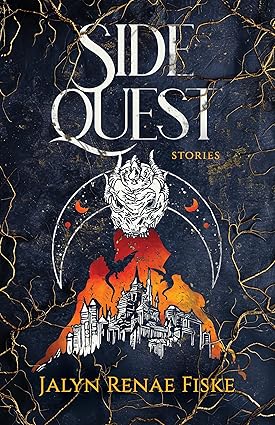

Jalyn Renae Fiske’s Side Quest is a spellbinding short story collection that threads together the fantastical, the bizarre, the sorrowful, and the hopeful into a vivid tapestry of speculative fiction. Each tale feels like its own little world, yet they all orbit the same sun. Stories about transformation, identity, and the human ache to find meaning in magic, or at least something just beyond reach. From haunted boxes that hold hearts to candy that can bend reality, Fiske’s writing thrives in liminal spaces where myth rubs up against memory and childhood wonder is soaked through with grown-up grief.
Fiske writes like she’s pulling you by the hand into each scene, whispering truths you’re not sure you’re supposed to know. The imagery is lush and often strange in the best way. Raw, dreamlike, sometimes grotesque, but always beautiful. Her story “Soul Candy” was one of my favorites. It dances between sci-fi satire and horror with a slow burn that leaves a pit in your stomach. It’s not just about mood-altering sweets; it’s about how easy it is to surrender yourself to illusion when reality offers so little warmth. And then there are stories like “Heart Box” that broke me open quietly, like a poem with a knife tucked between the lines. Fiske writes grief with a tenderness that hurts. She captures children in these moments of impossible emotion and makes them feel completely real. And she never talks down to her characters or her readers.
A couple of the stories leaned into allegory or felt like exercises in style rather than fully lived-in worlds. But even then, the writing kept me in it. Fiske knows her craft. She’s playful, she’s weird, and she’s sharp. I also loved the way she framed the whole collection as her “side quests,” which made me think differently about short stories, not as detours but as power-ups, each one leveling up the voice of a writer who’s still growing and pushing herself.
I’d recommend Side Quest to anyone who loves speculative fiction with a soft heart and a sharp edge. Fans of Kelly Link or Carmen Maria Machado stories will feel right at home here. If you’ve ever wanted to disappear into a story that feels like it a dream, this collection is a must.
Pages: 227 | ASIN : B0DKCYY7LG

Thief of Laughter
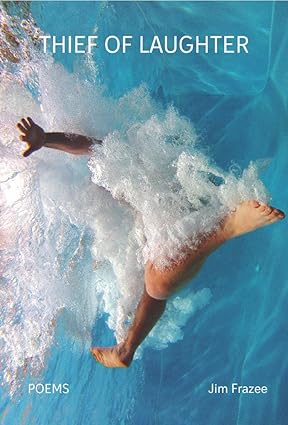
Jim Frazee’s Thief of Laughter is an intimate and evocative collection of poetry that scrapes raw nerves and lays bare the fragility of identity, memory, and family. The book weaves through a lifetime of emotional collisions. Fathers and sons, adolescent cruelty, war and its ghosts, spiritual betrayals, and fleeting moments of tenderness. Frazee captures these with a poet’s sharp eye and a survivor’s haunted voice, his language pulling no punches and never hiding behind pretense.
Frazee’s style is straightforward, sure-footed, but packed with layers. What struck me hardest was how many of the poems felt like emotional snapshots. The kind you can’t put back in the album once you’ve touched them. The violence of silence in “My Father’s Lesson,” the unspeakable grief tucked into “Elegy for E,” or the nearly unbearable self-loathing and regret that pulses through “Jell-O,” these pieces didn’t ask for sympathy. They earned it.
And yet, Frazee doesn’t let the darkness smother you. There’s a strange grace to his honesty. The title poem, “Thief of Laughter,” might be one of the most potent explorations of intergenerational pain I’ve read in a long time. It’s unflinching. Still, there’s beauty in the precision of his images and a kind of quiet rebellion in his insistence on remembering. Even when he writes about cruelty towards himself, others, or from the world at large, there’s a current of compassion, sometimes bitter, sometimes soft, running beneath it all.
If you’ve ever grappled with your past, questioned the people who raised you, or wondered what ghosts still rattle around in your own head, this book might sting, but it’ll also speak to you. I’d recommend Thief of Laughter to anyone who’s lived long enough to lose something important.
Pages: 156 | ASIN : B0F3KNLJ3P
The Mole Vol I
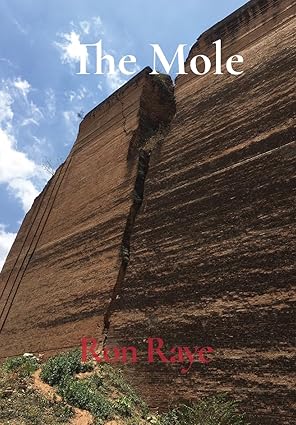

After reading The Mole Vol I by Ron Raye, I was left with the kind of restless wonder that follows a vivid, unsettling dream. This is not a book you breeze through or easily categorize. It’s a sprawling, poetic reflection on writing itself. What it means to create, to wrestle with imagination, and to birth stories from the void. Framed as a novel but flowing like a feverish verse epic, The Mole explores the narrator’s relentless, obsessive pursuit of a book that never quite lets itself be written. It’s a journey through false starts, unruly characters, and the chaos of creativity itself.
The writing is repetitive, fragmented, and sometimes circular. But maybe that’s the point. Raye plunges into the deep end of postmodern playfulness, layering thoughts about writing on top of metaphors about the self, identity, the muse, and madness. He breaks the fourth wall constantly. One minute we’re inside the narrator’s mind, the next we’re hearing characters rebel or vanish mid-scene. The language pulses with raw emotion. Some parts made me feel like I was watching someone have a breakdown in real-time, but in a way that’s painfully honest and often oddly funny.
What struck me most was how deeply personal it felt. The narrator’s longing to write, to leave something meaningful behind, resonated with me. It’s not really about the story, because there isn’t a traditional one. It’s about the process. The doubt, the silence, the moments when words feel useless. At times, I felt deeply seen, especially in those passages where the writer questions the worth of what they’re doing, yet keeps going anyway. That kind of creative vulnerability takes guts to put on the page.
The Mole Vol I isn’t for everyone. If you’ve ever struggled with your own voice or chased an idea until it nearly broke you, there’s something deeply relatable here. I’d recommend it to poets, writers, and anyone who’s ever stared at a blank page for too long.
Pages: 836 | ISBN : 978-0980045284
The Human Condition
Scandals is a collection of prose poems and microfiction, where the grotesque and mundane are transformed into surreal snapshots of American despair and dark humor. Were there specific influences that shaped the rhythm and tone of this collection?
I love the lyrics of David Yow, Nick Cave, Laurie Anderson, the lyrics on Nirvana’s In Utero, anything that paints the kind of stranger-than-fiction aspects of humanity. My favorite poet is Eric Paul, who was also the vocalist for Arab on Radar, The Chinese Stars, Psychic Graveyard, etc. His lyrics especially made me want to write poetry. I’m also influenced by overheard dialogue; I keep a small notebook to document things I hear every day. Then, there are more visual influences like Diane Arbus, Todd Solondz, Werner Herzog, Harmony Korine, Mary Ellen Mark, and the countless fly-on-the-wall documentaries I obsess over like Streetwise, Strongman, and Vernon, Florida. I’ve always likened poems to photographs, where I’m sorta writing what I can’t immediately shoot a photo of or document in a visual way, whether it’s in my head or right in front of me.
Scandals feels personal and raw. How much of it was drawn from your own life versus pure invention?
It’s a little bit of both. Some are fully autobiographical, some are entirely fiction, others are a blend where I might take my own experience and mix it with someone I saw on the street, then add something a friend told me when I was in 3rd grade.
What were some themes that were important for you to explore in this collection?
I definitely wanted it to be honest about the full spectrum of the human condition. Good people doing bad things, bad people doing good things. I’m not very interested in a kind of world without gray areas, where everything is boxed into good and evil. There are a lot of references to sitcoms to show the sometimes stark contrast between the viewer’s life and the fictional lives they’re watching on TV, where many of them are examples of the American dream that most viewers likely will not achieve in their lives. I also found it interesting how, when an actor gets arrested, ends up in the middle of a scandal, or acts out as a result of childhood trauma, many still see that person as the character they play on TV and forget they’re human/are not those characters. I imagined a kind of, “What happens when the camera is turned off/an episode is over?” world with all these sitcoms that mirrors aspects of the real world.
If Scandals had a soundtrack, what five songs would absolutely be on it?
- “Wichita Lineman” by Glen Campbell
- “Everyone I Went to High School With is Dead” by Mr. Bungle
- “Goodbye to Romance” by Ozzy Osbourne
- “Skrag Theme” by Aerial M
- “Runaway” by Del Shannon
Author Links: GoodReads | Instagram | Amazon
“Darkly comical, surreal, and at times, deeply touching.”- Sara B. (Artist)
“The tears of a clown clang against the floor like silver bullet casings. Speeding forward locked in battle with apparitions emerging from the afterburner, Alex Osman is in a league of his own.”- Gwen Hilton (author of Sent to the Silkworm House &Where the Breastplate Meets the Blade)
I’ll be honest – I jumped at the chance to blurb this book because it meant I didn’t have to wait as long to read it. Alex Osman’s work will do that to you. I needed another hit. No one else can find the absurdist wonder of dancing primates or toddlers graffitiing the KISS logo around their kindergarten.
Scandals – Alex Osman’s strongest collection of writing so far – is full of cultural references – because the morning kids show entertainers, sitcom stars, the brand names of the day are the true landscape of the Americana that Osman chooses to mine and dissect with and within his work.
Osman is a genuine surrealist and understands the comedy, the horror, the pain, the immortal and yet constantly fleeting nature within everyday pop-culture. Something that adds a strength and depth to his multi-faceted body of work is that he also sees the beauty, the brief moments of truth and bliss amid the confusing blur of the whole mess of everything that makes up life. And we should be thankful that he does. Work this brilliant and evocative should be treated like the rare jewel that it is.- Thomas Moore (author, Forever, Alone, & Your Dreams)
Just Myself and Pen and Paper

Ten Years of Bliss, Poems is a collection of over 300 poems spanning a decade, highlighting topics ranging from spirituality to love and grief, and from the mystical to the mundane.
Were there any poets or other writers who influenced your work on this collection?
I always write alone. Just myself and pen and paper and a whole lot of meditation in between. I’d say that sense of peace was the inspiration. I think it’s a gift that’s more of a reflection of the world around me. I prefer to maintain objectivity rather than seek.
I think I’ve read three poets in my life. Poe, when I was 11 years old, Yeats, I read once, and before I ever picked up a pen to write I found Virgil’s work at the library and I fell in love with Virgil. I spent the summer with a latin dictionary to decipher some of it. I don’t compare my work with his, who could? But wow, it made an impression.
How do you approach writing about deeply personal or emotional topics?
I don’t approach writing with that sense of direction. If someone can glean something from my work that they can reflect on then that’s great. Hopefully it has meaning for them. I try to write positive poetry, with spiritual meaning embedded in every corner of understanding. It may be floral, it might go deep but it’s never really dark and is always spiritual or about the human experience.
There are two kinds of artists, and poetry is a form of art. There are poets who emote, and ones who have something else to say or express themselves differently. There is a perception that poets are all emotion and I don’t think that’s always the case. To me, emotion is baggage. Passion is love, is a better feeling and I’d rather spend time expressing that.
What is one thing you hope readers take away from your collection?
I would hope that they see an evolution within the themes. The point and the growth. That there is enlightenment for the reader. I want someone to feel good, or to feel better after reading it. To know that’s it’s an act of love.
Thank you so much for the opportunity to discuss my work. I appreciate that so much.
Author Website
Everyone! In the Dream! Is You!

Adam Dove’s Everyone! In the Dream! Is You! is a sharp and intimate collection of interconnected short stories that grapple with identity, masculinity, memory, and the messiness of love. Told in a poetic yet plainly honest style, the book moves between dreamlike surrealism and raw psychological insight. From sculptors binding lovers in clay to children descending into the earth searching for their lost fathers, Dove’s stories weave together fragile characters trying to anchor themselves in shifting emotional terrain. The title story is both a literal and metaphorical encapsulation of the collection; everyone, in every dream, might be a projection of the self.
What struck me most about Dove’s writing is how intimately he writes about emotional discomfort. The dialogue has the cadence of real relationships, awkward, evasive, and occasionally brutal. The prose feels lived-in, worn at the edges like a favorite coat, which makes the moments of beauty hit even harder. There’s an undercurrent of melancholy in every story, but it’s not melodramatic. It’s quiet. It creeps in during a pause between conversations or in the way a character stops mid-sentence. I found myself rereading passages just to sit in the strange sadness of them.
Dove doesn’t shy away from power imbalances, codependency, or emotional manipulation, especially between men and women. At times, I questioned whether the intimacy bordered on claustrophobia. But that discomfort seems intentional. Dove isn’t trying to offer easy takeaways or comforting conclusions; he’s holding up a mirror, and not everything in it is pretty. And that honesty, to me, is what makes the book worth reading.
I’d recommend Everyone! In the Dream! Is You! to readers who appreciate literary fiction that takes emotional risks. It’s perfect for fans of Raymond Carver or Carmen Maria Machado. If you’ve ever loved someone too hard or felt yourself coming undone trying to be who someone else needed, these stories will resonate. They left me feeling unsettled and weirdly grateful. And that, I think, is the mark of something good.
Pages: 208 | ASIN : B0DY69TB2M
40 Days of Fasting

40 Days of Fasting, by Glenville Ashby, is a deeply personal and spiritual collection of 40 poetic recitations born during a sacred period of fasting by Glenville Ashby. Each poem is a meditation, guided by an inner voice named Carlos, and thematically grouped across four weeks: forgiveness, service, humility, and enlightenment. The book fuses mystical insight with raw self-examination, drawing from a rich palette of religious traditions and personal memories. As Ashby fasts from dawn to dusk, the poems become transmissions—messages of divine origin channeled through the lens of his lived experience.
What moved me most about this book was its honesty. There’s a rare vulnerability here. He confesses old betrayals and regrets, and rather than justify them, he holds them up to the light. The language is direct but poetic. Sometimes I felt like I was eavesdropping on a prayer, other times it felt like I was reading someone’s sacred diary. The recurring theme that stuck with me was personal accountability: how even the smallest wrongs can weigh on the soul if left unresolved. That’s a hard truth, but Ashby presents it with such tenderness that I didn’t feel judged—I felt invited to reflect, too.
The writing, while poetic and sometimes cryptic, never veers into fluff. These poems demand patience. They’re not meant to be skimmed. They whisper more than they shout. But when they land, they hit deep. Some, like “Roots Run Deep” and “The Veil,” made me stop in my tracks. Others, like “Tantra” and “The Divine Tongue,” explore esoteric ideas with grace and daring. At times, I found myself wrestling with the metaphysical elements—especially the idea of channeling a spirit guide—but even then, I appreciated Ashby’s courage to fully surrender to the experience. He doesn’t try to convince the reader. He simply shares what came.
40 Days of Fasting is a companion for quiet nights and long mornings. It’s for anyone walking through a spiritual fog, for anyone who feels like their prayers echo back without answers. For seekers, grievers, and those in transition, this book holds a gentle power. It doesn’t promise to fix you, but it just might help you find your footing.
Pages: 70 | ASIN : B0F8W1Z87F
Ten Years of Bliss, Poems

Lisa A. Lachapelle’s Ten Years of Bliss is a sweeping and soul-baring collection of 300 poems written over a decade. The work explores spirituality, love, grief, enlightenment, intuition, and the vivid experience of being alive. Lachapelle’s writing shifts effortlessly between meditative verses and emotional bursts, forming a layered mosaic of personal growth and cosmic musings. Divided into thematic clusters, spirituality, love, identity, and time, the book feels like a quiet unfolding of the author’s inner world, told in rhythm, metaphor, and unfiltered thought.
What struck me most was how Lachapelle’s voice dances between the mystical and the matter-of-fact. Her lines are often like whispered prayers or flashes of revelation. Poems like “Greet the Morning” or “The Majesty of Trees” feel rooted in the earth yet always reaching skyward. There’s a humbling beauty in her spiritual reverence, but it never gets self-important. It’s earnest, raw, and sometimes cryptic. A few poems do drift into abstraction, where the emotion is clear but the imagery loses grip. Still, I found myself going back to those pieces, confused at first, then weirdly comforted. The book doesn’t just present poetry; it invites quiet reflection.
On the flip side, her poems on love and human connection made me ache in the best way. There’s so much longing and gentle devotion, lines that made my chest tighten or my heart flutter a little. “It Was Always You” and “Count With Me” hit like confessions. She doesn’t write romance for show. It’s the kind of love that feels lived-in, broken a bit, healed again, then handed to the reader. The style can feel meandering at times, almost like journal entries dressed up in rhyme, but that’s part of what makes it feel honest.
I’d recommend Ten Years of Bliss to anyone who finds comfort in introspective writing or enjoys poetry that blends the mystical with the mundane. If you’re someone who has sat in stillness and asked big questions with no expectation of answers, this book will meet you there. It’s not a fast read, and it’s not always easy, but it’s emotionally resonant.
Pages: 328 | ASIN : B0F5N7MWLN



 LITERARY TITAN