Blog Archives
Forge New Paths

Goldie Bird follows an 11-year-old girl who copes with her sister leaving for college and her great aunt’s death on the same day, and navigates grief and loneliness, while searching for belonging. What was the inspiration for the setup of your story?
When a longtime friend read through my first draft of the book, she asked me what percent of Goldie was ME. I hadn’t thought that I was writing bits of who I was into my main character, but in looking back, how could I not? We write what we know, and fiction gives us the power to embellish our own experiences and forge new paths and outcomes. I have memories of traveling with my mother and siblings to lay my great-grandmother to rest. The backdrop to my story, the small town of Charlotte, Illinois, is a fictional place that takes much inspiration from bits of things and places that have meant something to me. My characters, too, have qualities that remind me of pieces of personalities and mannerisms of people I have known.
Goldie experiences multiple losses at once. Why was it important to layer those changes together?
Goldie must certainly have anticipated spending time differently with her mother once Elise would be at college. She never got to find out what that would be like, though, as the timing of her great aunt’s death and the events that followed changed the course of what Goldie had expected. I believe the compounded losses have a strong impact on Goldie as well as readers of the book—Goldie has much to overcome and figure out, and the pain is magnified by her own grief and her mother’s unavailability. Goldie must figure out how to navigate her days as she settles into her new place in her family.
Why weave in references to The Little Prince, and what does that story mean to Goldie?
Goldie’s first and subsequent encounters with Kip revolved around The Little Prince, a book assigned to Kip as a class project. Goldie had also read the book with her beloved sister before she left for college. The book serves as a connection to Kip and to Elise, but also, as the story progresses, to Goldie’s father, who highlighted part of the text before sending his copy of The Little Prince to Goldie. Goldie finds parallels with characters in the book as she explores her new relationships.
The “small world” realization near the end is powerful. Why was that moment important?
I believe Goldie’s discovery of who her father is showed her that we are always growing and changing, and when we are going through losses and challenges, there is also hope—and there are new, joyful discoveries waiting for us.
Author Links: GoodReads | Facebook | Website | Amazon
But when she joins her mother for a trip to Heritage where her late aunt lived, Goldie forms an unlikely friendship with Kip, a sweet boy with an infectious sense of adventure. Kip shows Goldie the carefree thrills of birch bending and secret caves where the two bond over common experiences and escape the complexities of the adults around them.
As she reluctantly returns to her life, Goldie must adjust to being a middle schooler as things at home become more challenging. Despite her deep love for her sister and mother, Goldie feels unsure of where she fits in their lives, forcing her to grapple with the bittersweet aspects of growing up and letting go of the way things used to be.
With her frequent letters from Kip and her new friend, Kate, by her side, Goldie tries to navigate all that comes her way on the quest for acceptance and belonging. In this timeless, coming-of-age novel, Goldie symbolizes the universal experience of deep familial connections, friendship, and self-identity.
Careers By the People: Candid Career Advice from 101 Experienced Professionals

Careers By the People is a wide-reaching look at what real work feels like for real people. Mike Wysocki gathers 101 interviews that span everything from CEOs to beekeepers to teachers, and he lets each person speak plainly about what their days look like, what they enjoy, and what grinds them down. The book moves through these stories with an easy rhythm. It shows how career paths twist and turn. It also explains how personality, luck, stubbornness, and honest self-reflection shape a life more than any job posting ever could.
I liked how direct the voices were, since many career books wrap advice in buzzwords. This one does not bother with that. The interviews feel like short but candid coffee chats. I caught myself underlining certain lines because they hit close to home. The mix of pride, regret, humor, and grit reminded me how messy most careers really are, and that made the entire book comforting. I also appreciated how Wysocki frames the stories with his own reflections. He speaks openly about his missteps. His tone feels friendly, almost like a mentor who refuses to sugarcoat anything.
At times, the honesty stings. Some stories feel heavy, and a few made me anxious in the best way because they pushed me to think harder about my own choices. When several similar roles appeared in a row, the forward momentum slowed. Still, that repetition also proved the point that every job contains highs and lows. I found myself enjoying the unpredictable flow of opinions. Some workers adore their field. Others are blunt about their frustration. I liked that mix. It made the book feel alive.
I would gladly recommend Careers By the People to high school and college students, early career professionals, and anyone who feels stuck or restless at work. The book works well as a guide, but it also works as a reality check. It gives readers permission to explore, to question their assumptions, and to admit when something does not fit. If you want straight talk, human stories, and a push to think about what you actually want from forty years of work, this book will serve you well.
Pages: 570 | ASIN : B0BPX59FT5

Funny Contradictions: Medusa as a Hairdresser

Cryptid Bits follows the residents living in the Fairy District, a unique place where creatures of myth and legend live side by side, and humans want to be a part of it all. What was the inspiration for the setup of your story?
The whole collection was actually spawned by a single flash story I wrote from a prompt. The prompt was to write a story where an unexpected character is in a mundane or well-known setting. I wrote a little piece about bigfoot going to the movies and it was such a fun exercise I wrote a couple more. Once I had a half dozen or so little micros I started to see some potential threads and arcs that could connect them and realized I was writing a collection. I’ve always enjoyed books that take a collage approach to storytelling or use a “found document” conceit, so once I knew I was working on a chapbook I made a point of trying out some different storytelling formats. That’s how things like the listicles and Yowl! reviews ended up coming to be. What’s kind of funny is that the original bigfoot at the movies story didn’t end up making it into the finished book, although the spirit of it is still there in the piece “Pros and Cons of Going to the Movies with a Bigfoot”.
The creatures in this book were very intriguing. How did you go about creating them for this book?
All of the creatures in the book come from some kind of folklore or mythology, so it was less about creating them than it was choosing which ones to feature, and which version of the creature archetype to use. I went about that in different ways depending on the piece. A few of them started from the “punchline”—Banshee and the Siouxies was one of those, and so was the vampire at the blood drive. For a lot of the others, I started with the creature I wanted to play with and brainstormed either real-world situations they’d be suited for (brownies working in hospitality) or things I felt would be a funny contradiction (Medusa as a hairdresser).
What were some themes that were important for you to explore in this book?
To be honest, I rarely intentionally explore themes in my work. When I was writing Cryptid Bits I was more focused on exploring the world and following the characters who lived there. I do think that some themes naturally emerged when I was writing just because this setting is so close to the modern real world, but I can’t really take credit for putting those in there, and honestly didn’t even really think about themes until after the collection was done.
Will there be a follow-up novel to this story? If so, what aspects of the story will the next book cover?
I definitely plan to come back to this universe, because it’s a very fun sandbox to play in! I’ve been working on other projects recently and haven’t decided yet which creatures the next book will feature or what the overarching plot will be. I do think the next one will probably be at least novella-length and will likely include some longer short stories rather than just micros. I’m also brainstorming some different types of “found document” forms to include, because I think the collage aspect is something I want to continue in some way.
Author Links: GoodReads | X | Website | Book Review
This is the story of cryptids and humans living in the same world, one where it’s not as obvious as you might think to figure out who around you is a monster.
Cryptid Bits
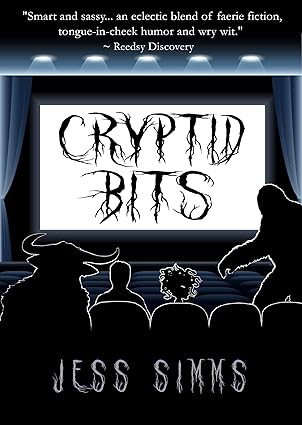

In Crypted Bits, readers are invited into a neighborhood unlike any other. It’s a fantastical realm where creatures of myth and legend live side by side. Here, beings of different species coexist in a fragile harmony, often clashing but mostly managing to get along. That balance, however, begins to shift when humans start moving in. The gentrification of the Fairy District is underway, and with it comes an inevitable upheaval. What was once a peculiar but peaceful community is now facing change that will ripple through its very core. Opening the pages of this novel is like stepping into an enchanted world populated by unforgettable characters, each with their own unique story. The narrative feels like a rich mosaic where reality and fantasy intertwine, creating something fresh, strange, and delightful. Jess Simms draws the reader into a world that is both familiar and otherworldly, reminiscent of Neil Gaiman’s urban fantasy or the whimsical mischief of Eoin Colfer’s Artemis Fowl series.
Rather than following a linear plot, Crypted Bits unfolds as a series of vignettes or episodic misadventures, each offering glimpses into the lives of the district’s residents. The narrative has a tendency to fragment and drift off in unexpected directions, which can be disorienting, but I found it captivating overall.
Simms deftly employs an array of literary techniques to build the Fairy District into a fully realized setting. Advertisements, listicles, social media posts, and news articles all serve as windows into this world, giving the reader a multifaceted view of a community where cryptids (mythical creatures from every corner of folklore) struggle to coexist both with each other and with the encroaching human population. Conflict arises, of course, but it’s handled with wit and charm rather than violence. The struggles of the district’s inhabitants, while real, never feel too heavy. Instead, they are infused with a whimsical energy that makes even the challenges feel endearing. There’s a certain magic to the way life in the Fairy District unfolds, and Simms invites the reader to experience it in all its quirky glory.
I think Crypted Bits isn’t meant to be a straightforward story. Instead, it’s an immersive experience, one that allows readers to wander through its dreamlike landscape, discovering new surprises at every turn. Jess Simms has crafted a world that is a joy to explore, and while the novel may be brief, the spell it casts lingers long after the final page is turned.
Pages: 76 | ASIN : B0CRGK4NJR
It’s Always Been A Dream Of Mine

Surviving the Second Tier follows a female college athlete and her team who rebel against a greedy coach and a system that cares more about money than the players. What was the inspiration for the setup to your story?
I had a couple sources of inspiration for my story. My first is personal experience as a former Division 1 athlete who navigated the college sports system myself and had some of the best and worst times of my life during my athletic career. College athletes are under so much social, personal, and external pressure and that’s really hard to understand unless you’ve been there yourself. Although I was a successful runner who loved my sport (until injuries derailed me) I struggled immensely with feelings of worthlessness, self-doubt, and anxiety. I was also in an emotionally abusive relationship with one of my coaches and I needed a way to make meaning of that. Surviving the Second Tier was an outlet for that experience as well as a way to educate readers about these dynamics and the problems that college athletes face in the real world.
The second source of motivation is my research. I’m a doctoral candidate at the University of Texas where sports policy is a huge part of what I study. The policy issues I research are important but frankly, policy can be boring to talk about even if it’s fascinating to me. Academic research is also very inaccessible because of paywalls and jargon so I needed an interesting and accessible way to discuss my research because, given the current climate, I believe the stakes of it are high. I started telling people “the NCAA is a dystopia” whenever they asked about my research as a way to create conversation. The metaphor really stuck with people and became a great gateway for discussing the ways bad policy negatively impacts college athletes. I wanted to give the college sports industry the 1984 treatment and give people a thought-provoking book that hit close to home and fiction turned out to be an effective vehicle for my academic work. Plus, it’s always been a dream of mine to write a book!
Did you create an outline for the characters in the story before you started writing or did the character’s personalities grow organically as you were writing?
I’m a terribly disorganized writer so I didn’t outline my characters so much as I outlined the issues I wanted to cover. They’re all stuck in a system that was never designed to benefit them but they’re also dealing with personal struggles like anxiety, injuries, burnout, identity crises, discrimination, poverty, abuse, and masculinity. Once I had a concept of the issues that I wanted to address within the real-world college sports industry, I had a good idea of how I wanted my characters to develop and they sort of had minds of their own once I started the writing process (which I loved!).
What were some themes that were important for you to explore in this book?
Identity was a huge one for me. College athletes tend to get really wrapped up in who they are as athletes and fixate on their performances, statistics, rankings, and so on as measures of self-worth. It’s a form of self-objectification that is hard to stop, and fans and coaches also dehumanize college athletes by viewing them solely in terms of their productivity. A big goal of Surviving the Second Tier was to humanize college athletes because they’re so often viewed in terms of production instead of personhood.
As the title implies, I also wanted to focus on themes of surviving a corrupt system. When we think “survival,” we tend to think of things like food, clothing, shelter, and basic necessities. For some athletes (like Sis and Striker), their sport is a ticket out of poverty so it truly is life or death, but sometimes athletes are surviving other things like abusive coaching relationships, mental health issues, crippling media pressure, and life-altering injuries. There’s a lot of pressure on athletes to be tough and gut through these things without showing weakness so I wanted to explore all of that through my characters, their work, and their relationships with each other.
What is the next book that you are working on and when will it be available?
I’ve very tentatively started my sequel but I’m also finishing up my Ph. D so it’s hard to juggle creative writing with my academic obligations. If I had to guess, I’d say I could be done with that in a few years (fingers crossed!). I’m also currently working on my dissertation which addresses many themes from my book so I’d love to publish a non-fiction book about college sports as well. The problems college athletes face are a great civil rights issue and writing about them matters a great deal to me.
Author Links: GoodReads | Twitter | Instagram | Facebook | Website
Topping it off is their cut-throat coach who pushes them beyond their limits for the sake of his own career.
It’s a new order in the world of college athletics. After a financial crisis, the AFA had to salvage its profits. Fighting became the only sport, a brilliant and violent solution to the economic collapse. But at what cost to the athletes?
Sis and her teammates have made it through nearly four years together at their little second-tier university. But all bets are off when the AFA puts Sis against one of her own. Will the Association survive the aftermath?”
Doctorate 101 A Concise Guidebook For Your Doctoral Journey


In Doctorate 101 author Dawn McLucas shares her personal journey pursuing her doctorate degree. Along her journey she shares tips and things to consider when pursuing a doctorate degree. McLucas starts off by sharing what she had to overcome to obtain her doctorate. The author continues on to provide in-depth information on what is needed in order to earn a doctorate.
I found a lot of the information in the book to be very helpful and pragmatic, like the authors recommendation to list out your goals prior to pursuing your doctorate. This is similar to creating a vision board and will help readers keep themselves on track. I also appreciated the emphasis on motivation when times get tough. The biggest pieces of advice that the author provides is in the lessons learned section, as she shares with readers that this journey is not a cake walk and to expect some roadblocks.
Dawn McLucas provides the reader with insightful and encouraging information. I believe those who are pursuing their doctorate will benefit from reading this informative book as McLucas sets the reader up for success by creating clear expectations and then diving into how to overcome them along with handling moments of doubt.
The writing comes off as conversational and encouraging, which makes the reader feel like they are listening to a friend or a mentor. The book is setup in an easy-to-read format and flows smoothly between sharing the author’s experience in pursuing her doctorate and her lessons learned as well as tips to stay motivated and how pursuing your doctorate can be rewarding.
This step-by-step guide will mitigate any surprises prospective students may encounter when pursuing their doctorate. The author shares exactly what to expect from planning your classes, scheduling your time, research and presenting your data.
Doctorate 101 shows readers that even though this is a difficult task, it is not unattainable. With hard work and perseverance it is possible. Doctorate 101 is an important book to read when pursuing, or even considering pursuing, your doctorate. McLucas sets the reader up for success and provides the motivation needed when you begin to doubt yourself.
Pages: 33 | ASIN : B09VY96N1G
Craziness and Humor

The College Shrink follows a recently divorced woman that takes a job at a college where the students end up helping her as much as she helps them. What was the inspiration for the setup to your story?
This story was built upon many unspecific tales that I have heard over the past two decades from a person who has spent their life as a college psychologist. It’s a hard job and the challenges are sometimes unimaginable. At the same time, there can be a good amount of craziness and humor working for a college, something I have learned over many years of being a witness to that world. But with the explosion of mental health issues among teenagers, it is a story that was well worth exploring.
Did you create an outline for how Emily would develop before you started writing or did her personality grow organically as you were writing?
Good question, Karen. I had developed an outline before launching into writing The College Shrink. As it is a character driven story, the personalities of each of the people (not just Emily), ultimately drove the story in a different way than I had originally planned. They were rich characters, and I grew quite fond of them. Some of their actions I applauded, and some made me cringe. In many ways, they wrote the story.
What were some themes that were important for you to explore in this book?
There are many difficult topics touched on in The College Therapist, all of which took a fair amount of research. Anxiety, depression, body image issues, substance abuse, racism, assault, rape, suicide. All of which, unfortunately, are omnipresent on college campuses. And, of course, central to all human beings is the theme of how relationships work in the midst of these difficult topics.
What is the next book that you are working on and when will it be available?
My next book is closer to home for me. Where poverty, Asperger’s, pedophilia, and churches make for strange bedfellows. It is a story of a family where dysfunction seems the norm. The manuscript is close to completion. The question is whether I can bring myself to publish it.
Book Review


