Blog Archives
A Fatal Affair


A Fatal Affair is a cozy mystery with a sharp, sly, character-rich story set in the sleepy town of Nyes Landing, where drama unfolds both on stage and off. The plot kicks off with Officer Callum Nowak dealing with a belligerent actor at a local tavern, and it snowballs into a tangled mess involving poisoned meatballs, backstabbing actors, an ambitious theater production, and one very chaotic opening night. As the small-town cops try to uncover what made a dozen townsfolk sick and nearly killed Oliver Crispin, the reader is treated to a fast-paced, often hilarious, and sometimes poignant whodunit.
From the very first chapter, I was thoroughly engaged. Callum emerges as a compelling narrator, direct, introspective, and burdened with a complex personal history that adds real depth to the narrative. From the opening barroom confrontation with the volatile Crispin, a character who consistently tests the boundaries of acceptable behavior, it’s clear this is no conventional detective story. Williams’s writing is sharp and kinetic, with brisk dialogue and a narrative pace that rarely lets up. Scenes unfold with a kind of controlled chaos, where tension builds only to erupt in the most unexpected ways, such as the unforgettable moment during the theater scene, when guests begin hallucinating and turning on each other in a frenzy of accusations. It’s outrageous, unpredictable, and thoroughly compelling.
Williams also handles the emotional undercurrents of the story with remarkable sensitivity. Callum’s relationships, particularly with his boyfriend, Demetrius, and his longtime friend, Annie, are portrayed with nuance and authenticity. His emotional distance and reluctance to fully embrace intimacy add a compelling layer to the central mystery. Moments like the tense camping discussion, the uneasy dinner with Demetrius and Annie, and the confrontation at the crime scene reveal a man grappling not only with external conflict but with internal scars that refuse to fade. This is as much a story of emotional survival as it is of uncovering the truth.
Some of the dialogue occasionally veers into melodramatic territory. Characters like Daphne, the self-styled diva, and her theatrical circle often feel as though they’ve stepped out of a reality television set, with moments of exaggerated flair that strain plausibility. Lines such as “They’re witches!” or Ernest Drucker’s over-the-top reactions can be both amusing and distracting. However, this heightened drama ultimately suits the tone of the novel. Nyes Landing is a town brimming with unresolved tensions, long-standing feuds, and relentless gossip, and it’s this very turbulence that fuels the narrative’s energy. Even the local goat farm is not without its share of theatrics.
A Fatal Affair is sharp-witted, queer-friendly, and packed with snappy dialogue and messy humans. If you’re into small-town mysteries with theater kids, found families, emotional baggage, and a touch of camp, this book’s for you. Fans of Only Murders in the Building, Knives Out, or even Gilmore Girls with body bags will feel right at home in Nyes Landing.
Pages: 286 | ASIN : B0F9X8ZZR1

The Nature of Artistic Inspiration
Seren follows an art dealer whose pursuit of a dead painter’s final work leads him into a surreal spiral of obsession, identity, and the dangerous power of the muse. What was the inspiration for the set-up of your story?
SEREN is a follow-on to the short story, “Deadfall”, which appeared in the New Guard anthology published a few years ago. Four of the major characters in “Deadfall”—Moss, Seren, Bainbridge, and Haller—are part of the main cast of SEREN. Moss only makes a cameo appearance in the short story but was thrust into a larger role in the novel.
How did your background as a visual artist shape the way you wrote the more surreal or atmospheric passages in the book?
As a painter and Art Professor, I’ve long been intrigued by the nature of artistic inspiration. To personify such a mysterious and elusive element requires the creation of a powerful, and equally mysterious and elusive creature—someone who, through various attributes, can assist artists in transcending themselves. With her, they are able to enter a state of intense limerence where no effort to please is too great.
The muse/artist relationship has generated much interest over the years, by both art critics and social critics. The idea of a deadly muse isn’t original on my part, but the concept of a personification of inspiration/genius always seemed a two-edged sword to me. The fact that history often chooses to diminish or ignore the role of the muse made the job all the more intriguing. The muse’s true story is only hinted at in the novel, but she inhabits the book as much as Moss—just in a different way. The relationship is very much that of lovers.
Margaret Atwood in her essay “MacEwen’s Muse” examines the nature of the muse (this time male) as experienced by Gwendolyn MacEwen the Canadian poet.
“I now know a language so beautiful and lethal
My mouth bleeds when I speak it.
Gwendolyn MacEwen
“You now comprehend your first and final lover
In the dark, receding planets of his eyes
And this is the hour when you know moreover
That the god you have loved always
Will descend and lie with you in paradise.
Gwendolyn MacEwen
I think the ecstasy of the muse could be described as a euphoria so intense it could easily be mistaken as agony.
Fairchild is such a vivid character. Did you always envision him as the protagonist, or did he evolve during the writing?
Moss is composite character loosely based on three individuals I’ve known for a long time. The art world is full of eccentrics, posers, and charlatans, as well as intelligent and talented individuals who are willing to sacrifice much of normal life for their calling. Moss is a flawed and failed human being who hopes to find meaning for his life. Selling the work of creators, but not able to create yourself is a heavy burden. Through Claudine he finds purpose, and connection. With Seren the last vestiges of his middleclass vanities are burned away.
What is the next book you’re working on, and when will it become available?
I’m currently in the middle of a follow-on novel to SEREN—working title AIX—which follows Moss and Claudine to Aix-en-Provence, France, where they pick up the trail of the muse. Given the verities of the publishing process, I’m guessing it will be released in 2026-27.
Author Links: GoodReads | Website | Instagram
MATE: a novel in twenty games
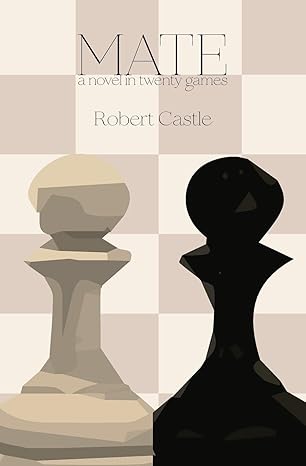

MATE: a novel in twenty games, by Robert Castle, is unlike any book I’ve read. It dissects a marriage by mapping each moment of intimacy, conflict, and compromise onto the framework of a chess match. The story of Pillsbury and Larkin unfolds over twenty “games,” each representing phases of their relationship like courtship, childbirth, relocation, and eventual separation. Every chapter reads like a brutal play-by-play commentary of a high-stakes match where each line of dialogue is a calculated move. The result is raw, honest, and often uncomfortably accurate in its portrayal of the delicate, ongoing war that can exist beneath the surface of domestic life.
Castle’s writing is sharp, biting, and at times hilariously cruel. His chess metaphor isn’t just a clever gimmick; it’s an ingenious device that illuminates the absurdity and tragedy of two people trying (and failing) to love each other properly. The characters aren’t likable in a traditional sense. In fact, they’re often selfish, petty, or clueless. But that’s the point. Marriage, as Castle paints it, is not about romance or even companionship; it’s about control, defense, sacrifice, and sometimes resignation. It was refreshing, even when it hurt to read.
I do feel the relentless move-countermove commentary, while brilliant, could feel overwhelming to some readers. The structure, while unique, can become a bit too clever, making some of the emotional beats feel like intellectual puzzles rather than lived moments. Still, I can’t deny that Castle has created something utterly original. He lets the characters tear each other apart, and we’re left to pick through the wreckage.
MATE is not a book for romantics. But if you’ve ever been in a long relationship, especially one that has frayed over time, Castle’s work will speak to you. It’s for readers who want their fiction uncomfortable, honest, and unflinching. It would resonate with couples therapists, chess fans, failed lovers, and those quietly questioning their own relationships. It’s both cynical and relatable, and it left me thinking about it long after I put it down.
Pages: 176 | ISBN : 978-1963908497
The Altar of Victory
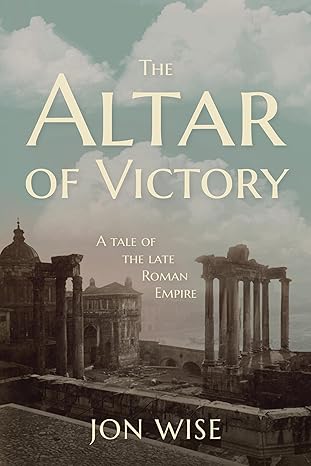
The Altar of Victory is a historical novel that plunges the reader into the waning days of the Western Roman Empire, centering around the death of Emperor Valentinian I and the political maneuvering that follows. Set in 375 A.D., it opens with Valentinian’s dealings with barbarian tribes and internal dissent, leading to his sudden death after a fit of imperial rage. The story then shifts into high-stakes political chess as the ambitious general Merobaudes races to install young Valentinian II on the throne before rivals can seize control. Along the way, the novel wrestles with themes of legacy, power, faith, loyalty, and the slow unraveling of an empire.
I found myself immediately immersed in its stark, lived-in world. The writing is richly atmospheric and historically informed, without ever feeling like a lecture. Every decision, every letter, and every small detail, like the crack in the aqueduct or the placement of a chair, feels purposeful. The prose is tight, clear, and evocative. What struck me most was how human the characters felt, especially Valentinian. He’s brutal, weary, proud, and oddly sympathetic. When he collapses mid-sentence, the emotional weight lands hard. The tension is just as strong in the quieter moments, furtive whispers in palace halls, long rides through uncertain terrain, as it is in battles and tribunals. I especially appreciated the balance between dialogue and action; the pacing kept me glued.
That said, what I really liked was the depth of the ideas. The book takes a hard look at power and how it mutates in uncertain times. The clash between the old gods and Christianity is not just window dressing; it’s a lens through which every character sees the world. Merobaudes, in particular, is a fascinating figure. He’s clever, opportunistic, not fully Roman yet entirely molded by Rome’s ideals. The women in the story, especially Justina and Mirjeta, are sharp and compelling, with agency that matters. There’s also an aching sense of decay in every corner of the empire, ruined towns, forgotten monuments, fading gods, that gives the story a haunting quality. I found myself thinking a lot about how empires die, not just politically, but spiritually.
I’d recommend The Altar of Victory to anyone who enjoys political intrigue, ancient history, or character-driven stories with bite. It’s a slow burn, but a rewarding one. If you like your historical fiction thoughtful, gritty, and emotionally textured, this one delivers. It’s not light reading, but it’s deeply satisfying, and in more than a few places, surprisingly moving.
Pages: 537 | ASIN : B0DCQ783YW
Man Against the Universe

The Call of Abaddon follows a gifted young scavenger on a crumbling, post-apocalyptic Earth who is attacked by an ancient alien obelisk, triggering a surge in his dormant psychic abilities. What was the inspiration for the setup of your story?
Thanks for the interview and for the thoughtful questions. The genesis of The Call of Abaddon goes back many years, through countless drafts and title changes.
The initial spark was Jason himself. I had a dream when I was younger about a guy (someone like me) using the power of his mind to fight something dark and terrifying. Obvious inspirations would be Luke Skywalker, Neo, Beowulf, and others. That darkness took many forms as the story evolved—from extradimensional demons (like in Doom or Warhammer) to biological zombie plagues—but eventually coalesced into the Abaddon Beacon obelisk. I did get my “zombie plague” in the form of the Nanophage, but it’s far more complex than a simple virus and will continue to (literally) evolve in future books, as Abaddon seeks revenge for Jason’s unexpected, hail-Mary-level victory at the end of Book 1.
The rest of the cast and world grew over years of development, both visually and on the page. In other interviews, I’ve mentioned some external inspirations—like a friend who started writing and a student teacher who gave me a massive sci-fi reading list in eighth grade—but the true origin of the story was always Jason. He began life as a bit of a power fantasy for me, but over time, Jason matured into something far more complex and mythic. Honestly, I think all my characters grew up as I did, which is why I’m glad I waited this long to publish. Great works take time to cook, and this one was no exception.
I find the world you created in this novel brimming with possibilities. Where did the inspiration for the setting come from, and how did it change as you were writing?
The setting changed a lot over time. Colossus Station, the orbital habitat referenced in Book 1 a few times, was originally supposed to be the primary setting. But as the lore and backstory deepened, I ended up pushing the journey to Colossus to future books. It’s kind of like going to Arrakis, stepping outside the Shire, or Odysseus leaving Troy—it marks the real beginning of the larger saga. That said, Book 1 is not a prologue or filler. New Toronto ended up becoming a much richer part of the story than I had expected, so the journey to Colossus had to wait.
Even New Toronto wasn’t originally envisioned as a sealed arcology. That came later, as the lore of the Confederacy and the Great War took shape. The idea of a dying Earth, ravaged by ecological collapse, ended up setting the perfect tone for readers—something like, “This world is old, broken, and a lot has happened here already… but you have no idea what horrors are coming next.”
Like any great SFF setting, the world grew, snowballed, got chopped down, and rebuilt several times. But once all the threads were tied together, it felt real. I think that’s what early readers and reviewers are responding to, regarding the setting in particular.
A lot of fictional worlds in SFF feel designed purely to serve the stories within them. A horror world, for instance, where things conveniently go wrong a little too easily. But I think that world of Abaddon strikes a stronger balance—it feels like it would still exist even if these characters weren’t in it. The events are wild, sure, but the world around them remains grounded. That’s something I worked hard to achieve.
What were some themes that were important for you to explore in this book?
In other interviews, I’ve talked about the themes of memory, identity, and mental health—all of which are central to the book. Tyranny, environmentalism, freedom—those are in there too. But the core theme, the one that threads through everything, is the power of the creative human soul—and how that power transcends anything external.
The Abaddon Beacon hijacks human society, addicting us to its nanotech like a drug. But none of that comes from our own ingenuity—it replaces it. The real question becomes: what happens when someone has all that taken away? No nanotech, no psychic powers. Just a man against the universe and its horrors. What does he do?
In Jason’s case, he channels something deeper—something that lets him subvert Abaddon’s godlike influence and strike a blow that no one else has. But the question remains: is the power he wields a twisted form of what the obelisk gave him, or is it something else entirely? Only future books will reveal the truth.
Where does the story go in the next book, and where do you see it heading in the future?
Great segue from the last question! As mentioned, future books will feature Colossus Station much more heavily. I won’t say how or why just yet—but the reason will probably shock readers.
The series is fully planned. Not down to line-by-line detail, but all the major arcs, twists, and character beats are mapped out—including the ending. Some things might shift along the way, but the key points are locked in. Readers are in for a saga with all the expected twists of epic sci-fi—but also some deeply personal character twists that I don’t think anyone will see coming.
Now that the world, characters, and conflict are in motion, readers get to grow with them, just like I did. I may be the creator, but I’m also part of the audience now, cheering them on… and hoping they all survive the hell I’m about to unleash.
Author Links: Goodreads | X (Twitter) | Facebook | Website | Amazon
New Toronto is a fractured city-arcology on a dying Earth, where hope is as scarce as clean air. For Jason, survival means scavenging the ruins beneath the city – where any day could be his last.
But everything changes when an ancient alien obelisk – the ABADDON BEACON – attacks Jason’s mind from afar, making his dormant psychic abilities spiral out of control. After barely surviving Abaddon’s psionic possession attempt, Jason and his companions are left with no choice but to find the obelisk before it consumes him.
Problem is, Abaddon has been sealed within a top-secret United Earth Federation research lab for over a century, silently worming its alien technologies into human society, presented as gifts with a far darker purpose. The Beacon doesn’t just speak; it infects, projecting its viral energies far beyond the walls of the lab.
And Jason isn’t the only one hearing Abaddon’s call. Across the Solar System, a ruthless Emperor will stop at nothing to seize the Beacon’s power for himself.
As the Imperial invasion of Earth looms, Jason’s quest to confront Abaddon will force him into a critical choice: master the strange power growing inside him … or succumb to the
Beacon’s godlike influence, ushering in mankind’s doom.
The Call of Abaddon is a gripping mythological tale of humanity’s struggle to overcome an unimaginable darkness, blending the political intrigue of Dune with the eldritch terror of Lovecraft, and the explosive world-building of The Expanse.
Let Them

Until I Come Back for You follows a young girl, the youngest of five siblings, as her family escapes the dangers of Detroit and tries to build a new life in the countryside, only to encounter a menacing and violent new neighbor. What was the inspiration for the setup of your story?
That’s easy – my real life! My family really did leave Detroit in the early 70s, and my city-slicker parents really did buy a small farm on a dirt road in rural Michigan. The bad guy is fictionalized, but the setting and family characters are all real.
What was your approach to writing the interactions between characters?
For me, the key to dialogue is to let it come quickly, naturally, and not overthink it. Don’t argue with your characters – let them speak. Let them stutter. Let them mispronounce words. Because that is how humans talk. Dialogue should “play” in the readers’ heads as if they can hear it, and so it has to “sound” authentic. If a writer edits dialogue the same way she edits the narrative, you lose that authenticity.
How do you balance story development with shocking plot twists? Or can they be the same thing?
For story development, I’m an avid plotter. I map out the big parts of the story, the bones. For this story, I focused on “the event” and worked backwards to include everything that had to come before it. Then worked forward, writing all the consequences and fallout.
The plot twist(s) were afterthoughts that organically stemmed from the story. There is a writing rule: “Get your protagonist in trouble. Then get them in more trouble and more trouble.” When I did that, she really surprised me, and it was just my job to capture that.
What is the next book that you’re working on, and when can your fans expect it out?
For right now, I’m having so much fun with this book, I can’t even think about another. This was a bucket list goal for me, so I’m just allowing myself to revel in this moment.
Author Links: GoodReads | Facebook | Website | Instagram | Amazon
Right where she left it.
UNTIL I COME BACK FOR YOU invites you to wallow in the comforting nostalgia of the 1970s, a simpler time when there were only three TV channels, two colas, and one phone in the house. Smell the honeysuckle of lazy summer days; listen to sisters sharing whispers in bunk beds before drifting to sleep. Just when you get comfortable, you’ll find yourself stranded in a tree, dragged across a field, held down on a cold examination table. Taste the blood in your mouth from a lost tooth. Feel the breath of a predator on your neck. Hear the death rattle of a lost soul.
Follow one family’s history woven into the tattered fabric of the Midwest and witness one girl tear at the seams of girlhood, suspended between the generations of women who reinvented womanhood.
Lost Love

Out of the Darkness centers around a biochemist who meets a mysterious stranger with a rare genetic condition seeking both survival and redemption. Where did the idea for this book come from?
The original idea for this story came from an old Jean-Claude Van Damme movie, Universal Soldier, which gave me the idea of vampire soldiers, Dean Koontz’s Moonlight Bay Trilogy, which gave me the idea of incorporating a real medical condition, and a tangent I went on while researching XP that gave me the idea of making vampirism a virus.
What draws you to the paranormal genre?
The idea of the impossible being possible.
What were some themes that were important for you to explore in this book?
Redemption, survivor’s guilt, lost love, forgiveness, power and corruption, and the healing power of love.
Can we look forward to more work from you soon?
Absolutely.
What are you currently working on?
I’m currently working on edits for Embrace the Darkness, the second book in the Darkness Series, and completing the third book, Edge of Darkness.
Author Links: GoodReads | X (Twitter) | Facebook | Website | Amazon
Her research could cure his dark hunger if a covert government agent doesn’t get to her first.
Vincent Maxwell is a vampire with a conscience seeking a cure for his dark hunger. But when a scientist looking to create vampire soldiers captures and kills a fellow vampire, Vincent seeks out Dr. Megan Harper, a research scientist who discovered a link between a genetic light sensitivity disorder and vampirism. Dr. Harper could hold a key to a cure and the answers to Gerard’s death. But getting close to the beautiful scientist could endanger both their lives.
When Megan meets Vincent she believes he suffers from xeroderma pigmentosum, the genetic disease that killed her sister. Sensing a deep loneliness within the handsome man, she offers friendship and access to her research files. But she and Vincent soon become more than friends and Megan learns the horrifying truth. She’s entered the dark and unseen world of vampires and Vincent is her only hope of survival.
Vital Historical Knowledge

Jigsaw: Shadow Ball follows a group of Temporal Guardians trying to preserve and repair the timeline from a ruthless organization set on altering history and erasing the racial integration of Major League Baseball. What was the inspiration for the setup of your story?
Excellent question. I love baseball, and I have always wanted to do a story on that. However, in the vein of my formerly titled History’s Forgotten series, I wanted to focus this book on Larry Doby, the second man to break the color barrier in baseball after Jackie Robinson. Most know the story about Robinson, but not as many know about Doby, and I wanted to delve into his importance in baseball and integration in American society in general.
When discussing the civil rights movement, most people automatically think of figures like Dr. King and other politically recognized activists; the involvement of athletes is not as well known, and I appreciate that you brought this aspect into the series. Was it important for you to deliver a moral to readers, or was it circumstantial to deliver an effective novel?
Yes. I want my stories to be both entertaining and educational where readers enjoy the tale but also take away vital historical knowledge, character education lessons, and moral parables.
I find that authors sometimes ask themselves questions and let their characters answer them. Do you think this is true for your characters?
Sometimes, especially with my two major protagonists, Francesca and Noah.
I hope the series continues in other books. If so, where, and when, will the story take readers next?
The next installment in the Jigsaw Series, titled Temporal Apocalypse will be released in the spring of 2026. It will center on the post-World War I era and take place in Jerome, Arizona, the Russian-Polish war front, and Fiume off the Adriatic Coast.
Author Links: GoodReads | Amazon
A rip in reality is spreading, and the fate of history hangs by a thread.
The ruthless organization Global Harmony has launched Project Shadow Ball, a devastating mission to erase the racial integration of Major League Baseball—rewriting the past to build their own twisted future.
Temporal Guardians Francesca and Noah are the only ones standing in their way. As they hurtle through time, they must protect baseball greats Rube Foster and Larry Doby, whose very existence is at risk.
With every pitch, every stolen base, and every moment altered, the fate of history—and the fight for truth—hangs in the balance.
Time is slipping away. The stakes have never been higher.
Can Francesca and Noah outwit their enemies before baseball’s greatest revolution is erased forever?
Or will history be rewritten in the shadows?
If they fail, history shatters. If they fall, the future is lost.



 LITERARY TITAN