Blog Archives
This Time


This Time is a story that weaves together love, loss, and redemption in the small town of Tartan Springs, West Virginia. At its heart, it follows Ty Harrell, a Marine pilot, and Siena “Seeney” Tyson, a woman rebuilding her life after a messy divorce and betrayal. The story opens with their ten-year high school reunion, where old sparks rekindle and dormant feelings stir. Around them, the novel paints a vivid picture of small-town America, filled with complex relationships, community politics, and quiet battles for dignity and forgiveness. Beneath the romance lies a thread of corruption, environmental tension, and moral choice, giving the book more depth than a typical love story.
Coe’s writing is full of detail, almost cinematic, and that made it easy to slip into the world he built. I could smell the rain in the hills, hear the small-town chatter, and feel the awkward warmth between Ty and Siena as they stumbled through old emotions. Sometimes the dialogue felt a little too polished, but the emotional truth beneath it rang clear. I liked that the characters were flawed, real people who made mistakes and carried scars. Siena, especially, stood out, resilient, sharp, and unwilling to let the past define her. Ty’s decency and quiet loyalty balanced her strength perfectly.
What really got to me, though, was how the story handled forgiveness. It wasn’t wrapped in a neat bow. The pain from betrayal lingered, and love didn’t erase it. Coe didn’t shy away from showing the ugliness of pride, or the way people cling to control when their lives are falling apart. Yet, somehow, through the grit and sorrow, the book stayed hopeful. The scenes about military service, small-town politics, and even environmental issues added layers that gave it substance without slowing the pace too much.
I’d recommend This Time to readers who enjoy heartfelt fiction with real emotional weight. It’s perfect for anyone who loves stories about second chances, especially those set against the backdrop of small-town life where everyone knows your secrets. It’s not just a romance, it’s about rebuilding, forgiving, and learning when to fight and when to let go. This book pulled me in, and when I turned the last page, I just sat there for a minute, thinking about how some things are worth risking again.
Pages: 348 | ASIN : B0FST7LVL2

Unexpected Surrealism

The Queen’s Dark Ambition follows a fourteen-year-old girl whose struggle to belong in a new town plunges her into a sinister fairy world where trust is perilous and survival demands courage. What was the inspiration for the setup of your novel?
What prompted me to write the first few chapters was when I dreamt of standing in a local wood, jumping over a stream, and finding a whole strange world of hostile fairies on the other side. Those first few chapters were written over ten years ago, when I was still at University, and the story itself developed slowly since then. I guess that shows the power of an idea or story, that it can stay with you.
I intentionally wanted the main character’s curiosity towards a stranger she meets to be what draws her back, as equally, if not stronger than, the dangerous pull of the wood and the fairy abode. A core part of the story explores the development of their relationship. The stranger, Bower, who is a wizard, helps Stacy, the main character, to question life and explore the bigger issues, whilst untangling the true and unexpected nature of the fairy domain.
A pivotal part of the story is about her finding not only her courage, but her voice as well, as fighting for what’s right. I initially thought of her as an introvert, like myself.
It wasn’t until much later in the revision and editing process that she really started to surprise me with just how strong a character she is and what she’s capable of.
Stacy’s voice feels raw and unfiltered, especially in her messy emotions. What inspired you to write her with such honesty rather than softening her flaws?
I’m an emotionally driven writer and love exploring characters’ thoughts and emotions. The protagonist, Stacy, is a teenager, and I craved leaning into that emotional space for the sake of the reader, for them to be taken along for the ride and feel those messy emotions along with Stacy.
The story shifts from domestic drama to eerie fantasy, almost like stepping from one world into another. How did you balance the real-life struggles with the supernatural elements?
I don’t think it’s much of a balancing act, but a question of putting Stacy’s domestic drama into perspective. She’s still obsessed with her phone and is wrestling with teenage worries. She realises the importance of her friends, from whom she is estranged, as well as her parents, whose love she’s been doubting recently, what with a family move and arguing with her Mum. Her friends have also shunned her due to the move. Despite this, she would do anything to protect them all and to get back to them, even in a perilous and unfamiliar world.
Throughout the story, I’ve sprinkled in some real-life grit, which hopefully makes it more believable and resonates widely with readers. I think that’s the glue between the two worlds, as well as seeing both through Stacy’s eyes. I hope I’ve created moments of unexpected surrealism and joy from Stacy’s perspective, too, though.
The fairies in your book are both beautiful and menacing. What drew you to portray them in such a dangerous, unsettling way?
I really wanted the main villain to be alluring to Stacy and to readers, hence why Elantra, the Queen, is beautiful too, to create jarring and unexpected undertones. Honestly, I think the most dangerous thing about the Queen could be that she’s relatable, and, at times, Stacy has sympathy for her. She gets under Stacy’s skin, and Stacy wants to understand how she got like that.
Author Links: GoodReads | Website | Amazon
Life for fourteen-year-old Stacy takes a terrifying turn when she discovers a parallel world hidden within the mysterious woods near her new home. After witnessing a child’s sacrifice, she becomes trapped in a realm where fairies aren’t the gentle creatures of bedtime stories. Under the watchful eye of Bower, a centuries-old wizard bearing the weight of his own tragic past, Stacy uncovers a sinister plot involving imprisoned children and a pure malevolence that will stop at nothing to claim the power of the stars.
Can Stacy find the strength to challenge a Queen who once turned her back on love itself? And if she fails, what fate awaits not only the imprisoned children, but the entire human world?
Are you drawn to magical realms, powerful adversaries, and tales of courage in the face of darkness? Then you’ll be spellbound by this captivating story.
If you like authors Laini Taylor, Melissa Albert or Holly Black, you may like The Queen’s Dark Ambition.
At the core of this low spice, character driven fantasy, Stacy’s journey explores themes of found families, fitting in and finding her voice, which will resonate with many YA readers.
If you enjoy these themes and fillings, The Queen’s Dark Ambition, may appeal to you: belonging/identity, glow up/ fish out of water, chosen girl, hidden heritage, confidence/self-love, power and agency, coming of age, angst & grit, plot-twists, mean girl, tear-jerkers, end of the world, clean Christian mystery.
The Solar Current Is Nuptially Tuned


Thomas M. Miovas, Jr.’s The Solar Current Is Nuptially Tuned is a lively, old-school science fiction adventure filled with invention, romance, and a touch of satire. The story follows Spencer Harling, a fiery engineer exiled from Lunar Industries who discovers that the so-called “alien ship” that crashes on the Moon is not an alien vessel at all; it’s piloted by his lost love, Adrian Lunar, the daughter of his former employer. What starts as a mysterious space exploration tale becomes a heartfelt reunion between two brilliant minds who combine science, love, and courage to outwit bureaucracy and rediscover their shared purpose. It’s an inventive mix of hard science fiction and playful romance, framed within the optimism of human ingenuity.
Reading this book, I felt like I’d stepped into a retro sci-fi movie from the golden age of the genre. The writing has that earnest energy, long paragraphs that brim with ideas, characters who speak in grand tones, and technology that’s both ambitious and oddly personal. Spencer is a classic idealist, the kind of scientist who believes knowledge and reason can solve anything, and I found that sincerity refreshing. Miovas has a knack for building tension in quiet moments, especially when Spencer debates the nature of communication and consciousness. The reunion with Adrian felt a little melodramatic, but in a way that fit the tone, like a satisfying reveal in an old pulp serial. The story’s heart lies in its belief that exploration, both scientific and emotional, is what makes life meaningful.
Some exchanges between characters feel a bit formal, which adds a unique charm. It is worth noting that the exposition can sometimes be heavy, but there’s also charm in that thoroughness. I could tell Miovas cares deeply about the science and the philosophy behind his fiction. I liked that the story wrestles with moral ideas, authority versus curiosity, fear versus discovery, and even what it means to be human when faced with the unknown. Beneath the space battles and romance, there’s a clear message about individual thought and integrity.
I’d recommend The Solar Current Is Nuptially Tuned to readers who love classic sci-fi with a philosophical edge, or anyone who appreciates a bit of romance mixed into their cosmic adventure. It’s a thoughtful and imaginative ride through human ideals and relationships. If you enjoy stories where love, reason, and invention all share the same orbit, this one will feel like a rare find.
Pages: 38 | ASIN : B0BRGCQBMR
The Queen’s Dark Ambition
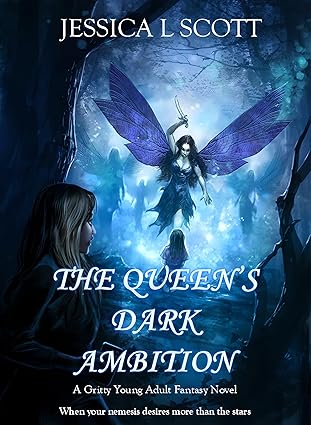
The Queen’s Dark Ambition follows fourteen-year-old Stacy, newly uprooted from her old life and friends, as she struggles to adapt to an unfamiliar town and strained family relationships. Drawn into the nearby Whispering Woods, first by curiosity, then by strange dreams, she discovers a hidden and dangerous world of fairies, rituals, and missing children. Caught between her fear, her longing to belong, and the peril of the Queen’s power, Stacy must navigate deception, captivity, and the blurred lines between friend and foe in a fight for survival. The story blends contemporary teen angst with a dark, magical undercurrent, shifting from domestic drama to eerie fantasy with ease.
I was struck by how raw and unfiltered Stacy’s voice felt. The writing doesn’t shy away from messy emotions like resentment, loneliness, and embarrassment that so many coming-of-age stories tend to polish smooth. The family tension is sharply drawn, and it hit me harder than I expected. It’s not just background noise; it shapes Stacy’s every decision. That made the jump into the fantasy elements more jarring, in a good way. The sudden emergence of the fairies and the sinister Queen felt like stumbling into a nightmare while you’re still mad about a real-world fight, which gave the whole story an uneasy energy I couldn’t shake.
There were moments where I wanted the plot to push forward, especially in the early chapters when the family drama circled. But when the fantasy plot took center stage, the imagery was vivid and unsettling, fairies with ghostly skirts, glowing globes in the trees, and a captive’s cell full of terrified kids. These scenes stuck in my mind. The writing has a blunt honesty in its emotional beats but a dreamlike quality in its supernatural ones, which makes for an unusual and memorable mix.
I’d recommend The Queen’s Dark Ambition to readers who like their fantasy tinged with real-life grit, and who aren’t afraid of a story that lingers on discomfort before offering resolution. It’s a good fit for teens and adults who enjoy moody, character-driven tales with a sharp edge of menace. If you like your magic beautiful but dangerous, and your heroines flawed but determined, this book will keep you turning the pages.
Pages: 342 | ASIN : B0F324QLFL
Mirrors of Humanity

Terra Secundus follows a war-weary journalist sent to Titan, where humanity’s quest for discovery collides with its oldest flaws: ambition, control, and the fragile meaning of being human. What inspired you to set Terra Secundus on Titan rather than another world or moon?
In my exploration of the world of science fiction, I often encountered situations where many famous writers with multiple awards and nominations set their novels on many planets of the solar system and seldom on any satellites of the gas giants such as Jupiter, Saturn, Uranus, and Neptune. Before I decided to place my protagonist in a new world, I carefully studied the science literature about the possibilities of colonizing moons and planetoids orbiting the gas giants. Saturn’s moon Titan was a very strong contender for such an endeavour, and after studying everything I could about that unique moon, I decided to send my protagonist there, since Titan is considered a good candidate for a colony. Many scientists believe it could become a smaller version of Earth, since Titan has a thick atmosphere composed of nitrogen and other gases. Add oxygen to it, and humans could theoretically breathe its air.
The novel’s tone feels both futuristic and nostalgic. Was that a conscious stylistic choice to evoke classic science fiction?
I love classic science fiction novels and my exploration into this literary genre started with many memorable books by Ben Bova, Issac Asimov, Ray Bradbury, Arthur C. Clarke, Frank Herbert, Allen Steele, and Robert Heinlein. When writing about a future removed from our time more than 1,200 years, I tried to imagine a future society of the 32nd century to develop amazing new technologies and modify its social and religious beliefs. In this novel, I tried to use a classic style of storytelling, because for most readers it is much easier to understand. I believe that every society must learn from the past experience and try to avoid repeating tragic mistakes that led to the fall of ancient civilizations and magnificent extinct cultures. The roots of the future are in the present, and I hoped to tell this story in such a way as to entertain and educate my readers about the fascinating distant worlds, new technologies that border on magic and what it means to be human.
How did you approach writing the Artborn androids like Erika, as characters, machines, or mirrors of = humanity?
Interesting question. I like robots. Even as a kid, living in a different society during the Cold War, I liked all science fiction movies that featured cyborgs and robots. Since those days, robotics and and cybernetics both made giant strides forward, and now we see many cybernetic models starting to imitate humans. We are also witnessing the radical advances in Artificial Intelligence and autonomous systems that help us to explore other places and other planets. My approach to such characters as Artborn Erika was both scientific and philosophical. In my story, Artborns are advanced synthetic humanoids that were created to assist humanity, working in most dangerous places in space and underwater. They are essential mirrors of humanity and in some ways are better than us when it comes to programmed mission parameters and sense of duty. In my novel, androids like Erka are employed as explorers, personal servants and bodyguards but they can certainly do much more than that.
If Paul Rexton were alive today, what story would he report on Earth in 2025?
If my protagonist, Paul Rexton were alive today, I believe that he would be deeply fascinated, intrigued and disturbed by the Earth in 2025. His world is certainly very different from ours in many respects, but he would be able to understand our world and form his own unbiased opinion about it. He would no doubt be pleased about the technological progress and human rights, Very concerned about environmental pollution and deeply affected by the fact that there are still powerful evil forces exist on the planet, making life difficult for their neighbors and many other countries. He would no doubt be fascinated by our means of mass entertainment and our taditionsl and electronic libraries of vast human knowledge that contain many centuries of wisdom. I would imagine Paul Rexton standing on a hotel balcony in a quiet and beautiful Japanese village, visiting the beautiful museums of Europe or enjoying a good book at home with a glass of old, smooth, wellaged brandy.
Author Links: GoodReads | Amazon
Life is Messy and Chaotic

The Unassuming Vector follows a gifted ten-year-old child who, after the death of his parents, is taken in by a mysterious organization that fosters exceptional children to further their clandestine agenda. What was the inspiration for the setup of your story?
The inspiration for The Unassuming Vector really came from my frustration with how many stories feel too linear and predictable. Life isn’t neat or perfectly structured—it’s messy, chaotic, and often full of contradictions. I wanted to write something that reflected that truth. For me, the story is less about extraordinary events and more about the human experience within them. I wanted my characters to feel real—to be humans first, defined by their vulnerabilities and emotions before anything else. Through this lens, The Unassuming Vector became a way to explore how people, especially a child with exceptional gifts, navigate a world that tries to shape them in ways that don’t always align with who they truly are.
Gaston and Alex are at opposite ends of the spectrum in terms of their moral compass. What were some of the emotional and moral guidelines you followed when developing your characters?
I wouldn’t necessarily say Gaston and Alex are opposites in terms of their moral compass. To me, Alex is more of a victim of unchecked ambition—a reflection of what can happen when drive and potential aren’t grounded by self-awareness or compassion. Her choices took a drastic turn, but they stem from very human desires: to be seen, to achieve, and to matter. It’s also important to remember that The Unassuming Vector is part of a six-part franchise. What readers see now is only a moment in a much larger journey. While Alex’s path might seem to be at a low point, things may evolve for her later, just as Gaston’s story might take an unexpected detour. My goal was to show that morality isn’t static—it’s fluid, shaped by circumstance, emotion, and perspective.
What were some themes that were important for you to explore in this book?
One of the most important things for me in writing The Unassuming Vector was to create an evolving story—one that takes readers on a genuine emotional journey. I wanted them to experience a full spectrum of feelings as they turn the pages: compassion, pity, anger, love, and even indignation. Life isn’t static, and neither are our emotions, so I wanted the story to reflect that natural ebb and flow. Another key theme was exploring the vicissitudes of life—its constant changes and unpredictability—through the lens of a child growing into adulthood. Seeing the world evolve alongside the character allowed me to examine how experiences shape identity, morality, and resilience over time. Ultimately, I wanted readers to not just follow a story, but to feel it deeply, as though they were living it themselves.
What is the next book that you’re working on, and when can your fans expect it out?
I’m currently taking a short pause from the Vector series to work on a sports thriller that’s packed with twists and unexpected turns. Beyond the thrill and tension of the story itself, it also takes a satirical look at some of the societal issues we often overlook in competitive environments. It’s been exciting to explore a different kind of narrative energy while still staying true to my love for complex, emotionally charged storytelling. Fans of the Vector series won’t have to wait too long, though—Gaston’s story is set to make a comeback in Mid 2027. In the meantime, the sports thriller is scheduled to debut in mid-2026.
Gaston, meanwhile, leads a major Tretfax initiative to create precision-enhancing weaponry, a project that the Pentagon successfully adopts. But when the same technology is distributed to a violent faction in an African nation, resulting in widespread loss of life, Gaston becomes disillusioned. Alienated within Tretfax and wracked with guilt, he leaves the organization and joins Biomer Energy, where he spearheads a revolutionary project that reduces carbon emissions by attracting bees to carbon dioxide. Just as he begins to find purpose again, Alex—having murdered the Tretfax CEO and seized control—sets her sights on acquiring Biomer to exploit Gaston’s discovery.
Emotional Vulnerability

Thank You for the Kiss follows a traveling entrepreneur who arrives in Cuba, carrying heartbreak and longing with her, seeking an escape and a new identity for herself. Why was this an important book for you to write?
“Thank You for the Kiss” was an important book for me to write because it allowed me to explore the fragile intersection between personal longing and cultural complexity. At its core, it’s a story about emotional vulnerability -how heartbreak can push us to seek escape, reinvention, and connection in unfamiliar places. But it’s also a cautionary tale about the seductive glamour of tourism and the ease with which we can misread the world when we’re emotionally altered.
I wanted to show how, in moments of pain or disorientation, we can lose ourselves,not just in the beauty of a place, but in the illusion that we understand it. The protagonist’s journey through Cuba is not just physical; it’s a descent into the blurred lines between empathy and projection, generosity and vanity. Gina’s desire to help, to connect, to feel something real, is sincere, but it’s also tangled with misunderstanding, privilege, and the unconscious assumptions we carry when we move through cultures not our own.
Writing this story was punishing in its honesty. It forced me to confront how easy it is to let consequences drift when we’re consumed by our own emotional needs. But it also offered compassion, or the flawed ways we try to heal, for the mistakes we make when we’re trying to do good, and for the quiet hope that even in misunderstanding, there can be growth.
I appreciated the candid nature with which you told your story. What was the hardest thing for you to write about?
The hardest part of writing this story was admitting it to myself first. Revisiting those nine months meant confronting not just the events, but the emotional undercurrents that shaped them: the heartbreak, the impulsivity, the moments of vanity and misjudgment. Putting it into raw words,without softening the edges, was bruising. It exposed the flaws of the protagonist, who in many ways mirrored my own vulnerabilities.
But that candor was necessary. It allowed me to reflect with humility, to trace the journey from emotional disorientation to deeper self-awareness, and to offer readers something honest to connect with. I wanted the story to be more than just a personal reckoning,I hoped it would resonate with anyone who’s tried to help, who’s felt lost in unfamiliar terrain, and who’s learned, through discomfort, how to see with greater clarity and compassion.
What were some themes that were important for you to explore in this book?
Some of the most important themes I wanted to explore in Thank You for the Kiss were deeply personal, but also universally resonant:
EMOTIONAL INSTABILITY – I was drawn to the idea of what happens when we’re emotionally ddestabilise,how heartbreak can push us to seek new identities, new geographies, and new versions of ourselves. The protagonist’s journey is as much about internal transformation as it is about physical travel.
CROSS – CULTURALISM – A central theme was the fragility of cross-cultural encounters, especially when filtered through the lens of emotional vulnerability. I wanted to explore how easily good intentions can be misread, how privilege can distort perception, and how tourism can sometimes blur the line between connection and consumption.
GLAMOUR AND SEDUCTION – There’s a seductive quality to escape, especially in a place as visually and emotionally rich as Cuba. I wanted to show how easy it is to fall into the fantasy of a place, to romanticize it, and in doing so, lose sight of its realities and the people who live them every day.
VANITY, VULNERABILITY AND SELF-REFLECTION -This story demanded a raw honesty about the protagonist’s flaws and her desire to help, her longing to be seen, her missteps. It was important for me to write a character who is both well-meaning and deeply imperfect, because that’s where growth happens: in the tension between who we are and who we hope to be.
POWER/ A HARK BACK TO COLONIALISM AND THE NEED TO DO GOOD I also wanted to examine the complicated dynamics between those who have and those who do not. The protagonist’s attempts to help are sincere, but they’re also shaped by her own needs and assumptions. This theme was about interrogating the ethics of giving, and how easily we can project our own desires onto others under the guise of generosity.
I wanted the story to be not just about love or loss, but about the messy, beautiful, and often uncomfortable process of learning to see more clearly – both ourselves and the world around us.
What do you hope is one thing readers take away from your story?
I hope readers take away from Thank You for the Kiss, that vulnerability is not weakness ; it’s a doorway. The story invites readers to sit with discomfort, to witness the messy, imperfect ways we try to heal, connect, and understand both ourselves and others. It’s a reminder that emotional honesty, even when painful, can lead to clarity and compassion.
Author Links: GoodReads | Facebook | Website
When warrior Queen Gina arrives in Havana, she seeks to rebuild her shattered life after profound loss. But Cuba, with its vibrant chaos, becomes both a healer and a destroyer. Caught in deception, cultural misunderstandings, and the pull of forbidden love, Gina must decide: surrender to ruin, rise again as the formidable woman she was meant to be.
a raw and unforgettable memoir of grief, identity and transformation
Thank You For The Kiss, a memoir, invites readers to witness one woman’s extraordinary fight to reclaim her life and spirit.
The Dragon Moonstone

The Dragon Moonstone follows the chaotic, funny, and often heartfelt journey of Noah Farmer, a young man who discovers he’s inherited wizard blood and must learn to control his unstable magic before it consumes him. What starts as an odd encounter with a mysterious enforcer quickly spirals into a whirlwind adventure full of enchanted forests, eccentric mentors, and mischievous magic gone wrong. At its heart, it’s a story about self-discovery, friendship, and finding courage when the world turns upside down. It’s got the charm of a coming-of-age tale with the wild unpredictability of a modern fantasy romp.
Reading this book felt like riding shotgun on a road trip through chaos and wonder. Garske’s writing is lively, cinematic, and easy to slip into. The banter between characters kept me smiling, especially the snarky exchanges between Noah and the exasperated Erik Guyguyum. I liked how the humor softened the heavier themes about loss and growing up. The energy of the story carried me forward. It reminded me of the kind of fantasy I read as a kid, where everything feels possible and slightly dangerous.
What really struck me was the emotional thread running beneath all the spells and mayhem. Noah’s grief, his uncertainty, his stubborn will to find where he belongs, all of it felt real. The story doesn’t just play with wands and wizardry; it digs into what it means to grow into yourself when you don’t fit neatly anywhere. I found myself laughing one page and unexpectedly touched the next. Garske’s characters are flawed in the best way. They make bad choices, say dumb things, and still keep trying. That’s what made them feel human, even when surrounded by magic frogs and talking raccoons.
I’d recommend The Dragon Moonstone to anyone who loves lighthearted fantasy with a dose of heart. Teen readers, fans of quirky wizard tales, or anyone needing an escape into a fun, fast-moving adventure will enjoy it. It’s about friendship, family, and finding magic in the mess.
Pages: 301 | ASIN : B0CK6G9V11




 LITERARY TITAN