Blog Archives
No Sugarcoating

Real Aussies: John’s Heartbreak follows a man struggling with family drama and his identity, who finds himself questioning his life choices and their impact on who he is now. What was the inspiration for the setup of your story?
There are plenty of brilliant authors out there, each exploring their own genre, offering their own lens. But something’s always struck me: as readers, we usually watch a story unfold. Whether it’s first or third person, there’s still a barrier — you’re seeing the world through someone else.
My work shifts that. I don’t want you watching. I want you inside it. I want you experiencing everything as if it were your life. No inner monologue distractions. No cinematic distance. Just you, immersed. That’s the goal — that the life unfolding on the page feels indistinguishable from your own.
Where many authors focus on plot, I focus on consequence. Cause and effect. The way people stay stuck in self-inflicted nightmares because it’s all they know. My job is to make it real. That’s why it hits hard. It’s confronting. And yes, it’s designed to be. Not for shock — but to surface what’s buried. I write to draw out the emotional junk most people never look at.
Call me a literary exorcist, if you like. My job isn’t to write pretty metaphors that need decoding — that’s useless to someone having a breakdown at 3 AM. My job is to make a reader feel, viscerally, so they process. It’s therapy without the label. Even Beatrice — when she speaks to John, she’s really speaking to the reader. “Good to see you.” That’s intentional.
The inspiration wasn’t John. It was the reader. My intention was always to unearth something in them — to bring them face-to-face with the parts of themselves they’ve ignored. That’s why the novel has a warning up front, why the blurb literally tells you to have tissues ready. It’s not a story about you… until it is.
That’s also why the novel ends with a poem. By the final page, I shift focus directly back onto the reader. Verse-by-verse, I hold up the mirror. You realise it was never about John. It was always about you. The choices you’ve made. The patterns you repeat. But there’s solace in that. You get to use John’s story as a scaffold — a safe space — to unravel what’s unresolved in your own story.
So far, every review echoes the same thing: “It lingers.” “It hit me harder than I expected.” It’s not a light read, by design. If you’re lying to yourself, this book won’t let you. It’ll show you — cracked mirror and all.
I didn’t write this to win awards. I wrote it for the people who didn’t know they needed it. And the most unexpected part? The reviews don’t reflect me or the book. They reflect the readers themselves. You can watch the healing (or resistance) play out in the reviews. One star, five stars — it’s not about John at all. That’s the art.
Is there anything about John that came from you or your life experiences?
Absolutely — but it’s not about facts, it’s about feeling. Every emotion in the novel is real. I don’t want readers to witness John’s feelings or mine — I want them to sit inside their own. That’s the point. I’ve spent years deconstructing emotion — peeling away the polite language and self-protective narratives we use — until I could write it raw, in its unfiltered form. That rawness is what bleeds through John.
Love, hate, despair, anxiety, disbelief, torture, horror, hope, humour — it’s all there. These aren’t just themes. They’re mine. I’ve lived them in one form or another, and instead of dressing them up in literary robes, I hand them to the reader as they are: messy, confusing, overwhelming. That’s what makes the novel so confronting.
My writing isn’t about literary awards or clever turns of phrase. It’s about impact. I write for people who don’t usually read. People who’ve been through real pain. People who are emotionally constipated and don’t even know it. That’s my audience. That’s who I care about reaching. My job is to make sure the work remains readable in 20 years — 50 years. That means: no sugarcoating. Just as I’ve never had the luxury of a sugarcoated life, as someone who grew up autistic, dyslexic, and an outcast — this work had to be just as honest.
Setting the novel in the past wasn’t just for the killer music (although — quote me — it is the best). I wanted to lull the reader into a false sense of nostalgia. That dream-state safety net. Then — rip — pull them deep into emotional terrain they weren’t expecting. That’s how real healing begins. When you’re least prepared.
The Real Aussies series isn’t fiction in the traditional sense. These are my emotional truths, fictionalised just enough to get under your skin. I make them yours. That’s the goal.
What were some themes that were important for you to explore in this book?
If you’re Australian, you’ll know the complexity of Australian men. From the outside, we’re seen as fun-loving, relaxed, and some of the friendliest people in the world. But scratch the surface, and you’ll find men are often expected to fit one of two emotional lanes: the hard-working provider, or the larrikin who cracks jokes over beers to mask the pain.
That’s the irony of Australia. Real emotional depth is often hidden. Having any feelings outside the intimacy of your bedroom — with your wife, your child, or your closest mate — is quietly forbidden. For me, it was time to show who the Australian man really is. Setting the story in the past allowed me to amplify that unspoken, strictly enforced social code: once you’re boxed in, you’re rarely reclassified. This limits potential — and creates internal chaos when your truth no longer fits the label.
Another core theme is beauty in pain. We don’t always reflect on the quiet glimmers in our darkest moments — the friend who helped, the stranger who saw us. Life can feel like one storm after another, but if we slow down and look closely, we’ll often find there was always a guardrail. Even in disaster, there’s something beautiful — that’s what carries us forward. This was true for John. For Chris. For Stew. For all of them, their “Refuge” was a club full of misfits — a symbol of chosen family in a world that rejected them.
I also wanted to preserve and spotlight community. Specifically, the LGBTQ+ community in Sydney during the 70s and 80s. It really was as intense as I depicted. The violence, the tension, the desperate need for a safe space — it was all real. Today, as society becomes more tolerant, we risk forgetting what community used to mean. I wanted this novel to capture that moment in time, so we remember how people found belonging through pain.
Finally, I wanted to confront the reader with the consequences of accumulated choice. The novel stretches through John’s twenties, showing how each decision either aligns him — or derails him. Life doesn’t punish. It doesn’t reward. It just stacks up your choices until the result is undeniable. You get what you build. If you live for others, lie to yourself, or compromise your truth — that stack eventually collapses. The novel reminds us: we’re born alone, we die alone. Everything in the middle is experience — but how we carry it determines who we become.
Is this the first book in the series? If so, when is the next book coming out, and what can your fans expect in the next story?
Yes, this is the first novel in the Real Aussies series — and also the first novel I’ve ever written. Quite the mountain, especially when you’re someone who reads words wrong, flips similar-sounding ones in your head and constantly fights to stay on the line. It’s exhausting. But I persisted. Because I had to.
The next novel is Peter’s Nightmare. If John’s Heartbreak was about how our choices align or unravel over time, then Peter’s Nightmare is about when you never had a choice at all. When your identity isn’t something you built — but something constructed for you through trauma, projection, and other people’s pain.
It explores what happens when the lessons you’re forced to carry don’t belong to you — childhood burdens, family shame, expectations you never agreed to. It’s a story about how we unconsciously repeat what we hated. How we become the bully, even when all we ever wanted was kindness. Peter’s story doesn’t hold back. It goes into territory most people avoid.
The schoolyard bully who wrecked you? He was likely wrecked too. This novel digs into that truth — that intergenerational cycles of pain can be broken, but not if we stay in victimhood. Not if we keep pretending we’re not part of the problem.
You’ll finally understand who Peter really was in John’s story. What shaped him. Why he was the way he was. And by the end of it, just like with John, you’ll be holding a mirror — not to Peter, but to yourself.
This is a novel about the parts of life we don’t speak of. The moments society can’t language properly. Peter’s Nightmare will give readers that language. And with that, maybe the power to finally change.
I’m aiming to release Peter’s Nightmare in early 2026. I’ve got a few other projects on the go that need to clear first — it’s a bit of a juggling act (especially when you’re navigating it all with disability compensation!) — but hey, that’s life. 🙂
Author Links: GoodReads | X (Twitter) | Website | Amazon
Sydney is thrown back to the late 70s and early 80s in this Aussie epic that sees John navigate the explosive consequences of his ill-thought actions, his wife’s destructive wake, and the unexpected feelings he has for his nurse; his male nurse… oh crap!
Amid drag queens, nightclubs, drugs, and iconic decade-defining music, John struggles with his identity, whilst trying to secure the custody of his two sons. With a batshit crazy family and a chaotic trip to Kiama, John’s life spirals out of control.
This rich multi-decade LGBT quasi-hetero romantic drama, written by an Aussie nomad, is layered with deep emotion and complex relationships. Profound, soul-touching, and reflective, this novel opens questioning the impact of all life’s choices.
Perfect for that weekend curled up in bed with a box of tissues, chocolates, and ice cream.
A Universal Understanding of Love

Unchained details your challenges growing up as an LGBTQ youth in a strict Nigerian community as a member of a Catholic family. Why was it important for you to share your story?
While Unchained isn’t a direct account of my personal experiences, it mirrors the struggles of LGBTQ individuals growing up in African societies, particularly where cultural and religious norms are deeply entrenched. When I moved to the UK, I witnessed a society where LGBTQ rights were respected and gay people were accepted as part of the social fabric. This stark contrast inspired me to use my writing as a medium to challenge the narrative back in Africa. I wanted to show that acceptance is possible and that being LGBTQ isn’t something to “pray away” or solve through religion. It was crucial for me to write this story as a call for change, urging African societies to move towards compassion and inclusion.
What was the hardest thing for you to write about?
One of the most challenging parts of writing Unchained was portraying gay relationships in the UK as equally valid and natural as heterosexual relationships. I wanted to vividly depict how love, commitment, and marriage transcend orientation, and I worked hard to normalize same-sex relationships for readers unfamiliar with such dynamics. Striking the balance between authenticity and sensitivity was tough because I aimed to connect these relationships to a universal understanding of love without alienating readers from more conservative backgrounds.
What is one piece of advice you wish someone had given you when you were younger?
I wish someone had told me that nothing is impossible and that I am my own limitation. Growing up in a restrictive environment, it was easy to internalize societal expectations and believe there were limits to what I could achieve. If I had understood earlier that with effort and self-belief, I could break barriers, I might have pursued certain dreams sooner. This advice would have empowered me to embrace my uniqueness and navigate life with more confidence.
What do you hope readers take away from your experiences?
I hope readers understand that societal norms are not fixed—they evolve, and they must make room for inclusion and acceptance. Africa is on the brink of a cultural shift, and the old ways of thinking must give way to new ideas that value the dignity and rights of every individual. I want readers, especially those from African backgrounds, to see that LGBTQ people are not asking for special treatment—they’re asking to live authentically and with the same respect afforded to everyone else. Above all, I hope my story inspires conversations, challenges prejudices, and sparks the cultural change we need to see.
Author Links: GoodReads | Amazon
free from societal constraints to live authentically.
Proud in Her Hijab
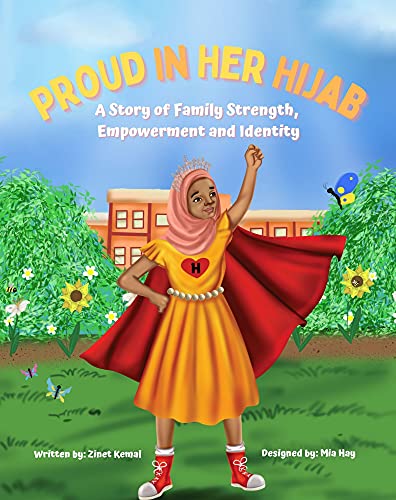

Iman is teased at lunch one day by her classmates that do not understand what the hijab is and what it means. She goes home really upset and tells her family what happened. Iman’s mother, sister, and brother validate her feelings and help her see how she is not odd and has no reason to be ashamed of her hijab. They have a long conversation about each of their differences and how they each feel about their different hairstyles. Her mother reminds her that doing hair together is part of their family bonding and traditions.
Proud in Her Hijab: A Story of Family Strength, Empowerment, and Identity is a heartwarming picture book that will not only educate but help young girls feel confident in their choices. While this story focuses on a young Muslim girl wearing her hijab, the message does apply to all children because everyone is unique.
Author Zinet Kemal has written a beautiful children’s book in a way that is conversational, easy to understand, and relatable to children in elementary school. Kemal delicately approaches a difficult topic. Rather than just brushing it off after the family talks, Iman confronts her classmates to educate them and let them know their behavior is hurtful. Iman learns to take pride in her identity and speak up for herself, this is a great message to pass on to young children, especially girls.
This colorful picture book is illustrated by Mia Hay. The illustrations are bold and bright, and the characters are brought to life through these striking images. The combination of the fantastic illustrations and Kemal’s description of the hijab will draw in young readers and encourage them to learn more.
Proud in Her Hijab: A Story of Family Strength, Empowerment, and Identity is a well-conceived and educational picture book for young readers. This is an excellent resource for teachers and parents to teach about diversity and inclusion, different cultures, and kindness.
Pages: 36 | ASIN : B099NX1GTV

Free Yourself

Free Yourself is a collection of intimate and engaging poetry written by Juliana Garcell. The poems are written in various styles and in various formats which helps to keep things interesting. The poetry sometimes hits on current social and political topics, but there is an overall focus on love, loss, and identity. Especially the struggle with identity in the face of love and loss; but having to define it in this way is somewhat limiting as I feel the poems are about much more.
I enjoyed this collection and found the poems to be lyrical, as if written for a song. Each poem has its own focus, although they area about slightly similar topics. The emotions expressed are often raw and painted in vivid detail with colorful connections and allusions to nature and culture.
Each poem is impactful, if not relatable, and I was able to understand each one. Understanding a poem is important for me, as I feel that poets often go off on some abstract ideas. But this collection is down to earth, and simple to follow, which makes the message ring clearly.
I appreciated the poems that left me with singular emotions at the end, but I really enjoyed the poems that were able to do the same work with just one or two lines. ‘Free My Expression’ is one of my favorite of the shorter poems, with the line “want you to stay but I always run away”. And the very last poem, which I believe is untitled, is probably my favorite of the collection because it manages the same emotional impact as one of the longer poems with only four lines.
I recommend this collection to anyone who enjoys poetry that is emotive yet easy to understand. The collection is short, but I suggest you give yourself some time to stop and ponder the thoughts, concepts, and ideas conveyed in each of these poems as this is an engaging assortment of passionate poetry.
Pages: 56 | ISBN: 1483622444

Physical: The Catastrophe of Desire

 Physical: The catastrophe of desire by Mari Reiza is a wild ride of a read. For both main characters, two middle aged women, Kiki and Fatima, it is indeed a catastrophe, but of their own making. Kiki is virtually strapped in a small town in Northern Italy and finds herself alone after her longtime boyfriend leaves for an “upgrade”. Fatima finds herself in a crisis of identity after having twins and struggles to find purpose in her enlarged family. Yet, both women feel pulled along by their baser desires to rekindle the energy and passion they had in their youth.
Overall, the book reads very fast pace, which for a shorter book is expected and I would say enjoyed it. There are moments where the book reads as if Reiza is experimenting with stream of conscious, but then it breaks away from that to continue in a more traditional narrative pattern. The change can occur on the same page or even within the same paragraph, which may be disconcerting to the careful reader.
The characters themselves are a varied mix of character strengths and flaws that can keeps the reader engaged. Kiki has a mouth like a sailor and clearly has a drive and motivation to make something of herself if she can overcome her very physical, base needs. There were times it was hard to follow her storyline given that she self-sabotages to a large degree. Fatima on the other hand seems to be the polar opposite, in the sense that she is in a steady marital relationship with children, something Kiki is allergic to. Fatima is no prude though and is as explicit as Kiki is about sex and the like. Both women seem driven to try and enliven their lives in any way they can no matter the cost, even if it dramatically disrupts their lives.
The story is told through both women point of view in alternating chapters and some heavy style choice make the narrative more “telling” than “showing”. But these are easy to push past as you get drawn into the struggle of Kiki and Fatima. The strongest point of Reiza’s writing is that you can truly feel where these women are coming from in their midlife crises. They are clearly tired and bored of their current lifestyle and need to do something to shake it up. It truly appeals to the deepest core beliefs that individuals can have when they have reached a “rock bottom” or stagnant part of life.
Overall, it is a classic contemporary fiction story. Of two women trying as best they can to beat back the overshadowing struggle of age and day to day responsibilities. Passion isn’t only reserved for the youth; it can always be rekindled later with a little help.
Pages: 143 | ASIN: B01N9ZU9XL


