Blog Archives
Limited Partnership Basics and More!
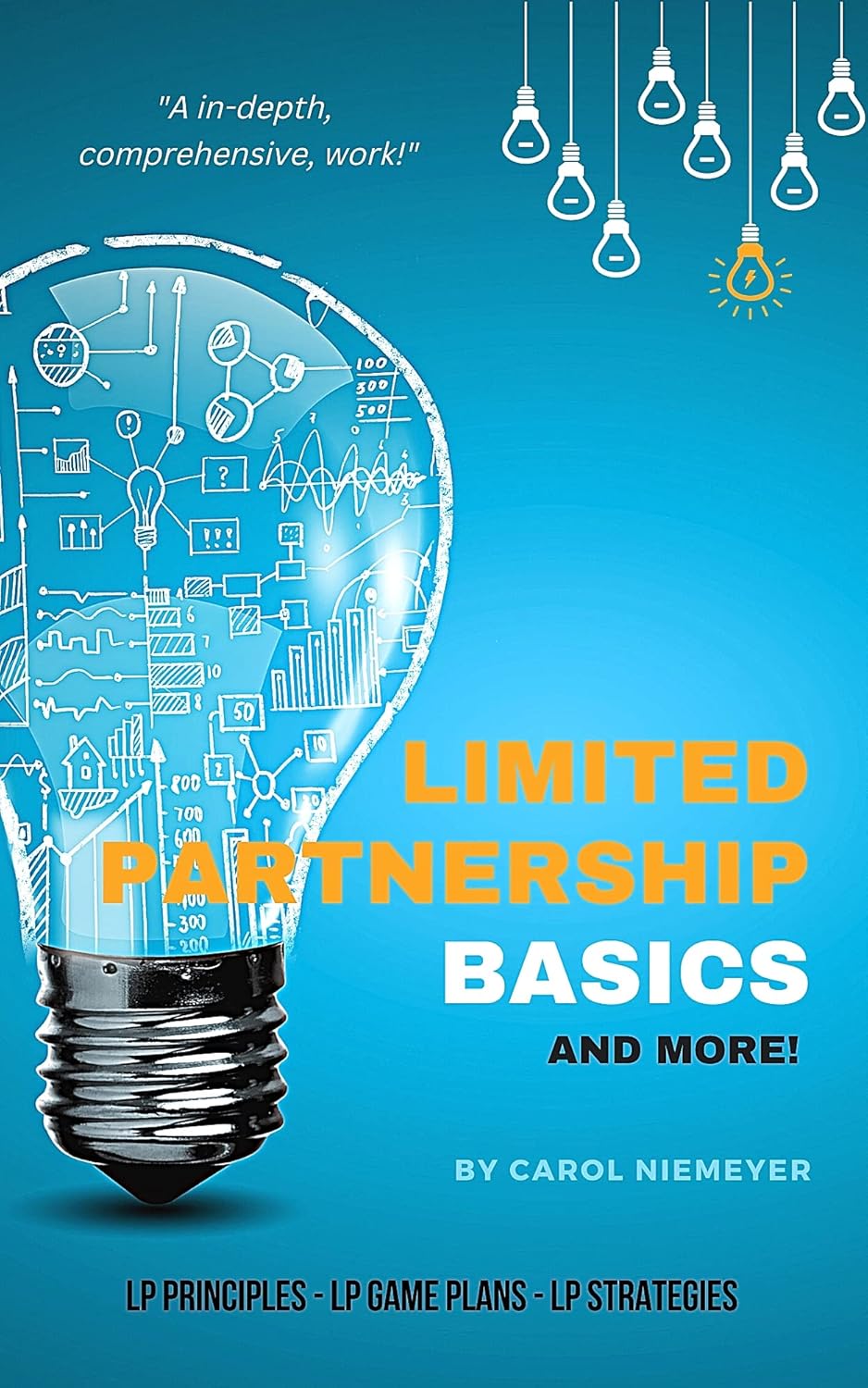

Limited Partnership Basics & More! is a practical, upbeat guide to understanding how limited partnerships work and why they matter. Author Carol Niemeyer breaks the topic down into clear parts: what LPs are, how general and limited partners function, how businesses raise money, how deals are structured, and why LPs can become long-term wealth generators. She mixes explanations with examples of apartments, sport facilities, retail strips, clubs, and even big names like major sports teams. The book sits squarely in the business and entrepreneurship genre, and it aims to show everyday people that investing in or building an LP is possible, even on a modest budget.
I felt like Carol Niemeyer genuinely wants readers to feel empowered. Her tone is enthusiastic, almost cheerleading at times, but that energy makes the material less intimidating. She doesn’t hide her belief that limited partnerships can be “little gold mines,” and she repeats that theme often. I liked how straightforward she made complicated things sound. The writing isn’t heavy. It’s more like someone at a coffee shop leaning in and saying, “Look, this is doable.” Some sections felt dense with numbers, but the charts and simple explanations helped balance things out.
What stood out most was how strongly she emphasizes community and teamwork. The “Friendship Formula,” the examples of friends pooling money, the idea of local athletes or students boosting visibility, it all paints LPs as something built on relationships. I appreciated the reminders about risk and due diligence, even if they’re brief. And while the optimism can feel a bit rosy, her message about people combining resources to build local assets feels grounded. I found myself imagining small towns where these projects really could reshape the local landscape. It made the ideas feel human, not just financial.
By the time I reached the end, I felt like I had been given both a pep talk and a starter toolkit. It’s a motivational, beginner-friendly look at LPs. It’s a book best suited for aspiring entrepreneurs, small-business dreamers, and investors who want a down-to-earth introduction to the structure. If you’re curious about the world of partnerships and want something clear, encouraging, and easy to follow, this book will fit you well.
Pages: 150 | ASIN : B0BS74L4QM

The Spiral Can Be Reversed
The Path from Hell to Heaven is a philosophical and psychological map of the ego, tracing how people spiral downward into “Hell” through fear, shame, and denial, and upward toward “Heaven” through trust, openness, and renewal. Why was this an important book for you to write?
Because ego explains nearly every human collapse and ascent, yet most people never receive a practical map for it. I wanted to translate psychological chaos—fear, shame, denial—into a recognizable model anyone could use, the same way we map complex systems in software or business architecture. This book is that missing human blueprint: a self-debugging framework that moves readers forward instead of leaving them looping in abstraction.
How did you come up with the concept of the two-sided spiral of the ego and develop this into a process that readers can implement into their own lives to find clarity and understanding of themselves?
I analyzed patterns before individuals. Ego contracts or expands; there’s no true neutral. Avoiding truth descends, openness creates lift. The spiral metaphor stuck because it captures momentum and acceleration.
To make it implementable, I structured it as an RPM self-awareness loop:
- R – Recognize the ego state you’re operating in
- P – Pause the automatic reaction loop
- M – Move with intentional correction or openness
It’s diagnostic and reversible, giving readers a clear exit path whether they’re descending or rebuilding upward.
I found the ideas presented in your book relatable and appreciated the actionable steps that readers can take to find their own clarity. What were some ideas that were important for you to share in this book?
The concepts that mattered most to me were:
- Ego itself isn’t the problem → closed ego is
- Narcissism is often unprocessed fear wearing armor
- Pain isn’t identity, it’s a turning point
- Ambition without self-awareness becomes self-sabotage
- Recognition of the loop always comes before the escape
And above all—I wanted a book that doesn’t just sound smart, but gets applied and changes outcomes.
What is one thing that you hope readers take away from The Path from Hell to Heaven?
That their ego has directions, and so do they. If they feel stuck, defensive, ashamed, or overwhelmed—it’s a state, not a life sentence. The spiral can always be reversed, rebooted, and climbed. The only real trap is believing the descent is normal and permanent.
This book is a Map of the Ego’s Double Spiral — a journey every individual, family, and society travels between Hell (closed ego) and Heaven (open ego).
Through vivid metaphors and grounded psychological insight, LANOU unveils how pain becomes protection, how protection turns to illusion, and how awakening begins when trust cracks the shell.
You’ll see yourself, groups, and even nations in these patterns:
The wound that starts the descent.
The mask that hides pain through control.
The collapse that breaks illusion.
The trust that starts renewal.
The open ego that frees love and truth.
Structured as a fractal spiral, the book reveals six repeating steps across all scales — from individuals to groups to the world itself. It blends the clarity of psychology with the simplicity of spiritual truth: hell is repetition; heaven is renewal.
Once you see the map, you cannot unsee it.
Changing Course Gracefully: A Travel Journal A Guided Travel Journal for Calm, Clarity, and Self-Trust
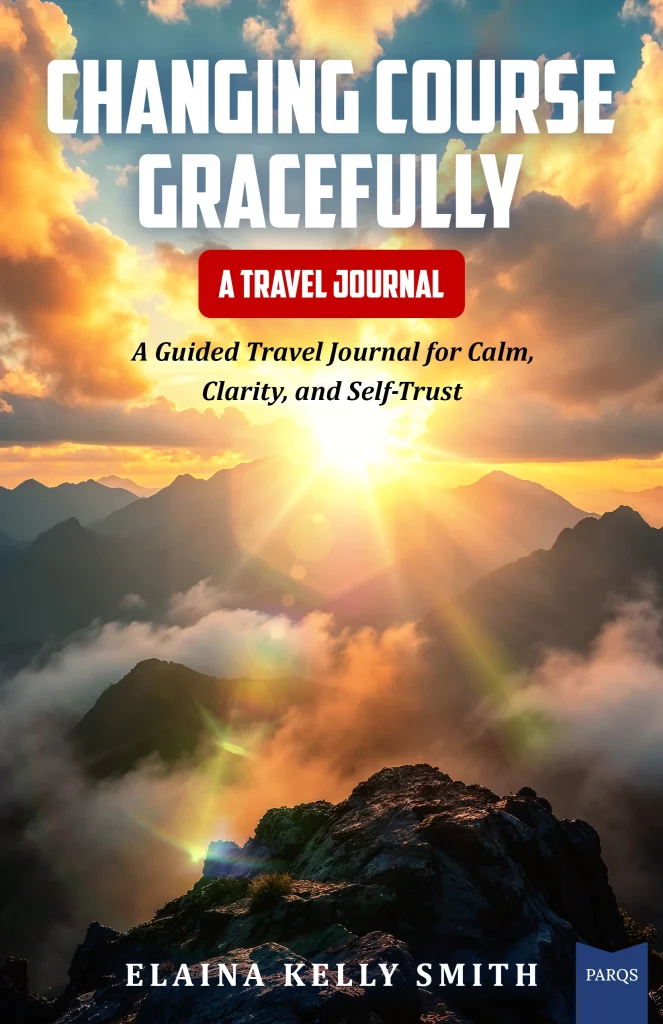
Changing Course Gracefully: A Travel Journal is a guided travel companion built around the PARQS Method, a five-part framework that helps travelers cultivate presence, curiosity, and self-trust. The book blends personal stories, reflective prompts, and practical tools. It moves from pre-travel preparation into deeper guidance for handling overwhelm, emotional waves, cultural differences, and everyday stress. The author uses her own memories from Cambodia, India, Russia, Malaysia, Thailand, and many other places to show how simple check-ins, grounding exercises, and honest self-talk can turn travel challenges into moments of clarity and calm. The journal prompts at the end encourage readers to apply the PARQS Method both on the road and at home.
I felt pulled into the author’s warm and steady voice. She writes in a way that feels friendly and grounded. The personal stories hit me the hardest. When she describes standing in a chaotic street in Siem Reap or crying alone in her hotel room in Varanasi, I felt that wobble in my chest, the kind you get when someone says something you’ve felt but never named. The honesty gave the book weight, and the small tools sprinkled throughout kept it from drifting into the abstract. I liked how she showed the PARQS Method in motion instead of just explaining it. It made the ideas feel practical, not preachy.
I also appreciated how gentle the writing is. The author never tries to impress or overwhelm. She steps carefully through each idea and lets the reader set the pace. Sometimes I caught myself nodding along because the language is simple and relatable. Some sections wrapped up neatly, and I found myself wanting the messier edges to be explored a little further. Still, the tone felt sincere, and I liked that she didn’t pretend travel is always magical. Her mix of humor, vulnerability, and practical advice made the book feel like a soft place to land.
This book feels like a gentle companion for anyone who wants to travel with more intention, or even just live with more intention. I’d recommend it to new travelers who feel anxious, solo travelers who want emotional support, and seasoned travelers who enjoy reflecting on the inner journey as much as the outer one. It’s also a great fit for people who like journaling and want prompts that feel personal instead of generic. If you’re looking for a travel guide that focuses less on where to go and more on how to be while you’re going, this book is a lovely choice.
Values Based Organizations: Aligning Culture and Strategy
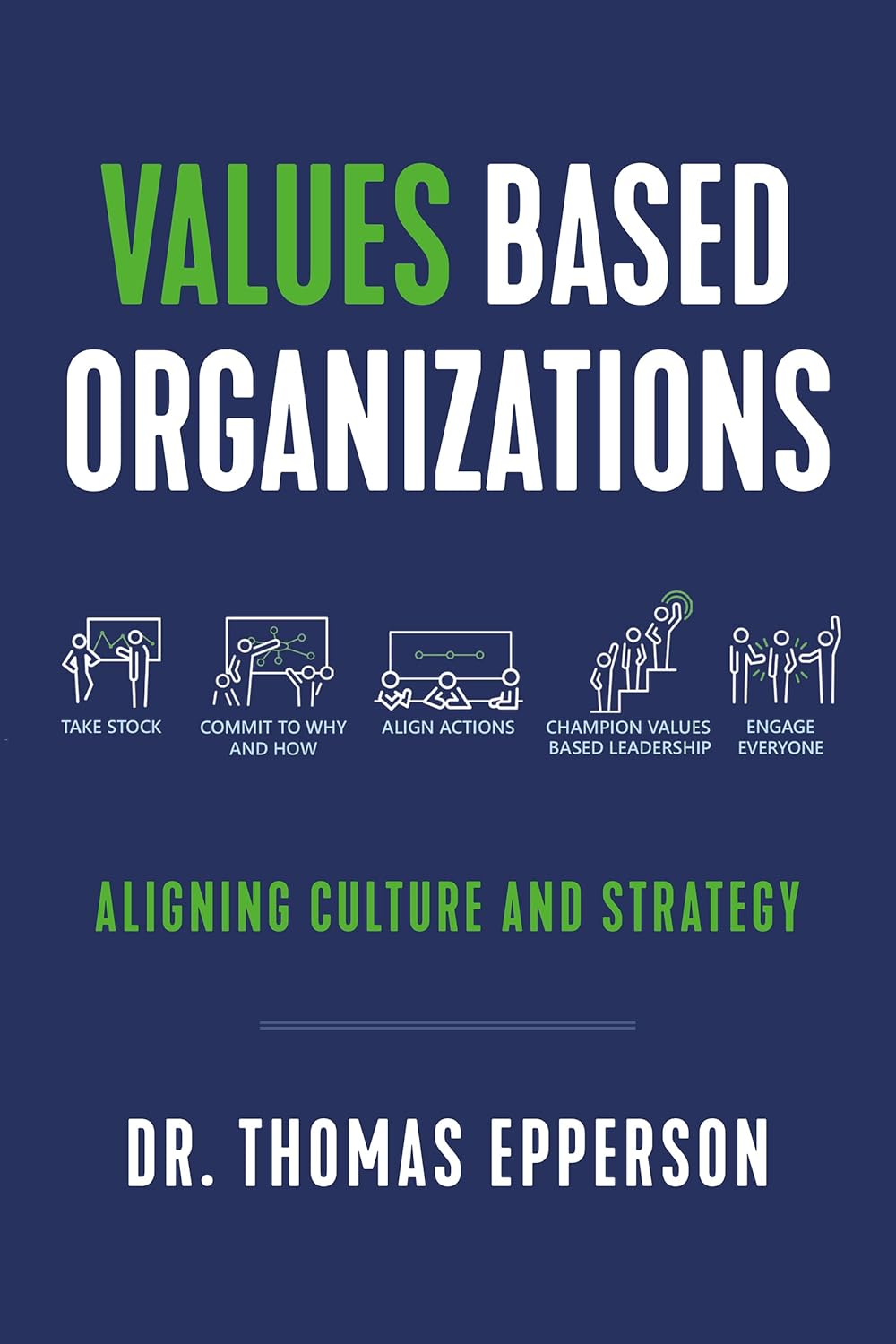

Values Based Organizations lays out a clear and practical roadmap for building organizations that actually live their values instead of just talking about them. It explains how culture, strategy, leadership, and processes can work together when they are aligned. The core idea rests on five practices: Take Stock, Commit to Why and How, Align Action, Champion Values-Based Leadership, and Engage Everyone. Throughout the book, author Dr. Thomas Epperson uses stories, interviews, and real examples to show how these practices play out in companies of all sizes. The narrative leans heavily on the transformation of Luck Companies and other organizations that chose to anchor their work in purpose and values.
I found myself reacting with a mix of curiosity and skepticism that often turned into appreciation. The writing comes across as honest and steady, almost like talking with someone who has seen the same mistakes happen over and over. I liked the plain language and the way the author admits that culture work is messy and sometimes painful. I felt the weight of those stories about organizations drifting or fighting themselves, and I caught myself nodding when he described leaders who avoid hard truths or cling to the wrong assumptions. The book made me think about my own reactions to change. I kept feeling a strange mix of discomfort and motivation, like someone tapping me on the shoulder saying, “Stop pretending you don’t see the problem.” That emotional push gave the ideas more power.
I also enjoyed the practicality of the examples. The section on Taking Stock made me laugh at the image of leaders scribbling complaints and then discovering that none of them had written “me” on the list. That moment says everything about the self-awareness required for real change. The parts about rediscovering a company’s history gave me a sense of warmth and even hope, because the idea that organizations can return to their roots instead of tearing everything down feels refreshing. Sometimes the book leans into repetition, and at moments I wished it would linger less on the obvious, but even then I understood why the reminders mattered. Culture work is slow, and people forget quickly.
The book isn’t flashy, but it is sincere, and it pushes you to think about organizations as living systems that need both care and discipline. I would recommend Values Based Organizations to leaders who want to shift their culture in a real and grounded way, and to teams that feel stuck or scattered. It would also be helpful for anyone stepping into a new leadership role who wants a straightforward guide to understanding how values can steer an organization.
Pages: 164 | ASIN : B0FTLLR57V
Beyond Power – Israel and the Struggle for the Ethical State

Beyond Power sweeps across a huge landscape. It starts with the brutality of October 7 and moves through the ethics of self-defense, the failures of modern democracies, the rise of progressive ideology, and the long history of Jewish vulnerability. It tries to stitch these threads into a single idea. The author argues that Western society is drifting away from the moral core that once made democracy possible. At the same time, he says Israel stands as a case study of a nation forced to defend that moral core while being attacked for doing so. The book blends philosophy, history, and political analysis into something that feels both wide-ranging and deeply personal. It does this through rational analysis, while acknowledging both sides of many of the arguments.
I found myself pulled in many directions at once. Some chapters hit hard. The discussion of existential threat felt raw, and the writing carried a pulse that seemed to come straight from lived fear. I felt the author’s frustration with how the world reacts to Israel’s choices. I also felt his disappointment at how fragile democratic societies have become. He writes in a way that makes big ideas feel urgent. At times, I nodded along. The book has a rhythm that swings between clarity and intensity, and that mix made the reading experience unpredictable in a good way.
Then there were moments when I felt the weight of the author’s certainty. Some arguments felt tightly reasoned and grounded in the text of history. Others felt more like a call to arms. I caught myself reacting emotionally. The sections on progressivism, for example, felt like they were written out of real concern. The passion behind the words made the book more alive. It never hides how the author feels, and that honesty makes the work feel human. The tone always remains respectful of divergent views and offers solutions as well as analysis.
I walked away thinking this book is suited for readers who want to grapple with difficult questions about ethics, identity, war, democracy, and power. It is a book for people who enjoy wrestling with ideas and who do not mind strong viewpoints. It will speak to readers who are curious about Israel’s struggles, Western political instability, or the philosophical foundations of ethical societies.
Pages: 247 | ASIN : B0G1CZG9J1
Dorm to Doorstep – Tips, Tidbits & Tales Every Young Woman Will Want to Read

Dorm to Doorstep is a lively mix of advice, stories, and straight talk aimed at young women stepping into adulthood. Author Hilary Afshary blends motivational tips, cautionary tales, and personal lessons into a bright, fast-moving guide. The book moves through themes of confidence, safety, health, relationships, and self-discovery, and it uses short chapters, bold reminders, and striking visuals to keep the messages clear and easy to absorb.
Reading this book felt like sitting with someone who genuinely wants you to do well. I found myself surprised by how open the writing is. Some moments made me smile, and others stopped me cold, especially the tougher stories about fear, loss, and mistakes. The honesty worked for me because it made the advice feel earned. I also loved how often Afshary circles back to choice. She keeps reminding the reader that you control you. That simple idea hit harder than I expected. The writing is plain spoken and warm, and at times I felt like she was nudging me gently in the ribs and telling me to get my act together in the kindest way possible.
There were moments when the book felt more like a pep talk. Still, the personal stories kept things grounded. The camping mishap, the chipped tooth saga, the warnings about safety and substances, the fashion flubs that turn into life lessons. They all gave the book texture. I appreciated how she admits flaws openly. I found myself trusting her more because of that. The mix of humor, vulnerability, and big sister energy kept me turning the pages even when the advice was something I had heard before. It felt fresh because it was hers.
I would recommend Dorm to Doorstep to young women heading into college or early adulthood and to anyone who wants a boost of clarity and confidence. It is quick to read and full of heart. It would also be a great pick for parents who want something positive to hand off to their daughters. The advice is simple and actionable and delivered with a mix of love, caution, and cheer that makes it easy to take in.
Pages: 282 | ASIN: B0F5HYW9CD


 LITERARY TITAN