Blog Archives
Everything From Nothing


Everything From Nothing, by S.E. Elwell, tackles one of the most profound mysteries of existence: why does anything exist at all, rather than nothing? This thought-provoking book delves into the origins and purpose of the universe, offering a compelling theory that revolves around the interaction between infinite potential and absolute nothingness. Through this lens, the author explores the natural laws that gave rise to our reality, emphasizing the vital role that order plays in maintaining the structure of the cosmos.
The concept of infinite potential is presented as a boundless source of possibilities, yet Elwell argues that without a framework of order—embodied in the laws of physics—this potential would lead to chaos rather than the structured universe we observe. The book deftly explains how these laws prevent disorder, enabling the universe to evolve in a meaningful way. Consciousness, another key theme, is portrayed as an essential aspect of this grand cosmic unfolding. Elwell suggests that life’s challenges—suffering and competition, for instance—are not only necessary but fundamental to the growth of consciousness. These forces drive evolution and adaptation, shaping the complexity and self-awareness found in living beings.
What makes this work truly engaging is its deep dive into the continued evolution of consciousness, which the author describes as an ongoing and dynamic process. Far from static, the journey of consciousness is portrayed as a path toward ever-greater complexity, with no clear end in sight. Reading this book was an eye-opening experience. It introduced me to new concepts, from the evolution of awareness in living organisms to the possibility of higher dimensions influencing our existence. Elwell’s exploration of the infinite source behind the universe opened my mind to endless possibilities.
The philosophical reflections on the nature of awareness and its origins offer a rich intellectual landscape for those curious about the deeper mysteries of existence. That said, I feel the book’s dense philosophical and scientific discussions may feel somewhat overwhelming to readers unfamiliar with these topics. Some of the theories could be difficult to grasp for those without a strong background or interest in philosophy and science. Despite this, it’s refreshing to hear a fresh perspective on the origins of the universe.
For readers with a passion for these subjects, Everything From Nothing offers a fascinating and educational journey. Elwell’s work is an ambitious and enlightening exploration of existence, perfect for readers who enjoy reflecting on the big questions about life, the universe, and everything in between.
Pages: 86 | ISBN : 978-1399918442

Everything From Nothing
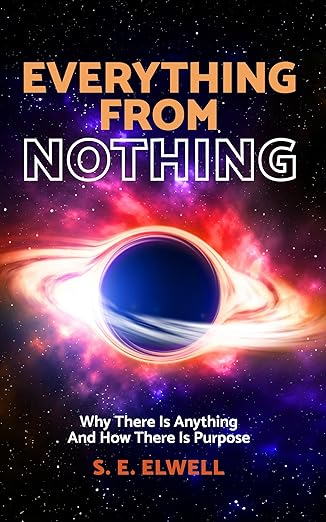
S.E. Elwell’s Everything From Nothing delves into the profound questions surrounding the origin of the universe and life itself. With a focus on the Big Bang theory, the book examines how the cosmos emerged from a state of nothingness to the complex reality we inhabit today, perfectly encapsulated in the book’s title. Drawing on decades of research in both science and philosophy, Elwell presents his own theories on the source behind the Big Bang. He explores how this origin may be intricately tied to the existence of life and the universe, proposing that life is a conscious manifestation of what he calls the “infinite source of potential.”
I appreciated how Elwell doesn’t bog the reader down with scientific jargon but explains complex ideas, such as the relationship between “nothingness” and an “infinite source,” in a way that feels conversational. The writing style itself is straightforward and easy to follow, but I found that sometimes the philosophical leaps felt too speculative without enough grounding in evidence. That said, Elwell is clearly aiming to inspire readers to look beyond what is empirically provable, and on that level, the book succeeds in being both provocative and engaging.
The discussions on consciousness and purpose are where the book really shines for me. Elwell argues that consciousness is not just a biological phenomenon but part of a larger unfolding of infinite potential. This idea, while ambitious, was fascinating to contemplate. The suggestion that all of nature is “self-aware” to some degree made me reflect deeply on the interconnectedness of all things. The notion that the universe is evolving toward a higher, more self-aware state resonated with me, even if it remains speculative. I appreciated the intellectual curiosity that drives these arguments.
Everything from Nothing is a thought-provoking read for anyone curious about the origins of existence and the possibility of a higher purpose. While some of the claims might feel more philosophical than scientific, Elwell does an admirable job weaving the two disciplines together. I would recommend this book to readers who enjoy contemplating the “big questions” and are open to a blend of science, metaphysics, and spiritual insight.
Pages: 86 | ASIN : B0DPMYSN8B
Conspiracy by Means of Natural Selection

Conspiracy by Means of Natural, Selection by Sherman P. Bastarache, explores the intricate relationship between faith, reason, human nature, and societal constructs. The author decodes the psychological and evolutionary origins of belief systems, language, and cultural narratives. Using a mix of historical, anthropological, and scientific perspectives, the book delves into humanity’s journey from primal instincts to complex ideologies, ultimately examining how belief and reasoning have shaped human progress and conflict.
One aspect I found intriguing was the book’s deep dive into language as a tool of human cognition and social structure. Bastarache’s claim that language is deeply rooted in primal senses and shaped by evolutionary necessities was fascinating. For instance, the exploration of the etymology of “V” and its symbolic ties to creation myths was unexpected and cleverly analyzed. At times, the explanations felt a bit elaborate which occasionally made it challenging to follow the central ideas as clearly as I would have liked.
The book shines when discussing the perpetual tug-of-war between faith and reason. Bastarache argues that these two forces are not inherently opposing but are evolutionary adaptations meant to coexist. The use of religious and mythological anecdotes, such as the reinterpretation of the Genesis story, brings a fresh and creative perspective. At times, though, I think the arguments felt more exploratory than conclusive.
I appreciated Bastarache’s exploration of “belief-reasoning” as a natural evolutionary mechanism. The idea that humans evolved to rely on “held-as-true” concepts for survival resonates, especially when tied to modern phenomena like conspiracy theories. Some sections, like the extended focus on primal consciousness and nervous system entanglements, felt lengthy and occasionally wandered from the main narrative, but I appreciate the depth they added.
Conspiracy by Means of Natural Selection is an intellectual yet accessible read for those fascinated by human evolution, cognitive science, and philosophy. Its unique lens on faith, reason, and their intersection with societal myths makes it particularly suited for readers who enjoy critical thinking and interdisciplinary analysis. Its blend of speculation and scholarly insight makes it a stimulating addition to conversations about human nature and belief systems.
Pages: 334 | ISBN : 978-0992159436
Mistakes, Misstatements, Lies and Other Miscommunication Tactics


Norm Cairns’ Mistakes, Misstatements, Lies, and Other Miscommunication Tactics is a witty exploration of the myriad ways communication goes awry, sprinkled with humor, philosophy, and a touch of absurdity. The book oscillates between fictional tales and reflective commentary, weaving a patchwork of anecdotes and insights that challenge readers to think critically about language and its impacts. It’s a cerebral yet playful work that doesn’t shy away from poking fun at the complexities of human interaction.
One thing I immediately enjoyed about this book is its dry humor. In the introduction, Cairns reflects on the evolution of the English language, describing it as both “a patchwork quilt of other languages” and “a disgusting lingua franca.” This sets the tone for the rest of the book—biting, unapologetic, and insightful. I chuckled at the author’s sardonic observation of American English’s global infiltration, not through admiration, but necessity. It’s a blend of erudition and irreverence that doesn’t take itself too seriously.
The fictional chapters are where Cairns truly shines. “Two Detectives Meet the Mummy” exemplifies his knack for creating chaotic yet relatable dialogues. The interaction between Floyd and the narrator, discussing whether “Why?” or “What the f***?” was the first question humanity ever asked, is both absurd and oddly profound. It captures the bizarre beauty of human communication—messy, flawed, and full of unintended revelations. I found myself simultaneously laughing at Floyd’s crudeness and pondering the existential implications of their debate. “The Black Site” explores the grim underbelly of the internet, delving into themes of anonymity and morality. This chapter was a stark contrast to the humor of others and left me feeling uneasy—but in a way that felt intentional. Cairns doesn’t shy away from showing the consequences of miscommunication or deceit, and this tonal shift highlights his versatility as a writer.
In the final reflection, Cairns reminds us of the power and responsibility tied to language. The chapter “The Big Reveal” is particularly memorable, with its poignant commentary on how lies, even small ones, shape relationships, and the world. This chapter left me with a lingering sense of introspection about the words I choose and the impact they have.
This book’s humor leans towards intellectual, with plenty of philosophical musings that might feel dense to some readers. That said, it’s perfect for anyone who enjoys a mix of satire, sharp dialogue, and thoughtful reflection. Whether you’re a linguistics enthusiast, a fan of dark humor, or someone fascinated by the quirks of human behavior, Norm Cairns’ Mistakes, Misstatements, Lies, and Other Miscommunication Tactics offers plenty to chew on—and laugh about.
Pages: 243 | ISBN : 978-1304081292
Maximizing Making Meaning
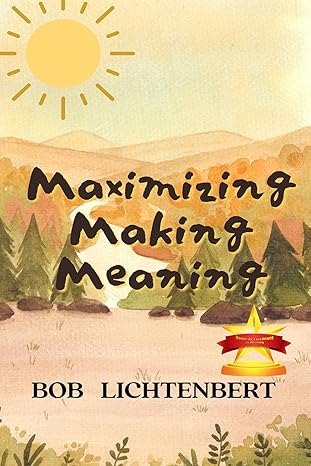
Bob Lichtenbert’s Maximizing Making Meaning tackles the profound question of what gives life significance, proposing a framework for making and understanding meaning. The book is structured around various “sources” of meaning, such as relationships, community, and even intangible concepts like justice or love. With a philosophical lens grounded in common sense, Lichtenbert argues for a life enriched by purposeful connection and reflection. His personal anecdotes and an overarching optimism tie it all together, making his exploration relatable.
What struck me first was the book’s approachable tone. Lichtenbert dives into weighty concepts but writes with the kind of clarity that makes abstract ideas surprisingly tangible. For instance, his exploration of “quality relationships” as a source of meaning highlights Martin Buber’s “thou” relationships—those sacred, intimate connections that transcend mere utility. The way he relates this to his own experiences, like reflecting on his struggles to find meaningful friendships outside his family, made the theory feel authentic. His vulnerability in sharing these moments added emotional depth to what could have been a dry philosophical discourse.
The call for re-establishing community through daily acts like picking up litter or starting local dialogues is heartwarming, but I couldn’t help thinking that this approach doesn’t fully account for the complexities of modern digital lives. Still, the author’s passion for reviving a shared sense of purpose came through, especially in his vivid description of feeding birds as a metaphorical act of communal care. It’s quirky, sure, but it left me thinking about the small ways I could make a difference too.
Another idea I liked was his emphasis on “intangibles” like justice, goodness, and beauty as key to meaning-making. These concepts could easily feel esoteric, but Lichtenbert grounds them with practical examples and even challenges materialism as a misguided source of fulfillment. I appreciated his argument that focusing on intangibles broadens the scope of what’s possible in a meaningful life. The section where he critiques “collections,” groups motivated purely by self-interest, hit close to home for me, especially in today’s hyper-individualistic world.
Maximizing Making Meaning is a refreshing blend of philosophy, self-help, and memoir. Lichtenbert’s personal insights add a relatable layer to his ideas. This isn’t light reading, but it rewards patient readers who are willing to engage deeply with its themes. I’d recommend this book to anyone interested in philosophy of life or to those feeling adrift and searching for a framework to anchor their purpose.
Pages: 261 | ASIN : B0BWBWCNGN

Jade Reflections: Decoding the Western Zhou Dynasty

Jade Reflections: Decoding the Western Zhou Dynasty, by Kako Crisci, is a thorough exploration of the Western Zhou era through the lens of jade artifacts. The book digs into the political, social, and philosophical shifts during this influential period in early Chinese history. By examining jade pieces—artifacts that served ritualistic, decorative, and burial purposes—the author sheds light on how the Western Zhou rulers used these objects to reinforce their authority and cultural identity. Crisci’s work stands out for juxtaposing Eastern and Western philosophies, particularly highlighting the differences between Confucian and ancient Greek thought.
The writing style is dense but rich in detail. One of the things I genuinely admired was how the author made ancient history come alive through vivid descriptions of jade pieces. When she describes the “Massive Gui with Relief Dragons” from the King Wu period, you can almost visualize the intricate dragon designs that symbolize power and virtue. However, I found some chapters a little overwhelming with the amount of scholarly information packed in, which somewhat slowed the narrative. I feel that a bit more balance would have made the text more engaging for general readers.
Crisci’s approach to the subject is passionate and sometimes controversial. She challenges modern scholarly views that jade vessels were rarely crafted before the Ming period, using archaeological findings to make a compelling argument. The analysis of Lady Fu Hao’s tomb, for example, raises questions about traditional views, suggesting that jade pieces found there represent an overlooked aspect of Chinese craftsmanship.
I appreciated how Crisci isn’t afraid to question accepted theories, but some of her assertions felt under-explained. The constant referencing of Western scholars and the push to compare Eastern jade philosophy with ancient Greek ideals added a unique but occasionally disjointed element to the book. Crisci explores how the Western Zhou used jade not just as art but also as moral and ethical reminders. The section on how jade embodied Confucian values, emphasizing “Li” (ritual) and “De” (virtue), made me think deeply about the cultural roots that continue to influence China today. I would like to have seen a little more time spent clarifying how this jade philosophy contrasts with the Western scientific pursuit of truth.
Jade Reflections is not a breezy read, but it is certainly rewarding for those fascinated by ancient Chinese culture, archaeology, or philosophy. If you’re a history buff or curious about how artifacts can illuminate a society’s values, this book will be a treasure trove. While I believe that the heavy academic tone might not suit every reader, Crisci’s dedication to uncovering the truth about jade’s significance is impressive and well worth delving into.
Pages: 171 | ASIN : B0CXYH6TFN
The “Great Filter”

Infrequent Frequencies, Rare Resonance invites readers on a journey through faith, science, and history, challenging conventional beliefs and exploring the intersections of spirituality, psychology, and quantum physics. Why was this an important book for you to write?
The writing of this book encountered a lot of resistance, not from outside but from parts within myself. It was written from a compelling necessity which is a bit difficult to explain.
The human species is rapidly approaching the stage of the “Great Filter” that inevitably faces all evolving, biologically advanced, sentient beings. Young people today are sadly, more often than not, disillusioned, suffering unprecedented levels of anxiety and depression. Too many young people have lost touch with their spiritual, religious and cultural roots and are free-falling in a world that seems senseless, materialistic, increasingly unnatural, dysfunctional and alien to them.
The traditional religions often now leave them uninspired, and confused as they witness the senseless fighting and conflict between the adherents of the outer forms of the faiths today. Young people are seeking answers to what life is about, but the ground of what once seemed certain and stable is shifting beneath them as materialism pervades and technology advances unguided and uncontrolled. They often feel as if they are heading for a dystopian future and that life is meaningless.
As humanity is rapidly approaching the Great Filter in the 21st Century. The challenge is for human beings to rise above their animal, lower selves in order to survive, evolve further and pass through the Great Filter. Human beings at this point could easily destroy our own species, and much of life on Earth, through mutual reciprocal destruction, also known commonly as war, or through suffocating in self-produced waste. If sapiens fail as as an experiment, there will be further vehicles and conscious experiments in the distant future evolved through the Sun and the Earth.
Continuing to release vast amounts of carbon pollution into the air from burning fossil fuels, desecrating the environment of the Earth with chemicals, and plastics and sewerage is not going to lead to anything other than a self-destruction. Human activity has already significantly disrupted many of the natural vibrations, patterns, and magnetic fields on our life-staining Planet. We are at a crossroads. We have choice because we were born into an organic life on the Planet of Choice. We will need to reach out for help from higher Consciousness as well as improving ourselves as well as practically changing our ways.
H. I. Khan had a tremendous vision for humanity and was, with Swami Vivekananda, the modern era pioneer of showing the inner truth of the great major faiths of spiritual teachings. Young people deserve to know the truth, as the truth can set them and everyone free.
Knowing our Source, however that may be conceived, selflessly serving others, and focusing on practical spiritual development is the principal worthwhile aim, the master endeavour. It is science and art, to consciously raise the personal vibration and resonate with higher frequencies. It is your birthright, our universal human potential.
The chapters cover both abstract concepts like Schumann resonances and practical guides on prayer. How do you hope readers will balance these two aspects in their own spiritual journey?
The perspective of the book is the message that science and mysticism are not distinct, opposing, separate worlds. In the 21st Century, as never before, there is a convergence emerging between science, mysticism, and ancient wisdom. Quantum Physics and String Theory opened the portal and led the way.
Dr James Lovelock and his Gaia concept was a major catalyst, as well as mathematician Prof Steven Strogatz. The works of these researchers and thinkers are cited and acknowledged in the book as well as pioneers such as Fritjof Capra and supremely-gifted mathematician Srivasa Ramanujan. My big first learnings were that All is vibration, and that the Divine is present in everyone and everything. The direct teaching and writings of my spiritual teacher A.I. Dougan of New Zealand, who passed away in 1987, had the paramount influence on my search for truth.
The main thrust is to start building self by improvement and sincere work on self which raises vibration. Selfless-service to others without seeking reward and bearing with the displeasing manifestations of others (tolerance) is also essential to raising vibration. There are specific practical methods, exercises, meditations, prayers, given out in the book.
To be of any use, all of this stuff has to be very practical, not some high-blown, airy-fairy notion of new-age crystal palaces in the sky. We have to do the hard yards, the best we can in order to ascend in consciousness, and to till the ground for Grace to descend. It requires persistence, patience and sustained effort to raise Consciousness.
What do you hope readers take away from the diverse perspectives on supernatural beings, faith, and history that you present throughout the book?
First and foremost, that the human species is an Experiment of Consciousness and this is a very high purpose and that you, the reader, the individual, are a vital part of this great experiment. Each one of us has the potential to contribute to the eventual outcome of the experiment, as experiments can succeed or otherwise. Each life is a small sub-experiment within the great, large experiment. The thrust of the hope for readers? Inspiration and motivation. Inspiration to know that everything is not what we have been led or conditioned to believe, that there is a matrix underlying the illusion we take to be reality, and that you have the possibility to attain liberation and consciousness. Motivation to work sincerely on oneself without seeking any reward, to improve and evolve and raise the personal and collective vibration. To aspire to ascend beyond the lower animal, to voluntarily evolve to resonate with the higher consciousness. Further inspiration to know you are not your body and that the spiritual is the ground of reality. The aim is that readers will find inspiration and resonate with Hope.
At the heart of the book’s thesis is the idea that we are all part of a vast cosmic experiment in consciousness. It isn’t just philosophical musing – it’s grounded in both scientific theory and spiritual insight. We are challenged to see ourselves not as passive observers of the universe, but as active participants in its unfolding drama. It’s a perspective that’s both humbling and empowering.
What is the next book that you are working on and when will it be available?
Well, the next book actually (subtle laugh) is a fictional work, a novel entitled: At Proximity Passage. It takes place in Nepal and is based on the story of a Tamang child named Anuja, who is sold into slavery by her own family into the slums of Kamathipura in India. It’s about finding meaning in suffering and transcendence. The characters are humanitarian aid workers who come together in Nepal, with each one illustrating some of the principles of the ideas contained in Infrequent Frequencies Rare Resonance. Strangely enough, the story was written when the writer was serving in humanitarian aid projects working inside Afghanistan between 2004-2006. It was saved onto two old floppy discs and deemed unrecoverable, until recently, when a very helpful and astute data recovery technologist in Melbourne was able to retrieve the manuscript. It needs a lot of work but should be ready for publication in 2025.
Evolution transcends material beginnings: higher vibrational frequencies resonate from the infinitely small, on through the level of the Solar System and up through vastness of galaxies. Conscience is your inner guidance system: your inner voice is the active force of a superior consciousness. This very different understanding of polarity leads to new insights about how and why the world operates as it does when approximately half of the population remain essentially spiritually dead. Evidence has been hiding in plain sight: within the core truths of each of the major world faiths, within ancient wisdom, through modern science, mathematics, physics, and cymatics, consistent clues to the puzzle are emerging. Advanced superior consciousness has been in plain sight and awareness and knowledge of this challenges our understandings of origins, extending the natural Gaia Principle through to the next logical stages.
There are very rare human beings who have attained enlightenment through raising their vibration and transforming their being in ways leading to a much higher resonance. This small group of masters have helped humankind along in every generation. During this lifetime you have extraordinary potential to lift your vibration and transform your inner frequencies. This work provides readers with new insights. The practical steps to help you achieve your aims, find your unique purpose and create your own path.
INFREQUENT FREQUENCIES RARE RESONANCE
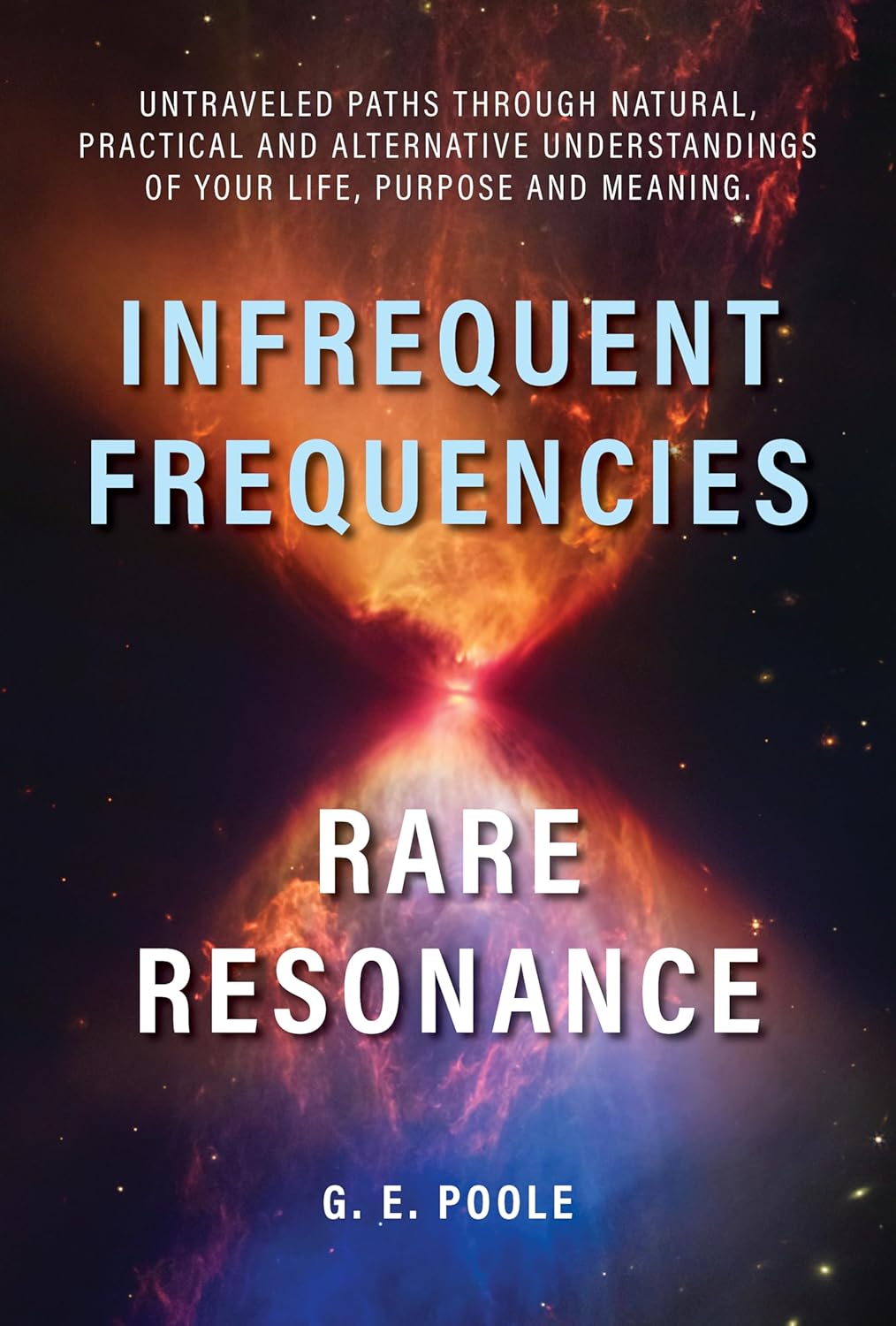
G. E. Poole’s Infrequent Frequencies, Rare Resonance delves into an expansive array of thought-provoking subjects, pushing readers to challenge conventional beliefs and explore new dimensions of understanding. This book invites an open mind, urging readers to engage in complex discussions on faith, science, history, and the future. Poole weaves together a fascinating mix of Christian and Islamic teachings, the writings of H.I. Khan, and an assortment of other religious perspectives while also offering in-depth historical narratives, a sharp analysis of the present, and thought-provoking future predictions.
The range of topics is vast, from the mysteries of quantum physics and Schumann resonances to ancient Greek myths like Pandora to a practical guide on prayer. Poole explores everything with a sense of curiosity that draws the reader into his exploration of science, spirituality, and psychology. The chapters are richly packed with ideas, offering a deep well of knowledge. For example, Poole’s discussion of the Fibonacci sequence and the Golden Ratio is insightful. Poole encourages readers to approach the material with an inquisitive mind and allow space for personal interpretation while his unique voice subtly shines through.
I think this book is best suited for readers who are open to exploring new perspectives, especially in areas that stretch beyond traditional religious frameworks. Poole offers essays on supernatural beings, explores unconventional arguments on faith, and shares eye-opening stories from the Bible, Islam, and other belief systems. Every chapter is organized into segments that brim with rich and varied content.
This is not a book to rush through. Instead, it’s a work that demands time, inviting readers to immerse themselves in its exploration of Eastern philosophy, quantum physics, religion, and psychology. Despite the abstract and sometimes complex nature of the topics, Poole’s writing is clear and fluid, making intricate ideas accessible. I found the sections on prayer particularly moving, especially the guidance on incorporating Saum and Salat into one’s personal spiritual practice.
Infrequent Frequencies, Rare Resonance is a treasure trove of insights. Its concise yet deep exploration of a wide range of subjects will spark curiosity and invite readers on a path to enlightenment. For anyone seeking an enriching experience, I recommend taking in every chapter with an open mind.
Pages: 473 | ASIN: B0D21KJP1D


 LITERARY TITAN