Blog Archives
There Are No Stars Here
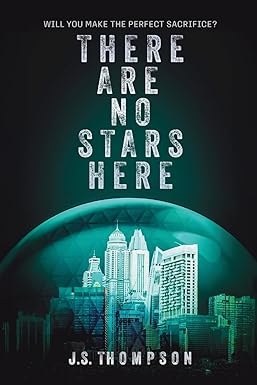

There Are No Stars Here is a speculative dystopian novel set in a near-future America torn apart by environmental collapse, authoritarian control, and ideological warfare. At its heart are the lives of Manuel and Solanis, two young adults navigating fractured families, corrupted systems, and the lingering shadow of a manufactured plague called Haze. Through split narratives, the book builds an urgent picture of a society breaking under its own weight, where AI companions, dome cities, and militant resistance movements exist side by side with old-fashioned grief, duty, and hope. It’s a story of survival, identity, and the terrifying beauty of personal rebellion.
What I liked about Thompson’s writing is the way he captures tension like it’s a living, breathing thing. There’s this pulse running under every page, whether it’s the quiet horror of a dying parent or the chaos of a city in flames. The prose doesn’t try to impress you with its vocabulary. It’s blunt, fast, and full of teeth. That style worked wonders for me. I never felt lost in the world-building, and that’s a real feat in a book with this many moving pieces. The pacing can be relentless, but when the emotional moments hit, they hit hard. Manuel’s grief, Solanis’s panic, it all feels lived-in and earned. There’s sincerity here, even in the most surreal scenes.
The ideas, artificial intelligence as surrogate parent, state surveillance morphing into salvation, climate catastrophe wrapped in corporate spin, are all big and worthy. But sometimes I felt they rushed past in favor of another twist. The emotional weight stays solid, and I found myself thinking about this world long after I finished it.
I’d recommend There Are No Stars Here to anyone who enjoys near-future sci-fi grounded in character and emotion. It’s not just for fans of dystopia or political thrillers; it’s for people who want to feel something, who want to sit with loss, hope, and rage, and watch characters claw their way toward meaning.
Pages: 470 | ASIN : B0FDZDYJ67

Sua Sponte: The Minneapolis ADOZ
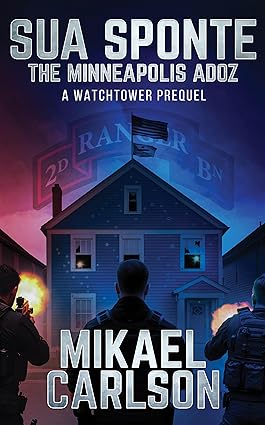

Mikael Carlson’s Sua Sponte: The Minneapolis ADOZ is a high-octane political-military thriller that blends the grit of combat realism with the chaos of civic unrest. Set in the aftermath of a brutal ambush in Syria, the story follows Staff Sergeant Emmit “Chicago” Haskins as he reintegrates into civilian life, only to find himself caught in the spiraling tensions of post-Floyd Minneapolis. The novel weaves together threads of political intrigue, media manipulation, grassroots activism, and the enduring loyalty of a brotherhood forged in war. It’s fast-paced, cinematic, and unapologetically opinionated.
What struck me first was how Carlson plunges you into battle from page one. The prologue doesn’t ease you in; it throws you into a searing ambush near Al-Tanf, Syria. The action is visceral. The description of RPGs ripping through MRAPs and Emmit refusing to abandon his wounded Rangers was raw, heroic, and honestly had me holding my breath. Carlson writes combat like he’s lived it. The whole opening sequence could easily rival any war movie for sheer intensity. I loved that it wasn’t just about firepower. It was about values. Loyalty. Brotherhood. Carlson knows what makes soldiers tick.
The narrative then shifts sharply to Minneapolis, where the tone grows considerably more serious. The city’s social fabric is fraying, and Carlson addresses these tensions with striking candor. The character of Police Chief Vanessa Campbell is placed in a particularly precarious position, as she navigates the volatile intersections of political pressure, internal departmental conflict, and a mayor whose priorities appear driven more by public image than justice. In a particularly jarring scene, the mayor demands the immediate termination of an officer who deployed a taser on a knife-wielding suspect, well before any investigation is completed. His curt command, “Fire him. Today,” delivered while he examines his fingernails, underscores the indifference to due process. The moment is deeply unsettling. It illustrates a system more concerned with optics than with truth, and it’s difficult not to sympathize with Vanessa, who is forced to balance integrity with job security. The tension feels uncomfortably authentic.
The narrative also delves deeply into the interplay between media and activism, presenting a nuanced examination of their power and volatility. Kai, an independent journalist, emerges as one of the novel’s most compelling figures. Intelligent, jaded, and visibly fatigued by the ongoing culture wars, he nevertheless remains committed to uncovering the truth. His analysis of the gathering at Gold Medal Park deliberating whether it constitutes a peaceful protest or the beginning of something more volatile is astute. His observation, “This somehow feels…organized,” resonates strongly, and Carlson’s willingness to confront the ways in which grassroots movements can be manipulated is both bold and unsettling. Landon, the charismatic agitator, delivers speeches that are disturbingly persuasive. When he declares, “Let’s take this protest to the steps of City Hall…or burn it down,” the moment lands with alarming intensity. It captures the razor’s edge between civic expression and orchestrated unrest, and Carlson handles it with disturbing authenticity.
What kept me reading, though, was the emotional heart of the story. Emmit, trying to find a purpose post-military, is such a solid anchor. His conversations with his sister Kenyala were unexpectedly touching and even funny. She’s tough, witty, and won’t let him wallow. Their back-and-forth gave the book some much-needed softness. It’s easy for stories like this to get lost in the adrenaline and outrage, but Carlson brings it back to the human level just enough to keep you invested in more than the politics.
Sua Sponte: The Minneapolis ADOZ is well-suited for readers who appreciate political thrillers that are unapologetically direct and thematically provocative. The novel confronts its subject matter without hesitation, offering a narrative that some may view as politically charged, while others may interpret it as daring and uncompromising. The story delivers a gripping and unflinching exploration of the challenges veterans face both abroad and upon returning home. For those drawn to narratives where the battlefield extends into civilian life, this book is a compelling and thought-provoking read.
Pages: 444 | ASIN : B0F6RMBYG7
Deadly Secrets

Deadly Secrets is a high-stakes political thriller that drops readers straight into a near-future America fractured by extremism and secession. Centered around Annie Price, an investigative journalist still healing from a past ambush, the story unpacks the creation of a new state called Westcarolina—a theocratic breakaway backed by religious fanatics, corrupt politicians, and shadowy powerbrokers. As Annie chases leads through bombings, government secrets, and personal betrayals, the book balances political commentary with the pulse of a fast-paced mystery.
Let me just say it up front: I devoured this book. The writing has that brisk, no-nonsense cadence you want in a thriller—nothing bloated or overly poetic. Every sentence moves the story forward. Nancy Stancill doesn’t waste time. Her protagonist Annie is sharp without being snarky, tough without being cartoonish. And while the plot careens through explosions, shady politicians, and mounting paranoia, it never forgets the emotional toll all this takes. Annie’s moments of doubt and trauma hit hard. You don’t just watch her chase a story—you feel the cost.
Some characters lean toward caricature, especially the villains. Reverend Kingston Avery, the zealot who builds a “Christian state,” reads at times like a mashup of every televangelist villain trope. That said, his hypocrisy and ambition feel eerily relevant. What really surprised me, though, was how layered the story becomes—especially in the way it weaves Annie’s personal entanglements with broader questions about truth, faith, and power. The romantic subplot adds tension without slowing things down, and there’s this subtle ache in Annie’s longing for normalcy that sneaks up on you.
Deadly Secrets feels like a warning disguised as entertainment. It’s a propulsive, emotionally grounded novel that juggles political fiction, crime drama, and character study without dropping the ball. I’d recommend it to fans of investigative thrillers, political dramas, and anyone who likes their mysteries with a bite of real-world grit. If you’ve ever wondered how close fiction can creep to reality, this one might leave you a little uneasy, in all the right ways.
Pages: 240 | ASIN : B0DHWFSXF4

The Brushy Ridge Militia

Roger Chiocchi’s The Brushy Ridge Militia takes a hard look at America’s deep divisions over gun control, political power, and the consequences of unchecked violence. The story weaves together political intrigue, grassroots activism, and personal tragedy, following Speaker of the House Fred Grantham as he maneuvers through a firestorm of public outrage following a school shooting. But the heart of the novel lies with Austin McGuirk, a bullied, isolated teenager whose desperation culminates in devastating action. This book is raw, unsettling, and impossible to put down.
Chiocchi’s writing is unflinching. From the opening pages, he throws the reader straight into the chaos of a protest, the rage of the public clashing against the stubborn resolve of politicians. The way he writes Grantham is fascinating; the man is cold, calculating, and seemingly incapable of genuine empathy. His exchanges—like when he coldly ignores a grieving mother thrusting a photo of her dead daughter in his face—are chilling. The writing style is direct, with short, punchy sentences that keep the tension high. Sometimes, it almost feels like a screenplay, moving rapidly between perspectives, keeping the reader gripping the edge of their seat.
The most haunting part of the book is Austin McGuirk’s story. Chiocchi takes us deep inside the mind of a bullied, ostracized kid, showing us his slow descent from hopelessness to horrifying resolve. The locker room humiliation scene is brutal, making it impossible not to feel the depth of his pain. And when he finally snaps, it’s a moment that is both horrifying and deeply tragic. One of the novel’s greatest strengths is how it forces the reader to sit in that uncomfortable gray area where you can understand why something happens, even if you can’t justify it.
Then there’s the “militia” of grieving parents who take justice into their own hands. Their motivations are understandable, their pain palpable, but their actions blur the line between righteous fury and dangerous extremism. The novel forces the reader to reckon with the consequences of political inaction, the cost of turning a blind eye, and the rage that festers when justice is never served.
The Brushy Ridge Militia is not an easy read, but it’s an important one. It’s for readers who appreciate stories that don’t shy away from tough conversations—those who like their fiction with a dose of unsettling realism. If you’re a fan of politically charged thrillers, or books that explore the human cost of policy decisions, this is a must-read.
Pages: 400 | ASIN : B0DTNX5J2P
One-Man Minority Opinion

In Dissenting Opinion, a federal judge manages to hide his liberal beliefs in order to secure a seat on the Supreme Court. What was the inspiration for the setup of your story?
In The West Wing episode “The Supremes,” one of the characters remarks that the Court is at its best when justices dissent and passionately argue the law. “Who writes the extraordinary dissent? The one-man minority opinion whose time hasn’t come…” For me, this was a powerful scene, a powerful episode. I imagined a Court where there was one lone justice who disagreed with the majority, and from that Dissenting Opinion was born.
What kind of research was required in order to put this novel together?
I tried to stay away from anything that was too technical about the workings of the Supreme Court; I relied heavily on my memory of government and economics from high school and simple internet searches.
Do you have a favorite scene in this book? One that was especially enjoyable to craft?
As a fan of political and legal fiction, I thoroughly enjoyed the whole book, but I think my favorite scene to write was the television interview where I borrowed a quote from The West Wing. Jason is in the television studio and is asked if he thinks he should practice some tolerance toward those who disagree with him and he replies “As long as Justice Reynolds remains intolerant toward women, Black people, gay people, poor people, immigrants and the First and Fourteenth amendments, I will remain intolerant toward him.” Jaws drop, the studio goes silent. I love it.
What is the next book that you are working on, and when will it be available?
I’m working on a psychological thriller, that I hope to have done later this year. It’s about an overworked psychiatrist who begins noticing patterns between his patients, and as he explores these patterns he finds that he is putting himself at risk. As he gets closer to the truth, his own world starts to unravel and he discovers that perception is fragile, reality is shifting and the truth is more terrifying than madness itself.
Author Links: GoodReads | Facebook | Website | Amazon
Dissenting Opinion
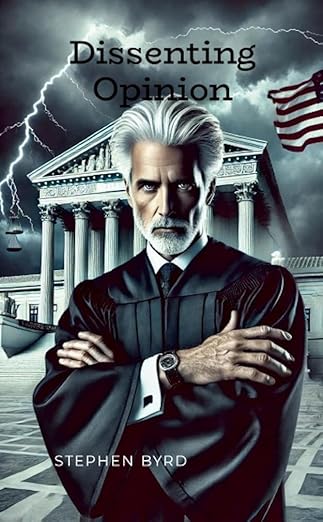
Stephen Byrd’s Dissenting Opinion is a sharp, clever, and wildly timely political-legal thriller that dives headfirst into the shadowy intersections of law, power, and identity. The novel follows Judge Jason Simpson, a respected federal judge tapped to fill a vacant seat on the Supreme Court by a conservative President who assumes Jason is one of their own. But Jason harbors a secret—his true beliefs align more with the liberal camp. What follows is a strategic dance of subterfuge, legal integrity, and ideological rebellion, all wrapped in wit, tension, and some laugh-out-loud moments courtesy of press secretary Vicki Smith’s PR disasters. It’s part courtroom drama, part political satire, and part character study of a man walking the tightrope between truth and survival in a world that expects allegiance above honesty.
I loved how Byrd played with tone. He bounces from biting satire to tense legal sparring without missing a beat. The opening scene with Vicki bungling the death announcement of Justice Egley had me laughing—lines like calling it a “standard, ordinary, everyday expiration of human life” hit with pitch-perfect awkward comedy. But then Byrd shifts gears in the courtroom scenes, like when Jason grills the government lawyer in the Argus Pipeline case. That whole back-and-forth about “potential” environmental harm and due process felt like reading a modern-day Aaron Sorkin script. It was fast, cutting, and quietly enraging. Byrd knows how to build a speech that punches through the page.
What stuck with me the most, though, was Jason’s internal conflict. His private monologues were some of the most honest writing I’ve read in a political novel. When he’s sitting in his study, weighing the morality of accepting the nomination under false pretenses, it’s not just good drama—it’s real. Like when he fears letting “the wrong kind of judge” take the seat instead. Byrd doesn’t shy away from that ethical gray zone. He leans in, and it makes Jason’s choices feel earned, not just symbolic. And the Supreme Court scenes where the other justices slowly start to realize Jason isn’t the conservative clone they expected? Absolutely delicious. It’s the quiet chaos of watching a system unravel from the inside out, led by someone who just refuses to be predictable.
If you like fast-paced political thrillers with brains, bite, and a moral center, this one’s for you. Fans of The West Wing, Scandal, or even Suits will be right at home. It’s not just for legal nerds or political junkies either—this book is for anyone who’s ever wondered what might happen if the person in power decided to put country and conscience before party. It’s smart. It’s brave. And it’s a good time.
Pages: 105 | ASIN : B0DZTRHP6C
Born of Bombs and Bullets: An Aaron Thornton Thriller

David A. Dummer’s Born of Bombs and Bullets is a sharply written, emotionally charged political thriller that pulls no punches. It follows Dr. Aaron Thornton, a prison psychologist whose life is upended after a brutal murder at the penitentiary where he works. Seeking a reset, he relocates with his wife Claire to Belfast—only to be thrust into a volatile world of old grudges, hidden identities, and a brewing storm of violence tied to the legacy of the IRA. Through layered narratives, the book digs into the personal and political costs of trauma, loyalty, and vengeance, all against the backdrop of Northern Ireland’s troubled history.
What grabbed me first was the way Dummer weaves high-stakes action with genuinely human moments. The opening scene inside USP Hazelton is pure tension. One second, you’re in a therapy session; the next, you’re watching the chaos unfold, ending in a devastating double murder. I felt the chill in the room, the tension in Thornton’s indecision, the horrifying weight of inaction. That moment—when Thornton can’t bring himself to strike with the baton—lingers through the rest of the book. It’s a quiet, haunting flaw that makes him real. Dummer doesn’t just serve up trauma; he lets it stew, then uses it to shape the characters.
The Belfast chapters dig deeper into identity and trauma, especially through Liam O’Malley and Tommy Magee. Liam’s backstory—particularly the vivid, heart-shattering scene where his sister Deidre is killed by a British armored vehicle—is one of the most powerful in the book. It felt cinematic and visceral. That single event justifies Liam’s rage and radicalization. At the same time, Dummer avoids painting him as a monster. Liam’s weariness, his doubts about renewed violence, his reflections on a life lived in shadows—they’re painfully honest.
On the flip side, we’ve got Tommy. He’s the emotional powder keg—an orphan, a trauma case, caught in a cycle of poverty and rage. His journey from suicidal despair on Ballycastle Beach to reluctant accomplice in a murder is wild. His flashbacks, especially the aftermath of the Sheehan’s furniture store bombing, are raw and haunting. What impressed me was how Dummer shows Tommy slipping into violence. He’s not evil. He’s broken. And in that brokenness, he becomes someone else’s weapon.
The pacing is tight, the writing is sharp, and the dialogue has just the right edge of grit and realism. It does get pretty heavy, especially with all the political history and acronyms. But Dummer does a solid job of keeping it digestible. He throws you into a world of factions and vendettas, sure—but never without anchoring it in people who bleed, mourn, and remember. The balance between plot and pathos is what makes this more than just a thriller. It’s a character study in the ruins of ideology.
I really liked this book. It’s not a breezy read—it’s emotionally heavy, politically messy, and morally gray. But it’s also compelling as hell. If you’re into thrillers with a conscience, stories that tackle trauma, redemption, and the gritty realism of sectarian violence, you’ll want to check this out. Fans of The Troubles-era fiction, political thrillers like The Ghost or The Constant Gardener will find plenty to chew on here.
Pages: 458 | ASIN : B0DY6MS7F8



 LITERARY TITAN