Blog Archives
9 Habits of Happy Retirees: Discover the Secrets to a Fulfilling Retirement


9 Habits of Happy Retirees offers a warm, upbeat, and very accessible guide to reimagining life after work. The book walks through the emotional phases of retirement, the mindset shifts needed to stay grounded, and the habits that build a joyful and meaningful post-career life. It blends practical advice with simple explanations about mental health, purpose, relationships, physical well-being, and the importance of staying curious and socially connected. The chapters move from preparation to mindset to hobbies to health, then social ties, learning, giving back, and travel. The whole arc forms a picture of retirement as a chance to grow instead of slow down.
This book felt surprisingly personal. I went in expecting a very standard self-help outline, but the writing has a friendly tone that made the ideas easy to absorb. The author speaks plainly, almost like a coach who wants you to feel excited about what’s ahead, and that energy made me lean in. I especially appreciated the focus on emotional transitions. Retirement is usually described as a reward and nothing more, yet the book spends time acknowledging loneliness, identity loss, and boredom. That honesty felt refreshing.
I also found myself reacting strongly to the sections about meaning and purpose. The reminders to try new things, build community, and stay flexible struck a chord. The book made me think about how often people assume retirement should mirror a fantasy rather than a real life with ups and downs. I liked the push to experiment, make mistakes, and adjust. I did wish for more storytelling or real-world examples in some chapters, but the spirit of the message carried the reading experience. The tone is upbeat without feeling sugary, and the steady encouragement made me feel motivated.
9 Habits of Happy Retirees is a strong fit for readers who want a straightforward, positive, and compassionate guide to the emotional and practical sides of retirement. It’s especially helpful for people who feel unsure about what comes next or who want gentle direction rather than technical advice. If you like clear language, simple steps, and a friendly voice that nudges you toward growth, this book will feel like a welcome companion.
Page: 136 | ASIN : B0D78Q1NWD

Coming of Age in Retirement: An Advertising Executive’s Story of Revelation and Enlightenment

Tom Marks’s Coming of Age in Retirement is a funny, thoughtful, and eye-opening memoir-meets-social-commentary about stepping away from a high-powered advertising career and fumbling through the uncertain terrain of retirement. In the first half, Marks digs into the historical and cultural origins of retirement, exposing how our modern view of “the golden years” was shaped more by ad campaigns, policy quirks, and economic conditions than by personal reflection or purpose. The second half is deeply personal, as he recounts his own missteps and lessons while transitioning from agency life into something more grounded, honest, and, eventually, peaceful. What starts as a search for what to do in retirement becomes a much deeper look into how to be.
Reading this book felt like sitting across from a sharp, funny, slightly grumpy friend at a diner who’s finally telling you what’s really going on. The writing flows like conversation, sometimes punchy, sometimes tender, often bouncing between sarcasm and sincerity. I liked that Marks wasn’t trying to be a guru. He admits he got it wrong. He planned financially but never thought about the emotional tailspin that can come from losing your title, your schedule, your identity. He makes fun of his own cluelessness while unpacking how the advertising industry (his industry) has long sold seniors a glossy, unrealistic dream. He doesn’t offer rules or routines; instead, he gives raw, reflective stories. And honestly, I felt seen in them.
What stood out most was Marks’s willingness to be messy. He doesn’t tie things up in a bow. He talks about therapy. About shame. About trying too hard and letting go. And while some parts wandered a bit, especially in the sections about industry history, they always led back to something meaningful. His writing style zigzags, like a curious mind darting between memories, jokes, and gut-punch insights. I appreciated that. It made it feel real. Like a person actually figuring life out, not just repackaging answers.
If you’re near retirement, newly retired, or even just burned out and wondering what’s next, this book will resonate with you. I’d especially recommend it to overachievers, late-career professionals, and anyone secretly dreading what happens after the job ends. This isn’t a how-to. It’s not about finances or hobbies. It’s about getting honest with yourself. About reckoning with who you’ve been, who you might become, and what really matters in the time you have left. For me, it was both a reality check and a relief.
Pages: 264 | ISBN : 979-8-992506-6-8
Escape The Clock – Your Program Guide for Financial Freedom and Early Retirement
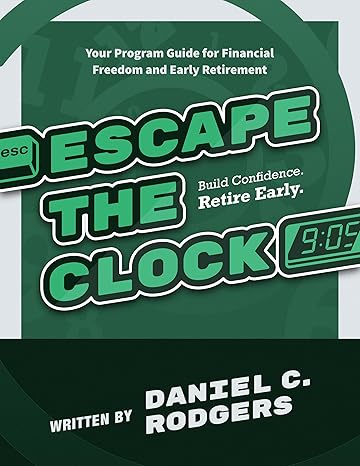

Daniel C. Rodgers’ Escape the Clock is a comprehensive manual that redefines how we think about work, wealth, and retirement. The book meticulously guides readers through the journey of achieving financial independence and embracing early retirement. It draws from the author’s personal experiences and professional expertise in program management. By blending narrative elements with practical advice, Rodgers provides a roadmap to reclaiming time and crafting a purpose-driven post-work life.
What stands out most about Rodgers’ writing is its clarity and relatability. He opens the book by describing the suffocating grind of the modern work-life cycle—a sentiment many can resonate with. The chapter “Trapped by the Clock” is particularly compelling as it details the emotional and physical toll of overwork. Rodgers’ candor about his own struggles adds authenticity, and his emphasis on financial independence as a means of reclaiming life makes the narrative deeply motivational. At times, some of his anecdotes cover similar ground, which can slightly soften the impact of his otherwise sharp insights.
The book’s strength lies in its structured approach to financial planning. Rodgers simplifies intimidating financial concepts, breaking them into digestible steps. Chapters like “Build Your Program for Financial Independence and Early Retirement” are treasure troves of tips—whether it’s calculating a financial baseline or setting measurable goals. I appreciated how the book demystifies investment jargon, though some of the more detailed strategies, like leveraging dividend stocks or rebalancing portfolios, might feel a bit complex for beginners. I think a slightly greater focus on balancing technical advice with simpler explanations could have made these sections more approachable.
Rodgers also shines in promoting a holistic vision of retirement. Instead of framing it as an end, he encourages readers to view it as a beginning—a chance to pursue passions and give back. The chapter “Retire Purposefully” is a standout, brimming with ideas for leading a fulfilling post-retirement life. There is a noticeable focus on ambitious goals, which might feel a bit lofty for readers seeking a more straightforward or minimalist approach to retirement.
Escape the Clock is an inspiring and meticulously detailed guide that will resonate with anyone determined to break free from the rat race. I feel it’s ideal for professionals in their 30s to 50s who are financially savvy and open to detailed planning. If you are looking for a practical framework paired with emotional encouragement to achieve early retirement then I think this book is a must-read.
Pages: 356 | ASIN : B0DPLP1D1V
Juggernaut


The informative book, aptly titled Juggernaut Navigating Your Career in the Worldwide Workplace, provides an incisive analysis of the substantial influence that our profession or ‘work’ exerts on our personal lives, shaping our identities in ways we often fail to realize. More critically, the author, John Weiss, delves into the realm of self-exploration and meaning-making in life post-retirement, offering insights to foster a sense of self beyond one’s professional role.
The author astutely observes the transformative shift in our work-life paradigm in the wake of the pandemic. This change arguably encourages a more sincere examination of work-life balance. This book appears to endorse a resilient mindset that remains unshaken in the face of unemployment, fostering positivity amidst adversity.
The structure of Juggernaut is comprehensively organized, charting the different stages of a professional career by partitioning the book into three distinct sections: ’employed,’ ‘terminated,’ and ‘retired.’ This thoughtful organization enables easy navigation, making the book accessible to a broad spectrum of readers who would invariably benefit from the author’s invaluable guidance on maintaining work-life harmony and nurturing positivity irrespective of circumstance.
Although some may argue that the information encapsulated within the pages of this book lacks novelty, the collation of such diverse insights under one umbrella certainly adds to its value, offering a convenient toolkit to those at the onset of their professional journey.
Perhaps the most striking feature of Juggernaut is its role in aiding those who find their identity unmoored following the end of their working life, helping them embark on a journey of self-discovery independent of their profession. In addition, the book’s advocacy for expanding our horizons beyond the confines of our jobs and appreciating the myriad other aspects of life is a refreshing reminder.
The transition into retirement can prove daunting for those who’ve dedicated decades to their profession and find their existence heavily intertwined with their work. However, Weiss masterfully emphasizes that the conclusion of a professional career does not denote the end of life itself. Juggernaut, Therefore, this book becomes an essential guide, inspiring us to stride forward and seek purpose in life, even without professional engagement.
Pages: 21
The All-Weather Retirement Portfolio
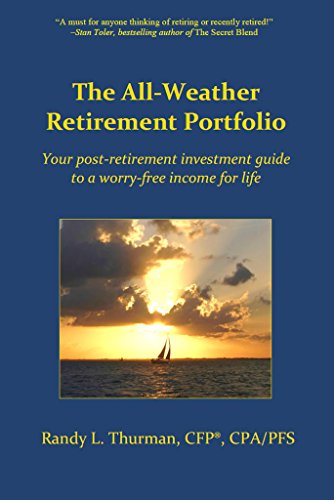
Money is a sensitive subject for many. However, it is also a necessity in the modern world as one can achieve a lot when their financial situation is secure. In his book The All-Weather Retirement Portfolio: Your Post-Retirement Investment Guide to a Worry-Free Income for Life, author Randy L. Thurman talks about making money and knowing how to save and invest you can have the retirement life you desire. The author gives practical examples and uses a language that the average reader can understand. This financial guide is for individuals that are just starting out planning their retirement, mid-career, and those planning to retire soon. Randy L. Thurman talks to different groups of working-class and entrepreneurs making profits off their investments and gives readers first-hand advice from those who are successful.
The book’s arrangement is systematic and shows a logical progression of the thought process and steps one should follow. The author starts from the root, expounding on the importance of having a healthy bank account and how to save even if it is only a little at the start. To help the reader comprehend his content better, Randy L. Thurman broke down various topics into 15 chapters. Each chapter focuses on one step, making it easier to put the plan into action in their own life.
For a subject as daunting as financial planning is, the author has made reading about the topic interesting and nonintimidating. One of the most valuable topics discussed is the importance of finding a financial advisor that you can trust. Readers will appreciate the author’s attention to detail, listing the qualities one should look for in an advisor. He also emphasizes that readers need to be cautious as not everyone claiming to be a financial advisor is well equipped to handle money. Providing questions to ask so you can find the right advisor for your situation will benefit readers.
The All-Weather Retirement Portfolio: Your Post-Retirement Investment Guide to a Worry-Free Income for Life discusses investing 101 and gives a detailed explanation of how best to invest. This information is beneficial to people in all stages of retirement planning.
Pages: 221 | ASIN : B00WF8XW78
Self-Fulfillment And Discovery

The Retirement Quilt follows a retiree and recent widow who seeks to make a quilt of his tie collection and meets interesting people along the way that teach him much about life. What was the inspiration for the setup of your story?
When I decided to retire from full-time work, my colleagues joked about what I would do with all my ties. I had worn ties all my life and to part with them was like destroying a part of my history. I had my first tie from Brooks Brothers in Boston, ties given to me by friends and lovers, ties from my overseas trips to Paris and Rome and ties from Australia.
I discussed this with a dear friend, Maisie, who said I could turn the ties into a quilt, find a new use for them and still retain the memories. I contacted several senior citizen centers and offered to underwrite the costs, including a small payment to the quilters. This proved far more problematic than I thought.
I wanted the quilt to be made by men since a man wore the ties and their history was a man’s history. It then occurred to me that I could write a story about the quilt’s creation by four men.
At the same time, my personal trainer posed a challenge. Complete the book by your birthday, the 28th of July. So in March, I started and did complete the first printed draft in July.
The characters in your story were all varied and interesting. What were some driving ideals behind your character’s development?
I wanted my main male characters to be strong individuals in various stages on the road to self-fulfillment and discovery. So I had identified each male character with an Australian actor – Geoffrey Rush as Geoffrey, Russell Crowe as Russell, Barry Otto as Barry and Bryan Brown as Bryan. The main female characters were also strong. Margaret, although dead, plays a role in the lives of all characters. I wanted my characters to experience all the normal emotions of middle-aged men and women and discover love.
What were some themes that were important for you to explore in this book?
The theme of resurrection dominates the interaction of the four men, and by the end of the book, each finds his path to fulfillment and happiness.
The role of Morton places an important role in the story, not only for its historical significance but for the support it provides all characters.
As Margaret and the Bigelow family demonstrates, the role of heritage and tradition colors the social setting. It is woven into the story as the quilt is being designed and executed.
Finally, the development of friendship and trust is woven into the fabric of the quilt.
What is the next book that you are working on, and when will it be available?
I am completing a book called “The Secrets of Ferncrest,” which traces four generations of a family, their role in Newport, Boston and New York society and the family’s Newport home.” Ferncrest. It is told through the diary entries of the principal characters as transcribed by the grandson and son of the main characters.
It reflects their life from 1900 to 1946 and touches on all the important social, intellectual and political events in the United States. For example, it reflects the reaction to the sinking of the Titanic, the passage of government acts that sought to redistribute wealth and increased the role of government in social welfare programs, the Women’s Suffrage and Settlement House movements, the financial panic of 1929, the Spanish Flu, and two world wars.
I expect to complete the book by the first quarter of 2022.
Author Links: Amazon | GoodReads
However, it is the spirit and love of Margaret, Geoffrey‘s deceased wife, which affects everyone and leads Geoffrey to love and happiness.
This is a beautiful story of love and loss that is destined to enchant and inspire.
The 86-Year-Old Orphan

Tessie always knew that getting old was part of life. What she didn’t expect was how quickly it happened. Or that she would be spending her golden years in Desert Twilights, the assisted living facility in Arizona, across the country from her home, her family, and everything she had ever known. As her 86th birthday approached, Tessie seemed to spend more and more time reflecting on the life that had led her here, even as those around her were often doing the same. She was comforted by memories of what was, as much as she was haunted by thoughts of what could have been.
The 86 Year Old Orphan by Caterine Bellizzi is a heartfelt, and sometimes heartbreaking, look at aging. It explores how hard this natural process can be to face, the different attitudes people take toward it, and the different paths that lead people to what is, eventually, the same place. When we’re introduced to Tessie, she has been at Desert Twilights for three years already, but faced with her upcoming birthday, falls into a bout of nostalgia that is stronger than usual. Via frequent flashbacks, Tessie’s life is shaped, from her tumultuous childhood as the daughter of immigrants, through her early hopes and ambitions, on to the expected role of housewife and mother. While Tessie expresses very little regret for her life’s decisions, she naturally wonders how things might have been different if her choices had taken other routes and different points. Her fellow residents at Desert Twilights are similarly introduced, both in their current situations and earlier years, and although they have all followed drastically different paths, they have all ended up spending the ends of their lives together.
The 86 Year Old Orphan touches on a variety of themes, ultimately focusing on acceptance, and the fact that life experience isn’t so much what happens to you, but your reaction to those events. Over the course of the story, Tessie has a renewed sense of self discovery, and comes to realize that the best way to live the last years of your life is to be as happy with the present as you were in the past, despite the gulf of differences that might exist between the two.
The 86 Year Old Orphan began a little slowly, and as a result I wasn’t sure if it would be very interesting, but it gained steam quickly and before long I was completely invested in Tessie’s life, wondering where it would go from here. I cried more than once as well! Bellizzi has written a beautiful story that will make reflect on your own life, past, present, and future.
Pages: 194 | ASIN: B0898K76SM

Freedom Justice are Both
![Freedom Justice Are Both by [Jones, Hendrick]](https://i0.wp.com/images-na.ssl-images-amazon.com/images/I/51X-Wh7xcvL.jpg?w=604&ssl=1)
Readers who are looking for an intimate view into the life of a man who has been through rough times will find that in Freedom Justice are Both by Hendrick Jones. This is a memoir of sorts: Jones is giving readers a glimpse into his life story. He outlines what he has struggled with and how it has shaped his life. This God-fearing man wanted nothing more than to provide for his family, yet what he has been given is a season pass to pain and suffering. This is not a book to be taken lightly, as this is the very soul of Jones, stripped down and laid bare for all to see.
It is undoubtable that Jones feels he has been wronged. He outlines his life very carefully for readers and shows how he feels he has been given the short end of the stick. He reiterates over and over that he doesn’t understand why these turns of events happened to him and he laments the loss of loved ones whose loyalty he heavily questions. Jones bitterly lays out his interpretation of the events that lead him along the path towards medical retirement from seventeen years of police service. It is clear that he is profoundly affected by what has happened; with good reason. This is the story of his life, after all.
Pages: 148 | ASIN: B07C9D1NJ5


