Blog Archives
Terrestrial Passions: A Regency Romance, with Aliens
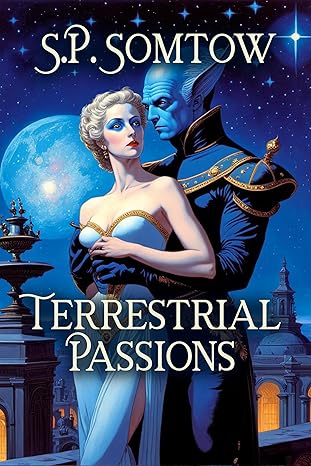

Terrestrial Passions, by S.P. Somtow, presents a unique fusion of Regency romance and science fiction, transporting readers to the quaint English village of Little Chiswick. In this unusual narrative, the life of Mrs. Emma Dorrit, a widow residing with her brother and twin daughters at the lower echelons of society, undergoes a startling transformation when an extraterrestrial visitor’s starship unexpectedly lands in her orchard.
The novel excels in its detailed characterizations, particularly in depicting the societal nuances and aspirations within 19th-century English society. The Dorrit family, along with the enigmatic alien, Monsieur Clatoux, navigate the intricacies of social conventions and class divisions. The story explores themes of ambition, intellectual exploration, and the intricacies of both terrestrial and interstellar relationships. The juxtaposition of Arabella’s intellectual pursuits against Anna’s more emotionally driven nature provides further depth to the narrative. The novel’s rich historical details and vivid portrayal of the era are a highlight, offering a textured backdrop to the story. Its melding of historical context with science-fiction elements showcases the author’s creative ambition, presenting a refreshing twist for those eager to explore beyond conventional boundaries.
The transition from the familiar setting of an English village to scenes involving extraterrestrial elements adds an element of surprise and innovation, appealing to readers who appreciate a blend of genres. The pacing of the novel, with its mix of reflective social scenes and dynamic sci-fi segments, provides a varied reading experience that keeps the narrative engaging and multifaceted.
Terrestrial Passions stands out for its imaginative approach, skillfully intertwining different genres to create an engaging and distinctive story. It’s a thought-provoking read for those who appreciate an inventive combination of historical fiction and science fiction, marked by well-crafted characters and an original plotline. The book is a testament to the author’s boldness in challenging genre conventions, making it a noteworthy addition to the realms of both historical and science fiction literature.
Pages: 281 | ASIN : B0CDQHNNJ9

War is Not a Game
Ultimatum follows a Marine Raider living in a post-apocalyptic world who has one mission: to reach Three Mile Island at any cost. What was the inspiration for the setup of your story?
I am a sci-fi and fantasy lover. The inspiration for this story was wanting to make my sci-fi classic. My favorite movies are Aliens ’86, Jurassic Park, and Terminator. I love cyberpunk also. I believe if you look through the book you can see the inspiration of all those stories in this novel.
One of the stand-out features in this novel is the character development. Were the characters’ backstory something you always had, or did it develop as you were writing?
As for character development, I am someone who likes teamwork. My first draft was so bad. My main character D was a genetic uber-competent superman. He was the only real character in a story where he travels through the broken world to find out how this happened. That story was a train wreck. My next draft needed more characters, and all of them needed to have traits that complemented D and filled in facts for the reader in a natural way, so I created Zach and gave him tech smarts, Hank with long military experience, Betty with psychological knowledge, and Cella with bioscience knowledge. From there I had to round out the characters and their motivations. I used myself, other family members, and the many people I’ve met in my life to flesh out the main characters.
What were some themes that were important for you to explore in this book?
The themes of this book are for people to care for resource management and to understand that war is not a game.
Is this the first book in the series? If so, when is the next book coming out, and what can your fans expect in the next story?
This is the first book of a planned trilogy. I plan to release the second novel, Ultimatum: Fallout County, later this year 2024.
Author Links: Goodreads | Amazon
The World Settlers

In The World Settlers by Callan J. Mulligan, readers are taken on a futuristic journey aboard the starship Astraeus, embarking on a 200-year quest to the Milky Way’s center. This science fiction narrative, divided into several parts, intricately explores the lives and challenges of its characters in an ambitious world settlement mission. Central figures like Jim Atley, a lottery winner adapting to ship life, and Lizabeth, who carries a potentially mission-altering secret, offer personal insights into the novel’s themes. These include the formation of new societies in space, the psychological impacts on settlers, and innovative technologies like the Tyson Particle enabling deep-space exploration. As the voyage encounters unexplained tremors, the tension among the settlers escalates, intertwining personal tales with broader societal and space travel challenges.
Mulligan masterfully crafts a narrative where intrigue, friendship, and despair are intertwined in a world brimming with imaginative settings and lore. The characters, from Cassian to Lisabeth and Carron, are rendered with remarkable realism, drawing the reader into their personal journeys of struggle and success. The author’s narrative prowess shines throughout the book as each character steps into the limelight, showcasing a commendable balance in character development. The intricate world-building complements the characters’ stories, making the reader increasingly engaged with the universe Mulligan has woven. The resolution of the characters’ complex challenges in an unexpected manner may leave readers with mixed feelings.
Callan J. Mulligan’s The World Settlers is a captivating science-fiction novel that takes readers on a thrilling journey through space. This imaginative space opera delves into the possibility of colonizing space and what that means for humanity’s future. The novel will keep fans of the genre engrossed from beginning to end.
Pages: 318 | ASIN : B0CTX3TCXZ
Flawed and Conflicted

Quantum Consequence takes readers into the multiverse where danger and challenges await the protagonists at every stage with a constant worry about the ramifications of their choices. What was the inspiration that created the fantastic journey these characters go on?
The plot for this book was inspired by the current political climate and the emergence of new demigods onto the national scene. The controversy about artificial intelligence—the whole question of whether it is good or bad—also inspired this work. The threat of AI is here, but at another level, the AI characters are mostly just silly.
There was a lot of time spent crafting the character traits in this novel. What was the most important factor for you to get right in your characters?
This is the fifth book in a series, so I’ve been with these characters a long time. Much of the way, they have carved their own path. Especially in a series, the characters must evolve. The can’t be the same people they were—or the same AI’s– as when we first met them. Their relationships with each other must evolve. They must be flawed and conflicted.
I found the balance between science and fiction in this story to be exceptional. How did you manage to keep it grounded while still providing the exciting and imaginative elements that science fiction stories are known for?
This is very much a character-driven series. While the science behind time travel and parallel universes is fairly well grounded, the details of the process take a back seat to the characters and their stories. We could plop these characters and their issues into the Old West or a noir depression setting, and the story—what the characters do and how they interact, and I think it would still work. Time travel only provides a setting in which the character perform.
What will the next book in that series be about, and when will it be published?
I’m sure there will be a sixth book because over the past three books, I’ve left several characters in different worlds dangling on a precipice of disaster and I really should resolve those stories. For the near future, though, I’m focusing on learning screen writing. I’d love to see these Tales of Physics, Lust and Greed find their way to a broader audience.
Author Links: GoodReads | Twitter | Facebook | Website
Keeping My Mind Busy

Starmen takes readers on a journey to 1875 where Apache witches are found to fly and an incredible hot air balloon introduces mayhem into one young anthropologist’s life. What was the inspiration for the setup of your story?
Writing this book came as therapy for spinal stenosis surgery on my neck in 2019 and 2022. It was during the COVID lockdown and started to prevent losing my mind to dementia. Another part of it was watching lecture series from the Great Courses to further engage my mind. I was suffering a lot of pain from the surgery and therapy. Watching, reading, and researching all kept my mind busy and helped suppress the pain by generating endorphins and growing white matter in my brain. Some of the great courses material, such as quantum mechanics, string theory, the Transcendentalist movement, Native American history and many others helped shape the narrative but I also did a lot of online research. I also had already heavily researched that era for my American Civil War espionage novels. So I had a deep base of knowledge to draw on. The addition of James George Frazer was a way to attack the narrative from a different angle.
I find your characters to be incredibly vibrant. Did any of your characters’ development occur organically throughout the story?
Well many are based on real people and their lives are well documented. The Pinkertons are very important to the history of that era. Allan Pinkerton’s memoirs have a lot of operational detail. They are part of history and every once in a while you draw an Ace. There is a picture of 18-year-old William Pinkerton II and his wife Mary in El Paso in 1875. That’s a factual anchor in many ways. They were there. The rest of what he did and said is entirely made up. I began my career in Theatre. When you study Method Acting and Improvisation, you learn to invent things on the fly. When you are post-surgical and can’t do much else, you have a lot of time to think about your story and how all the parts fit together. Some characters appear as if by magic to solve a plot problem, and others to provide context and background. Once they are there, you may find other uses for them elsewhere. It’s all organic and theatrical.
What scene in the book did you have the most fun writing?
All of them. But it’s not just the writing but the rewriting. My first drafts are usually horrible. They need a lot of work, and of course, since I’m dyslexic, I need an editor. Leigh is an important part of all this. When you self-publish it really does have to look professional.
Can fans expect to see more work from you soon? What are you currently working on?
Of course. This is my profession.
Starmen


Set in 1875, Starmen, by Francis Hamit takes readers to the El Paso branch of the Pinkerton Detective Agency, where a complex and unusual case unfolds. Anthropologist George Frazer seeks the agency’s assistance to connect with the local Apache community for a matter that has piqued his personal interest. Concurrently, the appearance of a mysterious hot air balloon over the town marks the beginning of a series of extraordinary events. The narrative weaves through the Pinkertons’ investigation of a missing Chicago heir and Frazer’s astonishing discovery about the Apache tribe, gradually intertwining concepts of string theory and quantum mechanics, suggesting a universe far more complex than its characters comprehend.
Starmen is a creative fusion of Western motifs, magical realism, and elements that might seem anachronistic for the late 19th century. Its ambitious nature is evident in its length and depth, making it more suited for readers looking for an immersive, rather than a quick, reading experience. Readers will note echoes of the HBO series Westworld and elements reminiscent of Back to the Future Part III within its pages. The story boasts a rich tapestry of characters, offering a multitude of plot threads that create a vibrant and complex narrative. This intricacy reflects the engaging journeys of the protagonists as they navigate their adventures.
Hamit thoughtfully provides resolutions to the many twists and turns, aiming to satisfy the curiosity and imagination of readers through diverse and creative storylines. Hamit’s narrative is a tapestry of gunslinging, romance, extraterrestrial life, witchcraft, and parallel universes. Such a rich mix of themes presents a formidable challenge in achieving a concise conclusion, but the author is more than successful.
Starmen is a richly layered novel that masterfully blends historical facts with fantasy, creating an immersive and captivating reading experience. Francis Hamit’s writing style is descriptive and engaging, and the novel’s plot is both intricate and intriguing. The character development is a standout feature, adding depth and complexity to the story. This novel is a commendable work for readers who enjoy a blend of history, mystery, and fantasy.
Pages: 620 | ISBN : 978-1595950765
Belonging and Diversity

Quantum Seed follows a neuroscientist with the ability to control brainwaves and see into the future who gets a shocking message from advanced beings that the end of humanity is imminent. What was the inspiration for the setup of your story?
I drew upon two things – my personal experiences in experimental neuroscience and a vivid dream I had about how our civilization has been steered off course.
Victoria struggles with fitting in, only to develop unique abilities that add to her challenge. What were some driving ideals behind your character’s development?
Initially, Victoria really wants to belong, to be understood, and to be accepted for who she is. Instead, she finds herself living a life of isolation because it’s safer and less painful than facing rejection by others. However, in order to survive, she must learn to lower her walls and trust others.
Also, her development shows that what sets us apart can also empower us. Of course, with her abilities, she faces the moral and ethical implications of how to use them.
What were some themes that were important for you to explore in this book?
Belonging and diversity – I see these as necessities for the survival of the individual and our civilization.
Living with artificial intelligence when it is less artificial was another big theme. The book is set in the future when AI is more organic matter like us. Thus, raising questions of rights and place in society.
Transforming ourselves is a prominent theme. Many people are disheartened by all the imbalances in the world, from inequality to a lack of value in human lives. I wondered if all of humanity depended on us transforming and evolving quickly, could we do it, and what would it look like?
The ethics of advanced interventions with the human brain is something the novel delves into, and it is a theme that won’t be confined to my novel.
Can you tell us a little about where the story goes in book two and when the novel will be available?
Book Two will be fast-paced as the team returns to save Earth in 187 days. They face unexpected challenges all along the way. There will be some big reveals.
Book Two will be available by the end of this year (2024).
Author Links: GoodReads | Facebook | Website | Amazon
This thought-provoking narrative explores the boundaries of human potential in the face of a looming global catastrophe. Through the eyes of Victoria Ottery, a neuroscientist with a unique ability to control brainwaves and glimpse into the future, the novel weaves the extraordinary with the familiar while tackling themes of belonging, human capabilities, and societal evolution.
Victoria finds it impossible to fit in, but this becomes the least of her worries when a brain-training session awakens her latent potential. Suddenly, she receives a shocking message from advanced beings. The countdown to humanity’s fate has begun—could the wisdom and technology of inhabitants in another world reshape our trajectory? What will they reveal about the true nature of Victoria’s abilities . . . and her destiny?
Corruption and Control Are Omnivores

Into the BeanStalk is the story of a woman determined to save her family from debt who finds herself working alongside an infamous hacker as they set out to uncover secrets of the city’s upper class. Where did the idea for this novel come from?
I have to call it “spontaneous synergy.” I was actually working on a heroic fantasy novel when the idea for Into the BeanStalk struck out of nowhere. And the seed was entirely a play on words — the idea of some hacker “jacking into” something called The BeanStalk.
From there, hundreds of latent ideas in my head started to attach themselves to the story. Even though I wasn’t planning to write science fiction, I enjoy studying emerging science. After spending hundreds of hours reading about everything from cybernetics to biohacking to theoretical physics, I’d banked away tons of narrative growth medium without even realizing it.
My own ideas about the future of government and the trajectory of society were, of course, already locked and loaded in the forefront of my mind. Interjecting these ideas was not only simple but cathartic.
What I’ve learned is that science fiction and futurism are a great way to play out scenarios and theories that have taken root in my head over decades. Along with the third Jack book, I’m also working on a novel that takes place in the Hope Megacity that is entirely focused on my research and beliefs regarding the Simulation Hypothesis, for example. This is a deep — and deeply misunderstood — subject that I’ve tried to write about unsuccessfully many times. But by wrapping it in an engaging fiction, I’ve learned how to express these unusual ideas in a compelling and accessible way.
What were some challenges you felt were important to defining your characters in this story?
I didn’t want to write “typical” cyberpunk. I won’t claim to be a genre expert by any means, but I’ve found that many modern cyberpunk stories are centered around fairly abrasive characters. They’re often aggressive, reactive, obscene, and generally no fun for me to read about.
While it’s true that cyberpunk is often summarized as “high tech, low life,” I think some writers take that too literally. I’m someone who has spent considerable time in the “low life” reaches of reality, and I’ve never had a hard time finding decent, intelligent people who have been marginalized.
In fact, I find that distinction to be key to highlighting the class struggle and societal issues that cyberpunk seeks to critique. Of course, drug-dealing gangers are marginalized — but what about the latent genius who was bored by the corporate advancement trajectory? Or the musician? Or the people who simply want to live by their own rules not because they’re degenerates, but because they’re unique and inspired?
If cyberpunk is to serve as a warning for where we’re headed, it’s important to show that corruption and control are omnivores. They don’t just feed on criminals and outcasts — they devour everyone.
The writing in your story is very artful and creative. Was it a conscious effort to create a story in this fashion, or is this style of writing reflective of your writing style in general?
First of all, thank you. I think at this point my writing style has solidified into something that just happens naturally. That said, I do have a little dial in my head that I’m able to turn up or down at will. I suppose you could call it a “purple prose” dial.
Depending on the story, I may write more or less descriptively. Shorter stories, thrillers, and action scenes have less room for metaphor and flowery prose, and I try to adjust accordingly.
The trick is that brevity can’t be an excuse for poor writing. When I get compliments about detail and description on something where I’ve tried to keep the prose spare, I know I’m doing something right.
What is the next book you are working on, and when will it be available?
I’m working on several, actually. The most likely to hit the shelves first is The Game State, which is the aforementioned novel set in Jack’s universe. This one is really important to me because I have some very strong opinions on the Simulation Hypothesis that have been brewing for years. I know that it’s the right time for these ideas to be released into the wild. That said, I’m doing a lot more rewriting and polishing on it than I did with Jack’s first two books, simply because it’s such a passion project. I’m hoping to have it published within the next three months.
I’m also working on Jack’s third book, the final in this trilogy arc. It’s about twenty-five percent written and ninety percent outlined. I will give one spoiler — this trilogy will not be the end of some of these characters’ journeys.
Lastly, I have a couple of side projects that came about when I started exploring LitRPG. One is a novel set inside a fantasy MMO game, and the other is an action episodic series set inside an online looter/shooter. Not gonna lie — I found it really fun writing about people trapped inside video games!
Author Links: GoodReads | Website | Amazon
Winner of the 2023 American Fiction Award in Sci-Fi / Cyberpunk!
A corrupt megacity. A broken world. A girl who can no longer afford to hide from her past.
Jack is a techie and long-time shut-in, driven to save her father from corporate servitude. That means getting her hands on scrip, and lots of it. Going into debt with the most violent bikers in Hope Megacity will get her the cybernetic limbs she needs to overcome her disabilities, but that’s only the beginning.
A vicious betrayal, a lethal cyberattack, and some broken neural hardware has Jack seeing things — namely a huge column of light climbing all the way to the Global Corporations’ city in the clouds. She’ll need to join up with the city’s most notorious hacker to find out what the elite are hiding from the millions of people living under their feet.
Action, suspense, and wit, presented in an accessible take on the genre. If you like complex worlds of near-future tech, dystopian struggle, and memorable characters, you’ll love Into the BeanStalk!



 LITERARY TITAN