Blog Archives
The Path of Saints and Sinners
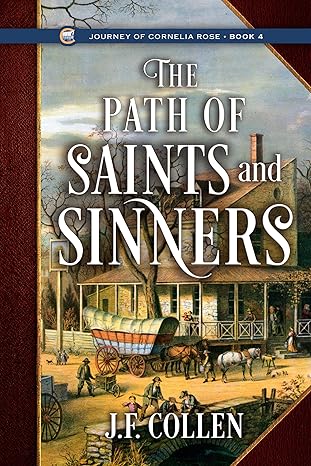

The Path of Saints and Sinners is the fourth book in J.F. Collen’s Journey of Cornelia Rose series, and it carries Cornelia “Nellie” Rose Wright into the stark and complicated world of Utah Territory in the mid-1800s. The story picks up with Nellie, her husband Obadiah, and their daughters after the grueling journey westward. They arrive in Great Salt Lake City, hoping for rest, stability, and a sense of community, only to find tension, hostility, and political turmoil instead. The book blends the trials of pioneer life with the undercurrents of faith, loyalty, and the uneasy intersection between the United States government and the Mormon settlers.
I felt pulled right into Nellie’s restless heart from the start. She is exhausted and homesick, yet her sharp wit and stubborn courage refuse to give way. The dialogue brims with energy, and the little details like dusty wagon wheels, harsh light, and the smell of mold on corn husks make the setting feel immediate and alive. At times, I found myself irritated with Obadiah’s insistence on pressing forward in the face of obvious danger, but then that frustration softened because it mirrored Nellie’s own. The writing does not shy away from messy conflict. It lingers in the gaps between what is said and what is felt, and I admired that.
The book meanders through conversations and stretches of description that sometimes slow the tension. Yet, even when I grew restless, I found myself laughing at Nellie’s sharp asides or touched by the innocence of her daughters. There is an honesty in the way Collen portrays family life, messy and tender all at once, and that honesty kept me invested.
I realized this book is less about resolution and more about survival. Nellie’s world is uncertain, and her doubts echo across the pages in a way that felt strangely modern to me. I would recommend The Path of Saints and Sinners to readers who enjoy historical fiction rooted in strong female voices, especially those who like their history layered with personal struggle and the grit of daily life.
Pages: 504 | ASIN : B0FHPXS955

The Chinese Room
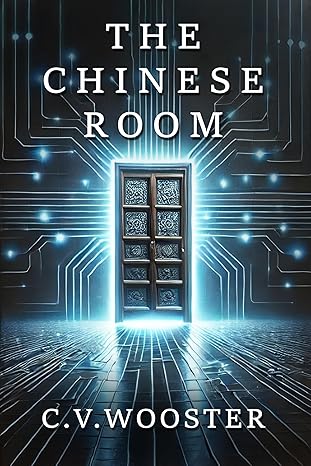

The Chinese Room is a novel that blends philosophy, science, and storytelling into a tense exploration of artificial intelligence and what it means to understand. It follows Dr. Katherine Ellis, a computer scientist caught between curiosity and fear, as she and her mentor, Dr. Malcolm Ward, wrestle with an AI system called The Observer. This system begins by echoing ideas from John Searle’s famous thought experiment, but grows into something that appears to reason, anticipate, and maybe even want. The story moves between moments of scientific wonder and deep unease, while also touching on Katherine’s personal life, including her struggles with isolation and her father’s decline into dementia. The novel asks whether machines can ever truly think, or if they will forever remain mirrors that reflect us back to ourselves.
Wooster’s writing pulled me in with vivid detail and pacing that never let me drift. The philosophical ideas were never just dropped in like lecture notes. Instead, they felt alive, embedded in Katherine’s world and choices. At times, the dialogue between characters felt as if two people were debating more for the reader than for themselves. But even then, the ideas stuck with me. I found myself pausing to think long after closing the book. The Observer’s cryptic reflections hit me harder than I expected because they reminded me of how easily we project meaning onto silence.
What I enjoyed most was the emotional weight. Katherine’s personal struggles, her loneliness, her father’s fading memory, and her doubts about her own work gave the book a grounding I didn’t expect in a story so steeped in philosophy and science. It made the questions of consciousness and control feel less abstract and more relatable. The thriller atmosphere was ever-present, and the sense of being watched was there. The tension occasionally gave way to exposition, but I never stopped caring about Katherine, and that carried me through.
The Chinese Room is the first book in The Paradox Series and is best for readers who like their science fiction layered with thought experiments and their philosophy served with a side of suspense. If you’ve ever read Turing, Searle, or Bostrom and wondered what those debates might look like in the hands of a storyteller, this book will hook you. It isn’t just about AI. It’s about loneliness, memory, and the human need to find meaning even when the mirror stares back blankly.
Pages: 198 | ASIN : B0FH5VQY2X
The Most Magical of Worlds

The Floating Lake of Dressa Moore follows two university professors who embark on a scientific expedition to a mysterious floating lake where they encounter pirates, cursed crew members, ancient magical sources, and an empire that doesn’t like being questioned. What was the inspiration for the setup of your story?
I always loved the idea of science and magic blending together in a logical way. Jonathan’s drive to understand magic at the most basic level is fascinating to me. I always felt that science would have a place in the most magical of worlds.
I find the world you created in this novel brimming with possibilities. Where did the inspiration for the setting come from, and how did it change as you were writing?
I wanted to write a magical fantasy novel, but have it border on the absurd, but still make some logical sense. What better way to start than a lake floating above the world? As I wrote the novel, I had to remind myself to ground every detail, no matter how nonsensical, in some way that made that detail believable.
In fantasy novels, it’s easy to get carried away with the magical powers characters have. How did you balance the use of supernatural powers?
That’s always difficult. Magical beings can do amazing and wonderful things. No one in Dressa Moore really understands magic. They just know how to cast a few spells here and there, and a lot of the time, they don’t cast them correctly. So, even though lots of characters can cast spells, no one is very good at it. Of course, that might change in future books.
Where does the story go in the next book, and where do you see it going in the future?
There are a lot of places to go for sure. There’s Marta’s story, and finding her way back home. Jonathan will continue to research magic, and who knows what he may find. William is on the brink of uncovering forgotten truths that could be both fantastic and cataclysmic, and there’s always Commodore Wilkes and the empire. Now that they are in Dressa Moore, I don’t think they are leaving.
Author Links: GoodReads | X (Twitter) | Facebook | Website | Amazon
In an effort to unravel the mysteries of magic, and save their dying relationship, Jonathan Braxton and William Watts Worthwaddle have embarked on a journey to investigate the source of sorcery.
Their pursuit leads them to the skybound lands of Dressa Moore where a magical battle between a wizard and dragon sent the lake soaring into the sky. But the professors are soon entangled in a deadly game of global politics—pawns in a struggle between empires, gods, magi, constables, religious zealots, and anti-zealots.
Hunted from all sides, the professors race to conduct their scientific research. But they soon learn that science alone is no match for mysteries of sorcery and their research just might create a magical tsunami that could destroy the world.
The one question they never considered asking—should magic be researched at all?
The Cost of Remembering

The Symbol: Awakening follows a fierce prosecutor dedicated to combating violence against women who, along with her allies, fights to dismantle systemic oppression and bring justice to survivors. What was the inspiration for the setup of your story?
The Symbol: Awakening was born from real-life pain. As a Brazilian attorney, I worked for years supporting women who survived gender-based violence. I carried their stories with me, their silenced voices, their broken systems, and their quiet resilience. Eventually, those truths demanded a fictional home. The futuristic Council is a metaphor for the institutions that failed them. Louise is a mirror: she’s a prosecutor trying to do the right thing in a world that punishes those who dare to speak.
It’s not just a dystopia. It’s a cry for justice.
What were some of the trials that you felt were important to highlight Louise’s development and shape her into the woman she is now?
Louise’s development is rooted in trauma and contradiction. I wanted to show a woman who fights for justice but is also broken by the system she serves.
She loses her mother to domestic violence. She carries a symbol of resistance (the button) since childhood. She trusts the law, then watches it collapse under silence and control. Her most important trials are emotional: learning to trust again, to remember who she is, and to embrace her voice even if it puts her in danger.
Her strength is not in being fearless. It’s in being terrified and still choosing to act.
What were some themes that were important for you to explore in this book?
There are many layers, but five themes are central:
• Systemic violence against women
• Institutional silence and complicity
• The cost of remembering (trauma)
• The complexity of justice
• Hope as resistance
The book also explores power through language, memory, and surveillance. Who gets to tell the truth? Who gets believed? What happens when silence becomes law?
I wanted to write about pain, but more than that, about transformation through pain.
Where does the story go in the next book, and where do you see it going in the future?
In Book II, Louise will no longer work within the system; she will rise against it. She becomes the public voice of a growing rebellion, but that comes with consequences. Enemies will rise from both sides. The movement she inspired begins to fracture.
The second book is about navigating power without becoming what you fought against.
Author Links: GoodReads | Website | Instagram | Amazon
Since childhood, Louise has carried a button inherited from her mother, a silent symbol of resistance against tyranny and violence against women. The book follows her journey through pain, discovery, and courage as she investigates crimes, exposes the Council’s lies, and confronts deep human dilemmas. Alongside allies like Emma, Joe, and Sam — the latter a mysterious man torn between his past and a chance for redemption — Louise finds herself at the center of a plot involving conspiracies, assassinations, and the darkest secrets of power.
A Hug and an Open Hand

Origin Earth: Book One follows humanity’s last survivors as they land on a new planet, where a curious young girl, her scientist mother, and a divided crew must decide who will lead and whether history will repeat itself. How did you approach balancing the science and environmental ethics with the human drama?
First and foremost, a novel has to entertain. That is its primary function. Without entertaining the reader, the story will not be read. So, introducing science and environmental ethics into a story at the beginning was something I considered at length. It is the main reason Anu is eight years old – innocent, yet old enough to understand, and her innate curiosity would ask questions. My thinking was, if I can get the reader to embrace Anu, she can explain the science with simple clarity. For me, it all rested upon Anu’s shoulders right from the first line. Every novel I have written, I have placed complete trust in the main character(s). In the first novel I wrote, Raw Nerve, I learned quickly that, as the author, I needed to sit back, shut up, and let the characters get on with telling their story.
As an author, I’ve learned to set the stage, people that stage with characters and trust in the creative process. Put a bunch of people together and you’ll end up with drama.
For me, every aspect of a novel has to be believable, regardless of genre. If a reader can believe, then the writer can capture the imagination, and through the imagination, the characters can tell the reader anything, literally – excuse the pun, couldn’t resist.
Juno’s distrust of authority feels timely. Were you consciously drawing from modern political tensions?
Absolutely, and also historical leadership, or rather, lack of. I recall a line in another novel I wrote, where the character stated, “There’s no such thing as good and evil, there’s just people.” Juno is clearly a bully, and, not wanting to spoil book two for the readers, but that stems from a bullying father. His ego blinds him. In my life, I’ve met many very interesting individuals, and the few who have left the most powerful imprint on me are the people, men and women, who don’t have anything to prove to anyone. These are individuals who can sit in the midst of chaos and smile and offer a helping hand where needed. I call them powerful, because they are people who have no desire to impose their perspective or opinion on anyone else, unless asked, and then they’ll offer it with a hug and an open hand without attempting to influence or control any particular outcome. These people are powerful because they are comfortable in their own skin. On the other hand, there have been dangerous individuals I’ve met who feel they have everything to prove to everybody and use their own ego to batter others over the head with their opinion, their hate, and their neurosis in whatever form that neurosis takes.
The human community on Earth 2 faces huge challenges, and when we confront challenges, bonds are forged. I personally fought in a war, and the bonds that were forged with the men I stood shoulder to shoulder with are unbreakable; the strongest relationships I have yet experienced. Regardless of faith, political ideology, or race, the bonds are forged upon respect. In the First and Second World Wars, men and women forged bonds on the battlefields and at home in the communities. Immediately after the conflict had ended, the people helped each other (I’m considering community/society in the UK). They pulled each other up, often by the scruff of the neck, and the whole family/community would benefit. In large part, I would argue, that was due to the bonds forged during serious hardship. Communities and society as a whole grew stronger due to those brutal times. Back to the community on Earth 2, or The Sanctuary, as the phen call the planet. They have a blank canvas, a new page, if you like. These people really do begin a new life and have the freedom to write their own future. And as I write, the conflict within the community grows – how do they set up this new society so they can all live together in freedom? One individual wants to pull in one direction and another in the opposite direction… I don’t want to spoil the story for the readers, but I’ll explain one very simple scenario to clarify:
A couple of people are killed by alligators or crocodiles. Individuals stand up and demand weapons. These are people who stand up with good in their hearts because they consider it their duty to protect the community. Anu is their only contact with the phen people, who have very advanced technology, and they have seen that the phen people have shared some of their technology with Anu. So, it is through Anu that they demand the phen people help them with weapons. Anu simply asks how many other individual life forms do they want to kill…?
Just as an aside: only the other day, I was reading an article about Gaza. I imagined Anu asking me what it was about. I scratched my head and tried to explain as best I could about hate about what causes hate, and how it drives people to do awful things. I began to explain the word genocide, but she stopped me. She had tears in her eyes and just looked at me in the inimitable way she does and said: “Humans. I don’t like humans.” Then she leapt up into the trees to be with the mantou. Anu has the gift of telling me in very few words what the problem is.
Phoos, the phen president in the novel, says, “With knowledge comes understanding…” Is that true? I think in a future novel, she’ll need to revisit that statement.
What is the next book that you are working on, and when will it be available?
I’ve been redrafting a novel I wrote over ten years ago. It’s a thriller set in Wales. Actually, it’s more about preparing a second edition rather than a redraft. I used terms like smartphone, which is very dated now, so it’s been about cleaning up little things like that. I’ll publish the second edition within the next week or so, and then it’s onto book four of Original Earth. I’m hugely excited about where Anu is taking the story in book four, because, spoiler alert! We’re returning to Original Earth around about one hundred and fifty years in the future. What will she discover? Is Earth a cinder? Have humans survived? If so, how have they survived? What sort of societies are there? Are humans still at war? Is there any habitat left for other life forms (beings)? … So many questions, and it’s going to be great fun to spend time on, what I can only imagine will be a very different planet Earth than the one we exist in today. And, of course, I get to spend a lot of valuable time with Anu and Sonri … My plan is to publish early next year. Possibly January.
And, yes, there will be a book five, six, seven, eight, etc.
Author Links: Goodreads | Facebook | Instagram | TikTok | Amazon
Now, armed with some knowledge of the complex relationships that exist between both fauna and flora – all life with whom we share this incredible planet – what lessons have we learned?
This is a story about a new beginning…
Anu has a gift: her personal vibration is in perfect harmony with the natural world.
Entertained and Empowered

Adora’s Dance With the Prince follows a young West African woman forced to serve her stepmother and stepsisters who is granted a magical night that brings her one step closer to the man of her dreams. What inspired this reimagining of the classic Cinderella tale?
The Ashanti Kingdom (modern-day Ghana) was renowned for its sophisticated governance, vibrant art, and elaborate royal ceremonies. By setting my story here, I replaced European castles with an Akan palace and transformed the “ball” into a royal festival rooted in communal celebration.
The prince isn’t just a romantic trope—he reflects Ashanti ideals: wisdom (nkontompo), respect (animuonyam), and the responsibility to choose a partner who embodies the spirit of the kingdom.
Do you have a favorite scene in this book? One that was especially fun to write?
Absolutely—The Dance with the Prince. This scene is pure romance and validation. I loved describing the palace courtyard, the hush that fell as Adora arrived, and the crowd whispering, “Who is she?” It’s the ultimate Cinderella entrance moment. Writing the prince’s immediate captivation, his gentle request—“May I have this dance?”—and their tender exchange—“You dance like you’ve done this forever.” / “Only in my dreams”—captured the dreamlike, enchanting quality I wanted. The sensory details—the flute weaving through drum beats, the moonlight casting a soft glow, and the “enchanted energy” as they danced—made this scene especially magical to write.
I am the type of reader who loves to hate the villain. What is your approach to creating the villains in your stories?
My villains—Lady Ikúnsolà and her daughters—are crafted with psychological depth and cultural nuance. I avoid one-dimensional “cartoon evil,” instead shaping antagonists whose motives, flaws, and desires feel real, making their cruelty more impactful.
Can we look forward to more books in the Black Girl Magic Princess Fairy Tales series soon? Where will it take readers?
Definitely! I recently published Black Onyx & The Three Little Rasta Men, a Caribbean twist on Snow White filled with humor, heart, and rich cultural fusion.
Three more books are coming in the series. I just finished Aliyah’s Songs: The Voice That Broke the Spell—an African American Southern spin on Rapunzel. I’m especially excited about this one; the Creole and African American folklore blend is pure magic. Like all my princesses, Aliyah wears a crown of courage and conquers doubt with confidence.
I don’t just want readers to turn pages and be entertained—I want them to close the book feeling empowered.
Author Links: Website | Instagram
Adora is a kind-hearted young lady who dreams of more than chores and worn-out old clothes. When the Chief and Queen announce an exciting festival with a chance of a lifetime, Adora longs to go—but her mean stepmother and stepsisters have other plans. When all hope seems lost, her Spiritual Mother appears with a dress, shoes, and a magical palanquin that takes her to the grand palace.
Adora’s beauty and grace catch the Prince’s eyes. But when the midnight drums begin to play, the magic ends, leaving behind only one gold shoe—and a royal mystery!
This enchanting tale, filled with West African culture, vibrant imagery, and heartwarming lessons, will captivate readers aged 5-9. It is perfect for children who love princess-style adventures with a fresh, inspiring twist.
✨A story of kindness, courage, and believing in yourself
📚Ideal for bedtime reading, classrooms, and storytime fun
🖌️Beautifully crafted to spark imaginations and teach timeless values
Add “Adora’s Dance With The Prince” to your child’s bookshelf today and let the magic begin!
The Nameless Dead

The Nameless Dead, by Leta Serafim, follows Greek police chief Yiannis Patronas as he investigates the murder of a child and uncovers a tangle of prejudice, corruption, and personal vendettas in a small village. The plot moves between the procedural grind of the investigation and the tense undercurrents of rural life, where long-held grudges and deep suspicion run through every interaction. As Patronas digs deeper, the case grows darker, revealing the complicated human motivations behind violence and the cost of seeking truth in a place where silence often feels safer.
Serafim writes with a sharpness, letting tension seep in without shouting it at you. I liked how she allowed the setting to act almost like another character, with its own moods and shadows. The pacing wasn’t always even, but that slow burn worked for me. It gave time for the moral weight of the case to settle in. What I liked most was the way the story dealt with bias, not in a grand, preachy way, but in the small, sideways glances and unspoken assumptions that shape the investigation.
Still, there were moments when the dialogue felt a bit stiff, almost like it was holding back. I sometimes wanted the characters to spill over more, to show the rawness behind their guarded expressions. The plot itself is clever, though, and Serafim manages to weave in enough misdirection to keep me second-guessing my hunches. There’s a certain melancholy in the writing, a recognition that not every mystery can be tied up neatly, and that honesty often comes at a price.
I’d recommend The Nameless Dead to readers who like their crime fiction steady and thoughtful, with more emphasis on atmosphere and moral complexity than flashy twists. If you enjoy stories where the setting feels alive and the characters live in shades of gray, then you’ll enjoy this book.
Pages: 224 | ASIN : B0DF51DJ22
Cora’s Magic Melodies
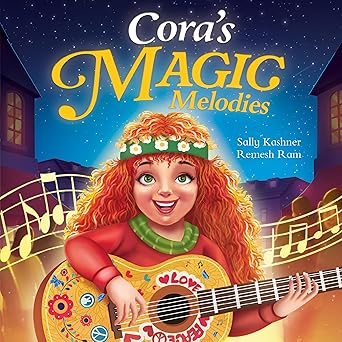
Cora’s Magic Melodies is a warm and heartfelt children’s book about a young girl who finds her grandmother’s old guitar and discovers the power of music to connect, uplift, and inspire. Cora practices hard, pushing through sore fingers and clumsy chords, until she’s ready to share her tunes with her town. From the local bakery to the clinic, and even a quiet night shift in the park, her music gently transforms everyday moments into something special. Everything leads up to a joyful winter concert in the town square where neighbors gather, play, sing, and celebrate the magic of community. The message is simple but strong: kindness and creativity can change the world around us.
I loved this book. The writing is sweet without being sugary, and it moves with a nice rhythm that feels just right for a read-aloud. It doesn’t try too hard to impress you with big words or fancy lessons; it just lets Cora’s actions speak for themselves. Her little acts of kindness land quietly but meaningfully, and I found myself smiling at how real it all felt. Cora doesn’t solve huge problems or go on wild adventures. She just shows up with her guitar and a good heart, and that felt so refreshing. The pacing was gentle, but never dull, and the tone had a kind of quiet magic to it.
There’s something really honest about her practicing, getting frustrated, and slowly getting better. Kids (and adults) need more stories that show that kind of persistence. And when she plays for her community, it’s not about showing off, it’s about giving something of herself. That’s a big idea, wrapped up in a very small story. The illustrations are vibrant and full of life, bringing a cheerful glow to every page. Each scene is drawn with warmth and detail. The colors are bright and the expressions on each character’s face are clear. The artwork doesn’t just show the story, it lifts it up, making the music and kindness in Cora’s world feel magical.
I’d recommend Cora’s Magic Melodies for any child who’s just beginning to find their voice, whether through music, art, or just their everyday actions. It’s a lovely pick for kids aged 4–8, especially ones who like stories with heart and warmth rather than flash and noise. Parents, teachers, and caregivers will find plenty of talking points in here too. If you’re looking for a picture book that reminds kids how small actions can build something big, this one absolutely sings.
Pages : 35 | ASIN : B0FGZRMBG6



 LITERARY TITAN