Blog Archives
Femme Led
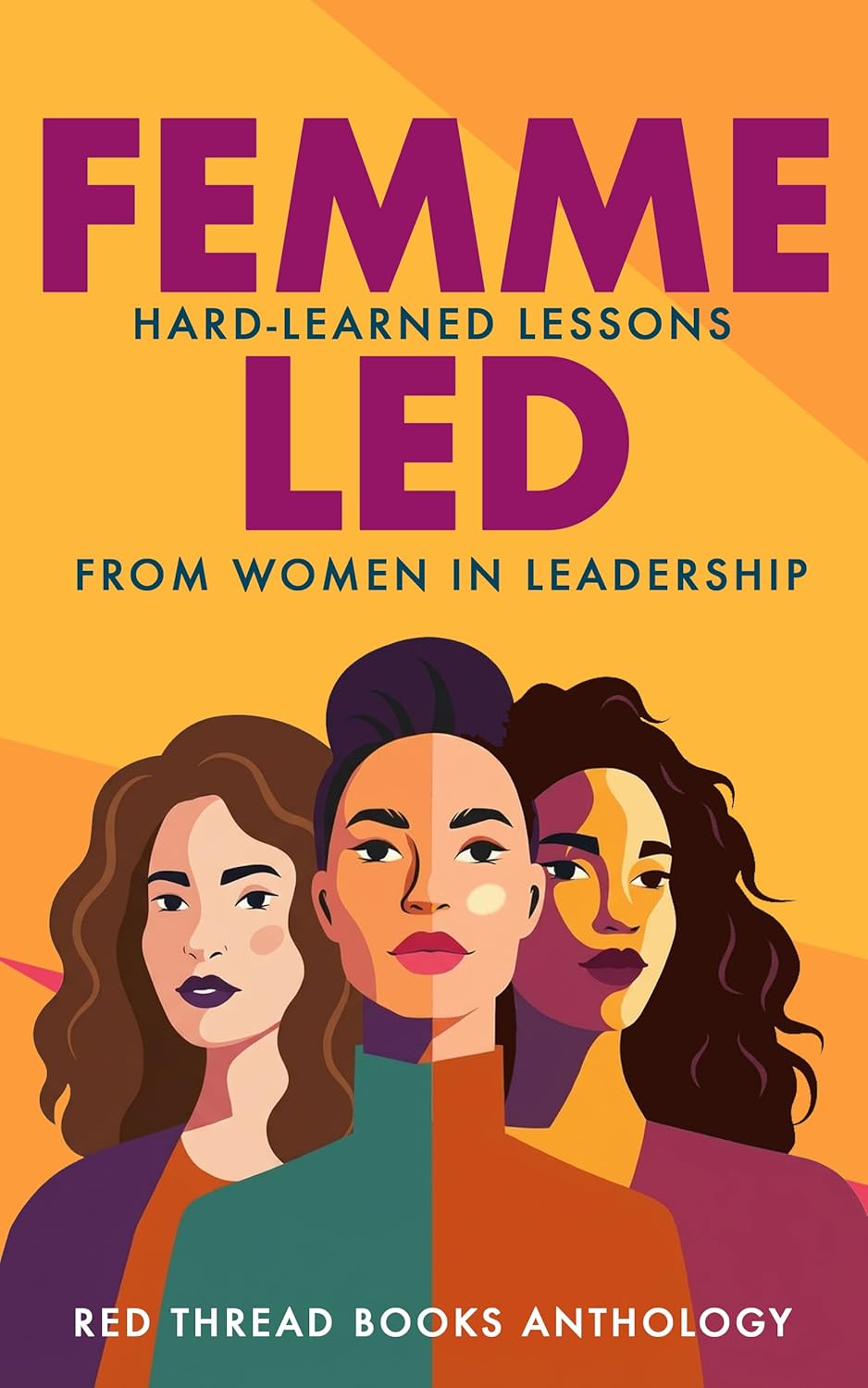

Femme Led: Hard-Learned Lessons from Women in Leadership is an anthology of women’s leadership stories that asks what becomes possible when leadership is no longer treated as control, performance, or self-erasure, but as truth lived in public. Across its chapters, the book moves from Sierra Melcher and Stephanie Mikulasek’s framing of the “leadership leap” to stories of reinvention, illness, entrepreneurship, grief, courage, and generosity. Catalina Escobar Bravo’s memories of growing up in Medellín, sleeping with taped windows during years of violence, eventually deepen into her purpose-driven work with Makaia. Carol Britton’s account of stepping into a high-pressure procurement role at the Bank of New York turns fear into a managerial instrument rather than an obstacle. Anna Dravland’s stroke and her transformation from a woman who did everything into a leader who built like a starfish instead of a spider web may be the book’s most tender image of all. Together, these essays argue that leadership isn’t a costume women must wear correctly. It’s a reckoning with one’s own voice, limits, power, and capacity to keep becoming.
What moved me most was the book’s assertion that the body often knows before the résumé does. I felt that idea gathering force each time a woman chose alignment over appearances: Tracy Macdonald turning in her badge and weapon after realizing the Secret Service no longer fit the life or values she could carry, Catalina stepping aside from the CEO role at Makaia to protect the mission rather than her title, Stephanie admitting that certainty itself had become a cage. These aren’t tidy triumphs. They ache. The book does a great job of showing how the emotional truth of leadership is often found in unmarketable moments: fatigue that rest doesn’t fix, ambition that has gone hollow, success that starts to feel like betrayal. I admired the way the authors return again and again to intuition without making it flimsy. Here, intuition is data of another kind, less quantifiable, perhaps, but no less exacting.
Some chapters read like polished keynote addresses, clear, instructive, almost ceremonious. Others arrive closer to confession, with rougher edges and a more immediate heat. Anna’s chapter, shaped around the aftermath of brain injury, resists a conventional arc, and I found that choice not only compassionate but artistically right. It lets form carry meaning. I was also struck by the range of metaphors the book earns rather than merely decorates with: the “leadership leap,” the internal flame, the spider web in a storm, the starfish that can keep functioning while it heals. The ideas circle familiar territory around purpose, resilience, and authenticity, but the best pieces refresh those words by grounding them in the particulars that people actually lived through, like Janice Marquardt leasing an office so her work would stop being absorbed by the quiet gravity of household labor, or Alexandra Yung reframing business as giving rather than transaction.
Femme Led respects uncertainty as part of the work. Leadership becomes most humane when women stop asking permission to be whole. I’d recommend this book to women in transition, founders, executives, coaches, nonprofit leaders, creatives, and anyone who has achieved the thing they thought they wanted only to feel some private truth pressing against the edges of it. This book’s gift is reminding us that crossing over can be frightening, scary, and necessary all at once.
Pages: 200 | ASIN : B0GQJPDW8Q

Discover A Glimpse Of Truth

More Other Such Matters is a collection of spiritually searching poems that circle around identity, love, mortality, truth, and the persistence of the thinking mind that asks what remains when the thinking mind finally grows quiet. Do you see thinking as a barrier to truth, or a doorway that must be passed through?
I see it neither as a barrier, nor as a doorway. The mistake we make is that we get attached to our thoughts and mistake them for truth and then identify ourselves via those thoughts. Truth reveals itself when thoughts are left behind. In that sense we can use thoughts until they exhaust themselves and in the exhaustion, in that dead end, we might discover a glimpse of truth.
Many poems read like questions rather than declarations. Why is inquiry more important than certainty for you?
The origin of my poems lies in the questions that have posed themselves around everything, ever since I was young. When I started writing those questions I usually found that the things I thought I knew revealed themselves to be mere outer layers of deeper truths, which in turn, at some later point, would probably get turned on their head by more questions.
Declarations, while giving the impression of safety, a ground to stand on, are mostly self-defeating, rigid and therefore not really compatible with life. Life itself is constant change, a constant adventure of discovery. Once you draw the circumference of certainty around things, around your mind, it turns rigid and eventually gets suffocated inside dead concepts. If you dig deeply enough and with inner honesty, you will find that certainty does not really exist.
Are the more intimate poems, like those centered on love and loss, harder to write than the philosophical ones?
Not at all. I don’t set out to write poems of a certain category. All my poems start out with a kind of urgency of something wanting to be explored or said, or maybe even screamed out. I just follow their lead and sit down to write them down. They usually emerge fully formed, even though I often don’t have the slightest clue where they are taking me. Sometimes a poem about loss, for example, turns philosophical in the process of diving into the loss itself rather than avoiding it, by merely describing it from the outside.
You asked about a doorway before. The doorway is the very process of not avoiding anything that wants to show up, of digging into the deepest places I can reach, whether jubilant or terrifying.
I wonder whether purely philosophical poems that do not spring from love, loss, longing, happiness, loneliness, grief or fear can even spring from a pen. That would be more like a disembodied, scientific dissertation … or something like that.
What do you hope a reader feels—not just thinks—after spending time with this book?
I would hope for them to experience some of what I experienced when I wrote them. Would love for the readers to go inside themselves and allow themselves to ask their own questions or maybe recognize some of the landing spots I discovered in the process of writing. I would love for them to feel inspired to go on their own journey of exploration of what lies under the surface of their own being and burst out in wonder when they discover the sweetness that lives inside them.
Author Links: Website | GoodReads | Facebook
Discover More Other Such Matters by multiple award-winning artist Fella Cederbaum—the fourth installment in her poetic legacy.
This thought-provoking collection invites you to journey inward. Her verses reach beyond the ordinary, capturing the essence of what it means to live authentically, love deeply, and rediscover the divine spark within. Within the pages of this powerful collection of deeply probing poetry, Fella explores themes of love, truth, feelings, societal challenges, and the art of staying present in the unfolding of human experience.
Through poems like “Before You Were You,” “Show Me Who You Are,” and “The Orchid and the Daisy,” she distills profound wisdom into elegant simplicity—offering readers moments of pause, reflection, and transformation.
Often described as a true Renaissance woman, she brings her relentless questions to inspire self-examination and introspection. More Other Such Matters is an intimate companion for the soul—perfect for reflection, meditation, or quiet contemplation. This latest collection continues to remind us to be grateful, to breathe, be still, and return home to our most authentic selves.
The versatile Fella Cederbaum has achieved success in many creative endeavors—as a poet, author, painter, independent filmmaker with nearly two dozen short films, and skilled composer and arranger. Her earlier writings, two volumes titled Of Life and Other Such Matters, Speech Acrobats, and her two poetry with music albums, Truth and Destiny and Speech Acrobats, have solidified her reputation as a versatile and accomplished artist. She has been exceptionally well-reviewed and described as “an artist who is brave enough to be an original.”
Cederbaum’s has received over 120 awards ranging from Best Short, to Best Soundtrack and Best Script. She has garnered not one, but two coveted IndieFest Humanitarian Awards.
Transform Procurement


Transform Procurement: The Value of E-Auctions is a practical, clear-eyed guide to building an e-auction program that actually works, not just as software adoption but as a cultural and strategic shift inside procurement. Author Janice Marquardt walks through the mechanics of e-auctions, the internal politics that can quietly sabotage them, the supplier psychology involved, and the importance of disciplined scopes of work, executive support, training, metrics, and thoughtful parameters. What could have been a dry technical manual becomes a lived account of trial, resistance, and eventual fluency, beginning with her own failed first auction and expanding into lessons drawn from thousands of events across materials, services, and supposedly “non-auctionable” categories.
I was most drawn to the book’s insistence that e-auctions aren’t cold by nature, but can become cold when people use them lazily. Marquardt is persuasive when she reframes the old “sharpen your pencil” phone call as its own kind of theater, warm on the surface but often vague, biased, and inefficient underneath. That comparison stayed with me because it gives the book its moral center: fairness is not always the same thing as friendliness. I also appreciated how often she returns to the human messiness behind procurement. The CEO’s friend calling to escape an auction, the procurement team mapping the process as a “black hole,” the oddly delightful leadership-conference auction built around guessing a Whitesnake song, all of these moments make the subject feel less like process engineering and more like organizational psychology with spreadsheets nearby.
The writing is at its best when Marquardt trusts her experience and lets anecdotes carry the argument. Her tone is practical, unpretentious, and refreshingly free of mystique; she writes like someone who has been burned, learned the hard way, and now wants to spare the reader a few scars. The book’s structure is more like a manual, especially in the parameter-heavy sections on bid ceilings, reserve prices, overtime rules, supplier training, and metrics. I didn’t find that a flaw so much as a signal of the book’s purpose. It wants to be used. The ideas are strongest when they complicate the usual procurement reflexes: that price is never just price, that scope quality may be the hidden prize of an auction program, and that suppliers can benefit from transparency when the process is built with care rather than intimidation.
I came away from Transform Procurement with respect for both the discipline and the humility behind Marquardt’s approach. The book doesn’t romanticize e-auctions, but it does rescue them from their worst reputation, showing how they can reduce cycle time, clarify expectations, widen competition, and make procurement less dependent on charisma, incumbency, and back-channel comfort. It’s a smart, grounded read for procurement leaders, sourcing professionals, executives considering an e-auction program, and anyone who suspects their organization’s negotiation habits are more emotional and inherited than anyone wants to admit. I’d recommend it especially to teams that want practical guidance, but also need the courage to change how people think before they change what people do.
Pages: 146 | ASIN : B0F79T6F25

Of Teeth & Claws

Of Teeth & Claws is a queer Southern horror novel about Alex Burkhart, who returns to Jasper Mill, Tennessee, after being outed and estranged, only to find his hometown stalked by a brutal creature tied to old secrets, witchcraft, and the boy he once loved: David Stone, now a young officer caught in the monster’s path. Around Alex gathers one of the book’s best inventions: Belle, Justine, and Grace, a grandmotherly trio with wine, weed, bite, and real occult weight. The result is part werewolf story, part small-town mystery, part second-chance romance, with blood on the porch boards and tenderness in the underbrush.
The book can be grisly, campy, foul-mouthed, romantic, and sincerely wounded within a few pages, and that volatility gives it a live-wire charm. The opening murder is nasty and theatrical, but the book’s deeper hook is not gore; it is the way shame travels through families, towns, courtrooms, pulp true-crime books, and queer childhoods. Alex’s voice has a sharp, self-protective humor that keeps the story from sinking into misery, even when the pain underneath is unmistakable.
I liked the chosen-family warmth. Belle, Justine, and Grace could easily have become comic-relief eccentrics, but they feel loved into being: funny, meddlesome, occult, occasionally ridiculous, and fiercely protective. The romance between Alex and David also gives the monster plot a pulse beyond survival. The book is not always subtle, but that bluntness fits its appetite. It’s a novel of big feelings, old wounds, and supernatural retribution, and I respected its refusal to be decorous.
This is perfect for readers looking for LGBTQ+ horror, queer romance, paranormal fiction, Southern gothic, and small-town supernatural mystery. Fans of Grady Hendrix’s blend of horror, humor, and regional texture may find familiar pleasures here, though A.J. Grea leans more openly into queer longing and occult melodrama. Of Teeth & Claws is bloody, funny, wounded, and oddly sweet.
Pages: 304 | ASIN : B0GJ8L2B1T
The Phoenix CODEX: 138 Palindromic Mirror Edition Complete Phoenix Chronicles: Complete Phoenix Chronicles: A Trilogy of Trilogies


The Phoenix Codex: 138 Palindromic Mirror Edition is a speculative science-fiction thriller with strong elements of conspiracy fiction, metaphysical fantasy, horror, and mythic adventure. At its center is Dr. Natori Saira Evren, a synesthetic researcher drawn into a hidden pattern of Phoenix cycles, ancient Egyptian consciousness technology, alien hunters, simulation theory, and recurring resets every 138 years. The book presents itself not just as a story, but as a codex, a puzzle box, and a ritual object, with its mirrored structure, sacred numbers, and recurring symbols shaping the reading experience as much as the plot itself.
The book is committed to its own mythology. It doesn’t ease the reader in gently. It opens with pain, blood, classified files, impossible geometry, and a heroine who is already half legend before we really know her. That choice gives the novel a charged, feverish energy. Sometimes it works beautifully. The world feels huge, dangerous, and strangely magnetic, like every room has a hidden door and every number is whispering. The book wants to explain its patterns, prove them, dramatize them, and make the reader feel implicated in them all at once. That’s ambitious, but it can also be overwhelming at times.
The writing is at its best when it trusts atmosphere and image. Copper, burnt cinnamon, cold concrete, humming frequencies, jungle silence, blood on leaves: those details make the strange ideas feel physical. I could feel the book trying to turn paranoia into texture. The author’s biggest choice, though, is structural. The palindromic design, the 138-year cycle, the ascending and descending arcs, and the central mirror are not decorative. They’re the book’s engine. Even when I questioned some of the repeated exposition, I could see the purpose behind it. This is genre fiction that wants the form to become part of the spell. It’s a story about recursion.
I would recommend The Phoenix Codex most to readers who enjoy big, strange, high-concept speculative fiction, especially people drawn to ancient mysteries, secret histories, simulation ideas, cosmic horror, and books that blur the line between novel, artifact, and prophecy. Readers who like genre fiction that swings hard, builds its own symbolic language, and treats conspiracy, myth, and science fiction as parts of the same burning machine, this book has a fierce pull.
Pages: 501 | ASIN : B0GBVLRVXP
I Finally Had to Write

Crown Prince follows a man whose extraordinary gift of Sight is a double-edged sword, allowing him to glimpse danger but never freeing him from his own pain. What was the inspiration for the setup of your story?
The New Blood Saga began with a recurring dream so emotionally intense that I would wake up in tears. I finally had to write it. The dream gave me the emotional core but not the characters, so I drew on my background in philosophy — especially my fascination with Socrates — to create Natharr, a man seized by the Daemon of Sight much as Socrates was seized by the Daemon of Philosophy. I already loved drawing maps, and one of them provided the world the story needed. I set out to write a single novel, but the emotional weight and complexity quickly outgrew that plan. I expanded to a trilogy, reading each night’s pages to my wife, whose psychology background helped me refine pacing and character realism (particularly with the female characters). As the world deepened with its history, mythology, and pantheons, I realized even three books weren’t enough, so I allowed myself six. However, while writing book six, my wife asked why it felt like I was rushing. When I told her it was because the story “had” to end in six books, she simply said, “What if I give you permission for more?” And that opened the door to the full eight-book saga.
Natharr avoids feeling like a traditional heroic archetype. How did you approach writing a character who is both capable and deeply constrained?
First of all, thank you. I try to do that with everything I write to at least some degree. When I’m writing anything, whether it’s a novel, a poem, a news story, or just developing a character, I come up with the kernel of the idea, then I think about all the others I’ve read that are similar. Truth of the matter is that all of fantasy if Homer repackaged. So I look for the common thread from all that I’ve read. Then I ask myself, “How can I do the opposite?” What I end up with is rarely the opposite, but it’s usually different enough that it takes readers by surprise. If I manage that, then I’ve achieved my goal: take something that has been done before (to some degree) and throw it on its head. As far as being both capable and constrained, that’s the easy part. Here’s why. Although I pretty much stopped growing when I was 12 (I’ve grown maybe two inches since then), I was a giant growing up. As a result, playing with my friends, doing nothing different than they were doing, I would accidentally hurt them. I didn’t mean to, I always felt horrible, then their parents would make it a thousand times worse. If I wasn’t already crying because I hurt my best friend, then I would be when his mom reamed me for what I’d done. From a very young age, I was fighting internally to control impulses, not rough-housing with my friends because I was so much bigger than them, even when they were having the time of their life. When I started wrestling when I was 6, my workout partners were 9 or 10 because they were my size. They had been wrestling a lot longer and beat me to death every day. I hated wrestling. When the next season came around, my dad (who was also one of my coaches), told me that he knew it was hard my first year, but he thought I had learned a lot. So, if I wrestled one more year and still hated it, I could quit. He was right. That year, I was an All-American in both freestyle and Greco-Roman and, at the peak of my career years later, was world-ranked and qualified to represent the United States in Greco-Roman. So, where normal life left me walking around in a straitjacket, wrestling gave me an outlet where I could let go. There are aspects of Natharr that have similarities, and were easy to write, because I didn’t even have to think to know how it felt.
The Elder and the warped space near the end introduce a new layer of mystery. What role does that kind of surreal element play in the larger series?
Huge. It’s called the All-White Realm or the Faceless Realm. It changes everything in more ways than I could possibly list. Nor would you want me to, because every one of them would be a spoiler. Ellis the Elder is just as significant, aside from being many readers’ favorite character. He is fun, enigmatic, deep, tragic, essential, and also changes everything, much like the other.
Can you give us a glimpse inside the next book in the New Blood Saga? Where will it take readers?
The cast of characters grows significantly. Some are loveable, some are not. Some are respectable, some are not. Some seem like a real problem from the first moment but are not. Some readers will hate, some readers will love. Some will be hated, but their persona will be understandable, perhaps even worthy of sympathy. Very little in the New Blood Saga is black and white.
TAGLINE:
The future of Mankind relies on the Guardian of Maarihk. Can a mysterious Order help him repair the damage of choosing happiness over duty?
BACK COVER COPY:
Despite the Guardian of Maarihk being condemned as anathema, and his very existence relegated to legend, Natharr resumes his ancient responsibilities as Mankind’s protector. He joins with a mysterious Firstborn companion, Ellis the Elder, to journey into the snowy reaches of Biraald, where his Sight promises he will find those who secretly adhere to the ways of the Olde Gods.
Although Biraaldi bloodlines show their Firstborn heritage more clearly than even in Maarihk itself, the two nations have never enjoyed peace. It has been far worse since the rise of Brandt the Usurper to Maarihk’s throne. Natharr and Ellis must navigate the threats not only against the Firstborn, but the Maarihkish, as they seek out the sympathizers he Saw who are brave enough to resist Maarihk’s tyranny. Only then can the damage be repaired from when Natharr chose personal happiness with Darshelle and the young crown prince over his weighty responsibilities as Guardian of Maarihk.
SAMPLE
Natharr leapt up and forward, arching his back, and the blade of a short sword sliced the air only a whisper away from his shoulder blade. He whirled immediately, slashing at the men at his back, but had to turn the attack into a defending stroke, and chopped down into one attacker’s blade, then reversed the motion to feint at the body before striking at the sword in a disarming attack. Their blades threw sparks and the soldier’s eyes bulged, big and brown, as his short sword twisted in his grip and flew to the ground, vanishing in the snow. Normally, Natharr would have pressed the advantage, at least bloodying the unarmed man to make him less of a threat when he retrieved his weapon, but the others were already surging forward to give their companion the necessary cover to rearm himself. Once again, Natharr was impressed with the training of these garrison line troops.
Natharr whirled away and leapt over the top of the snow, throwing a new cloud of white, and he saw Martice and Ellis. They stood, rooted in the knee-deep snow as if they were frozen. The old man’s face was hidden in the shadows of his hood, but the expression on Martice’s face was clear enough. Her eyes bulged and her mouth was open, a look of horror that took a strong woman and transformed her into any maid caught in a difficult situation. He was having a hard enough time fighting so many men in the deep snow, he did not need the distraction of the two of them acting like idiots waiting to be told what to do.
“The trap door!” he yelled, leaping over the top of the snow. “Get through it!”
They did not move.
“Now!”
Natharr turned hard to the right and the soldiers followed. He hoped he could keep their attention on him, rather than turning back toward the Elder and the woman, but that was not certain, particularly when he had just yelled instructions. Swords flew at him in rapid succession. By turning so sharply, he had closed the gap between himself and his pursuers, allowing three to get ahead of him, limiting his paths of escape, all of them back toward Ellis and Martice. His sword arm was heavy, his shoulder and wrist burning; his legs were becoming leaden from fighting through the crusty snow both as he raised each foot and as it came back down. He had to even the odds and he had to do it immediately. There was no telling how much longer he could keep this up. He was only a man and he could do only so much for so long, despite his Sight helping him ward off the worst of their sword strokes.
He attacked.
The three that had cut him off cried out, eyes bulging, as Natharr took his long sword in both hands to rain a barrage of strokes at their heads and shoulders. They stumbled backward through the snow, then one backed into the stiff branches of a pine. His eyes flicked upward for the briefest instant, but it was all the distraction Natharr needed. He swung his sword in a wide arc that ended with a wrist-wrenching impact as his blade bit into the man’s arm at the base of the shoulder. The soldier cursed and dropped to his knees, bright red spraying across the snow as he clutched at the wound. The bone had stopped Natharr’s edge from severing the limb, but the Guardian knew the man would not wield a sword for the garrison again.
It was blind luck that the second of the man’s two fellows ran headlong into him, flipping right over the top of him, upended as they both cried out. Natharr hacked at the man who fell atop his fellow, and his sword point sliced through the man’s fleshy backside, then the Guardian was off again, leaping over the top of the snow. The icy crust seemed thicker, or maybe it was just fatigue beginning to weigh him down, his knee throbbing as if aflame as his ankles started to ache, the repeated impact of the tops of his feet against the underside of the crust taking its toll.
“You heard him!” he heard Ellis yell. “Go through!”
Natharr cursed under his breath. It would be just like Martice to refuse to flee. He glanced toward her and saw that the old man held her aloft, arms locked around her chest. To the Guardian’s surprise, she did not resist. She simply dangled there, staring at Natharr as if stricken. It was that glance that turned Natharr’s head enough to see that Tavish was running through the snow toward him, throwing up his own wake of white, sword also clutched in both hands. The lieutenant sought to cut off Natharr’s path of escape. Tavish’s face was a mask of rage, cheeks red, and he was roaring like a Great Beast. Teeth gritted, Natharr planted his heels to stop and change direction, but his boot soles found no purchase and shot out from under him. The Guardian belched out an inarticulate sound as he fell backward, arms windmilling, despite the length of deadly, blood-wet steel in his hand. Tavish came in at him, unrelenting, sword raised over his head in both hands —
END OF SAMPLE
Author Links: GoodReads | X | Facebook | Website
The future of Mankind relies on the Guardian of Maarihk. Will his Sight be true? Or will his impure Firstblood prove the ruin of us all?
Natharr is Guardian of Maarihk, one of a long line of protectors dating back to the Firstborn Age, before the Aa Conquest. Natharr’s is an ancient role, rooted in his Firstblood, giving him Sight to see what is yet to be. He adheres to his sacred duties even in the centuries since the Firstborn were forced to the brink of extinction by the Aa.
Natharr still stands guard over all men, Aa or Firstborn, Seeing what will come to pass, deciding what is unavoidable and what is not. He spends decades planning how to save the life of the newborn Crown Prince Vikari so he may one day reclaim the throne of the land where Mankind was created, back in the time when the Olde Gods still walked.
Writing The Last Word

In Losing Mom, you reveal the shifting power dynamic between parent and child as you share the incredibly difficult final years of your mother’s life. Why was this an important book for you to write?
As my mom started aging and our roles reversed, more and more of my time and attention was focused on trying to make the end of her life as vibrant and easy as I could. After she died, the void in my own life was quite big, and writing helped me to fill it. Plus, when we were deep in the throes of her decline at hospice, she said something to me about how she hoped that what she was going through might help other people some day. That stuck with me.
I appreciated the candid nature with which you told your story. What was the hardest thing for you to write about?
The hardest part to write about was the last day of her life. It was such a mixture of sadness and relief, finding the right words to describe it took quite a bit of trial and error. The other hard part was writing the last word—it felt as final as if I was losing her all over again.
What is one piece of advice someone gave you that changed your life?
I wish I had the perfect answer to this question and that I actually was given one piece of advice that changed my life! But the only thing that comes to mind (after really giving this some thought!) is my father always telling me to ‘stick to my guns’. I can’t say it was life-changing, but I can often hear his voice in my head when I’m feeling like giving up or giving in.
What do you hope readers are able to take away from your family’s experiences?
My hope is that telling the story of the end of my mom’s life will help make death a little less scary. It’s like the proverbial elephant in the room that we all tiptoe around, and if we could just talk about it more with each other, I feel like we’d all be better off. Also, to hopefully demystify the role hospice and palliative care can play in making someone’s last days the most comfortable that they can be.
A Boy’s Best Comrade

In A Boy’s Best Comrade, Lauren Ennis tells the story of Sasha, a loyal dog in Stalin-era Moscow whose life is repeatedly shattered by the machinery of fear, suspicion, and state violence. After losing Mikhail and Sofia to the NKVD, Sasha is taken in by Andrei, Tania, and their son Yuri, only to watch that family broken apart too. What follows is part historical survival story, part animal adventure, and part aching portrait of devotion, as Sasha and Yuri navigate hunger, homelessness, the Moscow metro, a stray-dog pack, and the dangerous kindness of people like Vanya while trying to stay one step ahead of betrayal and arrest.
I was most moved by how sincerely the book treats loyalty. Sasha’s love never feels cute in a shallow way. It feels bodily, instinctive, almost sacred. The early scene with the New Year’s tree begins with such domestic warmth, Sasha puzzling over the strange spruce in the apartment, Sofia trying to create a little “winter fairyland,” and then that warmth is cracked open by the knock at the door. I liked that the book keeps returning to that emotional pattern: a small, tender human moment, then the cold hand of history pressing against it. Andrei naming Sasha “protector and friend” stayed with me because the whole novel keeps testing whether love can survive when every institution is designed to make people suspicious, selfish, and afraid. Sasha, in her wonderfully stubborn dog way, keeps answering yes.
The writing has a big-hearted, old-fashioned sweep to it, and I mean that affectionately. It leans into feeling. But more often than not, that earnestness works because the story itself is so emotionally direct. I loved the texture of Moscow seen from low to the ground: alleys, stoops, station platforms, scraps of food, damp fur, boots, crowds, the underground geography known by dogs better than humans. Mishka and the pack bring a welcome snap of humor and grit, and the ending, with Sasha forcing Yuri onto the train and then being invited into a new pack, hurt in exactly the right way. It doesn’t give her everything. It gives her purpose, which feels truer.
I felt that A Boy’s Best Comrade is really about chosen family under impossible pressure, and about the quiet heroism of staying tender when the world keeps rewarding hardness. Its ideas are strongest when embodied in action: Sasha biting, guarding, smuggling, waiting, refusing to understand love as temporary. The book would be especially good for readers who like historical fiction with an animal narrator, emotionally sincere adventure stories, and tales of courage that don’t pretend survival comes without grief.
Pages: 269 | ASIN: B0FTWM9BB3


