Blog Archives
Ceylon Moon


Ceylon Moon is a poetry collection built around memory, dreams, aging, identity, nature, and the uneasy business of trying to make meaning from a finite life. Aaron Gedaliah organizes the book into five sections that gradually move from childhood and personal recollection into dream life, questions of sanity, imagined voices from the natural world, and finally the experience of growing older. That structure gives the collection a real sense of progression. Early poems such as “I Am Becoming” capture the almost overwhelming vitality of childhood, while later poems look back on youth from a much greater distance. Gedaliah explains in the preface that childhood, dreams, sanity, nature, aging, and the absurdity of life are the central concerns of the book, and those themes keep returning in different forms.
The collection is especially strong when Gedaliah lets an ordinary experience open into something much larger. A toddler running downhill, a morning beside the Mekong, an old temple, a text message from a former lover, a pair of glasses, or a sleepless night can all become occasions for thinking about memory and identity. The poems frequently move between the physical world and an interior one, so landscapes, music, paintings, dreams, and personal recollections seem to talk to one another. That quality is especially vivid in “Ceylon Moon,” where a neglected piece of art becomes almost sentient, carrying with it distant places, submerged memories, and an atmosphere of longing. The language throughout the collection tends toward the sensory and dreamlike, with recurring images of moonlight, water, twilight, trees, music, silence, and shifting shades of blue and violet.
Gedaliah also has a playful philosophical streak, particularly in the “With [in] Sanity” and “The Voices” sections. Poems such as “Being Insane” and “Being in Between” treat sanity and madness less as fixed opposites than as forces people continually negotiate, with conformity on one side and freedom, impulse, and creativity on the other. In “The Voices,” stone, trees, clouds, mountains, and the sea are given their own perspectives, and the effect is surprisingly intimate. Nature becomes a way of talking about stability, memory, surrender, and the human desire to find significance outside ourselves. “A Song of the Sea,” for example, imagines the sea as an ancient rhythm binding us to existence, while “A Song of Letting Go” turns the seasonal loss of leaves into a meditation on accepting time and change.
Toward the end, the collection becomes increasingly concerned with aging, physical decline, estrangement from a more automated world, remembered intimacy, and the approach of death, but it keeps returning to gratitude and connection. “Because My Time Is Limited” places the speaker’s brief life against an immense and indifferent universe, yet arrives at astonishment. The closing poem, “What Is Life?,” reduces the book’s many questions to a simple chain connecting truth, memory, love, and the fragile experiences that give a life its meaning. I’d recommend Ceylon Moon most to readers who enjoy reflective, philosophical poetry and who are drawn to writers such as Rilke, Pessoa, Camus, or poets who use dreams, art, music, and nature as ways of thinking about consciousness. It should especially resonate with readers who’ve reached an age where memory feels less like a record of the past and more like something living alongside the present.
Pages: 84 | ASIN : B0HFQPBLZN

Connections and Patterns

Accelerating Intelligence explores how sharper observation, greater adaptability, creativity, and moral responsibility can help humanity remain fully human in an age of rapidly advancing technology. Why was this an important book for you to write?
The two things motivating me were a) to preserve the role of art and the human ability to increase its advancement of the gifts given us by our creator, and b) I knew I was the only person in the world that could write this and connect it to filmmaking so it remains superior to anything AI tempts us to allows as limitations that make us nothing more than its commodity.
Your formula for intelligence links observation skills with adaptation speed. How did you arrive at that definition, and how has it changed the way you understand intelligence in your own life?
I knew since I was 12 that I saw connections and patterns in the world in a deeper way than other people. This drove me to be creative in multiple arenas, first as a chef. My years solo camping in National Parks provided the influx of natural wisdom to fuel this mindset. The film industry was the first arena that challenged all my mind could create and deliver, and I love it for that. I saw the Power of Story and the art of filmmaking as one of the greatest motivators of mankind. Because a great film requires adaptation speed and observation skills, it magnified this message. Humanity has always been uplifted by the various eras of grand art, like the Renaissance. The more films I wrote and directed the more it honed my skills. Driven to write this book released all the wisdom and higher forms of elegance in me, and like a movie, made it something to share with audiences. In this, I hope to fuel the rise of human intelligence to counterbalance AI and the increasing limitations it will put on each mind as it turns us into data.
Your recovery from a serious brain injury gives the book’s ideas about neuroplasticity, perception, and creativity a deeply personal dimension. How much did that experience shape your philosophy?
Throughout modern science, some of the greatest minds and innovations seemed to be channeled into the famed innovator. I honestly must say I did not know the extent of my knowledge of how Physics interacts with the solutions to limitations of the mind until I began writing the books – which was days after the brain injury. It seems to have been my chance to leave the world a better place. I had always been an optimist, always been curious about other cultures and art, but this injury made me think of how lucky I am to have the ability to interpret more than usual and wanted to share it in its higher form that came to me in recovery.
Film, literature, science, religion, personal memory, and popular culture all interact throughout the book. What does moving between such different fields allow you to discover that a more traditional philosophical approach might miss?
Comedy, tragedy, heroism, and love chemistry often prove their value due to juxtaposition with another relatable and sometimes polar human experience. I knew I had to make this high science and philosophy relatable and realized references to films and even comical juxtapositions connected more neural connections and emotions in the readers. My most common compliment is that this style made it fun to read, a page-turner, and easy to understand. Most philosophical reports or books are very linear and build off of what is widely known already. The writer might be able to think deeply about a philosophy but lacks the storytelling style of a film screenplay writer or sitcom writer. In this book and my others, I hope the readers get inspired but also get amused. This makes them accept the “hero within them” that will accelerate their intelligence and create a living philosophy of morals to counterbalance AI turning us into nothing but data.
Readers can purchase Accelerating Intelligence at a discounted price through my website, Event Horizon Studio.
Author Links: GoodReads | X (Twitter) | Instagram | TikTok | Website | Amazon
Musing Art for the Quantum Revolution!
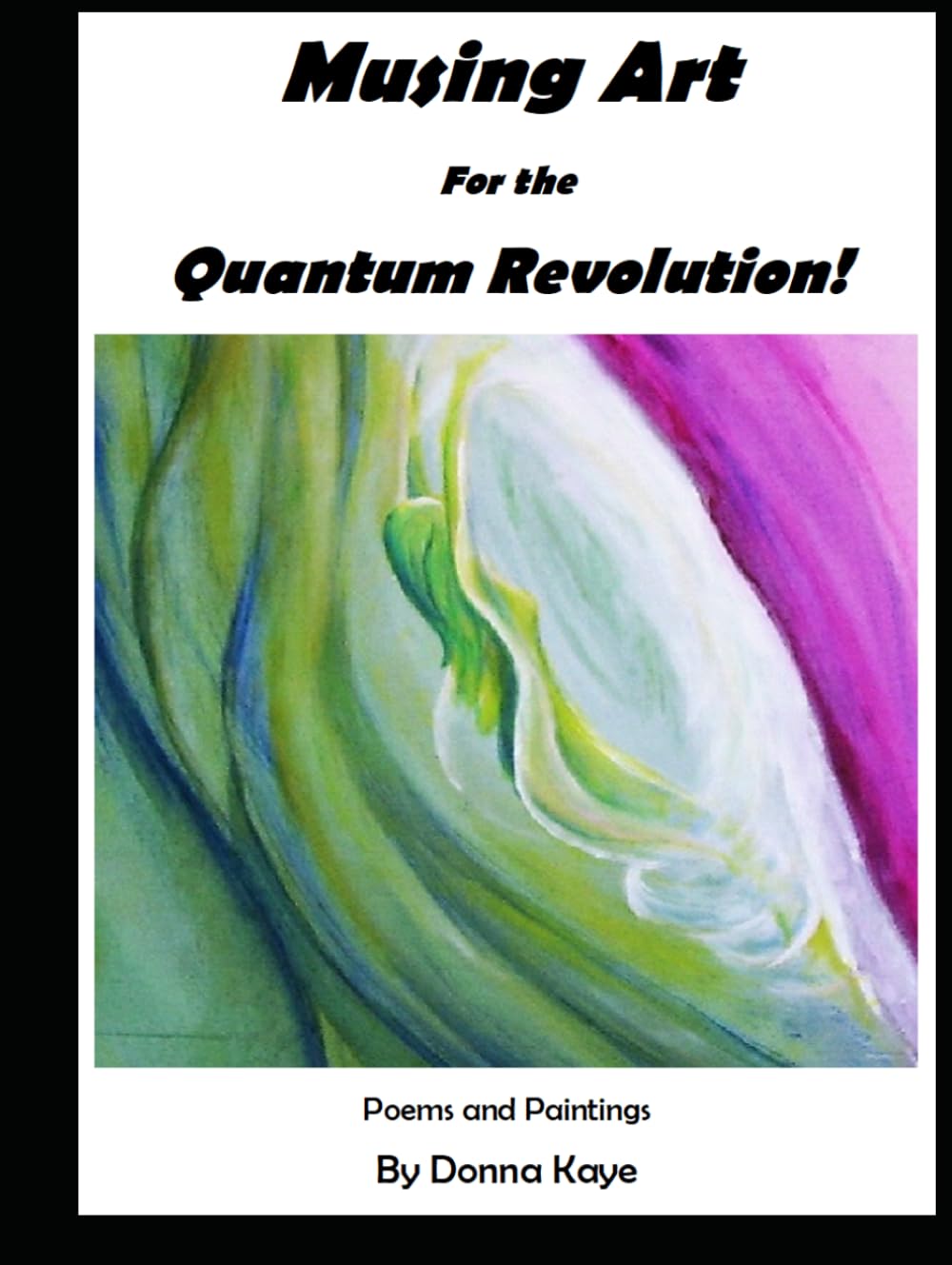
Musing Art for the Quantum Revolution! by Donna Kaye is a mixed collection of poems, spiritual reflections, political meditations, and original artwork centered on healing, freedom, human unity, and the idea that consciousness participates in shaping reality. The book moves from broad poems about war, fear, propaganda, poverty, and social control into more inward pieces about ego, anger, forgiveness, grief, and renewal, then closes with a short allegorical story about Freedom and several symbolic paintings that explain the author’s view of spirit, polarity, and illusion.
I read this less as a conventional poetry collection and more as an art journal with a clear moral compass. Donna returns often to the same core idea: the outer world won’t change unless the inner life changes first. That theme shows up in pieces like “Oh, Little Ego,” where the self is treated almost like a frightened child, and in “I Hate to Speak in Anger,” where anger isn’t dismissed but traced through the body, breath, words, and consequences. The poems are direct, sometimes chantlike, and often written as declarations rather than quiet observations.
What stood out to me most was the way the artwork and text talk to each other. The paintings use bright colors, cosmic imagery, figures, animals, symbols, and fractured shapes to make the book feel less linear and more like a sequence of meditations. Some sections, especially the Covid poems, are pointed and politically charged, so readers should expect the book’s worldview to be explicit rather than implied. Still, the book’s dominant movement is toward repair: peace over fear, sovereignty over compliance, love over division, and forgiveness as a practical act rather than a soft abstraction.
This book is best for readers interested in spiritual poetry, visionary art, metaphysical nonfiction, inspirational poetry, consciousness studies, healing, freedom, and social commentary. Readers who appreciate the aphoristic, devotional quality of Kahlil Gibran’s The Prophet may recognize a similar desire to turn private insight into public guidance, though Donna’s work is more contemporary, political, and visually esoteric. The Quantum Revolution is a candid, color-saturated appeal for personal healing as the first form of social change.
Pages: 86 | ASIN : B0H2JHTPYM
Our scientific capabilities must merge with the wisdom of the heart
if we are to survive our death spiral of war and aggression.
If we want a better world, we must heal our inner traumas and become better people.
Only then can we stand in the true power of compassion and effective change.
Thank you for letting me share my healing journey!
May we All find deep Healing, Peace and Love!
I Am A Modern Day Artist

In The Creative Way, you share with readers the photography and digital artwork that has grown out of nature, travel, memory, illness, recovery, grief, and curiosity. Why was it important for you to share this book with readers?
I wanted to share my story and my art because I have always enjoyed capturing the beauty of nature in photos.
Was there a particular moment when you realized photography and digital art had become an essential part of your life?
Photgraphy has been a hobby for most of my life. I am a modern day artist who creates art out of photos. I use photo editors or apps to perfect my images. I use A.I. when I can I used it to create an image of a woman standing at heavens door when a close woman friend passed away.
Do you typically see the finished image in your mind before you begin editing, or does the artwork evolve as you work?
Sometimes I have an idea on how the should look and other times I experiment with apps or a.i. and change the image to some even more beautiful.
What advice would you give to artists who want to experiment with digital tools but feel intimidated by the technology?
Don’t be afraid of Technology. I use it in my photography and when I am writing to research and check for errors. You can create an image of anything without leaving the house.
Author Links: Instagram | Facebook | Pixels | Website
The Creative Way


The Creative Way is a compact, image-driven portrait of Steven B. Wills as a photographer and digital artist, tracing how his work grows out of nature, travel, memory, illness, recovery, grief, and curiosity. The book moves between biographical reflection and visual catalog, showing Wills’s fondness for landscapes, coastal scenes, wildlife, skyscapes, urban structures, abstract color experiments, and images. What emerges is less a conventional art book than a personal archive of creative momentum, where a phone camera, photo-editing apps, and a searching eye become tools for turning ordinary sights into bright, emotionally charged images.
What I appreciated most was the sincerity running through the book. There’s something quietly moving about the way Wills frames creativity as a way of surviving and noticing. The section on Bodie structures stayed with me because the ghost town’s “arrested decay” feels like a natural extension of the book’s deeper ideas about resilience and remembrance. The image made for a friend who passed away in May adds a tender human ache to the collection, while the self-portrait near the end gives the whole project a disarming intimacy. I liked that the book doesn’t try to hide the artist behind polish. It lets us see the maker, the process, the experiments, and the emotional weather behind the images.
The writing is plainspoken, sometimes repetitive, and occasionally reads more like notes for a curated portfolio than a finished narrative. That looseness has its own charm. The language keeps circling back to nature, digital tools, healing, and transformation, and those repetitions begin to feel like the book’s heartbeat. The ideas are strongest when they’re paired with the art itself: the red-and-black image generated from two colors, the vivid lighthouse with its stained-glass intensity, the bear in the canoe beside the deer, the moody coastal and moonlit scenes. I found the mix of photography, filters, and AI both intriguing and a little uneven, but that unevenness also makes the book feel alive. It’s an artist’s workshop with the door left open.
I came away from The Creative Way feeling that I had spent time with someone who genuinely needs to create, not for spectacle, but for steadiness, wonder, and connection. The book is imperfect in structure, but generous in spirit, and its best moments carry a warm sense of gratitude for beauty wherever it appears. I’d recommend it to readers who enjoy personal art collections, digital photography, outsider art, nature-inspired imagery, and creative journeys shaped by resilience and emotional honesty.
Pages: 32 | ASIN : B0GR1ZQL68
Voicings

Voicings, by Carroll Blair, is a collection of brief poems, meditations, aphoristic fragments, and more formally elusive lyric pieces that circle the inner life with unusual persistence. The book moves through solitude, spiritual hunger, artistic struggle, nature, language, ego, suffering, and the quiet courage required to keep becoming oneself. Its two parts feel less like separate sections than two movements of the same long listening: one rooted in the search for vision, the other widening into sharper social observation and a deeper tenderness toward the fragile, unfinished human soul.
I found the strongest pieces in Voicings to be those that marry plain-spoken insight with a sudden image that makes the thought bloom. “Never Completely Alone,” with its crickets singing through the cool of night, turns loneliness into something porous and living, while “Going On” compares the artist to a battered prizefighter still moving without quite knowing where the strength is coming from. That image stayed with me because it captures so much of the book’s emotional center: endurance without self-pity, faith without prettiness, and creativity as a form of survival. Blair’s ideas can be bracing, especially when he writes about ego, attention, and the cost of truth, but there’s warmth beneath the severity. He seems to believe that life wounds us into awareness, and I responded to that belief because it’s neither sentimental nor cruel. It has the ring of something earned.
The writing is at its best when Blair allows thought and image to lean into one another. I loved the musical simplicity of “Alphabets,” where letters become notes and words become “music for the eye as well as the ear,” and I admired the quiet grace of “A Child’s Exploration,” where the flower and the child seem to recognize each other. The book’s texture has force. Its language can be rough, gleaming, prophetic, tender, and strange, sometimes all within a few lines. I often felt challenged in a way I respected. Blair’s voice asks the reader to slow down, to accept difficulty, and to meet language as an event rather than a vehicle.
Voicings left me with the sense of having walked through a mind that refuses the small comforts of distraction. The closing poems, especially “Every Moment of One’s Life,” “Keeping On,” and “Who Lift Their Eyes,” gather the book’s many concerns into a final affirmation of attention, growth, and spiritual reach. It’s best for those who enjoy philosophical poetry, meditative fragments, and writing that treats the soul as both a wilderness and a workshop. I recommend Voicings to reflective readers who are willing to sit with mystery, wrestle with abstraction, and be rewarded by moments of sudden, piercing clarity.
Pages: 154 | ISBN : 978-1936430215
Echoes of Memory: War, Testimony, and Survival on Sanzao Island

Echoes of Memory is a deeply personal work of public history by Robert Cupchoy and Lani Cupchoy, rooted in survivor testimony, family archive, poetry, and scholarly reflection. It traces the Japanese occupation of Sanzao Island during World War II, beginning with the shattering recollections of Fook Im Chen as planes descend over rice fields, moving through starvation, forced labor, cultural suppression, and the devastating history of the comfort women system, then widening into questions of inheritance, healing, and remembrance. What makes the book distinctive is its refusal to separate history from kinship. The authors present Sanzao not as an obscure footnote to larger wartime narratives, but as a wounded, living place whose people carried memory in stories, rituals, photographs, silence, and even in the later transformation of the family home into the Cupchoy Café.
Fook Im’s memories of bombs falling, villagers hiding food, and families clinging to one another have an aching immediacy that formal history often struggles to hold. The chapter on the comfort women is especially harrowing, not because it reaches for shock, but because it understands the intimacy of violation. Jin Yuan Lin’s presence in the comfort house, his memory of the women staring out windows, and his fear that forgetting them would mean losing them again, left me with a quiet grief that lingered after the page ended. The writing is sometimes at its strongest in these moments of restraint, when the authors trust a remembered image to carry the weight. The prose can become academically dense, with theoretical frameworks crowding the emotional field, but even then, I sensed the urgency behind it. The book wants to protect these stories from being dismissed as anecdote, and that protective instinct gives the scholarship its moral heat.
What I admired most is the book’s central idea that memory itself can be a form of evidence. That argument feels both intellectually persuasive and emotionally earned. The poems that open chapters don’t always have the precision of the testimonies, but I appreciated their function: they create a ritual threshold before the reader enters material that is painful, fractured, and sacred. I was also moved by the book’s attention to cultural survival, especially its insistence that festivals, language, family meals, and oral storytelling matter as much as destroyed homes and ruined fields. The Cupchoy Café section could easily have felt sentimental, yet it becomes one of the book’s most affecting gestures, a cup of Hawaiian coffee in Sanzao carrying the long route from violence to diaspora to renewal. That image feels humble and profound, proof that remembrance doesn’t only live in monuments. Sometimes it lives in a room where people gather again.
Echoes of Memory is a work of witness rather than a conventional history, and that is its strength. Its emotional truth is unmistakable. I closed it with a fuller sense of how war survives inside families, landscapes, and inherited silences, and with real respect for the labor required to turn private grief into communal memory. This is a thoughtful, affecting book for readers interested in World War II history, Asian and Pacific studies, oral history, trauma studies, family archives, and anyone drawn to histories told from within the circle of those who still carry them. Its lasting gift is its conviction that to remember the dead with care is also to restore dignity to the living.
Pages: 232 | ISBN : 9798279679836
Practice Makes Perfect


Practice Makes Perfect: Draw Facial Expression is a fresh and creative take on the traditional colouring book. Instead of only giving readers finished outlines to color, this book introduces a new concept: drawing faces and facial expressions within a larger scene. That makes it feel more interactive, imaginative, and skill-building than the usual colouring activity.
The sports theme gives the book energy and movement. The pages show athletes in various sports and in a variety of situations. This kind of subject matter makes the colouring experience more exciting because the reader is not just filling in shapes; they are thinking about the character, the setting, and the emotion of the moment.
What makes this colouring book different from the norm is its focus on expression. This one encourages the reader to add personality by drawing faces. That small creative challenge can help build observation skills and storytelling ability. A happy, nervous, focused, or surprised expression can completely change the mood of the picture.
This is a thoughtful and original colouring book for young artists, sports fans, and anyone who enjoys drawing characters with emotion. It combines colouring, drawing practice, facial expression study, and sports storytelling in one book. It’s different, engaging, and a great choice for children who want something more creative than an ordinary colouring book.


